The Journeys of Jesus
A Chronological, Geographical and Topographical History of the Journeys of Jesus and the Twelve Disciples in Palestine — Founded on the Gospels and the Latest Surveys in the Holy Land, with Correct Maps and Beautiful Illustrations
by Addison Darre Crabtree
Table of Contents
- Chapter I — Bethlehem—Our Departure
- Chapter II — Visit of the Shepherds
- Chapter III — The First Journey
- Chapter IV — The Visit of the Magi
- Chapter V — The Flight Into Egypt
- Chapter VI — End of the Third Journey
- Chapter VII — The Boyhood of Jesus
- Chapter VIII — The First Passover.—A Journey on Foot
- Chapter IX — Jesus with the Elders
- Chapter X — The Brethren of Jesus
- Chapter XI — First Journey After Maturity
- Chapter XII — John, Andrew and Peter Introduced
- Chapter XIII — A Joyous Journey
- Chapter XIV — A Journey to Jerusalem
- Chapter XV — The First Passover
- Chapter XVI — The Return to Galilee
- Chapter XVII — The Second Miracle
- Chapter XVIII — The Second Passover
- Chapter XIX — End of the “Four Months."
- Chapter XX — Preaching By the Sea-Shore
- Chapter XXI — The First Circuit of Galilee
- Chapter XXII — “Home Again.”
- Chapter XXIII — The Call and Feast of Matthew
- Chapter XXIV — The Second Circuit
- Chapter XXV — Capernaum.—A Short Stay
- Chapter XXVI — The Journey to Nain, and Raising of the Widow's Son
- Chapter XXVII — Nain—The Dinner with the Pharisee
- Chapter XXVIII — Opening of the Parables
- Chapter XXIX — A Journey Over the Lake
- Chapter XXX — A Journey to Nazareth
- Chapter XXXI — Jesus Sends Out His Apostles
- Chapter XXXII — "Murder, Most Foul.”
- Chapter XXXIII — Over the Sea of Galilee—Subject: Feeding of the Five
- Chapter XXXIV — Two Weeks* Respite in Capernaum
- Chapter XXXV — A Journey Into Heathen Lands
- Chapter XXXVI — Another Journey Northward
- Chapter XXXVII — ' the Transfiguration
- Chapter XXXVIII — Jesus Arrives Home with His Disciples
- Chapter XXXIX — The Brothers of Jesus Visit Him
- Chapter XL — Jesus Arrives at the Feast
- Chapter XLI — The Farewell to Galilee
- Chapter XLII — On Samaria's Border
- Chapter XLIII — Jn “Judea Beyond Jordan."
- Chapter XLIV — At the Feast of Dedication
- Chapter XLV — Christ’s Abode in Judea Beyond Jordan
- Chapter XLVI — The Raising of Lazarus
- Chapter XLVII — Jesus Retires to Ephraim
- Chapter XLVIII — Emerging from Obscurity
- Chapter XLIX — Zaccheus and Bar-Timeus
- Chapter L — Jericho to Bethany
- Chapter LI — Jesus and the Twelve at Bethany
- Chapter LII — The Entry Into Jerusalem
- Chapter LIII — Second Day in the Temple
- Chapter LIV — Third Day in the Temple
- Chapter LV — The End of the Jewish Age
- Chapter LVI — The Supper at Bethany
- Chapter LVII — The Last Passover
- Chapter LVIII — Gethsemane
- Chapter LIX — Jesus Before the High-Priest
- Chapter LX — Second Trial of Jesus
- Chapter LXI — Jesus Before Pontius Pilate
- Chapter LXII — Before the Crucifixion
- Chapter LXIII — The Crucifixion
- Chapter LXIV — The Entombment
- Chapter LXV — The Resurrection Morn
- Chapter LXVI — Jesus at Emmaus
- Chapter LXVII — Eight Days Afterward
- Chapter LXVIII — On the Sea of Galilee
- Chapter LXIX — Jesus' Last Days on Earth
- The Gospels
- The Disciples
- Climate and Products
- Dress
- The Birds of Palestine
- Palestine
- The Destruction of Jerusalem
- The Sanhedrin
- Pharisees
- Sadducees
- The Herodians
- Salome, Herodias, and Mary Magdalene
- The River Jordan
- A Railroad in Palestine
- Notes of Appendix
- Chronological Table
- List of Illustrations
- General Index
Maps and Illustrations
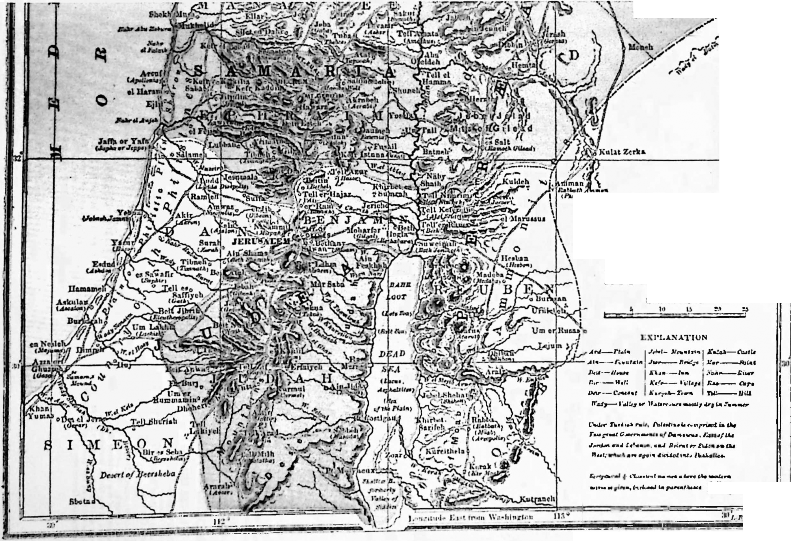
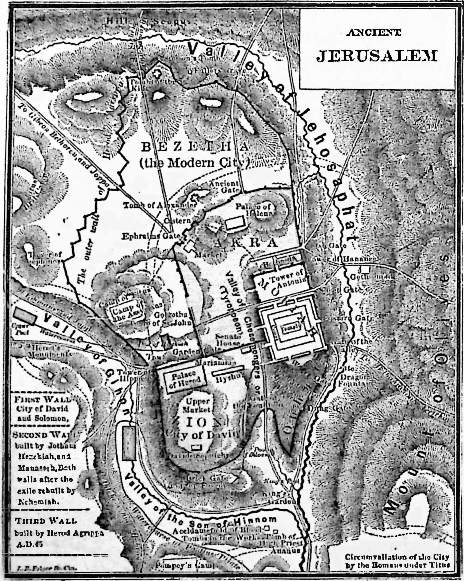



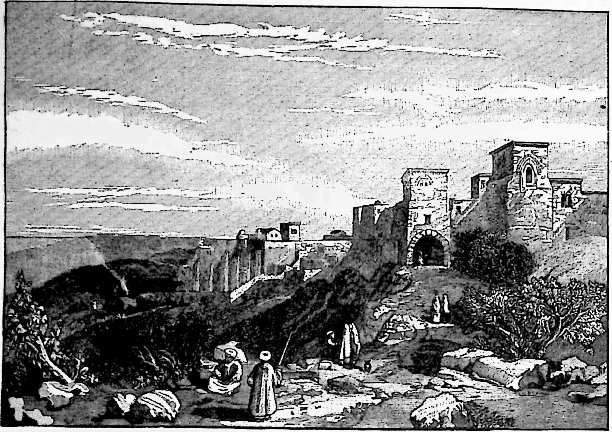
Chapter I
Bethlehem—Our Departure
Time—A. U. C. 749, month of December. PLACE—Bethlehem-Judah, in B’e line. Place—Augustus Csar, emperor or the Roman empire; Herod the Great, king or Judea.
[A. U. C., Anno Urbis Conditx, means “ In the year from the building of the city; ” that is, Rome. Time was so reckoned until Christ’s time.]
HE one thing which has made the little city of Bethlehem, above all others, a place of universal interest, is
References
Matt. a: x-xa. Luke a: 1-20.
John x: 14.
Micah 5: a.
Gen. 35: zg.
the undeniable fact that Jesus, who is called the Christ, I was born within her borders; and if, in the great difficulties involved in the task which the writer of these pages has taken upon himself, he is found immersed in depths unfathomed by mortal man, it may be said of him in apology:
“ His start was sure and well founded.”
Therefore, “ Let us go even unto Bethlehem, and see this thing that is come to pass, which the Lord hath made known unto us." The words of the shepherds on the plains below Bethlehem.—Luke 2:15.
Bethlehem is one of the oldest cities • of Palestine, and was * first known, in Jacob’s time, as Ephrath, meaning “ fruitful.” Her later name, Bethlehem, meaning " House of bread," in-dicates her as no mean place for the production of the staff of life.
Bethlehem lies six miles southward from Jerusalem, on the east side of the highway leading to Hebron. It is “a city set upon a hill,” being situated at an elevation of 2,750 feet above the Mediterranean Sea. It is about a mile in length from east to west, covering the top and a part of the eastern slope of the elevation, and contains at the present period about 3,000 inhabitants, nearly all of whom are confessed Christians.
The view from the house-tops is exceedingly fine on a clear, sunshiny day. On the north is seen Jerusalem and the Mount of Olives. On the east, across the wilderness and the Dead Sea, the mountains of Moab rise up and trace their blue lines across the horizon like a wall of defence to the “ Holy Land.” On the south and southeast lie the rich fields where Boaz reaped and Ruth garnered, and where the favored shepherds listened to the midnight song of angels. On the west the far-off waters of the “Great sea” sparkle in the sunshine.
A LITTLE RILL
Drawing nearer, we may look down on the “ Tomb of Rachel,” the Church of the Shepherds, well cultivated vineyards and rich barley fields, watered by a little rill, and see the sheep still grazing in the valley, vividly recalling the scenes of David’s early life, and of the shepherds watching over their flocks by night The valley on the northern side is also cultivated, from whence rise “ bold, sweeping lines of terraces,” ascending to the very summit of the hill, like the stairway of some mighty giant, and each cultivated, bearing abundance of almonds, figs, grapes, pomegranates and olives. On the west the hill is rough and rocky, descending to the highway—it cannot be called a road, nor need the reader expect to find any- roads in Palestine—and beyond, an open, rough country.
There was nothing in the Jewish record better understood
than that the Messiah should be born in Bethlehem. The Jews looked for its literal fulfilment When Herod con-vened the Sanhedrin* a few weeks later, on the arrival of the “ Wise men,” and demanded where the Messiah “ should be born," they promptly replied, “In Bethlehem, for it is so written."—Micah 5 : 2.
How was this to be brought about, since His parents re-sided in an unknown town nearly one hundred miles away to the northward ? Let us examine.
It is a matter of history.
St Luke briefly explains the fact as follows :
“ It came to pass in those days, there went out a decree from Csar Augustus (at Rome) that all the world (under Roman power) should be enrolled," preparatory to taxation, which soon followed. “Augustus was too wise a ruler to hasten taxation.”—See Andrews' Life. 70.
“And all went to enrol themselves, every one to his own city.
“ And Joseph also went up from Galilee, out of the city of Nazareth, into Judea, to the city of David, which is called Bethlehem, because he was of the house and lineage of David—to enrol himself—with Mary his (espoused) wife being great with child." Luke 2 : 1-5.) The New Version reads," enrol,” instead of “ taxed.” Matthew speaks of Joseph and his “ WIFE, Mary," and that she was his WIFE, there need be no doubt. The law was very strict in regard to such matters.—Deut. 22: 23-25 ; 23: 2.
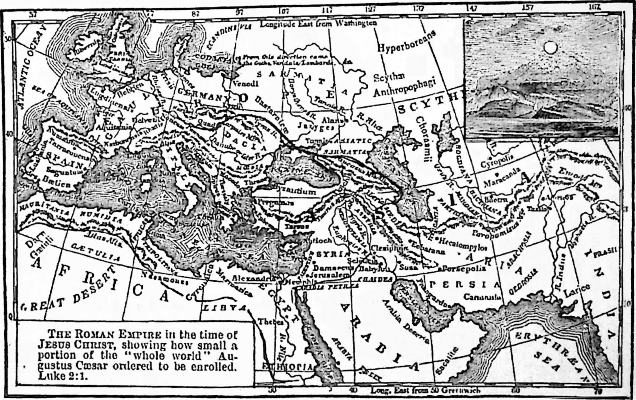
Rome ruled the civilized world, which included Palestine, and the Jews. Their very time was computed from " the city,” i. e., Rome. She willed that all her Provinces should be taxed, therefore they must first be enrolled. To this end, Augustus Czesar, at Rome, sent word to Cyrenius, governor of Syria, to enrol the people.
A messenger, with trumpet and proclamation, had gone over Palestine, proclaiming from hill-top and “house-top" these words—
* See 4 Sanhedrin " in Part Second.
“ Go ye up every man unto his own natal city, there to be enrolled. It is the command of CASAR."
Toiling up the hill, over the rough limestone path, in the fading twilight of a brief winter's afternoon—the husband on foot, the wife riding upon an ass, the usual domestic beast—, came Joseph and Mary to the little city of Bethlehem, They have arrived at the end of a long and wearisome journey of above eighty miles; he footsore and tired, from walking so far over the rough highway; she suffering “ from heavy languor, or even the commencing pangs of travail ” (Farrar), only to find the city over-crowded, and the one “ Inn so full that there is no room " for the blessed Mary even, who is speedily to be advanced to a mother. Has she come all this distance that her babe may be born in the one dusty, crazy street of Bethlehem ? For in Bethlehem He must be born, even though “Low lies His head with the beasts of the stall."
The “inn,” or rather, khan, was situated at the extremity of the town. It was one story high, built of limestone, and was probably erected by Chimham, on the site of the house of Jesse and David.—See Dixon's Holy Land, p. 98.
"When David fled from Absalom, the former took refuge in Gilead with a wealthy but half barbaric chief, Barzillia by name, who shew the unfortunate king great kindness and hos-pitality. On the death of the rebellious son, and the return of David to his capital, Barzillia declined the generous offer of the king, to become his guest, but accepted it for his son Chimham. . .
Upon him David bestowed the house of his father Jesse in Bethlehem, and on his death-bed charged Solomon to per-petuate the property to Chimham. This was converted into an inn, or khan, and was known in the days of Jeremiah as a stopping-place'on the way to Egypt (Jer. 41: 17). When Jerusalem lay in ashes and ruins, and many of the cities of Palestine were demolished, this khan stood as of old, and within its walls the prophet Jeremiah found refuge (Jer, 41: 17).
Was it not here he commenced his LAMENTATIONS ?
11 How doth the city sit solitary. She that was full of people 1 How is she become as a widow.
She that was great among the nations I"
"There was no room for them in the inn," is Luke's simple statement, therefore, “ When the babe—Jesus—was born, Mary laid him in a manger." .
Very plain, and easily understood.
In fact, Joseph and Mary took up their temporary abode in the stable connected with the khan, with the cattle and their keepers, and here Jesus was born.
Thus began that life of humility which only ended with His expiation on the ignominious cross!
In this strange land it is not unusual, at this day, to find man and beast lodging under the same roof. The donkey feels safer in the presence of his master, and, usually, the master feels that his beast is safer when under his watchful eye. “ It is common to find two sides of the same room, where the native farmer resides with his cattle, fitted up with mangers, and the remainder, elevated two feet higher, for the accom-modation of the family.
"The mangers are built of small stones and mortar, in the shape of a kneading-trough, and when cleansed and white-washed, as they often are during summer, they do very well to lay little babies in. Our own children have slept there in our rude summer retreat in the mountains.”—Dr. W. M. Thomson, Missionary to Palestine.
But it is of mid-winter that we are writing, and the stalls were occupied by cattle, which may have been turned out, in this emergency, to give place to the sorely pressed strangers, Joseph and Mary.
"Cave of the Nativity.”
The place to which tradition has removed and located the spot of the Saviour’s birth, is a cave at the southeast of the village, and now covered by an imposing pile of buildings, devoid of all architectural beauty, neglected and decaying, called the “ Church of the Nativity," with three convents, Latin, Greek and Armenian. The tradition which locates the stable and the manger in.the bowels of the earth, does not tell us how the cattle were lowered into it at night, or hoisted out in the morning.
“ The place where Christ was born,” says Willibald, A. D. 722, "once was a cave under the earth, but is now a square house cut in rock, and the earth dug away from it, and a church built over it" • Tradition has a very convenient way of making caves and grottoes the sites of very many remarkable biblical events, which fact naturally awakens our suspicion and incredulity.
"The Cave of the Nativity," as now shown—for a trifle—is thirty-eight feet long by eleven wide. Its one merit is ca-pacity. “A silver star set in a marble slab invites us to believe this the very spot where the infant Redeemer was born."—Land and Book.
The Church of the Nativity, or Convent, is interesting be-cause of its great antiquity as a Christian edifice.
This convent was built—first, by the Empress Helena, mother of Constantine, about A. D. 325. Rebuilt by the Emperor Justinian. Notwithstanding that the " manger was taken to Rome by Pope Sextus V, and placed in the church of St Marie Maggiore, a consideration will repro-duce it at any time—in marble. A few paces opposite, an altar marks the spot where the Magi (Wise men) stood. The absurdity of this latter will appear in the chapter relating to the visit of the Wise men. This was fully forty days after the nativity.
For two reasons, the traveller in Palestine may doubt that the Church of the Nativity marks the spot of the birth of Jesus:
1. It was in a manger. 2. It was in Bethlehem. How long did He remain in the stable?
Not long. .
Eastern hospitality would forbid.
From this fact we may infer that the birth took place im-mediately on the arrival of Mary in Bethlehem. How long, think you, would a mother and babe be allowed to remain in such a place, in any land, half-civilized even, on the face of the globe ? Only till it became known that they were so ex-posed. It was soon “ made known " by the shepherds.—Luke 2: 17.
It is not presumable that the enrolment required the people to remain any length of time in the places where they had been summoned; only just long enough to be recorded; therefore, in a day or two there would be plenty of houses open to receive Mary aad her babe.
That this was quickly " made known ” is evident, and that they were as soon removed to a comfortable " house ” is also proved by St. Matthew’s word. That Evangelist informs us (2: 11) that when the “Wise men” had arrived in Bethlehem, they found the young child with Mary his mother “ in a house.” All those illustrations representing the wise men in a stable, are inexcusably erroneous. • The birth of Jesus occurred, doubtless, before the death of Herod the Great. “ Christ was certainly born before the death of Herod, which at the earliest, was not before March of 750,” A. U. C.—Geikie, in his " Life of Christ”
Probably Herod died on or before April 1st, 750, A. U. C. .
Josephus says (Antiq. 17: 8, 4) that an eclipse of the moon occurred just previous to Herod’s decease. Astron-omers have ascertained that this eclipse was on the 13th of March, 750.
The next Passover occurred April 12th of that year. Be-fore that feast, Archelaus, his son and successor, observed the usual seven days’ mourning for the dead.—Andrews.
Therefore, we fix the date of Herod’s death between the 13th of March and the above seven days before the Passover, i. e., before the fifth of April Among those chronologists who place the king’s death at this time, are named the most able in the world’s history—
40 THE BIRTH OF JESUS, WHERE?
Ammer, Ewald, Meyer, Wiesler, and others. Under the heading of "The Visit of the Wise Men,” we will endeavor to shew just how long before Herod's death the Lord Jesus needs have been born.

Chapter II
Visit of the Shepherds
Time—Night of the Nativity.—Probably December 35. PLACE.—Vicinity of Bethlehem, and the Khan, or Inn. RULERS.—The Same as previous,
And there were shepherds in the Referenee. Luke 3: 1, 31. same country, abiding in the field, keeping watch by night over their flocks.
“And an angel of the Lord stood by them, and the glory of the Lord shone round about them, and they were sore afraid.
“And the angel said unto them, “ Be not afraid, for, behold I bring you good tidings of ' great joy which shall be to all people. For there is born to you this day in the city of David a Saviour, which is Anointed Lord.
“And this is the sign unto you (whereby they might iden-tify H m):
“ Ye shall find a babe wrapped in swaddling clothes, and lying in a manger.”
When the messenger had gone away—accompanied by the heavenly choir—“ the shepherds went with haste up to the city, and found Mary and Joseph, and the babe lying in the manger.”
There are several questions which naturally arise, in this connection,'which demand our attention.
Why were sheep pastured out in mid-winter?
Why did the shepherds, if faithful keepers, leave their flocks at dead of night, and go away into the city?
8 (48)

Why should these shepherds, of all the world, have been selected to receive the 11 Glad tidings, which shall be for all people ? "
FIRST. In Palestine the seasons are divided into summer and winter, or dry and wet seasons. By reference to our “ Climate table,” it will be found as true, that the wet season sets in as early as the first of November, and continues into March. In fact, during five months there is almost incessant rains. But as mid-summer has its respite, so does mid-win-ter, and there is usually a cessation of severe rains during the last of December and first of January.—(Descriptive Pales-tine, S.)
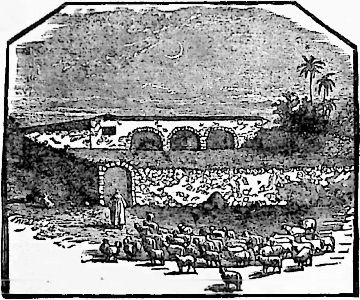
In summer season the sheep are pastured in forests—or wildernesses—far from home. We find a plain illustration of this in the story of David and Nabal. The sheep were in the wilderness and mountains until shearing time, in November, .after which they were pastured near home, usually in “ fields," and housed at night, in a “sheep-fold."—John 10: 1.
This is a walled enclosure. While it kept the sheep from wandering away at night, it did not entirely protect them from prowling dogs or wolves that might scale the walls; hence there were " night-watchers,” as these of St. Luke’s narrative were, and of which it is a correct translation.
The Talmud says that the flocks were taken to the forests, or pastures, in March, and brought home in Novem-ber.
“ The spring coming on, they drove their beasts into the wildernesses, or champing-grounds, where they fed the whole summer. The winter coming on they (the shepherds) betook themselves home again with their flocks and herds.”—Light-foot.
From the fact of the sheep being kept near Bethlehem we may, therefore, infer that it was during winter that Jesus was born. At any other season they would be absent At this season of the year, from abundance of rain, and the average temperature for the months of December and January being 540 5‘ and 50°, grass would be abundant in all the “ Helds " and valleys of lower Palestine. Warm rains are not prejudi-cial to sheep. .
These facts respecting climate have been gathered from those who have resided in Palestine and the vicinity of Jeru-salem and Bethlehem during many years.* That the same condition existed in the days of Christ there is also good authority. . . . Arago, Dom, the French Astronomer, informs us that, during three thousand years, there was no material
SHEEP-FOLD
change in climate. For further authority, see Part Second, * Climate."
SECOND. Why did these shepherds leave their flocks at dead of night and go away into Bethlehem, if faithful shep-herds, as we believe they were ?
: Again we refer to the Talmudist. Sheep do require a faithful shepherd, as Jesus has implied—“ I am the good Shep-herd."
* Descrip. Geog. of Palestine, Schwartz, Barclay, Thomson, See also Climate table, December, PART SECOND.
46 WHY DID THE SHEPHERDS LEAVE THEIR SHEEP?
These were no common sheep, their keepers no common shepherds. These sheep were sacred, and, according to the Talmud, kept for sacrifices. In the fields of Bethlehem they were pastured in winter, housed at night, as was the universal custom, and well guarded by day. The office of shepherd, in the Orient, was an honorable one. It devolved upon the sons, and even daughters, of wealthy chiefs. There were various grades among them, as “rulers" and “chief shep-herds,” even the title of “mighty” was applied to some.—I Sam. 21: 7.
Sacrifices were very numerous among the Hebrews, as “ Burnt-offerings ”—“ Meat-offerings "—“ Purifications "—and the great annual festivals, “ feasts,” and the “ Passover.” All these required the keeping and fattening of thousands of sheep, and as the most of them were sacrificed in the Temple, it was expedient to keep many of them near Jerusalem.* For the important office, of keepers of the holy sheep, no ordinary men were selected.
The night-watches were divided into four parts, beginning at the hours of 6, 9, 12 and 3. It may have been that the sheep kept on the plains near Bethlehem were very numer-ous, and that the “ watch ” of those several shepherds, who received the message that December night, were soon “ re-lieved ” by the next round of watch-men.
A better excuse for their hastening to Bethlehem, and for-saking the sheep of sacrifice, may be found in the fact that these were devout men, looking and praying nightly “ for the consolation of Israel,” and when the heavenly messenger had made his effective announcement, they believed that the real Messiah had come, that the “ Lamb of God that taketh away the sin of the world,” had superseded all other sacrifices, hence they left the sheep—the old dispensation—in the fields, as worthless, and hastened away to the city of David, where Christ was to be born, according to prophecy, and welcomed the new sacrifice, who lived, and was to “ die once for all 1 ”
* About 250,000 sheep were sacrificed at the Passover.—Josephus.
There never was any merit in sacrifices of animals, they , were never demanded by Jehovah (Ps. 40: 6), but, on the contrary, were an “ abomination " in His sight Well might they apply the words of Shakspeare to them, now and for-evermore—
“ Hence, horrible shadow i unreal mockery, hence I ”
So they left the sheep and went up to Bethlehem.
About a mile east from the foot of the hill, is a little ham-let called the “Village of the Shepherds.” It is said to have been the home of those shepherds to whom the angel ap-peared. Not far from here is pointed out the field where they were, on that memorable night, watching over their flocks. It is marked by " The Grotto of the Shepherds.” Here the Empress Helena built a church, long since gone to ruins. “ One mile east of Bethlehem is the monastery of the Holy Shepherds to whom the angel appeared at our Lord’s nativity.” It may be seen in the illustration.
The number of these shepherds was three, according to tradition, which also conveniently gives us their names.—Andrews, p. 84: Hoffman, 117.
THIRD. Why should these shepherds, of all men, have been selected to receive the good tidings ?
This is partly explained under caption second. They were doubtless Holy men, believers in the coming of a Messiah. He was to be born in Bethlehem, and these Holy Shepherds were the nearest and most proper persons to whom this great an-nouncement might be made. They were, as the Talmud said, keepers of the holy sheep, kept for sacrifices.
“ To have received such surpassing honor from above, they must have been members .... of that true Israel which in-cluded Mary and Joseph, Elisabeth and Zacharias, Anna and Simeon, representatives in those dark days of the saints of their nation in its brighter past”—Geikie.
And when they saw the child lying in the manger the shepherds made known what they had seen and heard con-cerning Him.
• “And all who heard it wondered.” .
This implies that it was told broad-cast. ( “ But Mary kept all these things, and pondered them in her heart” So little did she understand them I "And the shepherds returned, glorifying and praising God for all the things that they had heard and seen.”—Luke.
After eight days the child was named JESUS, and the first requirement of the Law complied with.—Lev. 12:3.
Chapter III
The First Journey
Presentation of Jesus at the Temple.
TIME.—Forty days after birth. About February 4th, A. U. C. 750. PLACE.—Bethlehem to Jerusalem, and Return.
RLLERS.—Augustus, Emperor at Rome—Herod still alive in Judea.
HE world has accepted the state-
Reference
Luke a: 22-38. ment that Jesus was born on, or very near December 25th, in the year of Rome 749. Some authorities fix it as January 6th, 750.
The SEASON is a fixed fact.
Jesus was six months younger than John the Baptist. We arrive at the date of John’s birth, by learning that the annunciation was made when his father Zacharias was ministering in the Temple.—October 2d to 9th. See Andrews, p. 14. • The only reliable datum of this matter in the gospels is derived from Luke (1: 5), wherein we learn, “ that a certain priest named Zacharias (was) of the course of Abia,” or of Abijah, whose turn it was to officiate, was then in the temple.
Priests were divided into Twenty-four classes, each of which officiated at the temple, in its turn, during one week. Abia was of the eighth course.* The time of this has been ascer-tained by reckoning back from the destruction of the temple by Titus. On the 5th of August, 823, the first class had * Josephus—Talmud. The 9th, Ab, was on the Sabbath.

50 DECEMBER 25. entered its course. Zacharias’ course would occur in October. The birth of John would, in the natural course of events (Luke 1: 57), take place in July. Jesus was born six months later, according to the same rule, which would bring His birth at the close of December. It seems all in the course of nature (Luke 2: 6). It is a fact that no earlier day than December 25 has been celebrated by any religious rites, or so mentioned by early writers. Whereas the churches observed January 6th * as the day of Jesus’ birth, previous to A. D. 340, or 350, Julius, Bishop of Rome, of this latter date, for definite reasons, fixed its observance, as now, on December 25th. So we accept it So has the world fixed it It is un-alterable.
Between this date and that of the next passover, occurring on April 12th, several important transactions took place, among which are the following:
The naming of Jesus—eight days later—January 2d.
The presentation at the temple, according to the Law, occurring on the forty-first day after birth.
The visit of the Magi—i. e., the wise men.
The warning, and flight into Egypt with the babe.
The death of Herod the Great.
The second of these is what we have now to consider—The presentation at the temple.
All that was done unto, or by, Jesus up to the age of thirty years, was in strict accordance with Jewish rites, and also with the Mosaic law. Bear this-in mind. The naming and the circumcision were so performed already—Luke. The ideas of Joseph and Mary did not extend, judging by their acts, beyond the strict letter of the Jewish law.—Lev. 12: 3,4.
According to the Levitical law, Mary could not go out of her house, she could not touch any sacred vessel, nor receive any sacred gift until after her purification, and all who have studied the character of that most conscientious woman of •This referred to Christ's baptism, which was said to have corresponded with His birth-day. '
Israel, will feel fully assured that she kept that law with the most perfect exactness.—See Matt. 5 : 15 ; Ps. 40: 8.
Hence, the next step, before she could see the wise men, or before she could receive or touch their presents, though intended for her son, fully forty days must expire, and on the forty-first dayashe must go to Jerusalem, present her child before the Lord, as-" the first bom unto her," and herself before the priests for purification. Such was the law. Let us quote it:
"She shall touch no hallowed thing, nor come into the sanctuary until the days of her purification be fulfilled." For these, and other reasons, the visit of the Magi was neces-sarily after the forty-one days.
Now, on the forty-first day, Mary, taking her babe in her arms, arid seated upon the ass, for her feet must not touch the ground, Joseph walking beside her, she leaves Bethlehem by the eastern and northern gate and proceeds onward toward Jerusalem.
A quarter of a mile northward, they pass the well of David, the waters of which he so much desired to drink, when hid in the cave of Adullam.—1 Chron. 11: 15-17.
One mile on their way, Joseph and Mary pass a spot ever dear in the Jewish memory. It is the tomb of Rachel. “And Jacob set a pillar upon her grave; that is the pillar of Rachel’s grave unto this day." The identity of this sacred spot has hardly been questioned.
The way up to Jerusalem ran along the western side of the hill overlooking Mount Zion, passing Herod's great amphi-theatre, with its pagan adornments *—" a sight as revolting to a pure Jewess as was the remembrance of the bloody games celebrated within,”—past the “ Valley of giants," the Royal gardens, in which King Solomon once took so great pride, the Kidron, and the valley of Hinnom; past beautiful man-sions and palaces, terraced gardens and blooming orchards, up to where the Royal Porch of the temple glistened in daz-zling whiteness, in the early morning’s sun.
* Herod the Great built a theatre at the south of Jerusalem.—Josephus II. 3 Passing through the Gennath gate of the old wall, under the very shadows of the threatening towers of Herod,* they were, at last, within the Holy City. Yes, for the first time the “ Son of David " was brought within the city of His father, David.
How would He be brought the last time ?
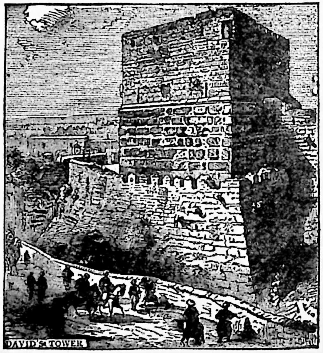
DAVID’S TOWER
Crossing Zion's hill, past Herod’s lordly palace—the resi-dence now of Pontius Pilate, into which Jesus should one day be led in fetters bound, with scoffs and abuse;—over the bridge which spans the Tyropcon valley, perhaps within sight of the very spot where the wretched traitor Judas ♦The three great towers, while a menace to the Jews, were erected by Herod in honor of the parties whose name they bore—Hippicus, a friend of Herod’s, Phasael, Herod’s brother, and Mariamne, Herod’s murdered wife, "the loveliest woman in Palestinc,”
hanged himself, thirty-three years afterward,—and onward to Mount Moriah; the Holy family would finally reach the passage leading to the eastern side of the Temple. Here Mary would dismount on the temple threshold. Leaving the beast with a keeper, Joseph and Mary would enter through the “ Beautiful Gate," near the Golden Gate, above the long flight of steps leading down into the Kedron valley (Geikie)—and enter the " Court of the Women." No woman was permitted farther.
The hour is nine in the morning.
While Mary with her blessed babe in her arms stood wait-ing here with other women, Joseph hastened to " the seats of those who sold doves” (Matt. 21: 12), and purchased "the pair of young pigeons," demanded for presentation to the priests, as asacri-. fice of " sin-offering.”—Leviticus.
Saint Luke has well outlined this ceremony for us.—2: 22-25.
A lamb may be offered if the mother is in affluence,‘but if poor, a turtle-dove, or a pair of young pigeons, is an accepta-ble offering.*—Lev. 12: 8.
' After the burning of the morning incense, and the nine blasts of the trumpets of the temple, calling to prayers within, during which Mary, and those other women who had come up to present themselves for purification, stood waiting and praying without the " Holy place," came the priest and re-ceived her humble offering, with her name and residence, as The priests, of which Annas was the head, held the monopoly of selling these sacrifices. These sold them to retailers in the temple, or on Olivet. So great was this monopoly that a single dove had been sold for a golden denarius —$2.50. .Hitt. dt la JPaltitine. Derenbourg. [G.]

54 CEREMONY OF THE “PRESENTATION." was the custom (Lev. 12: 6, 7, 8). After a time of waiting, the priest having sacrificed the doves—one being burned on the altar—he returned and sprinkling the women with some of the blood, pronounced them clean, and thus ended the rite of purification.
Now, being again made pure and whole according to the Levitical law, Mary could present her child, as her " first-born unto the Lord,” to whose service he was to be consecrated. A male child may be presented by his father when a month old (Numb. 18: 16); but St Luke has informed us of the exact date of the presentation of Jesus (Luke 2: 22, 23). The temple fee was fixed at five shekels, or about fifteen shil-lings English. The child was to be perfect, without blemish, the " first-born of Man,” and in every way worthy of becoming a priest unto Jehovah.—Numbers 3:13, and 18: 15, 16.
The Jews boast that, during more than two thousand years, their religious customs have undergone no material change; therefore from the practice of their rites of to-day, we may infer what they were in Christ’s time. The present custom is for the father to present the child when thirty days old, unless the ceremony is deferred until the mother's time of purifica-tion, which is forty days, as in Mary’s case.—Luke.
The law reads, ” The first-born of man .. . shalt thou re-deem.”
This is the present ceremony in England:
The father with ten witnesses, brings the male child into the presence of the rabbi. The babe is laid upon a table with the sum of redemption money, which is twelve to fifteen shil-lings English. .
The father then states to the rabbi that this babe is his first-born, that the mother is an Israelite, and this is her first-born male child, whom he, the father, presents to the Lord.
The priest then asks the father, Which will you rather do, give up this your ‘ first-born,’ who is the first-born of his mother, to Jehovah, or redeem him after the manner of the sanctuary, by paying five shekels?” (This has never been altered. Numb. 18 : 16.)
THE STRANGE ELEMENTS. b To this the father replies, . “ He is my first-born—take therefore the five shekels due for his redemption.” The rabbi receives the money, after which the parent adds—“ Blessed art thou, O Lord, our God, King of the Universe, who has sanctified us with thy Commandments and commanded us to perform the re-demption of a son. Blessed art thou, O Lord our God, who hast maintained us, and preserved us, to enjoy this season.”
The rabbi receiving the shekels, repeats certain words, closing with a blessing, as follows—his hands on the babe—“Jehovah make thee as Ephraim and Manasseh. The Lord bless and preserve thee. The Lord lift up His coun-tenance upon thee, and give thee peace. Length of days, years and peace be gathered to thee, and God keep thee from all evil and save thee."—See Mill's British Jews, quoted by
Geikie
So ended this rite also. Such, no doubt, or very similar, was the solemn ceremony performed over the infant Jesus within the temple, nearly two thousand years ago.
During the time of waiting, crowds of Israelites, men, women and children, were coming and going. Curious eyes were doubtless lifted upon the young and timid mother; mercenary Jews, estimating (Numbers 18: 16) to a nicety how much Joseph could pay for a nice fat lamb, or the utmost for a pair of doves, or if they would pay usury for exchanging provin-cial money for the true sanctuary shekels (id.)—mendicants who had crept in under pretence of giving rather than receiv-ing, and who boldly demand of the happy mother a trifle—maidens jealously criticising the inexperienced young wife and mother, thinking, “ I too shall some day be thus and so"—lovely children, happily peeping at the “sweet babe"—lastly, an aged patriarch and a far more aged woman came early into the court of the women.* The first is Simeon, a devout and righteous man, who is looking continually for the redemption of Israel.—Luke 2: 25.
See “Widow’s Mile,” given in this very room.
He sees Joseph and Mary standing there. There is nothing striking about them. They are the lineal descendants of kings and princes, but no one knows it I He sees the child in Mary's arms. Ah, he knows that I How he knew the child, by what sign he recognized it, is not revealed to us. The Holy Spirit had informed him (v. 26) that he should live to see Jesus, and, hence, he was continu-ally on the alert for His appearance. He knew that he must be brought to the temple to be presented to the Lord (27). Here he found Him. He took the child Jesus in his arms; he blessed Him, he poured out his praises aloud to God for " Salvation."
Mary and Joseph were struck with amazement Their child “A light unto the Gentiles ? ”
“ The glory of thy people Israel ?”
” Yes, Mary, and bless you, for your child is set for the falling and rising of many in Israel, and a sign against them.
" Yea, and a sword shall pierce thine own soul."
Such language from the lips of venerable man may well have filled the minds of Mary and Joseph with astonish-ment "And his father and mother marvelled at the words spoken of him."—Luke 2: 33.
From this they could hardly have recovered when the ancient prophetess, Anna, approached, and, probably, over-hearing the words of Simeon, caught up the praises he uttered, carrying them before " all those who were looking for the redemption of Jerusalem." * Here Luke’s narrative suddenly breaks off, or rather he omits much important matter, of which he could not have been ignorant, it having long since been familiar to him through the writings of Matthew, and others. This the intro-duction to Luke’s Gospel shows: " For as much as many have •Who either Simeon or Anna was is unknown. She was of the tribe of Asher and hence a Galilean. She was 84 years of age. According to legend Simeon recognized Jesus because he shone like a pillar of light in His mother’s arms—
Farrar
taken in hand to draw up a narrative concerning those mat-ters which have been fully established among us,” etc.
After the rites were ended at the temple, Joseph and Mary, with the Child Jesus, returned to Bethlehem.
There the Magi came unto them, as we shall see by fol-lowing the next chapter.
Luke's reading would imply that the Holy family went direct from Jerusalem to Nazareth, which evidently they did not.
So we follow them to Bethlehem.

VISIT OF THE WISE MEN
Chapter IV
The Visit of the Magi
Time—Soon after the expiration of forty-one days from the birth of Jesus.
February, A. U. C. 750.
PLACE—At Bethlehem. “ In a house."—Matthew. RULERS—As before.
N the days of Herod the king, wise men from the east came to Jerusalem, saying, Matt, a: x, 33. Num. 24: 17.
“ Where id He that is born King of the Jews?
“ For we saw His star, in the east, and are come to worship Him.”
Startling news to King Herod!
A “ King of the Jews,” born in Judea, under the very shadow of his palace, and the news thereof spread to Persia (i. e., the “ east ”), and Herod had not heard of it ?
The evidence must have been conclusive that the Messiah, or “King of the Jews,” was born, and as such Herod re-ceived it. • “ It troubled him.”
In other words, it alarmed him.
Detaining the unwelcome messengers from the east, Herod hastily summoned that once august body, the Sanhedrin, and earnestly inquired of them, where Jesus should be born, well knowing the Jewish expectation of a Messiah.
While he is making this inquiry of the proper authority—for it was well authenticated, not only among the Jewish authorities, but also among Gentiles, that a new King of Israel was shortly to appear—let us inquire—
4 (61)

Who were the " wise men ? "
Professional astrologers of the east “ The east " doubtless refers to Persia, particularly Babylon.
“ Historically the Magi, i. c„ the 1 wise men,’ are conspicu-ous chiefly as a Persian religious caste.”—Smith's Bib. Diet.
Herodotus reckoned them among the six tribes of the Medes, and in his history of Astyages (last King of Media, B. C. 593), as interpreters of dreams. Astrologers and inter. preters were one.
We first learn of them in Scripture in the book of Jeremiah (39: 3 and 13), where Rab-mag, with the other princes of the King of Babylon, came and sat in the middle gate. The name Rab-mag is interpreted as equivalent to chief of the Magi.
This high dignitary was sent to Jerusalem (B. C. 600) among Nebuchadnezzar's chief officers ; therefore it was no new thing, in Christ's time, for “ wise men ” to visit the city of David. Furthermore, this fact shows their high station. There is a tradition which makes them kings, or their equals, which is probably founded on the prophecy of Isaiah (60: 3)—"And the Gentiles shall come to thy light, and kings to the bright-ness of thy rising." Or to Psalms (72 : 10): “ The kings of Arabia and Seba shall bring thee gifts."
The Magi or magicians were also astrologers or, vulgarly, "star-gazers," and among such Daniel and his fellow-prisoners were classed during their detention in Babylon (B. C. 604). When the king in his anger, because they could not interpret his dream, ordered all his magicians slain, the executioner sought out Daniel and his companions to mingle their blood with the other “ wise men ” of the realm (Daniel 2: 13-18). Thus we trace the wise men back to the Babylonian captivity, and find them of a Babylonian origin.
The city of Babylon was situated upon both banks of the river Euphrates, covering with its walls, fortresses, royal palaces, temples and houses, many of which were three and four stories in height, streets, squares, bridges, hanging-gar-dens and towers, an area of about two hundred square miles.
"THAT GREAT CITY." 63 The river was here about one thousand yards wide, and strongly walled and garrisoned. The streets were laid out at right angles and well paved. The walls were sufficiently wide for ten chariots to drive abreast around on them a dis-tance of upwards of fifty miles. It required two days of rapid marching for an army to encompass them. In these walls were twenty-five solid brass gates to a side, and the whole strengthened by two hundred and fifty towers. Thus the city was five times the size of London.* The palace of Nebuchadnezzar was immense in proportions and magnificent in embellishments. Its outer wall embraced an area of six miles, including a high tower of observation and defence. Another palace adorned the west bank.
The wealth and splendor of this “ great city" was never equalled by any other on earth. It had arrived at the zenith of its power and wealth during Daniel’s captivity.
The city was captured by Cyrus in the year 538 B. C.,f or according to the book of Daniel, by Darius the Mede (Daniel 5 : 31; 9: 1). Cyrus was the real conqueror—“a shepherd” and “ anointed ” of the Lord (Isa. 41: 1). While Darius was “ a monarch of certain delegated authority."—Smith, The decree of Cyrus (B. C. 536) liberated the Hebrew colonists, and 42,360, with their servants, returned to Pales-tine. Many still remained in the east, and in generations after, in common with western Jews, were in continual expectation of a great Prince, who should rise up in their nation and call them all together again. All Hebrew literature, from Daniel to Jesus, teemed with this one great Messianic theme. Any great political commotion, the birth of a new king, or even the sudden appearance of a comet or new planet in the heavens, were of sufficient moment to attract the Jewish mind. It might be looked for in any part of the known world, for, ac-cording to Josephus, the whole inhabitable globe was full of * According to Herodotus, ten times as large as London. f From this period began its decay. Darius Hystaspes threw down its walls (500 B. C.) and gates left by Cyrus. Xerxes plundered the temple of Belus, and, in 50 B. C., Strabo found it in complete ruin.
Jews, and in Alexandria alone, the synagogue was so large that the worshippers only could know where in the service to respond “ amen,” by the waving of a signal cloth—until the later prophet fixed the place of the birth in Bethlehem of Judah.
Thus astronomers turned their powers of observation toward the western horizon for the sign of His coming.
Such were the “ wise men " and such their original country. With the fall of Babylon they did not lose their power, but became absorbed into other and succeeding governments.
Little can be said of Matthew’s " wise men."
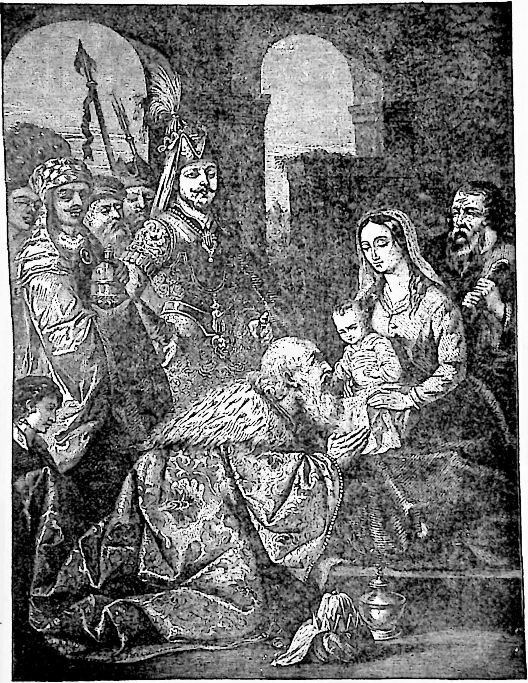
Tradition says they were three in number, and the venera-ble Bede gives their names and personal appearance. Our illustration follows this tradition (agreeing with Matthew as far as he gives any particulars), representing the first, Melchior, a venerable man with white, flowing beard, and richly dressed; Balthazar, a dark, swarthy man of middle age, and Caspar, a fresh and handsome youth, gorgeously arrayed. '
These were kings in their own right, and doubtless came with horses and rich trappings, and accompanied by a royal retinue. Hence Augustine (4th Century) and Chrysostom said that their number was twelve.
They were no common horde, as often represented, kneel-ing in a stable! for had they been, Herod would have be-headed them at once, and given the matter no further notice. I have no doubt that they came in state, very much as the queen of Sheba came to see king Solomon. And Herod trembled I
The Star
This star was in the “ west,” not as Heber perpetuates the error—
" Star of the east, the horizon adorning."
Balaam’s prophecy had led the Jews to expect a peculiar star as the announcement of the birth of the Messiah. “ When Messiah is to be revealed, a star will rise, shining with great brightness.”—Sohar.
MAGICIANS, STARS AND COMETS. * 65 It was to remain during fifteen days.—Geikie.
It was the universal belief that extraordinary events, as the birth and death of kings and the rise and fall of kingdoms,' were heralded by the appearance of new stars, or of comets. They might appear a year or two before or after a remarkable birth or death, but every new astronomical discovery por-tended good or evil to some convenient ruler or country. All history and scripture are filled with evidences of this assertion. The Talmud says, “The life and portion of children hang not on righteousness but on their star.”
With the death of Caesar (Julius) a “ hairy star shone con-tinuous during seven days, rising at about the eleventh hour."* Josephus relates that during a year before the fall of Jeru-salem (A. D. 69) a star like a suspended sword hung over that doomed city. • This was also a comet The number of stars and comets which have hung over cities and countries which did not fall is not recorded.
Now, “ while in the east," these magicians had observed a new star or comet in the western sky. How long they had discovered it before they decided where it was and what it portended, we do not know, but it may have been nearly two years. According to Matthew’s account thereof, Herod in-quired carefully at what time the star appeared (verse 7). This was, if we rightly understand the sense of verse 16, nearly two years before Herod’s slaughter of the children of Bethlehem. The passage reads—
“ Then Herod . . . slew all the male children that were in Bethlehem . . . from two years old and under, according to the time which he had carefully learned of the wise men.”
Josephus passes this by; but he was a JEW who ignored Jesus.
If the star of Bethlehem appeared on the day of the birth of Jesus, of which there is no proof, it would have required fully forty days for these magicians to prepare for and ac-complish the journey to Jerusalem and Bethlehem. "Whether * Suetonius Caesar, 88. It was a comet. Suetonius was a Roman historian of the 1st century, A. D. it appeared two years, or forty odd days, before their arrival, is entirely immaterial, except to the believers in astrology. To Herod, and with him "all Jerusalem,” it was not visible, else unremarked, for Herod need not have so carefully inquired when it appeared if it had been a new and remarkable planet which shone in the sky. According to the record (v. 9), the same star was seen by the wise men on the day when they left Jerusalem and went down to Bethlehem.
“ Go and search out the young child,” said Herod, “ and when you have found him bring me word that I also may worship him.”
How the murderous Herod would do this is too evident. So the wise men proceeded to Bethlehem.
Here they found the object of their search, with Mary his mother, " in a house,” in Bethlehem.—Matt. 2 : 11.
"And they rejoiced with exceeding great joy.” Why? Were they Hebrews ? No.
And they prostrated themselves before Jesus—" worshipped him—and opening their treasures, they offered him gifts of gold and frankincense and myrrh.”
Why should these wise men, who evidently belonged to another, and not the Jewish, nor yet Roman, nation, come so far, search so diligently for the new " King of the Jews,” and when having found him, rejoice greatly and present him with kingly presents ?—Ps. 72 : 11, 15.
There were multitudes of Jews residing in Persia (and all the East) whose hopes of a coming Messiah must have been well known to the Jews. Doubtless these wise men were sent to Jerusalem either by those Jews or, through their influence, by the ruler of the country' in which they resided.
Though there is no truth in astrology, it is not impossible that a fallacy may be instrumental in revealing a great truth. And so it may have been in the above case.
The wise men, having seen the child Jesus, returned south-ward (another way from which they came) unto their own country.—Matt 2: 12.
“Then Herod, when he saw that he was mocked—made a laughing-stock—by the wise men, was exceeding wroth, and sent a band of his soldiers to Bethlehem, and slaughtered all the male children under two years of age.” Matthew only records this shocking affair. It is not easily understood why Herod should have selected children over one year of age, or even six months, unless he feared that the magi had deceived him in relation to the time of the birth of the young " King of the Jews," or that the star had been two years in the heavens.
How many children were slaughtered ?
Not very many. Bethlehem was but a small place; its in-habitants, now some three thousand, is supposed to have been not over one thousand then. The number of children under two years, of male sex, would not exceed thirty or forty.
Says the Rev. F. A. Malleson, “ it is a sad speculation how-many of these budding lives were thus cut short by the bloody Herod.”—Life of Christ 'Die words of Matthew, that “ Joseph arose and took the young child” and fled into Egypt, implies that the babe was still very young. Because Herod murdered all up to two years of age, it need not be inferred that the " young child ” Jesus was of that age. He was not above two months old, according to the best evidences.
Chapter V
The Flight Into Egypt
Time—Spring of 750, A. U. C. Place—Bethlehem to Lower Egypt; thence to Nazareth, via shore of the Mediterranean. Rulers—Same as in previous Chapters. During the brief sojourn in Egypt, Herod died, and his son Archelaus succeeded him in Judea.
: F the Magi revealed to Joseph and
Reference
Matt, a : 13, 33.
Mary the fact that Herod desired them to re-turn to Jerusalem and inform him where the child Jesus could be found of him, it must have given them sufficient intimation of that cruel, jealous ruler's bloody intentions, without further warning.
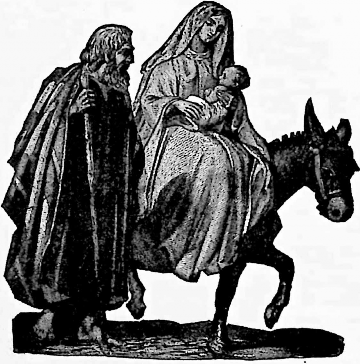
But warning they had, and Joseph arose and took the young child and his mother and fled at night from Bethlehem cn route for Egypt.
There need be no speculation as to the route between these two points. Being in haste, Joseph took the most direct way, viz.: to Hebron, over the mountains to Gerar, three days, thence westerly to Gaza, or following the River Besor to the coast, leave Gaza on the right, thence, following the coast of the Mediterranean, until their safe arrival in the land of the Ptolemies. Their residence while here was near the heathen city Heliopolis.—See Andrews’, 93 ; Kitto's Life of Jesus, 139.
And when Herod was dead, and the news was conveyed to Joseph, he took Mary and her child and returned to the land of Israel.
This implies, “ as soon as he heard that Herod was dead.”

Herod was dead by the first week in April, of that same year, therefore the sojourn of the Holy family in Egypt did not exceed two months. It was a compulsory exile, from which they would, doubtless, return at the earliest possible moment* When Joseph had reached the borders of Judea he heard that Archelaus reigned in Herod’s stead. Herod had named him as his successor, to be sure, but Archelaus had early
FLIGHT INTO EGYPT
gone to Rome to obtain confirmation of Herod's will. This latter fact may not have been revealed to Joseph, for absent or present, Archelaus was, de facto, the ruler over Judea from * Lichtenstein says 4 to 5 weeks. Ellicott and Wieseler, 3 weeks. Greswell, 7 months. Josephus, Ant. 17:6, 7, says that Herod died shortly before the Passover (April 12) after an eclipse of the moon. This eclipse occurred on March 13, astronomers tell us.
the death of Herod. Therefore we derive no datum from this circumstance.
Joseph feared Herod’s son, as much as he had the father, and avoiding Jerusalem and its vicinity, he followed the route along the coast of the “ Great Sea," probably up as far as Ca:sarea, thence easterly over the lower end of Carmel to Megiddo, and the plain to Nazareth.
Additional description of this old route may be interesting to my readers. It was very familiar to the Israelites, from the time when Joseph's brethren first went down into Egypt to buy corn, or Jeremiah and his contemporaries fled this way for a refuge to the same lands.
The Holy family in their first night’s and following day’s flight, would, over a very rough or hilly country, reach Heb-ron on the second night.
Hebron is situated in a valley among the mountains, nearly twenty-four miles south of Jerusalem. It was appointed a city of refuge “in the mountain of Judah," and might be such if a refugee could find it.
It is a patriarchal city—very ancient—a rival to Damascus. It was an old place when Abraham discovered it 4,000 years ago.—Numb. 13: 22.
Here Sara died, “ and Abraham came ... to weep for her."
The city lies on the eastern slope of the hill, and is a well-built town. The houses are two stories high, stone, and flat-tened dome-roofed, as are those of Gaza and Ramleh. Its inhabitants, none of whom are Christians, are, Jews 50 families, and Moslems. These latter hold the “ Cave of Machpelah ” to the exclusion of all others! It is claimed that here rest the bones of the patriarchs, Abraham, Isaac and Jacob, also Joseph (?) and Sarah, Rebekah and Leah.
In the open field, just north of the town, Isaac awaited the arrival of his bride, Rebekah, from Haran. Very few places possess greater interest to Bible readers than the ancient city of Hebron.—See Land and Book.
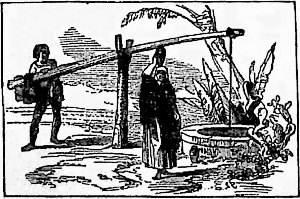
Another place of great antiquity and deep interest to be seen on the route to Egypt, is Beersheba. Here Abraham J planted a grove and redeemed a well of water which Abime-lech’s servants had violently possessed. Here are seven wells at the present time, two of large size and five smaller. They are all located on the northern bank of the Wady Sheriah or Es-Saba. The largest well is twelve and one-half feet in diameter, and sixty feet in depth, the next in size five feet by sixty feet in depth, and both of great antiquity.—Gen. 21: 25.
Look at those curb-stones of trap-rock.
They have not been in use to any great extent for a thou-sand years, yet they are " frilled and fluted all round,” from the
A MODERN EASTERN WELL
action of the grass ropes running over them, in drawing water by hand; ropes held in the hands of father Abraham, his son Isaac, his son Jacob, and their wives—the laughing, fibbing Sarah, the lovely, politic Rebekah, and the weak-eyed Leah, and their convenient and accommodating hand-maids, Zilpah and Bilhah—and thousands of their descendants. What silent witnesses are these old wells, and what ghosts of the past flit through our imaginations in our vain endeavors to grapple with the marvellous scenes which have been enacted about them! These wells, and a few rocky mounds, are the only evidence left of the once famous city, the extreme southern limit of ancient Palestine. Not a tree or a house is to be
seen. Silence, like the grave, hangs her deathly pall over the land once so famous and prosperous. Desolation reigns!
Both Abraham and Isaac went directly from Beersheba to Gerar, when Abimelech was king of the latter city. It was on the extreme border of Canaan, toward Gaza, at a distance of about thirty miles, in a northwesterly direction.—Gen. 10: 19; ch. 20.
" We had heard of it at Gaza (some twenty miles north) as the ‘ Rapids of Gerar,’ which we found to lie three hours to the south-southeast of Gaza. . . . Near Gerar are the traces of an ancient city called Khirbet-el-Gerar, ' the ruins of Gerai.’ ”—Rev. J. Howland.
JACKAL
Here Isaac fed his flocks upon the great plains, and in' creased in wealth and multiplied in number to such an alarm-ing extent, in the eyes of the Philistines, that their king demanded a covenant with him to keep the peace.
Now the WILD CONIES and JACKALS are the principal inhab-itants of the land.
Gaza was not too far northward to be taken in the way, following down the northern bank of the river Sheriah. From the housetops and hillside they may have obtained their first view of the Mediterranean Sea. The views from the elevated cities of the south shore of thia great sea arc the finest in the world.

KARNAK, EGYPT
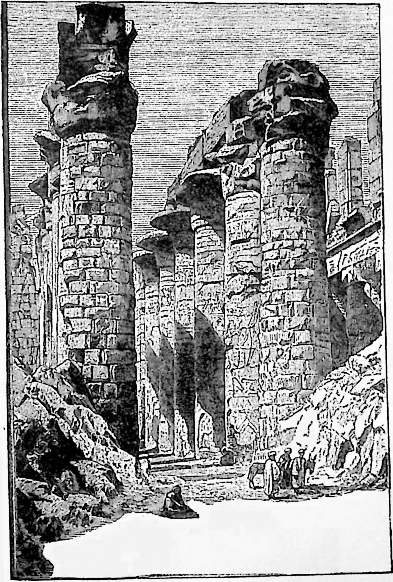
Extensive commerce is carried on between Gaza and Cairo. There is now a direct line of travel over the desert, following the coast, to Egypt.
Doubtless this old travelled route was known historically, if not geographically, to Joseph and Mary, since the patriarchs from Abraham to Joseph had gone over it into Egypt; there-fore it may, without great stretch of imagination, have been the very route taken by the Holy family in their forced and hasty flight into the same country.
On the first of January, 1798, A. D., Napoleon went from Cairo in Egypt, to Acre in Syria. The route lay directly to the southeast along the sea-shore to El-Arish, which is the last place in Egypt, bordering on Palestine. “ El-Arish is a email, strongly fortified military town, deformed by every aspect of poverty and wretchedness with which iron despotism has filled the once fertile plains of Syria.
“ Napoleon with his usual celerity fell suddenly upon the place at the hour of midnight, and captured it, with 2,000 prisoners. Eighteen miles northeast of El-Arish stand the granite pillars marking the boundary line of Egypt. From Katiah to Gaza there is one continuous stretch of dry, sandy desert. Approaching Gaza, the whole aspect of the country began rapidly to change for the better. Green hills and flowery valleys, groves of olive trees and “ apples,” rose like a vision of enchantment before eyes so long weary of gazing on shifting sands and barren hills.
Gaza, too, fell. No other place held out before reaching Jaffa. Here Napoleon arrived on the third of March, twenty-three days after leaving Cairo.—See Abbott’s Napoleon.
This description may aid us greatly in making up our time and route of the Holy family into Egypt.
Chapter VI
End of the Third Journey
Nazareth
TIME.—750 to 761 A. U. C. or A. D. 8.
PLACE.—Nazareth, an inland town of Galilee.
RULERS.—Augustus, Emperor at Rome—Archelaus, Ethnarch of Judes—Herod Anilpoi. Tetrarch of Galilee—and Philip, Tetrarch of the countries north of Galilee in Palestine. first manuscript of these journeys," * contained a
References
Matt, a: 33.
Mark x: 9.
Luke a 1 39, 40. Luke a: 5a. very extensive, and, it is believed, a most interesting description of the little city of Nazareth, the blest home of Jesus, during thirty years. I hope I may be able to reproduce it, with all its long sought-for details and embellishments.
Because it was the place where Jesus passed the greater portion of His earthly life, we are deeply interested in all that pertains to it, and for this reason, it deserves more than a passing notice.
Nazareth has no place in history, previous to Christ’s time. Matthew first wrote of it.
Scripture is silent respecting her. It is nothing surprising that Josephus completely ignored her existence, since he repudiated Jesus as the Messiah. He did not even recognize Him as “a prophet.” Matthew seems to have thought that * Burned with all my library and office effects May 31, 1882. (76)
there was one scriptural reference to Nazareth. Writing his gospel more particularly for the Hebrews, he drew largely upon the scriptural prophecies for evidences of the Messiah, and thereby brought in some quotations relating to past sub-jects. Are there not three of these applications in his second chapter ?
1. In verse 15 he quotes, “Out of Egypt have I called my son;" implying its fulfilment in the “ Flight," and return of Jesus. Plainly that quotation (Hosea 11: 1) refers to bring-ing the Israelites out of Egypt At least, to whomsoever it applied, were servers of Baalim (verse 2). Again (2), in verse 17, Matthew quotes Jeremiah 31 : 15, “A voice was heard in Ramah,” referring it to the slaughter of the children by Herod. Whereas it originally referred to what had transpired 600 years before, it might also illustrate Matthew's text to the Hebrews. It could serve a double purpose. Dr. W. H. Thomson, in referring to this far-fetched quotation, says:
" Not four hundred yards from Rachel's tomb, the guide showed me a heap of rubbish which he said was called 'Ramah.' This appeared to me like a modern invention, originating in a desire of these very accommodating guides to gratify the solicitude of Biblical antiquarians. ... Of course it is accommodation. The prophet himself (Jeremiah) had no thought of Herod’s slaughter of the infants."—Land and Book. , “ Ramah " means a hill, or any place set on a hill. Rachel's tomb is not on a hill, but in a valley, but there are many places mentioned in Scripture, as Rama, Ramah, Ram and the like.
Evidently Matthew believed that when he quoted Judges 13: 7, “for the child shall be aNazarite to God," he was referring to a citizen of Nazareth, whereas it plainly related to a sect, and was applied to “ the child" Samson.* This being true (let any one read Judges 13), there is, * It is worthy of notice that the birth of Samson was announced to the mother, by an angel, the same as John the Baptist’s and Jesus’, but Samson morally tailed the people of God, both as a prophet and a Saviour.—Judges 13, 16, Chapters.
78 “A MOUNTAIN VILLAGE.” therefore, no reference in Scripture to Nazareth, until the time of Matthew’s Gospel, his being the first of the Gospels written.
The Present Nazareth
is situated in the centre of Galilee, nearly eighty miles due north from Jerusalem, and about half way between the lower end of the sea of Galilee and the sea Mediterranean, or twenty-five miles from the former and thirty from the latter.
THE NAME OF NAZARETH, like the name of all places in Palestine, was doubtless derived from the leading character-istic of its location. Thus,.Magdala is “the tower;” Safed, high on a mountain, is “ the watch-tower; ” Sepphoris, sitting perched on high, is “ the bird; ” Ramah “ the high place," or “place on a hill,” and the true etymology of the word Nazareth is not from “a Nazarite,” but from netzurah, “the watched,” or “guarded one."—Geikie, Notes on Chap. 12.
So, the home of Jesus sits in a little vale, surrounded by a circuit of mountains, towering up all around it, as if for its protection. It is a “ mountain village,” and while these thir-teen mountains completely enclose it from the outer world, towering from two hundred to five hundred feet above it, Nazareth itself lies nearly twelve hundred feet above the great sea. These hills and mountains are formed, in the main, of white and gray limestone, and, like all the hills of Palestine, present a ragged and barren appearance. Not so the valley below.
Our best approach is from the south. It must be through a natural cleft in the centre of these limestone hills.
“ The village lies on the northern side of a green vale, and is reached by a narrow, steep, and rough, mountain foot and donkey-path, over which the villagers have to bring their har-vests laboriously from the plain beneath, on camels, mules and donkeys.”—Recovery of Jerusalem.
“ If the traveller rides up this path in March, when the coun-try is at its best, he will be charmed by the bright green of
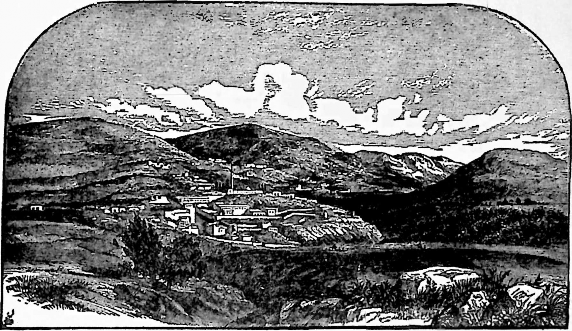
NAZARETH
the plains and the beauty of the flowers everywhere lightening up the otherwise barren hills, which at best only yield scanty pasturage for sheep and goats. The red anemone and the pink phlox are the commonest; rock-roses, white and yellow, are plentiful, mingled with the golden-flowered cytisus and marigolds, wild geraniums, red tulips, orchis in several varie-ties, mignonette, salvia and pink and white cyclamen in pro-fusion."—Geikie.
As we reach the summit of this mountain path, the village bursts upon our view.
Its first appearance is very attractive and picturesque from this point In the foreground the little vale, not over half a mile in width, is divided into gardens by hedges of cactus, “ which, after the spring rains, wear an aspect of indescribable calm, and glow with a tint of the richest green."
It is near the hour of sunset.
What is this scene of animation beside the pathway ?
It is a fountain pouring forth its waters as free as the air above it, into water-jars, to be borne away by women, who stand around and playfully contend for the first chance,—into troughs from several spouts, around which, mingled with men and maidens, as of old, are cattle, mules and donkeys, eagerly quenching their thirst. Dr. Farrar gives a very interesting account of a similar scene.
Above these, the village rises, terrace upon terrace, house upon house, on the southern slope of the gray and white hill, clinging to the rocks, seemingly, like bee-swarms to their hives. The houses are built of the whitish limestone of the native hills, flat at the top, and, at this distance, lock, in the de-clining sunlight, very like huge blocks of stone set on end. Their sameness is relieved by the dark shades cast toward the right, and the bright green trees and bits of garden interming-ling. There is also further variety in the scene, from the discovery of a large convent, a modest church and a " heathen" mosque with its graceful minaret conspicuous above all its surroundings.
Drawing nearer, we pass through modest fields of “ waving 6 82 "WAVING CORN.” corn," gardens of almonds and figs, orchards of lemon, orange and pomegranate, hanging in clusters of lovely green, or richer golden fruit, with here and there a more stately palm, now in its fullest luxuriance. These trees once so abundant are now very rare.
There is one pretty little brook run-ning through this valley, where, now, everything is so fresh and green, for it is just at the close of the " rainy season ; ” but a few weeks hence it will almost cease to babble and sparkle as now, and water will be at a premium.
The trees are alive with BIRDS of many varieties, and their evening concert is fully opened, reminding us of the coup-let, 11 The birds of eve now float around, And make the air with love resound."
(See Birds of Palestine, Part Second of this work.)
"The song of the lark floods a thou-sand acres of sky with his melody; the restless tit-mouse, the willow-wren, the black-cap, the hedge-sparrow, the whitethroat
WAVING CORN
LAKK LONG-BILL DUCKS
and the nightingale, flit and warble in the trees and cactus hedges, while the rich notes of the song-thrush and black-bird rise from the green clumps in the valley below.”
—Nat. Hist. of Bible, G.
The streets of Nazareth are crooked, narrow and not over cleanly. Just now the dust is well laid from recent rains, and,


being lined with the well-washed white limestone walls of the houses, intervened with fresh green trees and foliage, present a fine appearance.
" No wonder that in spring-time this should have been called a paradise, or that it should have been spoken of as, per-haps, the only spot in Palestine where the mind feels relief from the unequalled desolation that reigns nearly everywhere else."—M. Renan's Life of Christ, p. 18.
Later in the season the charm will be broken.
Dust, dust, dust! Everything will be covered with dust, from the lowly flowers, drooping and fading in the valleys, to the trees and fruit on the hill-sides; the streets will present a cloud under the donkeys’ feet; dust will fill the air and cover the house-tops, and the town, which looked more " like a hand-ful of pearls in a goblet of emerald " so recently!
Now it is a white city (Bonar). The white rocks all around give it a peculiar aspect It appears dry and tame, and this effect is increased by the trees being powdered over with dust during the summer season. The heat is very great and the gleam from the rocks painful to the eye.
These rocks are very soft, and easily go to decay, and Dr. Thomson says, " I am most happy to believe that there is not a fragment of the ancient Nazareth itself which can be identi-fied. It is nearly certain that every stone of the small hamlet where the Saviour spent so many years has long ago dissolved back into the white marl of the hills from whence it was quar-ried. This kind of stone disintegrates with great rapidity, and as the place was repeatedly almost, or quite, destroyed and forsaken, the soft stones thus exposed would not last fifty years.” * Of this there can be little or no question. Neverthe-less, two churches existed there during the 7th century, one on the site of Joseph and Mary's house, the other on the very spot where the angel appeared to Mary.
It is now, the present building, called “ Church of the An•Land and Book, Eng. Ed. 430. Nazareth was not visited by Christian pil-grims till the 6th century (Dr. Robinson, 11., 341). It was destroyed A. D. 1200, by Saracens (Early Travels). Dr. Thomson, who was during many years a mis sionary here.—L. and B., 430. nunciation.’ This with ” the cave, the kitchen of Mary, the workshop of Joseph, the dining-table of our Lord and His apostles, the synagogue where Jesus read the prophet Isaiah, and the very precipice over which His enraged fellow-villagers were about to cast Him headlong, arc now shown (and) are all fabulous, apocryphal, and have no claims to my veneration or respect.”
" The everlasting hills ” remain around the spot where He lived on earth. His works remain. This we feel assured of. These remain the same.
Its present inhabitants arc variously estimated:—Dr. Thom-son, “over 3,000;" Dr. Robinson, "3,000;" Dr. Porter. “4,000;" Captain Lynch (later), “ 5,000." It is gradually on the increase.
Jesus was a lover of nature and nature's solitude. His first appointment with the twelve was on a mountain; His last meeting with the five hundred was also on a mountain. The transfiguration was on the highest mountain of Palestine. Day and night often found Him communing upon the mountain’s height, therefore there maybe no doubt but that His feet have often trod these present mountain paths about Nazareth, and His blessed eyes gazed from this highest mountain’s top.* The highest of these “ thirteen hills " is nearly 500 feet, at the west and north of the village. From here Galilee is spread like a map before one’s view. Looking eastward towards the rising sun, first Mount Tabor rises before our vision, six miles distant. It is thirteen hundred feet above the valley of Es-draelon, on the west. In Christ's time it was well wooded almost to the top, and crowned by fortifications (Josephus). Below, at the right, lies the city of Nain, on the western slope of Little Hermon, and on the south lies Endor. Over these and the hidden Jordan lie, like a blue wall, the mountains of Gilead. Southward, over the great plain of Esdraelon, is seen the hill Samaria,f purchased by Omri “ for two talents of *“ He went up into a mountain,”—Matt. 5 : 1. Little Hermon is 3,013 feet above the sea level.— Kiepert. t A "watch mountain.” There seems no evidence that Jesus ever entered the heathen city, “Samaria.”—Matt. ro: 5. silver.” Farther to the right hand is traced, even at this dis-tance of 25 miles, the ridge of Mount Carmel to where its very headland plunges into the Mediterranean sea.
“ The blue waters of the Mediterranean Sea, speckled with its white sails, stretch far away beyond to the distant horizon. The whole Bay of Acre is (also) seen, though the town itself lies too low to be visible.”—Geikie.
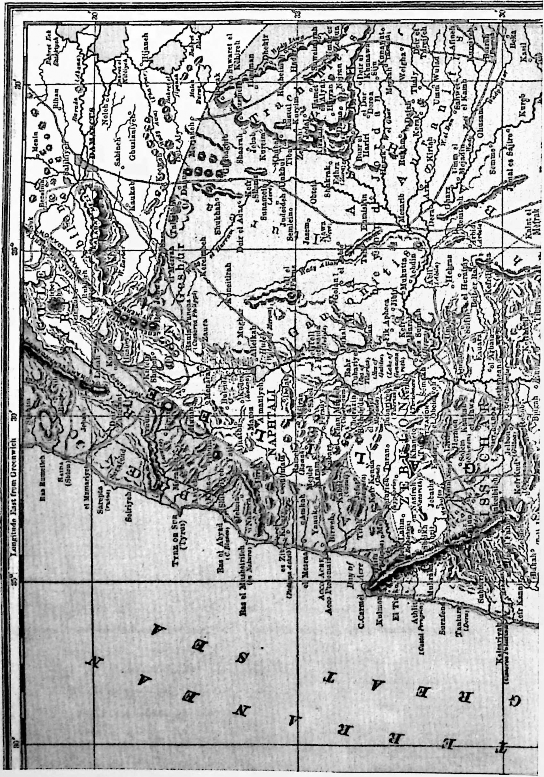
By and by we shall follow Jesus and the twelve on His journeyings to the beautiful sea,.which, I have no doubt, He longed so much to visit. I refer to His journey to Tyre and Sidon.—See illustration.
Cana of Galilee, famous as being the place where the first miracle was wrought, lies on the slope of a hill just above the green and fertile plain of Battauf, not above eight miles dis-tant, beyond which is a continuous sea of hills and mountains —“ the highlands of Galilee.” Elevating the gaze, the eye rests a moment on still higher mountains, the hills of Safed, twenty miles to the northeast, almost in the range of Hattin —mount of the Beatitudes—Capernaum, Chorazin, and on far-ther, Lake Merom, from whence flows the Jordan, to the Sea of Galilee and the Dead Sea.
But, what is that on the same line, far away in the north-east, which looks like a snow-bank ?
That is the top of Mount Hermon—“ the chief mountain.”* It towers above the sites of ancient Dan and Panias, Banias, or Caesarea Philippi, over which it stands an everlasting sentinel, while the cities themselves have faded into dust and ashes.
Its height is variously estimated from 10,000 to 12,000 feet Since “ its top is covered with snow throughout the summer, it must, therefore, rise above the point of perpetual congeal-ation, which in this quarter is about 11,000 feet. It might be safe to add another thousand feet, perhaps, making it 12,000 feet”—Dr. Kitto.
When all else of Syria is parching under the mid-summer * It is now called “JaM eik-^keibk, the chief mountain,” and also Jabtl etk-Tkilj, “ mountain of snow.” (Dr. Wm. Smith.) ” It is thought to rival Mount Blanc."—Encyclop. Kitto. sun, it is really refreshing to turn one's eyes to that one cool spot far away at the north,* By and by our " Journeys ” will bring it nearer.
We marvel greatly at the obscurity of Nazareth. When we notice her central position, it seems truly wonderful that nothing is known of her until the time of Christ.
It seems to me that Nathaniel referred rather to this ob-scurity than to the evil reputation of the place, in his excla-mation, " Can any good come out of Nazareth ? " " So small and hid in a basin ! "
There were no Roman highways or other roads, save one leading to her. Farrar says, “Along the one narrow moun-tain-path which I have described His feet—the feet of the boy Jesus—must have often trod, for it is the only approach by which, in returning northward from Jerusalem, He could have reached the home of His infancy, youth and manhood."
And here He remained in utter obscurity during nearly all of thirty long years, and, save one bright momentary glimpse, all history relative to Him is as silent as the tomb in yonder hill-side.
One thing more is remarkable. During His after life, in none of His sermons did He ever revert to anything relative to the scenes of His boyhood's home.
•When King Richard, “ the lion-heart,’’on his crusade', lay sick and tossed on a bed of fever in the lower hot country, his gallant foe Saladin sent him ice from yon mountain’s top to cool his fevered brain, and fresh grapes from Da-mascus to nourish his wearied body. A deed worthy the vicinity of the home of Jesus.
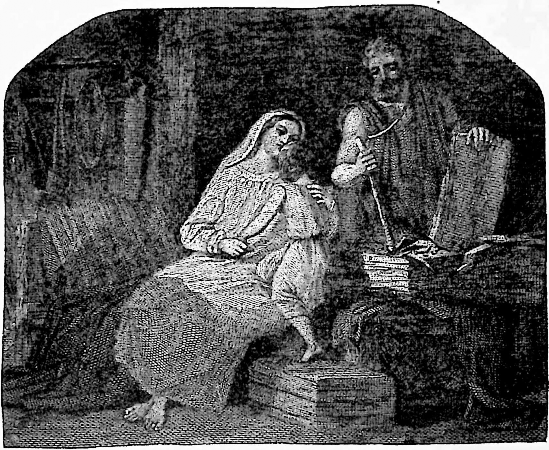
MARY, JOSEPH AND THE BABE (Carpenter Shop}.
Chapter VII
The Boyhood of Jesus
Time—Following last chapter. PLACE.—Nazareth,
Our system of education
Referenees
Luka st 33.
Prov. 31: I-31.
of the present day is no more fixed and uniform than was that of the Hebrew children eighteen hundred years ago. Education was obligatory with the Israel-ites. It began with the infant. As soon as it could speak it was taught orally the lessons and petitions of the morning and evening services. This devolved upon the mother. At the age of five the rabbis required it to commit the law to memory. This comprised the command-ments and " statutes." The thoroughness of these lessons may be understood from the following injunction—
"And thou shalt teach them diligently unto thy children, and shall talk of them when thou sittest in thine house, and when thou walkest by the way, and when thou liest down, and when thou risest up."—Deut. 6:7; Prov. 7 : 1-3.
[Thus did Jesus teach His disciples.]
These lessons were written upon the door-posts and pillars of their houses where they should ever be before their eyes. • From these they passed to Proverbs. Geikie, in his Life of Christ, quotes page after page of them, adding, 1 (89)

"All these were Jewish sayings which Jesus may well have heard—and treasured—in his childhood.”
The scriptural collection called " The Proverbs ” is an ex-ample of the character of these teachings. Then followed the necessity of learning to read. Beside the parent teachers, there were schoolmasters and teachers of higher grades. Paul boasted of having been instructed by the very highest of the latter.—Acts 22.
"At the age of twelve boys were instructed in the law, sub-ject to the fasts, and required to attend regularly the feasts, and were called the sons of the law."—Dr. Meyer.
Thus all Hebrews grew up educated, in a certain sense.
Even the fishermen of despised Galilee could read and write.
[How does this compare with the condition of the people of the present period? “There are 3,200,000 colored and about 3,000,000 whites, 1,800,000 being adult males, in the United States who cannot write—a worse showing than that of the previous census—and 5,700,000 children of school age who attend no school, and only 6,250,000, out of 20,000,000 who should attend Sunday-schools, are found in them.”—HON. JOHN EATON, United States Com. of Education, on census of 1880.—Congregationalist, Dec., 1882.]
It is evident that Jesus was instructed in the same order as other Jewish boys. As fast as He grew in stature He was ad-vanced in wisdom. Luke says, “ And Jesus advanced in wis-dom and stature ;" as the one so the other. His teachings were of " God and men," with both of whom “ he grew in favor."—Luke 2: 52, R. V.
At the age of 14 He, in common with all Jewish boys, learned a trade. At that age St Paul learned the tent-maker’s trade, in Tarsus of Cilicia.
A Jew boy could not be sent out to a teacher until he was six years of age. A teacher could receive no more than twenty-five boys. If more were sent to him he must have an assistant.* Respecting Jesus and His boyhood life, Canon Farrar says, * Schurer, quoted by Geikle.
“ His outward life was the life of all those of his age, station and place of birth. He lived as lived the other children of peasant parents in that quiet town, and, in great measure, as they live now He who has seen the children of Nazareth in their red caftans and light tunics of cloth or silk, girded with a many-colored sash, and sometimes covered with a loose outer-jacket of white or blue ; he who has watched their noisy merry games and heard their ringing laughter as they wan-dered and played in bands in their native vale, or on the hill-sides .... may perhaps form some conception of how Jesus looked and played when He too was a child."—Farrar's Christ, chap. 5.
Of the social and domestic qualities of the man Jesus, we have positive proof, hence of His childhood. Let us recall the fact that among His first acts, when acting for Himself with other young men of his vicinity, He attended a wedding feast. Of this we shall speak in its own place, however. At present we have to do only with His boyhood days.
The houses of Nazareth were plain and unostentatious. The Jewish mothers and maidens were much neater than the present mongrel Arab women of Palestine; therefore we know that the home of Jesus, under the care of the excellent Mary and her two daughters (Luke 6 : 3) was neat, and their simple food sweet and wholesome.
“ She looketh well to the ways of her household.” “ Her own works praise her in the gates.”* “ No literature," says Geikie, “ of any age offers a finer ideal of the Wife and Mother than this Hebrew poem, written not less than two thousand five hundred years ago, when the history of Greece was still an era of fable, and Rome was little more than a rude fort on the top of Palatine hill."
Doubtless all these proverbs were familiar to every Jewish maiden’s heart, and her course of life was ordered- thereby. The sons, also, and from early age, were instructed therein by “Theprophecy that his mother taught him."—31 : 1.
* « King Lemuel," in the worth of his mother, has given us an exalted opin-ion of the average Jewish mother and maiden.—Proverbs 31.
Thus were the sons, as well as the daughters, taught in their tender years, and which blessed instruction was remem-bered in their after walks of life. The gentleness of these home teachings appears all through the life of Jesus, while the opposite is found in the life of those who in their youth "never learned wisdom nor the knowledge of the holy." One such openly acknowledged himself as “ more brutish than any man, and without the understanding of a man."
1 —Prov. 30: 2, 13.
The fanciful pencils of great artists, from Giotto and An-gelico to Da Vinci* and Angelo have given the world very gorgeous conceptions of Mary and Jesus, in decorative walls fit for a palace, stately seats fit for an emperor, set upon splen-did floors of finest mosaic, and hung about with canopies of purple and gold, rivalling those of Tyre and Babylon.
But here is the reality!—
“ Nothing can be plainer than those houses, with doves sunning themselves on the white roofs and the vines wreathed about the corners. The floors covered along the walls by mats . . . the room (often without a window, hence the woman lighted a candle and searched and swept for the lost piece of silver), the room lighted by a lamp in the centre, the only ornament seen. On a ledge (or shelf) that runs around the room, are neatly rolled up the gay-colored blankets which serve as beds (Mark 2 : 4), and on the same shelf are seen the earthen vessels for daily use. ... At meal time a wooden stool is placed in the centre of the room upon which is set the dish of rice and meat (libban), or stewed fruits, from which the whole family eat in common."—Farrar.
Early in the morning, as was the custom of the family (Prov. 31: 15 ; Mark 1: 35), Mary and her household arose and began the duties of the day. Commending themselves to the care of Jehovah, they were each “ assigned their portion ” of the duties of the hour.
There is evidence that Joseph and Mary conformed to all * Florence, ” Coronation of the Virgin,” 1454, “ Last Supper,” etc. the rules and customs of good, law-loving Hebrews. The law was their guide. Though lowly born and humbly reared, as she herself has said,* Mary was an exalted (52) woman in Israel, and learned in all things becoming a Jewess of the highest rank.
Therefore Jesus, as her son, was early taught to pray, walk in the ways of the fathers, to pronounce blessings on all food —as was His custom in after days, with His disciples—and fulfil the law, but not to follow traditions. The Pharisees once said to Him—
" Why do thy disciples transgress the traditions of the elders ? "
To which Jesus replied—
“ Why do ye transgress the commandments of God?"
It may be observed that through His ministry, Jesus an-swered those hypocrites in like, He always took them on their own ground.
“ Is it lawful to give tribute to Csar?"
" Give to Caesar what is his, and to God what is due to God."
It was His custom to wash before meals, and He rebuked Simon of Nain for not having furnished Him water and towel for this purpose, as duty bound.—Luke 7: 44.
Like other mothers in Israel of her station, Mary spun flax and wool and wove them into garments for herself and family; she cooked the food for them, and of her abundance or penury she never forgot those more needy (Prov. 31). At evening in common with the other women of the village she would visit the fountain, with her earthen pitcher, carried upon one shoulder, and bring home the water necessary for a day.
Of the few things of which we are made certain, is this, that Jesus was brought up to attend church! Many things we have had to deduce, arrive at from custom of the day, and from after results and habits. Habits formed in youth never depart. When Jesus revisited Nazareth (Luke 4: 16), after *For He hath looked upon the low estate of HU kind-woman.—Luke I: 48.
His baptism, etc., He went on the Sabbath, into the (one) synagogue, “as was His custom."
He doubtless went to school there, also. The Chazan was also the school-master.—Lightfoot. It was he who handed Jesus the book to read. Jesus read, as He had often done before. It was not this act, but His comment on the book, which offended the Nazarenes at that time.
He had outgrown them !
" Mysterious as it seems to us, we must not forget that, as a child, I le passed through the same stages as other children.”
—Geikic.
And now we turn over a leaf, and come to the one living and true anecdote of His boyhood life.
FOUNTAIN WHERE MARV WENT
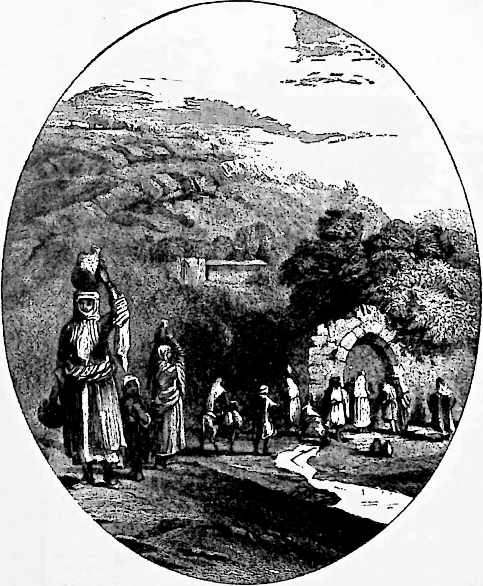
Chapter VIII
The First Passover.—A Journey on Foot
Time—Nazareth to Jerusalem and return. Place—Augustus, at Rome, toward end of his reign—Coponius, governor of Judea—Herod Antipas, Galilee and Perea,
Distance eighty miles.
Reference
OSEPH and May went every tukesifte year up to Jerusalem to the feast called the passover.
At the passover, occurring April 7 to 14, or 14 to 21, when Jesus was twelve years and three months old, His parents took Him up with them to the feast at Jerusalem.
The reader is aware of the error in our calen-dar which begins to count the Christian era four years too late. Hence, when Jesus was twelve years old, it is only reckoned as the year of our Lord 8.
The “ preparation day ” called “ feast of unleavened bread,” begins at 6 P. M. of the 13th April (Andrews). The distance from Nazareth to Jerusalem, through Samaria, was about eighty miles.
In order to arrive in Jerusalem on the 13th, or early on the 14th, the Galilean pilgrims must needs’start from home by Tuesday morning, or four days before the beginning of the passover.
Of the preparation before the start we know nothing, therefore we shall begin with the route.

Josephus informs us that the accustomed route of central Galilean pilgrims to Jerusalem was through Samaria. The reason of Jesus and His numerous followers being for-bidden to cross that country on His last journey is explained in the text (Luke 9 : 52, 53), namely, because He was fixed in going to Jerusalem, to become the King anointed there, rather than in Samaria; or their holy Mountain, where they also expected a Deliverer. It seems (Luke 17: II, 12) that they were to pass through the midst of Samaria, but being repulsed at the first city (En-Gannim) they went on the border-line between Galilee and Samaria.
Of this central route there is no question.
“ The direct route toward Jerusalem from Galilee lay through Samaria.”—Prof. Philip Schaff.
We have learned that it was the custom of these Oriental people to “ rise up early in the morning,” when starting on their journeys, thus getting in much of the day’s labor while in the freshness of the morning.—John H. Paine, Esq., Boston.
The inhabitants of Nazareth would form a caravan of their own, and start out early to join those from the northeast, at Nain, or the eastern part of the great plain of Esdraelon, or at Shunem, with those from the northwest part of Galilee.
The aged rode.
" Veiled women and venerable men would pass, mounted on asses, camels, or perhaps horses; younger men walking along side, staff in hand; children playing at the side of the path as the cavalcade slowly advanced, and the journey ever and anon beguiled with musical instruments.”—Geikie.
Were the women required by law to attend this feast ?
No, it is not so mentioned in the law, yet pious females, by the recommendation of Hillel, the great Jewish teacher, had become accustomed to accompany their husbands and children to Jerusalem on these occasions, which they esteemed as a great privilege.
Leaving the town of Nazareth they would cross the little valley below, and going due south, climb the narrow, ledgy, mountain path, past the little gardens, the waving grain, ripe for the harvest, the pathway on either hand strewn with many flowers, fresh and bright in the cool morning air, and reach the summit before the heat of the day began.
Says Dr. Thomson, in reference to travel in this vicinity but a few days earlier (March 31): "This is the very luxury of travel; bright days and joyous—air cool and fragrant—hill-side and vale robed in green and spangled with flowers—birds and beast and man himself gay and happy."—Land and Book.
Descending the southern slope of the hill, they would cross a branch of the ancient river Kishon, leave Nain, that little city where Jesus afterward raised the widow’s son, on the left, six miles on the route, turn southerly from a southeast course, and going directly through Shunem, the birthplace of Abishag, that beautiful Shunamitess who was taken to father David’s harem to comfort his declining days; cross the upper half of the valley Esdraelon and reach the heights near Jezreel for a midday encampment and rest.
Did they while away the noon-day hour by rehearsing the wonderful histories of these places just passed ? *—1 Sam. 28* On a dark night King Saul passed this very spot, on his strange and unhallowed mission to the "witch of Endor,” some eight miles towards the northeast The Philistines were encamped in mighty. numbers at Shunem, just passed. This place, now called Sulim, possesses admirable advantages for the encampment of a large army. We can see Little Her-mon from Jezreel; Endor is on the opposite slope, hence out of view.
Did the “ witch ” impose upon Saul, or did he see the real ghost of the departed Samuel, is a question to puzzle future generations. She could not have been deceived by Saul, for he was familiar in those parts, besides he must have been recognized by his gigantic stature at once, being head and shoulders above those of his army.—1 Sam. 9: 2.
"And the battle went sore against Saul, and the archers hit * I Kings I: I, 4. Shunem is mentioned by Eusebius as being five miles south of Mt. Tabor. Five miles southeast from Jezreel is Mt. Gilboa. him and wounded him.... Therefore Saul took a sword and fell on it. .. And died, and his three sons, and his faithful armor-bearer. And when the enemy came to strip the slain, they found Saul and his three sons, dead on Mt Gilboa.”
The whole story reads like a romance.* How sincerely David mourned over Saul and Jonathan I “ They were lovely and pleasant in their lives, and in their death they were not separated.”—2 Sam. 1: 23.
And David cursed the mountain, Gilboa, whereon they died, saying, " Let there be no dew, nor rain upon you, nor fields of offering,” etc.—2 Sam. 1: 21.
If there are any at this day who believe that David's words were of any effect in producing a dearth of moisture for vegeta-tion or beast, on that elevation, let him encamp thereon in the open air. ” I have had abundance of evidence that both dew and rain descend there as copiously as elsewhere. David's poetic imprecation had no more influence on the mountain or the clouds, that hover over it, than Job’s malediction, or Jere-miah’s, upon the day of their birth. Heaven has no spite against the earth it has pronounced * good.' ‘ Even the denun-ciations against cities,’ Babylon, Chorazin, Tyre, Sidon, etc, must be restricted to the inhabitants and not to the habita-tions.”
A WICKED Crrx.t This truth is illustrated in the present site of the once great, flourishing, but terribly wicked city where our pilgrims are encamped—Jezreel. The modern name is Zerin.
All there is remaining to mark the spot is the ruins of a once large, square tower, surrounded by a few squalid huts, inhabited by Arabs, their donkeys, dogs and vermin.
Perhaps in this very tower Jezebel sat and watched for the chariot of Jehu as he came pell-mell up the valley from the battle-field of Ramoth-Gilead. Here at the east side of the city were the gate and the watch-tower. Just outside was the See " Romances of Religions." f Jezreel was the chief city of King Ahab, and Jezebel.
A HORRID FATEl 101 coveted plot of ground which cost its owner his life, and there the eunuchs, at the command of Jehu, threw Jezebel down head-foremost and dashed out her brains on the pavement below. Then came the dogs and devoured her while yet reeking and warm!
Horrid fate!
The pilgrims move on.
They cross the dry bed of several small rivers—wadys—where far up the valley toward Carmel is seen Megiddo.
This plain of Esdraelon has been well termed " the battle-ground of nations."
The first of these battles of which we know was fought between Joshua and one of the Canaanitish kings nearly 3,350 years ago, and Megiddo captured. Here " on the river Kishon " were gathered the numerous war-chariots of Sisera, 900 in number, when the terrible army of Barak, consisting of ten thousand men, came down from Mount Tabor upon him, and the more destructive torrents falling from heaven, came rushing down from every hill and mountain side, swelled the torrents and overflowing the Kishon, hemming Sisera’s army between its bank and Mount Carmel, “ and the river Kishon, that ancient river, swept them away.”
Those " iron-chariots ” were really human mowing-machines, to cut down the opposing armies. In these deadly machines Sisera’s own horses became entangled, and were “ broken by means of the prancing" (Jud. 5 : 22), and thus the whole army became demoralized and “ swept away."
Therefore the words of Deborah were literally true,—" Is not the Lord gone out before thee ? "
Turn to Judges 5, and you have the explanation:
" When the Lord went out of Seir . .. the earth trembled, the heavens dropped, the clouds also dropped water.”
“ The river Kishon swept them away."
Deborah was a judge over Israel and "dwelt under the palm-trees of Deborah, between Ramah and Bethel, where the children of Israel came to her for judgment” Tradition makes her a giantess. .
Who have not fought up and down this plain of Esdraelon! Israelites, Canaanites, Philistines, Chaldeans, Egyptians—for here come “ Necho-Pharaoh up from Egypt to fight in the vale of Megiddo "—with Persians, Greeks, Romans and Mos-lems. Yes, and Christians, for Napoleon's troops fought at Sejera, routing both Arab and Turk.
Where now are all those many cities which once covered this vale? On the north side ruins upon ruins mark the site of them.
Where the stream runs down the mountain’s side, looking towards the north, is a little city called Lajjan. The stream is copious, turning a number of mill-wheels, and this is the famous " Waters of Megiddo."
The river Kishon extends still farther up the valley, and the Galilean pilgrims now cross the dry bed of its southern branch, and ascend the hills leading to the first Samarian city on the southern border of Galilee.
This is En-Gannim, or modern Jenin. The name implies " Fountain of Gardens." “ Samaria begins at En-Gannim (Ginea) and ends at Akrabbin."—Josephus’ W. 3: 3,4.
In this pleasant village, probably on an open plot by a copious fountain, the Holy family, with other Galilean pil-grims, pitched their tent for the night’s encampment.
They have travelled but twenty miles this day, for there are aged men and women and young and tender children in the caravan, for whom twenty miles is a sufficient day’s journey.
En-Gannim lies on the direct route from Nazareth to Nab-lus, and is now the only place of importance between those two cities. Jenin, as the Arabs now call it, for the lazy, idle wretches abbreviate everything possible, has about 2,000 inhabitants, all Moslems. It deals largely in country pro-duce. Below it lie green fields ; above and beyond, wooded hill-sides.
This is believed to be the city from which Jesus and His followers were repulsed when on the last journey toward Jerusalem (Luke 9: 52), as will be shown in the proper place.
While the " Jews and Samaritans had no dealings with each other,” it is certain that in times of general peace they passed unmolested, except by robbers, over each other’s lands.
So the pilgrims encamped in, or near, this heathen city. " He shall judge among the heathen."
“ He shall drink of the water on the way.”—Ps. no: 6, 7.
They ate of their frugal meal, parched grain, baked unleav-ened bread—“ journey-cake ”—and drank of the " fountain ” by
A FOUNTAIN
the village side. They sang their psalms and offered their evening prayer, and retired upon beds, or quilts, spread upon the ground, covered by a light tent. The rainy season was past, the air was soft and balmy at night, and all who were strong enough to travel so far were able also to sleep in the air and upon the mother earth.
Again they start early on the morrow.
As this is the route which Jesus often travelled, we are taking time to describe it once for all, that it may be familial
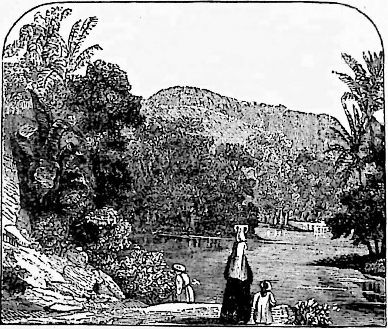
to the reader hereafter. There is little doubt but that He went over this very way “ every year ” up to his thirty-first year. After that He probably went several times via the Sea of Galilee and thence by the East Jordan route, a much pleasanter route from Capernaum to Jerusalem.
“On leaving En-Gannim the road follows the Wady Bel-amy for a few miles, passing the ruins of a town on the right This wady (stream bed) is full of springs in winter and very muddy, but as hot and dry as an oven in summer." * Rising out of this, they ascend a long hill, and descend to a little town called Kubatich.
The hills about here are covered with groves of flourishing olive trees, and the net-work of vales and plains westward is extremely pretty and fertile.
The next place passed is Dothan.
Of course it is now only a ruin, called " Tell Dothan."
This was a very ancient place, first mentioned as being the vicinity where the boy Joseph went after his brethren.
"And he found them in Dothan."—Gen. 37 : 17.
His jealous brethren discovered him coming up yonder valley, staff in hand, happy in finding them after so long a search.
" Here comes the dreamer," said Judah.
" Let us kill the fellow and cast him into this pit," said another of the conspirators.
"No,” exclaimed Judah. "Why kill him when we might sell him to some Ishmaelitish band, and our hands be free from his blood ? ” This was on the great route of travel between the East and the Mediterranean Sea.
So when Joseph came near, they caught him, and in spite of cries and entreaties, they stripped off his clothes—quite gayly dressed, we will recollect—and cast the lad into a deep pit. Having done this, they sat down coolly to their meal and talked over the matter in a brotherly manner. Meantime *This description is from Thomson's Land and Book, Eng. Ed. From the highest elevation hereabouts may be seen the hill of Samaria, based with green trees and crowned by ruins. one of those numerous caravans from the East came in sight, when the brothers drew Joseph from the pit and traded him off for twenty pieces of silver. They were “ Midianite mer-chantmen,’ These sold Joseph to Potiphar in Egypt, and it proved a very good speculation.
The whole story is well known and need not here be repeated.
There is a fountain flowing at the foot of the hill Dothan where no doubt those naughty brethren once watered their flock. Certainly here is excellent grazing lands to this day, but where is Joseph's Pit?
Filled up, in these past three thousand years I Still the caravans pass this way as of old, They cross the Jordan from the East, three miles from Biesan, over an old stone bridge, follow up the river-bed past the ruins of that old city; passing Zerin and Lajjan on the right, enter the hill country of Samaria, following Wady Dothan, thence to Ram-leh and the sea-coast to Egypt. < Yes, over this very route came those trading Ishmaelites from Gilead, with their camels, those " ships of the desert,” “ bearing spices, balms and myrrh, to carry them down to Egypt."
And all these interesting themes were familiar to the parents of the boy Jesus, who doubtless questioned “ them on the way” regarding every particular, resting at noon-day by Joseph’s Pit.
Here also that proud Syrian King sent a host of men and horses and chariots, by night, and surrounded the “ city ” to capture one man of God, Elisha! But he captured them instead I The whole route onward to Shechem is beautifully and endlessly diversified with hill and valley and fertile plain, even now well cultivated and thickly settled. Villages stand out on every conspicuous place, and border every gushing fountain."
Jeba, a small town, is perched on a sharp hill on the right hand, and strongly fortified. Here in the vale the road branches off from the main, to the hill and ruins of Samaria.
Though one of the most beautiful sites in all Palestine, Sama-ria is but a hill of ruins.
Would not the Holy family seek famous historical places and sites, and where there was abundance of water, during this dry season, on which to en-camp? No doubt.
What more famous spot en route than Jacob’s well ?
Here it is, a mile and a half east from ancient Shechem. Whereas most nations have erected mounds and monu-ments, as mementos, the He-brews have been remarkable as a well-digging people. When Jacob dug this famous well at Shechem is not known, or whether he in person ever dug it, is equally a mystery. It was dug, and there remains, a fact to this day. This well was not less than one hundred feet deep—“some say one hundred and twenty—and only fifteen feet of water in it.” This may account for the reluctance of the woman of Samaria, mentioned by St. John, to draw up water for the stranger sitting on the curb.—John 4: II.
A WOMAN OF SAMARIA
{Photographed,} “ The well is very deep,” was her characteristic reply to the Saviour’s demand for water in the noon-day's heat The well is nine feet in diameter, and the stone curbing is worn into deep grooves, like those at Beersheba, from the action of the

ropes over them during nearly four thousand years. The water of fountains, as also of some wells, was, by He-brews, called "living waters,”—John 4: 10—and thus dis-tinguished from cistern water. Jacob’s well is now filled with rubbish.
Nablus the modern name of Shechem, given it by Vespa-sian, is a corruption of Neapolis. This is one of the grandest old cities of Palestine; situated in a glen between the two mountains, Ebal and Gerizim. The vale is not above 500 yards wide. Gerizim, on the south, is 800 feet higher than the city, and is the holy mount of the Samaritans. The ruins of their famous temple, as well as those of some old city, crown the summit and extend down the northern side of the mountain. Josephus says that this temple was destroyed about 129 years before Christ. It was 250 feet square.
Nablus is a very remarkable old place.
" The streets are narrow and vaulted over.” When Aug-ustus’ messenger went through “ all the world ” to proclaim the tax, he might, on coming to this city, walk over street and house top, from one mountain to the other, without step-ping on the earth.
The water-sheds of the two mountains empty themselves into the streets, which serve as sewers, and during winter, or the rainy season, they run like rivers, carrying along everything in their way. “ The brooks rush along over the pavements with a deafening roar, making their passage very difficult and often dangerous."
The houses are built one above another, in terraces, mingled with which are trees, shrubs and flowers in grand profusion. " In this respect it is like Brusa, or Prusa, at the foot of Mt Olympus in Asia Minor, with mulberry, orange, pomegranate and other trees, mingled with the houses, whose odoriferous flowers load the air with delicious perfume during the months of April and May. Here the bilbul delights to sit and sing, and thousands of other birds unite to swell the chorus.” It is the most musical vale in all Palestine, Perhaps the pil-grims passed through it on their way to Jerusalem. Certainly, Jesus was once here “ and abode two days with the Samaritans, and many believed on Him."—John 4: 40, 41.
This spot around Jacob’s Well has been a famous camping-ground for thousands of years. Abraham and Sara, Isaac, Eleazer and Rebekah have been here; here “ Jacob pitched his tent before the city,” and purchased a parcel of ground of Shechem's father for one hundred dollars. Here Dinah went a sight-seeing on her own account and fell a victim to the beguiling prince of the country, for which act Jacob’s sons took summary revenge, and much spoil. A romance ending in a grand tragedy, surely.—Gen. 34: 1-31.
But we are spending a long night here, and must proceed on our journey toward Jerusalem.
During the third day the pilgrims pass many flourishing villages and cities; Lebonah, close to the highway, on the right, two miles north of Shiloh ; Corea, Bethel, and Ephraim on the left; Bethel is eight miles south of the first place due.
Every route leading to the city has now become densely crowded, and the heat and dust are intense and suffocating. Beeroth, some nine or ten miles north of the city, is conceded as being the place of the last night’s encampment before enter-ing Jerusalem, on the north. It may have been selected for its excellent camping grounds as well as for the abundance of water there (" The Wells ").
“ From the pleasant springs by which they would encamp, a short and easy stage would bring them—on the fourth morning—within sight of the towers of Jerusalem, (where) the profane plumage of the eagle-wings of Rome was already overshadowing the holy city."—Farrar.
Now the long line of the northern wall of the city comes in view, and above it, glistening in the morning sunshine, the lofty, golden dome of the Temple. What wonderful sights to the child Jesus, who for the first time gazes upon the scene!
What great emotions must needs swell His heart! He is about to enter on foot, for the first time, the city of His father David—the " Holy City," the “ crowning city." How His eyes, in common with all Jewish people's, had longed to be-hold her I Here was the very habitation of Jehovah, in His sacred temple. From every quarter of the earth where an Israelite lived, might come up the same cry of those exiles at the fountains of Jordan:
"As the hart panteth after the water-brooks, " So panteth my soul after Thee, O God.
" My soul thirsteth for God, for the living God. " When shall I come and appear before Him ?
" When I rend I these things, I pour out my soul within me;
“ For I went with the multitude;
" I went with them to the house of God, , " With the voice of joy and thanksgiving,' " With a multitude, to keep the holy day."
They enter at the Damascus gate, and pass through the liveliest portion of the city. The streets are already over-crowded with pilgrims from every part of the known world. They have poured down from Antioch and Damascus; they have come up from the cities of the sea by thousands; they have sailed from its far-off islands and borders; they have
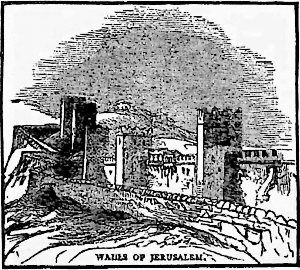
crowded the fords of the Jordan coming up from Perea, and the heathen lands far beyond the mountains of Moab. They have come by land and by water; they have journeyed on foot, and ridden upon asses, dromedaries, horses and pal-anquins.
Herod Antipas had left his palace on the lake Tiberias, and come up to the feast of the Jews. Herod’s palace on the north of Mount Zion was crowded with kings and queens and princes and ladies of rank and beauty. Here was the second Mariamne, “the fairest woman in Palestine," and per-haps her descendant, the ambitious Herodias, already planning for future conquests, and her infant daughter SALOME (see Part Second). While the city was crowded, the hills and valleys round about her were white with the pilgrims' tents. On the north they extended nearly to the “ tombs of the kings;" on the east the valley of Kidron and the western slope of Olivet were crowded with them; on every hand they were encamped. Gardens and private grounds were thrown open to them, always, on this occasion, and hospitality reigned everywhere.
We shall not at this time describe the passover, but leave it for the future, and hasten on to the end, when the Galilean pilgrims start for home, at the end of the feast.
During the feast no business was transacted ; no purchases were made, save such as were necessary to the feast. The shops of the goldsmiths in the upper city, called the “ City of David," were closed during the passover. Below, in the lower city, crowded in narrow streets, leading from the main street, which ran north and south, were the bazars, where were sold all sorts of goods. On the morning before leaving the city, the females must need make their annual purchases, while the men gathered up the tents and packed the beasts of burden for the journey. The start, therefore, would not be very early, and Beeroth might again become their lodging-place, on this their first day’s journey. In fact, a place so near the city might well have been elected, by all the Galileans, as a place of rendezvous, preparatory to the real start.
F
JERUSALEM
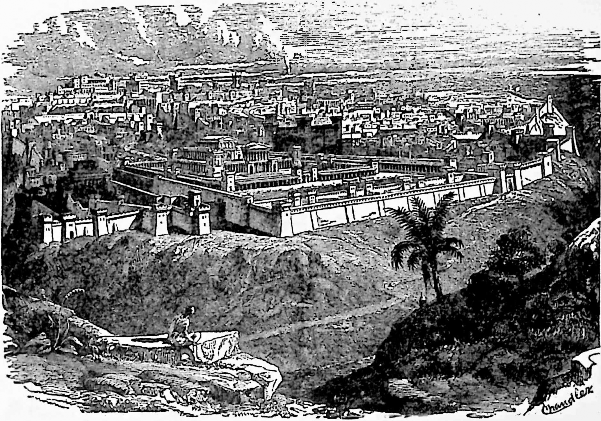
There each party would begin to gather together and ascertain if all were present to complete their number. If any were deficient it would now be found out. In such a sea of human beings as must necessarily leave the city, it is not surprising that some should get lost at the start.
Chapter IX
Jesus with the Elders
Time and PLACE as in last chapter.
ND when the
Heferenee
Luke a: 43, 51.
SIGAET AING9. passover was ended, and they — the parents and friends of Jesus—were re-turning, the boy Jesus tar-ried behind in Jerusalem, and His parents knew it not, but supposing Him to be in the company, they went on a day's journey, before missing Him.
They then made inquiry for Him among kinsfolk and acquaintances, and when they failed to find Him there, Joseph and Mary returned to Jerusalem in search of their child.
Necessarily they had missed Him on the evening of their arrival at Beeroth, and there searched for Him. So Farrar—Andrews. The confusion and bustle on leaving must have been indescribable (Geikie). On that night the city gates, open at night during the passover, were closed, and the parents could not have reached Jerusalem much before noon of the second day. During that afternoon they diligently inquired for Him to no effect. On the third morning, early, they renewed the search, when, after looking over the entire city, with many inquiries and almost in despair, finally, as the last resort, Joseph went into the council chamber of the great Sanhedrin, and there he found Jesus “ sitting in the temple,
in the midst of the elders, both hearing them, and asking questions.”
“And all who heard him were amazed at his understanding and his answers.”—Luke.
" Schools,” says Geikie, “ were characteristic of the times; they were open, and any one might enter and answer or propose a question.” Oriental freedom permitted it Had Jesus been in such a “school,” when found, it is probable His parents would have found Him before the third day, as they would instinctively have there searched for Him. The very fact of their long search before finding Him is pre-sumable of His being in an unusual place; besides the “amaze-ment” of all, and this afterward included His parents, tends to show that those “ doctors ” or “ elders " were no common school-masters, but members of the council.
Therefore we say, Jesus was found in the presence of the Sanhedrin, that is, the Seventy, seeking knowledge.
Lightfoot says, “ There is nothing absurd in it if we should suppose Christ had - gotten into the very Sanhedrin itself. Thither Joseph {not Mary) might come seeking Him, and find Him on the benches of the fathers of the council for that once, they having found Him so capable both to propound questions and answer them." Females were not here permitted.
In order to do this, to the “ amazement " of that august -body, the Sanhedrin, Jesus must have understood both the Greek and Hebrew languages. We know that His ordinary conversation with His friends was often carried on in the Aramaic tongue, the “country language," as when He addressed Jairus’ daughter, “ Talithe cumi,” or Mary Magda-lene at the tomb, and she answered with the endearing excla-mation “ Rabboni! ”—or “ Master mine I ”
Like a dutiful son Jesus followed His parents from the tem-ple, His mother gently chiding Him as they went “ Son, why have you so dealt with us ?
“ Behold, THY FATHER and I have sought you, sorrowing 1 ”
Jesus did not rebuke her for “ the error which fell from her lips in speaking of Joseph as his father," as the Rev. F. A.
Malleson, of England, is pleased to say,* but He replied, majestically:
" How is it that you sought me ? "—R. V.
“ Did you not know that I must be in my Father’s house ? ” This is the correct translation; as if He had said:
" Why spend time in seeking me? Did you not know that you could find me in my Father's house?” that is; the temple.
“ But they did not understand His reply," says Luke.
“And He went down," from the temple, and Jerusalem, with them to Nazareth, Mary pondering these sayings in her heart As in verse 33, “And His father and His mother marvelled at the things which were spoken concerning Him."
With His parents Jesus returned to Nazareth, and during eighteen years retired into complete obscurityI ‘ What do we know of those eighteen years ?
Very little. Only this—
He learned the carpenter’s trade.
He grew to the stature of a Man.
He increased in wisdom in the same ratio. Of these we are very certain.
FIRST. Every Jewish son is required to learn a trade. The educated and wealthy (?) Paul was not exempt from this law. Jesus on going home, after the age of twelve, became “subject to ” His parents. His father Joseph was a carpenter. If these two facts do not convince us that Jesus learned the carpen-ter’s trade,! let us turn to Mark 6:3, where we have more direct proof:
It was the occasion of His second visit to Nazareth, when He astonished His townsmen by His knowledge, and they severally asked—
“ is not this the carpenter ? "
* I had rather take the evidence of the simple-hearted Mary, than that of any other, as to the lawful parentage of her son. t"ls not this the carpenter ?" (Mark 6: 3). On His former visit, last part of April or first of May, A. D. 28, they asked, 11 is not this the Son of a car ftnitrt (Malt 13: 55). Celsus scoffs the idea of the Saviour of the world being a carpenter.—Farrar.
“ Is He not the son of Mary ?” • “ Is He not the brother of James, Joses, Judas and Simon?” “Are not these His sisters, here with us?”
They knew Him and His family well, it is evident And Jesus acknowledges these facts in His reply—
"A prophet is not without honor except in his own country, and among his own kin, and in his own house."
He here acknowledged these as His kin. But why His “own house?" As eldest son, His father being dead, by law He was required to become the head and support of the family, i. e., of the mother and unmarried daughters.
“And," says Farrar, " Christ labored with His hands, and fashioned ploughs and yokes/’ Justin Martyr (A. D. 100 to 150) says—
“ Christ being regarded as a worker in wood, did make while among men ploughs and yokes ... thus teaching them an active life.”
“ It is most probable that He was taught His father Joseph’s trade, according to the settled custom of the Jews to bring up their sons to some trade or art”—Andrews' Life of our Lord. So Fleetwood.
Of His extensive knowledge of the Hebrew scriptures, there is abundant proof throughout the Gospels. “ He has a quotation ready to meet every hostile question " of the scribes and Pharisees. His frequent retort on the rabbis themselves —" Have ye not read ? ” and His deep insight into the spirit of scripture, prove how intensely He must have studied the sacred books.
“ To unite the study of the LAW with a TRADE kept away sin, whereas study alone was dangerous and disappoint-ing,” was a proverbial saying of the Gamaliel family.—P. Aboth.
"Of the rabbis in honor in Christ’s day, or later, some were carpenters, others cobblers, tailors, bakers, builders, masons, farmers,” etc.—Geikie.
And thus it seems that Jesus grew to manhood’s estate, working with His hands, while He acquired “ wisdom ” and 118 "GROWING IN WISDOM.” knowledge from the great book of nature, open all about His mountain home, and “ of man,” as also a perfect understanding of the written revelation as handed down by the Hebrew fathers.
That His studies in the book of nature had been perfect, is well shown in the apt illustrations of His sermons.
The grain sown by Galilee's blue waters, the lilies blooming in the valleys of Perea, the foxes hiding in the caves on Sama-ria’s borders, the various birds filling the air with their music, the habits of the sheep, the ass, and the cattle of a thousand hills, were familiar to Him, as one who had observed them all His lifetime.
All domestic habits, and occupations, customs of past ages and present, as well as law and equity, the geography and topography of the country, seemed ever familiar to him, as well as the conditions of the atmosphere and the various changes of weather.—Luke 8: 16; Matt 6: 47-49; Matt 16: 12; Luke 7: 32.
Habitation was strong within Him, showing that He did not wander about the country (as some think), but remained at home during his youth. When He was forced to leave Nazareth, at last, He took a " house ” in Capernaum, and there made His home. When worried from thence and He sought a temporary asylum in a heathen land (Tyre), there we find Him and the disciples in a house of their own. While about Jerusalem, He made His home with Mary, Martha and Laz-arus. Finally, leaving this world He declared that He was going to a House of many apartments.
Chapter X
The Brethren of Jesus
Il numerous references to the brothers, as well as the sisters of Jesus, throughout the Gospels and the whole New Testa-ment, lead us to the proper inquiry—
Who constituted the household of Joseph and Mary ?
Let us commence our inquiries with the mother.
Did Jesus have a mother? Yes, all answer.
What was her name ? Mary; all will reply. How do we know these facts ?
Matthew, first of many (12 : 46, 47, and 13: 55), testifies to both of these accepted truths: that he had a living mother, and that her name was Mary. Of this there is no question.
Has not Matthew in the same paragraph included the brothers and sisters of Jesus? Certainly he has. Then if one is true the other is: if one false the other is equally so. But it is not false, therefore Matthew testifies to the four brothers and as many as two sisters* of Jesus of Nazareth. Does he not ?
Have other Evangelists so recorded ?
Yes; Mark, Luke and John; as also Paul, Peter and other sacred writers.
Then, why question that Jesus had brothers and sisters ?
Because of the invention of St Jerome, followed by others, * They are mentioned in the plural: hence there were more than one.
7 (119)
that after the “miraculous conception,” Mary could not have again conceived, in the flesh; hence these five “ brethren" were not brethren at all, but cousins of our Lord! ohn 7:III John 7 s S
John 7: 10*
John 7:10 John 7:10 John 7:10 John 20:17* John 20:17 John 20:17
John 20: 17
Acts 1: 14*
Acta 1:14* Acta 1:14* Acts 1:14*
Gal. 1: 19
Jude 1 s I Heb, 2:17* Heb. as 17* Heb. 2:17* Heb. 2:17* 1 Cor. 9:5* 1 Cor. 9:5* 1 Cor. 9:5» I Cor. 9:5* Matt. 27:56 Matt. 27:56
Malt. 28: 10
Matt. 28:10 Matt. 28:10 Matt. 28:10 The fact, however, that they were brethren* in the flesh (uterine brothers) is too evident to controvert. This evi-dence, first in the New Testament, let us sum up in tabular form, giving under each name the several references to each:
JAMES
Malt. 13:55
JOSES
Matt. 13:55
SIMON
Matt. 13:55
JUDAS
Matt. 13:55
Matt. 12: 46, 47*
Matt. 12:46, 47*
Matt. 12: 46, 47*
Matt. 12: 46, 47*
Mark 3 : 31, 32*
Mark 3:31, 32* Mark 3:31,32* Mark 3:31, 32*
Mark 6: 3
Mark 6:3
Mark 6: 3
Mark 6: 3
Luke 8: 19, 20*
Luke 8: 19, 20*
Luke 8:19, 20* Luke 8:19, 20* John a: 12* ’ ohn 7: 3* John 7:5* John 2:12* John 7:III John 7:5 {ohn 2:12* ohn 7:III John 7:5 John 2:12* In these references marked with a *, the brethren are taken collectively; in all others they are called by name. In Rom. 8: 29, Jesus is called the " first-born of many brethren.” In Heb. 2: 17, Paul says that Jesus was made in all things like His brethren.!
There are other references which seem to point to these same brothers, calling them by their respective names, not included in the above table. Mark 16: 1 reads, “ Mary the mother of James.” Luke 6: 16, "Judas the brother (?) of James.” Acts 1: 13, is the same. In Acts there are three references to a “ James,” whom Dr. Smith (Bib. Diet) says has been identified for us, by Paul, as "James the Lord’s brother.”—Gal. 1: 19. Compare Gal. 2: 9-12.
It is worthy of notice, FIRST, that in these Gospel refer* Ack is brother, ackim is brethren. Atkatk is sister. Suggnut is cousin.
+"That He wight be merciful . . for having Himself suffered, being tempted. He is able to succor others who are tempted.” ences, these are called "brethren," or brothers, and not cousins or kinsmen; SECOND, that they are called His (Jesus,) brothers, rather than the sons of Mary; and, THIRD, that they accompany Mary, the same mother of Jesus, all about the country, and are found with her and her daughters, at home in Nazareth.
These facts appear to dispose of one theory—the Papists’—that these were cousins of Jesus! In Luke i: 36 and 58, the word “cousins” is used, in which case a very different Greek word appears in the original texts. The “cousin theory” will not stand.
Another theory is, that “they were Joseph’s sons by a former wife, and that Mary had no children, save by the Holy Spirit”
This is Jerome's creation, the object being to exalt celibacy (Dr. SchafT), and is a mere fiction of the Romish church to save Mary’s virginity! (So Andrews, Greswell, Steer and others.)
Let us show the improbability, if not impossibility, that Joseph was the father of sons before the birth of Jesus.
The Hebrew law respecting the presentation of the FIRST-BORN was, and ever has been, as unchangeable as the laws of the Medes and Persians, " which change not.” The Jews make their boast that their rites have been handed down from generation to generation “ without a shadow of turning," or changing.
In presenting a son, the first-born, before the Lord, the law requires that the father with ten witnesses present the child to the rabbi, as God’s representative on earth (see Geikie, chap. 10), when he, the father, must affirm five things, viz.:—
1. That the child is a male. 2. That he is his (my) first-born.
3. That he is the first-born of the mother. 4. That the mother is a Jewess,* and, 5, that the child is perfect.— Deut St. Luke informs us that the child Jesus was presented ac-cording to law, in the Temple at Jerusalem. Having waited * Who cannot appear before men until after the expiration of forty days from child-bed. forty days before presentation (though one may be presented according to the Levitical law after thirty days), Mary could be present also, and was present No one supposes that Joseph or Mary perjured themselves there. Some one must needs stand up as Jesus’ lather, else He could not be presented. Only legitimate children could be accepted of the Lord. The law explicitly says of illegitimates, that such “ shall not enter into the congregation of the Lord.”—Deut. 23 : 2.
Had Joseph children—sons—previous to the presentation, as recorded by Luke, he could not have presented Jesus as his “First-born.”* There is abundant evidence that Jesus was the “ first-born,” and as such He is recorded all through the New Testament The scriptural injunction that, “the first-born of man shalt thou surely redeem,” was as binding on the parents of Jesus as upon those Hebrews to whom it was uttered by the mouth of Moses a thousand years before, and is equally binding in the Hebrew estimation to this day.—See Mills’ British Jews.
Jesus is called not only the first-born of His father, but also “ the first-born of many brethren.”—Rom. 8: 29.
Andrews pertinently asks (Life of Our Lord, p. 107), “ If He was not the eldest son of Joseph, how could He be called the legal heir to the throne of David f" Sure enough 1 In spite of all these facts, “ It is an article of faith with the Roman and Greek churches that Mary had no children be-side the Lord Jesus,” thus separating Him as widely as pos-sible from His brother man. But this is all wrong. This very brotherhood is the tie which binds Him to us; that “He might be touched with a feeling of our infirmities.” For this we praise and worship God Our Father!
Leaving all dogmas aside, “ the more natural and obvious interpretation of the language of the Evangelists leads to the belief the Lord’s brothers and sisters were such in the ordinary meaning of the word. In the case of another no hesitation would be felt.”—Geikie.
Numb. 181 15, lait clause, “The first-born of man thou shalt surely redeem.”
—See, also, Luke a t 7.
If He had brothers in the flesh, why did He give John charge to provide for His mother at His death?
Answer—“ His brothers did not believe on Him." John did. ‘ This is sufficient answer. As the eldest son, Jesus failed not, even on the cross, to provide for His mother according to law!
The Jews, who were gathered in the synagogue at Caper-naum in the spring of A. D. 29, on the occasion of Jesus de-livering the ever-memorable sermon of the “ Bread which came down from heaven," heard with amazement that He was that bread, and came down from heaven, and they said:
“ Is not this Jesus the son of Joseph, whose father and mother we know? How then does He say, ’ I am come down from heaven ? ’ ”
May we infer from this that Joseph is still living, since they use his name in the present tense ?
Not necessarily.
It is believed that these were pilgrims, from the north (so Andrews), who may not have known whether Joseph was dead or not Again, they may have been strangers from Judea.
We had inferred that Joseph was dead when Jesus made His last visit to Nazareth, because he was then spoken of as the son of Mary, and not of Joseph, as on a former visit (April 28). “ This may have been true, and still these Judean Jews may not have heard of it; hence, still speak of Him as if living."
TIME.—“ These words said He in the synagogue in Capernaum” (John 6: 59). This was when the passover was at hand ” (6: 4). Verse 1 of chapter 7 says that Jesus abode in Galilee, for fear of the Jews in Judea (this is in April, 29). The next verse seems to contradict this, but not so, for there is six months time between the two verses, the time when He did go to Jerusalem (verse 10) being October of the same year.—See PREFACE.
Chapter XI
First Journey After Maturity
(The Baptism of Jesus TIME.—Winter of A. D. 26-27. A. U. C. 779-780, PLACE.— Bethabar, on the lower Jordan, ROUTE,—Nazareth, through Samaria to Jericho.
RULERS.—Tiberius Caesar, Emperor at Rome, ruling Palestine by his govern-ors, Pontius Pilate (ist year) Governor of Judea, Herod Antipaa (30th year) of Galilee, Philip, Perea, Upper Palestine.
LL these have testified that Jesus, when at about the age of thirty, " left Nazareth," which is “ in Galilee,” and came to the place on the river Jordan,
References
Matt. 3: 13, 17.
Mark x: 9, xx. Luke 3: ax, aa. John 1; ag, 33.
Peter in Acta x: 23. James x: 18. and was baptized by John, who is better known as John the Baptist.
During six months, at least, John had been preaching and baptizing in that part of Judea bordering on the Jordan. The Hebrew people were momentarily expecting a temporal King, who should deliver them from Roman bondage. This in brief was their expectation and only dream. A spiritual Messiah they never thought of. It was not consistent with their worldly nature. Therefore whenever a new prophet, or one claiming to be a leader of any sort, rose up, the Jews turned their longing eyes immediately upon him, sometimes to their sorrow.* Jesus warned his disciples of this fact—Matt 21: 5.
*See revolt of Judas of Galilee, referred to by Gamaliel, Acts 5 : 37; oc-curred A. D. 6.

Therefore, when the Jews heard of the new and strange prophet, "crying in the wilderness ” of Judea, “and as the people were in expectation and all men reasoned in their hearts concerning him (John) whether haply he were the ex-pected Messiah,” they went out to him in great numbers.
First there went out to him the people “about Jerusalem,” then followed there from a distance "all Judea,” as far as the Great Sea, and, finally, those from the northern portion of Palestine, including those about the sea of Galilee,* and “ last of all ” those of the more remote and central parts of Galilee, including Nazareth.—Luke 3: 21.
Among those who came were the Pharisees and Sadducees, the two great religious sects among the Jews.—Matt 3 : 7.
"O ye offspring of vipers I” cried the Baptist, on seeing these come to be baptized, “ who warned you to flee from the wrath to come ? ” The viper, or serpent, is the Jewish symbol of the devil—a personage of their special belief—of THEIR OWN CREATION (John 8: 44)... hence the Baptist charac- • terized them as vipers, children of their own father.
Also came the Roman soldiers who guarded the fords of the Jordan, and the publicans, with whom the soldiers were in collusion to rob the people by violence and fraud.—Luke 3= 14.
And lastly came Jesus to be baptized.—v. 21.
The preaching of repentance by John the Baptist began at a remarkable period in Jewish history (Luke 3: 1). • We might also add, in the world’s history. Excepting the few local risings, Palestine, as the province of Rome, had long enjoyed nominal peace. Yet like a carcass undisturbed by outward influences, it lay decaying in its own corruption. Its rulers were the most cruel and licentious of any who ever existed. In and about Jerusalem the theatre and amphitheatre were the least of the governor's engines of corruption. Antipas, now about fifty years of age, was, in the vile embrace of his broth* Peter, Andrew, James and John, who were baptized by John.—John X : 35, 40 and 41.
+ Dr. Abbott in Peloulet’s Notes, 1881. er’s wife, revelling in royalty at Tiberias. Philip I. at Beth-saida, and Philippi Cesarea, where he had built a magnificent palace, was the only worthy ruler in the known world. The priest-craft, headed by the craven and blood-thirsty Annas, seconded by his son-in-law, Caiaphas, oppressed the people, controlling even the Pharisees with multitudinous rites and ceremonies, monopolies Ind taxes.—See PHARISEES in PART SECOND.
For good, or for evil, many great personages were rising in the world, or soon appeared on its stage, among whom were Claudius, an '‘imbe-cile,” waiting in Cali-gula’s palace with his infamous wife to take his turn at cruelty and oppres-sion—he was now forty years old—Caligula, two years older, who was soon to horrify the world with his crimes, sec-ond only to Nero, yet to be born of the twin-demons first mentioned above; Vespasian in his prime, pride and am-bition, soon, with his son Titus (born ten years later), waiting, in prophecy, to raze Jerusalem to the ground and forever blot out Israel as a nation; Pliny, the elder, the infantile scribe, yet to record these facts and hand them down to us; and Josephus, yet unborn, the great "Jew-ish Historian," who for authority in many things is quoted by all cner warrifare Af mAlavn fimeo
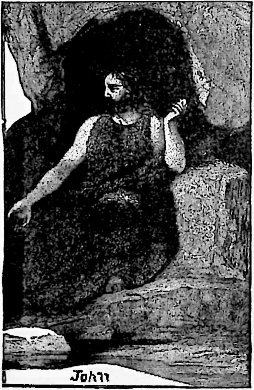
Such were a few of the coming men, at the period of John Baptist’s preaching.
Of the personal appearance of the new prophet, little is related. He doubtless took Elijah for his type. His hair hung long and loose over his massive shoulders, never having been cut from his birth.* His dress consisted chiefly of a burnouse of coarsely woven hair-cloth, made from the long hair of the camel, such as is still worn by the Bedouins of the country, as also such as was worn by Elijah. This was sus-pended from the shoulders very like a bag, and girded at the waist.
His food, we are told, was locusts and wild honey. The former are very plentiful in this same country, but are only eaten by the poorer Arabs. They were pronounced clean under the law—“ the locust and the bald locust, the beetle and the grasshopper.”—Lev. 11: 22. They are fried in butter and taste very like shrimp.—Nat Hist, of Bible, 308. T.
Leaving Nazareth and proceeding by the Samarian route described in Chap. 7, Jesus could reach the Jordan’s lower ford in four days. The place where John was baptizing was on the east side of the Jordan. The new version reads (J. 1: 28)—
“ In Bethany beyond Jordan where John was baptizing.” The most ancient MSS. read, " Bethabarah."
In John 10: 40, it is again definitely mentioned.
“John’s Baptism” (Acts 19: 3) was peculiar to himself, and approved by Jesus, as “ fulfilling all righteousness.”—Matt 3: 10.
John’s work was three-fold.—Acts 19: 4; Matt 3: 11;
John 1: 29-34.
To preach repentance and preparation.
To herald the coming of the Messiah.
To witness Him at His coming.
He was the Elijah of prophecy (Mal. 4: 5,6),and so recog-nized by Jesus and declared to His disciples. But John did not know it—John 1:21. They were descending Mt. Her* Elijah, however, was bald-headed.—Judges 16: 17, and 13 : 5, + Baptism. (See Smith'* Bible Diet.) mon, during the summer of A. D. 29, after the “vision," wherein Peter, James and John had seen Elijah, These disci-ples, in common with all Jews, knew that Elijah must come before the Messiah; nevertheless these three had just seen Elijah on the mount after Christ had long come and had been so acknowledged by them the day previous I This seemed a contradiction, at first, but Jesus soon set it to right—Matt 17: 8-13. .
On that occasion He acknowledged John as the Elijah.
" Have I not before told you ” (Matt. 11 : 14), said Jesus, “that he has come? I said, ‘This—John the Baptist—is Elijah.’ Again I repeat,' Elijah has already come, and the Jews knew him not’"
I doubt not but that flat piece of ground presented very much the same appearance as when the Israelites, under Joshua, encamped thereon. It must have been covered with tents of the pilgrims, far and near, who had come to listen to the new doctrine of the strange prophet John, and who, repenting and restoring, were baptized in the river Jordan.
Lastly came Jesus. • John looked upon Him.
" He knew Him not" (John i: 31),but recognizing in Him a dignity never before revealed by man, John hesitated.
" Nay,” said he, “ I should rather be baptized by you, and do you come to me to be baptized ? ”—Matt.
The First Words of Christ.
The answer records the first words of the man Jesus.
“ Suffer it now, for thus it becometh us to fulfil all' right-eousness.”—See Psalms 40: 7-8.
Here also Luke mentions Christ’s first prayer (3: 21).
Then was Jesus led down into the water, and baptized by John.
As they were walking up from the water, the sign from heaven, promised John (Gospel ofI John, 1: 33), appeared, informing him that this was indeed the SON OF GOD. This faith, which, after long imprisonment, once wavered, sup-ported the Baptist to the end of life's journey.
FORD OF JORDAN AND WATERING PLACE {By Pierce}.
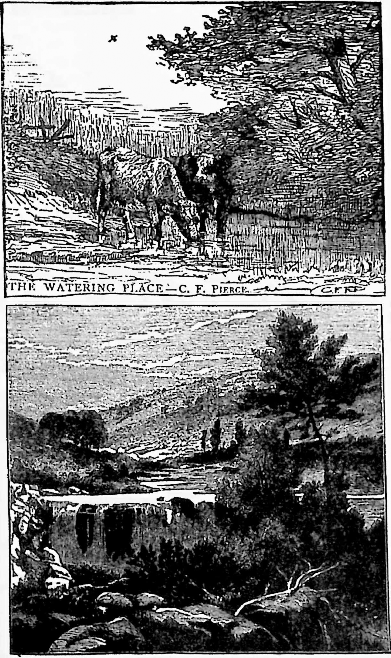
“A wooden cross stands in the Jordan on the spot where our Lord was baptized. The river here is about as broad as a man can throw a stone with a sling. A stone bridge raised on arches reaches from the (eastern) bank of the river to the cross, where pilgrims bathe. A little church stands at the brink of the water, on the spot where our Lord is said to have lain His clothes when entering the river. On the higher ground is a large monastery of monks, and a church dedi-cated to St John.” This was the condition of the place in the year A. D. 700. It was at the ford opposite Jericho, the place where the Israelites crossed, under Joshua.—Josh. 4 : 19; Arcuff, A. D. 700; Smith's Bib. Diet It seems that John commenced baptizing in mid-summer, when the waters of the Jordan were comparatively low at the ford, not being above three to five feet deep. In winter, fed by the heavy rains, and in spring by the melting snows of the north, the water would rise to eight or twelve feet, and, over-flowing its lower or summer banks (Josh. 3: 15), would be from ninety to one hundred feet in width.
It is believed that Jesus was baptized during the last of December, when the river was on the rise, and very soon after John would cease laboring here, as the water would be deep and dangerous. This condition would continue until May.
Dr. Thomson, who visited this spot on the first of April, says, “ I found barley harvest about Jericho ended. I also found the river full to the brim, and saw evidences in abund-ance that it had overflowed its banks very recently.”
Dense thickets of red tamarisks, stately sycamores with broad leaves, oaks massive and thick, acacias, willows and the flowering oleander, still cover the upper terrace (Geikie, 25), where, in the days of the Baptist, the graceful palms flour-ished, as in the days of the prophets.
Here the lion made his lair, as says Jeremiah—
“ He shall come up like a lion from the glory (palms) of Jordan.”
After His baptism, Jesus passed into the wilderness of Judea, where He remained fasting during “ forty days.” The phrase " forty days” is often used in Scripture for an indefinite period. Thus, " Isaac was forty years old when he married Rebekah, Esau was forty when he married, the flood was for forty days. Moses was forty when he fled from Egypt, he was forty years in the land of Midian, he was forty days in the Mount, he fell down before God forty days and forty nights, he was forty years in the wilderness. Were all these exact? So in Judges you read repeatedly that the land ‘ had rest forty years.’ David was forty years old when he began to reign. Absalom was forty when he arose against David. Elijah was forty days on his way to Horeb. Jonah cried out for forty days. Christ was forty days in the wilder-ness. The space between his resurrection and ascension was forty days. The use of figures in the Orient was different from ours—inconstant and uncertain. We, however, say, ‘ I have told you so a hundred times,’ meaning a good many.”
Beyond the time mentioned by Matthew we know abso-lutely nothing of either place or circumstance of the tempta-tions of Jesus.
The Evangelic narrative plunges us into an unfathomable mystery. " We find ourselves beyond our depth at the first step, and deep follows deep to the very end.”—Beecher.
It is supposed by some great minds, however, that these temptations of Jesus were similar to those through which other youth of ambition and promise may have passed before and since the days of our Lord. He could not be called “ our example ” unless He had passed them unscathed.
The baptism in the Jordan, the descent of the Holy Spirit in the semblance of the “heavenly dove” upon Him, and the voice of God acknowledging Him as his “beloved Son in whom he was well pleased,” at once elevated the humble vil-lage rabbi to the mysterious dignity of the Holy Son of God.
Was He not from this moment another person ?
Being now anointed by Jehovah and endowed with the Holy Spirit, and possessed of supernatural powers, “to go about relieving all who were oppressed by the Devil" according to Luke, in Acts 10: 38, it need not be supposed that Jesus Christ was very likely to himself fall before any temptation which that Devil might suggest.
This same authority, Luke (4: i),says that—
“Jesus, FULL of the Holy Spirit, returned from the Jordan and was led by the (this same) Spirit in the wilderness.”
There may be no doubt that His temptation was an actual experience; but as the Son of God fresh from his hands, and “ full of His Holy Spirit,” He could withstand any worldly temptation, and, also, by His example, “succor all who are like tempted.”
“ I need Thee every hour, Stay Thou near by; Temptations lose their power When Thou art nigh "
From the wilderness He went up to Jerusalem.
There are two evidences of this fact First, Matthew 4: 5.
Here we find Jesus sitting on the " Pinnacle,” that is, the “ wing " of the temple, overlooking the valley Kidron (R. V.)
Second, the deputation sent to John Baptist was from the Sanhedrin. That body was at Jerusalem. These sent were of that body, and to them John said—
“In the midst of you stands one (Christ) whom ye know not. whose shoe-latchets I am not worthy to unloose.”
He did not stand there, at Bethabara, but in Jerusalem, where. unknown and untrammelled, I believe, He overlooked the entire ground of His future operations.
After His last temptation, which was to abandon Jehovah’s work and become a worldly ruler, Jesus returned to the place where John was still baptizing. Was it Bethany or Bethabara? Bethany may mean “ ferry house,” according to Winer, but the reading of John indicates that the place was “ beyond Jordan "some distance (10:405. We prefer Bethabara, be-cause there is a Bethany near Jerusalem, of more importance, and we need not confound the two places.
The Baptist saw Jesus coming up from the ford (29). John’s “On the morrow” follows well after Matthew 4: 11, John taking up the narrative where Matthew omits its regular order. Therefore Christ’s struggles with ambition (the Devil) being ended, He had reached Bethabara on “the morrow," the second day from Jerusalem and Olivet, a distance of twenty-two to thirty-two miles. Some place it several miles beyond Jordan. It was during cool, and perhaps rainy, weather, being about the first of February.
Jesus, according to tradition, was baptized on or about the 25th of December (Luke 3 : 23). During the next forty days He was in the wilderness. Allowing a few days for His so-journ in Jerusalem, brings His return to Bethabara early in February. John and his disciples still tarried there. It was late in the day; Jesus may have been fatigued with His walk, and “ another morrow ” (35) came round before the introduc-tion of John, Andrew and Peter.
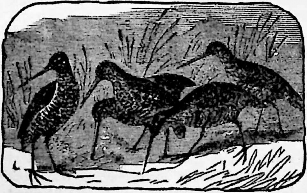
Chapter XII
John, Andrew and Peter Introduced
Time—Early in February, A. D. 27 or A. U. C. 780. PLACE—Near ford eart of Jordan, thence to Bethsaida,
Reference, John, the brother of James and son of Zebedee and Salome, we owe our knowledge of the interesting introduction of the first disciples of Jesus to their' Master. They were at Bethabara, over Jordan, having come from their homes in Bethsaida, at the extreme head of the Sea of Galilee.
James and John were brothers, as we said, as also were Andrew and Peter; the latter were sons of Jonas, of Bethsaida. These, with Zebedee, were fishermen of Galilee and in partnership. They seemed well-to-do, owning their own boats, large and small, nets and other fishing outfits, and some of them, at least, had hired assistants. Peter, afterward removing to Capernaum, owned a house there, supported a wife, who in later years travelled with him on his preaching missions, and also maintained his wife’s mother. It is supposed that John had a house in Jeru-salem,'to which he took Mary, the mother of Jesus, after the crucifixion. The first direct reference to James occurs four-teen months later. Though the same modesty which forbid John speaking of himself kept him from naming his brother James, some have thought that James was among the first disciples whom Jesus met at Bethabara.

The introduction to John and Andrew was as follows:
On the day previous to the introduction, the Baptist had been telling these his disciples of the certainty of Jesus being the promised Messiah. Now, seeing Him coming toward them, and about to walk past, John exclaimed:
"Behold! The Lamb of God! This is he of whom I spake.”
Then John and Andrew (verse 40) followed Jesus.
Hearing their footsteps, or seeing them, or hearing the Baptist's words, the most probable of the three, Jesus turned and looked at them, saying to them:
“ When seek ye ? "
“ Rabbi," they answered. (John was also called rabbi.) Here they at once acknowledged Him as their " Master.”
And they asked Him where He lived. John had not so much as learned that Jesus dwelt at Nazareth.
“ Come and see," was Jesus’ hospitable response.
So they followed Him to His place of “ abode,” showing that He had already some friends in that vicinity. Perhaps His mother and brethren were there, and all tented together. It was the rainy season, and they could not live out-doors. They became deeply interested in the conversation of their new Master, and Andrew, " first" of the two, went out and found his own brother Simon Peter, and, probably, next John’s brother James, all returning and passing the night with Jesus.
Through the remainder of the day and into the quiet watches of the night did the blessed Jesus open to their listening souls the message of the heavenly kingdom in which they were forever to take a part. Peter, of course, became en-thusiastic over the prospect, as on all occasions, and Jesus seemed also deeply impressed with the noble character of the fiery Galilean, saying to him:
“You are now only Simon, a fisherman. Hereafter you shall be called Peter. You are now only the son of Jonas; you shall be called the Son of God.”
Hospitality is mutual in the orient On the following day, Peter and the others having doubt-less urged the matter, Jesus consented to go with the Galilean fishermen to their home in Bethsaida.
“He was minded to go forth into Galilee,” are the exact words of John. If we bear in mind the fact that the word “Galilee” is used by John in distinction from Nazareth (which is also in Galilee), and is by him used in reference to the vicinity of the lake, we shall better understand him hereafter.
How many disciples did Jesus start with ? Four.
“The earliest traditions,” says Geikie,“ join his brother James with John as one of the very first disciples; ” therefore if so, James made the fourth who accompanied Jesus to their home in Bethsaida. They were all alike residents of this city, and all alike recalled, including James, a year later.
From the east side of Jordan, we have a new route to describe to Bethsaida. It is through the land called Perea to the lower end of the Sea of Galilee, thence by boat, fourteen miles, up the lake to Bethsaida, at its northeastern extremity.
The impetuosity of Peter would cause him to select the most direct route to the landing at the southern end of the Lake of Galilee. There is no road near the Jordan on the east, owing to the deep gorges and the high hills in that imme-diate vicinity. Neither is there a single city or village after leaving Bethabara till reaching Pella.
This is a city (now in ruins) situated on a hill three miles east of the Jordan opposite Beisam, on the west side. It is called Felah by the Arabs.
Since Jesus and the disciples were not on a missionary tour, only “ desiring to reach Bethsaida,” to which Jesus had made up his mind to go (43), they would not stop here, but hasten on, to a town at the foot of the lake, where there is a good boat-landing pn a pebbly beach, near Sumakh.
Sumakh has (at present) about 200 wretched huts packed together in the most uncomfortable manner possible. Their walls are daubed with mortar, and not a few of the houses threaten to crush the inhabitants beneath their ruins. This is supposed to mark the site of the ancient and famous city Hippos. Above this is a hill from which the disciples may have offered to Jesus His first view of the “ Sea of Galilee.”
At that period there were no less than ten cities bordering on this beautiful body of water. At the extreme head of the sea, east of Jordan, stood the city Bethsaida, formerly, as its name implies, a “ fish-house," but raised to the dignity of a city, by Philip II. Here he built a palace and otherwise adorned the place, naming it Bethsaida Julias, in honor of the emperor's daughter Julia. Westward, on an elevation, stood Chorazin, and southwest, three miles from Bethsaida, Caper-naum the proud city, " exalted to heaven,” but since, with all these others, “ thrown down and covered over." Next, south, on the west side of the sea, was Magdala, and more than half way down the coast the heathen city of Tiberias. This city was founded and built by Herod Antipas, during the advent of Christ, near the site of the old ruins of Tubarieh. Seventy years later, Josephus mentions it as a place of importance. When Vespasian and his son Titus destroyed all the other cities about the lake, they spared Tiberias, it being inhabited chiefly by Romans and Greeks. Probably Jesus never en-tered this city. John is the only Evangelist who mentions Tiberias.
Next, south of Tiberias, was ancient Hammath. In fact, it is believed that Tiberias encroaches upon the ruins of that old city.
THE WARM BATHS in this vicinity were very famous, and are still there. They contain minerals, as iron, salt and sulphuret of potassium, and are considered valuable for medical pur-poses.—Kitto's Bible Encyclopedia.
Directly opposite Tiberias, on the east side of the lake, stood the city of Gamala, upon a high hill resembling the hump of a camel, from which resemblance the place derives its name Gamala. It is eleven hundred and seventy feet above the lake. The city was nearly two miles in circumference, with a high tower in the centre. It was a walled and strong city, and some of the stones of which its temples, or palatial
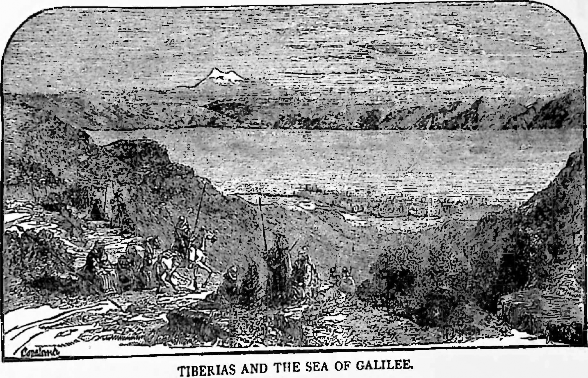
residences, were built, were quarried in Egypt An eminent traveler says, of these: " There must have been great wealth in this city, and roads and machinery. . . . The entire wealth and power of the present generation (of Syria) would be exhausted, and fail, in the attempt to carry one of these columns from Tiberias to the top of this ‘ camel’s hump,' and there are at least thirty of them, some of which are more than fourteen feet in length.” The whole city was considered impregnable, but Vespasian and Titus undermined its wall, and massacred its inhabitants —all Jews—forty-two years after the time when Jesus first looked upon it This city fell after six months' siege. Five thousand Jews perished by self-destruction. Fathers and hus-bands threw their children and wives over the walls, into the terrible abyss below, themselves following, and all perishing thus together, rather than to fall into the hands of the cruel Roman soldiers.—Josephus Wars.
On the east side of Jordan; at the foot of the lake, is a town called (at this day) Sumak, and below it, a fine pebbly beach, which would make a good landing-place. Opposite was the city of Taricha, the “ Pickling-place,” the great fish-curing and packing mart of the lake. Here these disciples, who were fishermen by occupation, would most likely have busi-ness connected with their trade, and here they may have left * their boat when going to Jerusalem, until their return home-ward. The Jordan is not navigable below this bridge, for a distance of over sixty miles to Jericho’s lower ford. Fish could only be conveyed so far, during winter, there being no ice in Palestine for packing in warm weather.
It was now winter, be it remembered.
This would, then, be the returning route—Bethabara to Taricha, by land sixty miles or more; where, embarking in the boat, they would, with a fair wind, reach Bethsaida at the northern extremity of the lake, a distance of less than fifteen miles, in a few hours.
All this is natural, easy and supportable.
Thus did Jesus commence those “Journeys” up and down the Lake of Galilee, of which we know that He took very many during His ministry. Of this mode of convey-ance He seemed very fond, and early in His Galilean min-istry we find Him requesting the disciples to place a boat at His disposal, which they did (Mark 3 : 9), and which, as “ the boat,” so remained to the end.
The references in Mark are as follows:
" Let us go over the other side,” He said.—4 : 35. "And he crossed over again in the boat"—5 : 21. “And they went in the boat.”—6: 32, also 45.
“ Crossed over, and came to the land.”—5 : 53. " He entered the boat.”—10: 10.
“ He again entered the boat.”—10: 13.
AN EXTRAORDINARY FISH 1 Among the many varieties of fish found in the Sea of Galilee is a species which incubates its young in the cavities of the head!" What is still more remarkable, the male performs this part of the family office. The female deposits her eggs in the sand at the bottom of the sea, immediately after which the male absorbs them into his gills, where they are kept safe between the leaves of his respiratory organs until hatched. During this time of incu-bation the head of the fish assumes extraordinary dimensions until relieved by the departure of the little fishes. It is said that as many as two hundred are thus hatched at one time.
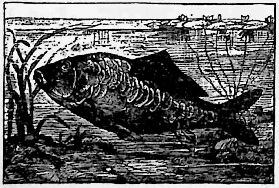
Chapter XIII
A Joyous Journey
Time—February and March, A. D. 27. 780. Place—Bethsaida to Cana. About twenty-one miles. Jesus and his disci-ples started on Monday morning. •
what length of time Jesus re- ---------------------------mained in Bethsaida, the guest of the brothers, Andrew and Peter. Long enough, how-ever, for Jesus to 0 find,” for Himself, another disciple. This was Philip.
The text is concise. "And He findeth Philip.”
Did this imply a previous seeking?
Philip, however, was anxious for Jesus to see Nathanael, after his own happy call from the Master to follow Him.
Here we have five disciples who lived in Bethsaida. James is not spoken of by the modest John, but there is no doubt that James was with the others here at this time.
With these disciples, Jesus went to Cana of Galilee. The distance was about twenty-one miles.
THE ROUTE. •
Leaving Bethsaida, early in the morning, as was the custom of all Eastern travellers, the party would cross the Jordan either by boat or the "Jacob’s bridge.” It is presumed that they would go by water to Magdala, since it would be the shorter route, and Peter owned a good boat* There is a good mooring place at Magdala.
* This boat will be shown further along. It was a large boat, and carried a lug-sail.

Capernaum would be passed on the right hand, four miles or more northward from Magdala.
This was the home of that Mary* out of whom Jesus, early in His healings, "cast seven demons.”
Magdala was probably a small village at the time. Matthew first mentions it (15 : 39), on which occasion he says that—
“Jesus entered into the boat and came to the borders of Magdala,” as we have no doubt He did on this occasion.
" THE boat" implies His accustomed boat, or accustomed means of conveyance.
Magdala means " Tower.”
The village lies near the water, about half way between Capernaum and Tiberias. At present it is a wretched hamlet of a dozen low huts, huddled into one, and the whole ready to tumble into a dismal heap of black basaltic rubbish (Land and Book). Yet some of the inhabitants are farmers, for the fields about here, through which Jesus and his disci-ples must needs pass—by a mere donkey path—“ are covered in large expanse of luxuriant barley and wheat,” called “ corn ” in the Gospels. We shall accept these as the very fields where the disciples, a year later, plucked the ears of “ corn,” rubbing them in the palms of their hands.
Turning westward, gradually ascending from the plain, we have a magnificent view of the towns below, the glossy lake beyond, and across the sea, the villages on the eastern shore, their white, limestone houses brought out conspicuously by the dark back-ground of hills and mountains, rising one above another to the very clouds of heaven.
Pursuing our journey we pass the base of the hills on the right, and enter the great gorge of the Wady Haman.
" It is truly a most surprising gorge; the precipices are a thousand feet in height, in some parts of it, from which have fallen immense blocks of stone into the brook of fine, cool water at the bottom.”—Dr. Wilson.
“ This place is called Haman, from the clouds of pigeons which 1 flock to their windows ‘ in these perforated rocks.
* See MARY MACDALENK.
“These perpendicular walls are perforated by multitudes of caverns, holes and narrow passages, the chosen resort of numerous robbers in former days.
“The walls and fortifications which united these caverns and defended them in case of attack are still visible.”—Land and Book.
In Part Second of this work, under the caption of “ Herod the Great,” will be found an interesting account of the man-ner in which this fierce young Roman general finally suc-ceeded in capturing these robbers.
Josephus gives an important description of the mode of capturing these robbers, by Herod the Great; therefore it was but a few years before this passage of Jesus and His few dis-ciples, that these rocks were made “ a den of robbers.” This wady, therefore, was a great thoroughfare.
” This is indeed a fatiguing ascent, but now we have gained the summit, what a beautiful plain spreads out to the south and west! and those cone-like hills (to the south) must be the * Horns of Huttin.’ ”
" Yes, and at the base on the north is the village of the same name—Huttin. It is three miles distant, and our path lies through it”
Mount Huttin is believed to have been the place of the celebrated discourse of Jesus, called the “ Sermon on the Mount,” and the village near is where He healed the leper. This little village of Huttin (or Hattin) is quite hedged in by immense cactus plants, some of which grow to extraordinary height “ In fact the cactus hedges form impenetrable ram-parts around many of these villages in Galilee, which neither man nor beast can scale, and which fire cannot consume.”
Some travellers are so sure that yonder mountain is the spot on which Jesus “sat" (Matt 5: 1) in delivering “His great sermon,” that they will pay a large fee to guides to show them “ the very stone on which He stood." Dr. Thomson says, in referring to this feet—
“ When I first visited here, I Was taken to the very stone upon which the Great Teacher is said to have stood. It lies on the southeastern slope of the second horn.”
» Historically, the Crusaders in 1187 A. D. were here de-feated with great slaughter by the great Saladin.—Dr. Kitto.
There can be no question but that Jesus passed and re-passed this mountain and village of Huttin very many times during His ministry, and that all these surroundings were very familiar to His blessed eyes. These have changed very little since then.
Between this place and Nazareth is a site called Kerf-Kanna, which has been mistaken for the real " Cana of Galilee,” where Jesus was now going. The latter, however, lies on the north of the plain of Battauf, some ten or more miles north of Nazareth, with a high range of mountains between. “ Dr. Robinson has about settled the question in its favor as the true site of the first miracle (of our Saviour) recorded in the second chapter of John.”
1 Cana of Galilee is situated on the slope of a hill above this beautiful green plain of Battauf. It is now uninhabited. On the road, easterly a short distance, we have passed the tradi-tional site of the “ Tomb of Jonah." South, on a hill behind Nazareth, stands a tomb of some Mohammedan saint, and westerly, a bit, the ruins of the once prosperous and beautiful city of Sepphoris. Early in Christ’s time it was the pride of the Roman governor and a pretty and lively city. It is but two or three miles from Cana, and but little farther from Nazareth, but the road from there did not pass through Nazareth.
CANA means a "place of reeds," derived from the reeds which doubtless grew in great abundance in this plain below. Not so Kerf-Kanna I The remains of limestone huts indicate the former once a thriving village.
“ Not a living soul, not even a dog, was there to give a sound; . . . only flies held their marriage rejoicings in the sunshine” (Sepp, 2106), while jackals find haunts in her de-serted streets, and wild boars and leopards hide in the jungles of oak and coppice in the hills and wadys around.—Dr. Thomson.
How different in Christ’s day, when all was “ gay as a mar-riage bell I"
Here arrived not only Jesus and His four or five disciples from Bethsaida—at evening—but also His mother and brothers, perhaps sisters, from Nazareth. Did not these first arrive before Him ?
Here, evidently, Jesus met Nathanael. Philip went to find him (John i: 45 and 48).
Nathanael was sitting, reading, under his fig-tree. He went to meet Philip (verse 48).
“ I have found Him of whom Moses in the law and the Prophets did write and speak,” said Philip.
“ Who is he ? ” Nathanael was incredulous at first. " Jesus of Nazareth, a son of Joseph."
“ Nazareth! Can ahy good thing come out of her ?”
Nathanael lived within, at least, ten miles of that city, and had never heard of any great thing done, or of any great man living so near him. “ Can it be possible that He, of whom Moses and the prophets spake, lives there ? "
This was Nathanael’s idea; not, as some suppose, that Nazareth was a bad place! Far from it 1 There is no intima-tion that Nathanael thought it so; he merely expressed his astonishment that the Messiah should have lived there, the son of Joseph, a well-known carpenter, and he never have heard of Him I Hence, Nathanael said, " Can these things be?”
“ Come and see," was Philip's laconic reply. Come and be convinced, as I have been.
So Nathanael went, with Philip, to see Jesus.
Seeing Nathanael approaching, Jesus said to the others—“ Behold! an Israelite, indeed, in whom is no guile.”
“ How do you know me ? " exclaimed Nathanael, in great surprise. He never had seen Jesus before, it seems.
Then Jesus reminded him of where he sat, under his fig-tree, and, probably, of what he was doing, and what his con-versation was with Philip afterward.
“ Master," cried Nathanael, “ thou art the Son of God | Thou art King of Israel."
And Jesus replied to him. * 148 RAPID TRAVELLING. • “ You believe because I said that I saw you under the fig-tree" (evidently a spiritual sight). “You shall see greater things than these.”
" On the third day there was a marriage in Cana of Galilee.” To those who say “this means the third day after (and including the day of) His departure from the Jordan ” (John 1: 43), we would call attention to the great distance from Bethabara to Cana, the wet and muddy travelling, and the lack of modern facilities for rapid transit.
From Bethabara to the lake is 60 miles.
From the foot of the lake to Bethsaida, 15 miles.
From Bethsaida to Magdala, 8 miles. • From Magdala to Cana direct, 13 miles.
If they went to Nazareth to take Mary in their company (verse 3), as is probable, that would add ten miles more, mak-ing a distance of 108 miles to travel on foot, and by boat, at an inclement season of the year, with swollen rivers to pass and muddy highways to labor over, all to be accomplished in two days—the wedding being on the third—beside the sev-eral necessary delays in making proselytes and resting and refreshing. This was next to impossible, calling for rather more rapid travelling than was customary among Eastern people.
.Evidently the “ three days ” must be reckoned from leaving Bethsaida. It is not impossible that Nathanael was found at Bethsaida, and went with Jesus and the five disciples to Cana. At least Nathanael was instrumental in bringing them to Cana. Philip desired the meeting of Jesus and Nathanael.
THE THIRD DAY OF THE WEEK was fixed by the rabbis for the marriage of a virgin. Widows remarried on Friday.—. Talmud; Sepp. .
Naturally Jesus would rest over Sabbath at Bethsaida.
On the first day of the week Jesus and His disciples would start for Cana, where they could easily arrive at evening. This is one day. The second was devoted to Nathanael and his friends, and the “ third day ” was the commencement of the marriage feast This probably lasted the week out
ORIENTAL WEDDING FESTIVITIES
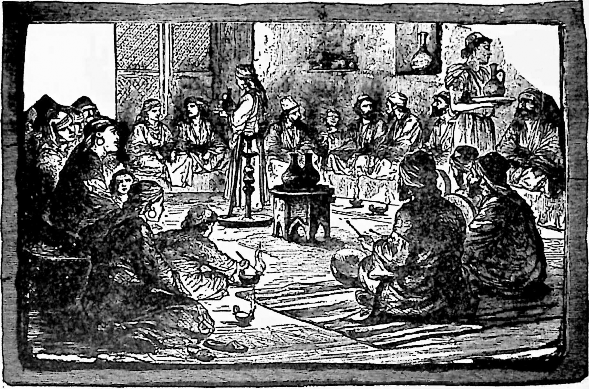
Observe the order of John.
Mary was there (v. 1). Does he mean already there ? Jesus was bidden—specially invited (2).
And also the six disciples (2).
Mary was there, Jesus and His disciples came last, and were perhaps unexpected. That is why the wine fell short! The arrival of seven guests whom the ruler of the feast did not expect (v. 9). At least Mary held her son responsible for the failure in the wine (3).
Whether she was related to the bride is unknown. There is no evidence that she was. Jesus came here to see Nathan-ael. He was worthy the trouble. He took His mother en route, and His disciples accompanied Him. In honor they were all invited to this wedding. Nothing is more evident. Nothing easier!
A wedding in the East was always made the occasion of great rejoicing with all concerned. “ He who hath the bride is the bridegroom." He necessarily rejoiceth. "But the friends of the bridegroom who stand and hear him, rejoice greatly also when they hear his voice.” Jesus soon afterward used this as an illustration (Matt. 9: 15). The words refer to the meeting of the bride, veiled from head to feet, at the hour of night, and well accompanied by maidens with lamps, who conducted her to the house of the bridegroom’s father, who usually gave the feast (Matt. 22: 2). It was not unusual for the groom with his friends, " sons of the bride-chamber,” with torches, and instruments, singing and " rejoicing,” to set out and meet the bride and maidens on the way.
Sometimes these festivities continued seven days, if the bridegroom, or his father, was wealthy enough to so prolong it In this case the bridegroom furnished the means (v. 9,10), and it was a very large company, as the consumption of wine would indicate. “ The feast consisted of baked meats, bread, fruit and wine in abundance, accompanied by music and dan-ing.”
At this wedding, however, the wine failed before the end of the feast. It was not because the bridegroom was poor. He had “ servants ” of his own, a steward (v. 9), and at the door stood the “six water-pots of stone;" holding three pails apiece—ordinarily used for bathing purposes—or, in all, hold-ing about 125 gallons.
To have been deficient in so necessary an article as wine would have been very mortifying to the bride and groom. “ They would have felt it a bitter and indelible disgrace ” (Farrar). They seemed not to have known it, however.
It is not clear why Mary should have gone to Jesus with a complaint of this misfortune. So she did, and perhaps His language to her indicated that it was scarcely His place to remedy the deficiency.
“ What have I to do with thee ? ” (it ?) He asked.
" Whatsoever He orders, that do,” she answered—to the servants.
He ordered the six water-pots filled with water I “ Now draw out and bear it to the steward ” (8). “And,” says John, “ the water had become wine" Very simple I Thus did Jesus honor the institution of marriage.
“The household was His first temple, the opening of a wedded life engaged His first sympathy, and the promotion of social and domestic happiness was the inspiration of His first miracle."—Beecher.
“After this," this one act, says John, “ He, His mother, brethren and disciples, went down to Capernaum." John usu-ally says, “ after these things." Now his language, “ after this,” implies that Jesus did nothing else in the line of mira-cles, or teaching, till after He went to Capernaum, “ and there He (they) abode not many days,” but soon went to Jerusalem to the passover (12).
This was in April. Where had they passed the intervening time, perhaps four or six weeks ?
Probably at Nazareth.
They went from Cana to Nazareth, and there took in com-pany “ His brethren " (v. 12). We must rely upon the exact-ness of John’s word; he says:
“ He went down to Capernaum."
Cana was in the highlands of Galilee; Capernaum lay 682 feet below the Mediterranean. So, in all this narrative, which many a " moralizing philosopher, who despises pleasure,” would gladly expunge from the Gospel, if he could!—" It is a mis-take; Jesus did not attend a wedding, as such; He did not participate in its gladness; it was notwine at all that He made. John is too lenient in his gospel; we must not stick too close to John! Oh, no 1 ”
As for me, I am glad that John did record the bright side of Christ’s early life. It was brief enough, at best The dark days came too soon !
Peter and the others had to go home to Bethsaida, and prepare for the journey to Jerusalem; involving an absence of some fourteen days.
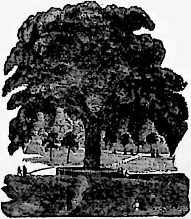
Chapter XIV
A Journey to Jerusalem
First Passover
TIME.—April II-18, A. D. 27, or A. U. C. 780.
PLACE.—Capernaum to Jerusalem.
RULERS—Pontius Pilate, Governor of Judea, residence at Cesares, on the Mediterranean, with a Palace also in Jerusalem. Herod Antipas, Governor (“lung”) .of Galilee. Philip II. of upper Palestine, with Palaces at Bethsaida and Cesarea Philippi, thirty miles northward.
Reference
are totally John 2: 13 to 3: ar. silent respecting this visit----------------of Jesus to the passover, as they are to all subsequent feasts, except the very last pass-over. While John, “ true to the, purpose and characV teristics of his Gospel,” mentions, or particularly de-' scribes, them all.
These are the Feasts which John names:—
Passover, April, A. D. 27; John 2: 13.
Passover (?), April, A. D. 28; John 5 : I.
Passover, April, A. D, 29; John 6: 4.* Tabernacles, October, A. D. 29; John 7: 2, 10.
Dedication, December, A. D. 29; John 10: 22.
Passover, April, A. D. 30; John 13: J, also Matthew, Mark and Luke.
Let us keep in remembrance the fact that John wrote his Gospel last, and after the fall of Jerusalem and the fulfilment # Jesus did not attend
of Christ’s prophecies, and until that time we have no record of anything which Jesus did in His ministry in or about Jerusalem, excepting during the week of the crucifixion and what followed. We cannot account for so remarkable an omission, especially by Luke, the Greek scholar, who claimed to have " traced the course of all things accurately from the first, (and) to write them in order,” to his “ excellent friend Theophilus.”
Therefore for the record of the whole Judean ministry we may thank John.
After a “ few days’ abode in Capernaum,” Jesus, His mother, brothers and six disciples, * went to Jerusalem to attend the passover. '
Probably, as Farrar suggests, they here joined the great caravan of pilgrims going to this same feast They came down from the north and east, past Bethsaida, crossed the Jordan on a sand-bar—ford—at its entrance into the upper end of the lake, and thence to Capernaum. The old Roman road then led down across Jacob’s bridge, thence to Chorazin and Capernaum. Great concourses of pilgrims went past Bethsaida, as we may learn from John 6: 4, on the next pass-over, when Jesus was in that vicinity, at the time of feeding the 5,000; when "Jesus lifted up His eyes and saw a great multitude.” Those were pilgrims, en route to Jerusalem, who stopped over a while to see and hear Jesus.
What a story they carried to Jerusalem I Since Jesus and His family and friends joined the caravan, as is supposed, the boat was left at Capernaum, and they went on foot to Jerusalem. Their route would lie along the lake shore to Magdala, the home of MARY MAGDALENE.
Let us stop a moment to inquire for her.
As yet Jesus had not begun His ministry in Galilee, and ex-cept the one at Cana (John 4: 54) He had performed no miracle in the country, therefore Mary was not yet cured. We need not doubt that at the very hour of Jesus’ passing this ♦W e count Peter and Andrew, James and John, and Philip and Nathanael—that is, Bartholomew.—Bible Die., Smith; Kitto, Bible Encyc. town she lay a bound and raving maniac. We shall refer to her cure in its order.
On leaving Magdala, there were two routes to choose be-tween. One, already described, led over the hills to Nazareth. They did not go that route, since Mary and her sons (2: 12) had already come down to Capernaum to accompany Jesus to the passover (verses 12, 13).
The other route lay southward past Tiberias. Jesus, it is believed, never entered this heathen city. It lay on the sea-shore below them, as they passed. It was the capital city of Herod, and the finest on the lake, yet would illy compare with one of the old cities of the Rhine.
Tiberias was to the Jews an " unclean city,” having been built, in part, upon "the city of the dead” (so Josephus), as the exposed tombs of the present period demonstrate.
"The people who owned that cemetery had totally disap-peared before Herod founded Tiberias on its ruins.” Here he erected walls, and houses within them, and a magnificent palace, adorning it according to Roman tastes with carved images of animals and birds and heathen gods and heroes, which were abominations to the Hebrews. The city contained an amphitheatre, and other buildings of immense size and wealth, as the ruins, which strew the shore, bear witness. These consist of huge " Grecian colonnades, granite columns, marble statues, blocks of costly marble, porphyry and syenite, the wreck of the splendid villas ” of the " lords and high-cap-tains ” of the king's court in the days of Herod, when no heathen luxury had been wanting.—Geikie.
The work on this city was commenced about the year A. D. 16, and completed in the year A. D. 22. Before it was done, Antipas had obtained a large population for it, either by bribery, the gift of houses, force, or lastly, when these failed, by buying slaves and making of them citizens for his new capital.—See Josephus.
And this was the condition of Tiberias when Jesus and his family and disciples passed it on this April day, A. D. 27. The present city is surrounded by a wall, with ten round. strong towers on the west, seen from the hills above; five on the north and eight on the south. The city is about one hun-dred rods on the lake front and forty deep.
Its present population, mostly Jews, is about 3,000.
It is six miles from Tiberias to the outgoing of the Jordan.
On the west side, at the outlet, is the ruins of an old city, named Taricha, “the pickling city.” The Arabs call it Terak.
There are evidences hereabouts that the lake was once some twenty feet higher than now. The river formed an island, on which this ancient city stood.
TERAK offers a good harbor, and during the Roman-Jewish
A GOOD HARBOR
wars was an important naval station. Josephus tells us that here were gathered two hundred and thirty “ ships," prepara-tory to an attack on the city of Tiberias.—Jewish Wars.
THE JORDAN, here at its outlet, is rapid, shoal and rocky.
Besides it is partially choked up by rubbish, trees and the ruins of an old bridge. Just below is an excellent ford. The river' is but a little more than a hundred feet in width, and only three feet in depth, except in winter and spring.
' SUMAK, once ancient Hippos, lies just to the east of the Jordan. The beach is quite fine, and strewn with shells and beautiful pebbles of agate, chalcedony and flint, specimens of which may be seen in my cabinet
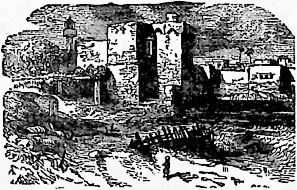
This out-going of the Jordan, in the lifetime of our Lord, teemed with life and business. The bridge was thronged with travellers and merchantmen, crossing and recrossing, laden asses and camels, horses and war-chariots, from the great East, from Jerusalem, and up and down the shores of the lake, and away to the Great Sea and Egypt, while the lake was alive with vessels, pleasure yachts and fishing boats, all pre-senting a scene of great activity and prosperity.
OUT GOING OF THE JORDAN
Present ruins indicate the existence of other and unknown cities farther down the river.—Lynch, Robinson.
Seven miles below the first is another bridge called "Tisr-el-Mujamia." .
The Jordan is very crooked throughout • “ In all her length, far winding lay, With promontory, creek and bay, And islands that, empurpled bright. Floated amid the lovelier light;
And mountains that like giants stand To sentinel enchanted land.'* Several rivers, worthy of the name, fall into the Jordan, below Terak.
The largest of these rivers is the Jermuk on the east, and the Sharar and Jalud on the west These are bridged.
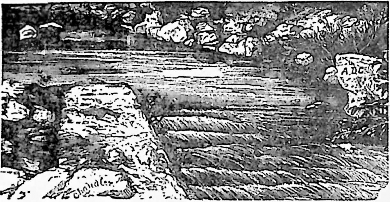
“ HOUSE OF REST."—A BIT OF HISTORY. 169 “ HOUSE OF REST.” Such is the meaning of the name of the largest place on the river Jordan. It was named Beth-shean in the days’ of Joshua, afterward called Scythopolis, B. C. 631, and lastly, Beisan. It lies on ascending ground, two miles from the Jordan, west, eighteen miles from the lake, and on the old road from Damascus to the south and west Its ruins cover some three miles, showing it to have been a large city.
In history it is famous. It was assigned to the tribe of Manasseh; who never was able to conquer it On her walls • the Philistines hung the headless body of King Saul, which was rescued in the night by the brave men from Jabesh-Gilead. . This latter city stood upon the mountain heights, over the Jordan,' in full view of Bethshean, and the rescuers could creep up the banks of the river Jalud, whose deafening roar drowned all sound of their approach. These Jabeshites owed Saul a debt of gratitude for his saving each of them an eye, which may account for this rescue of his body. Nahash had demanded the surrender of the city, and an eye from every male inhabitant—to unfit him thereafter for military services. They agreed to this, with seven days for ratification of the treaty. Meantime Saul collected an army and hastened to their relief. Forty years later, these Jabeshites rescued the bodies of Saul and his three sons, which they carried to Jabesh-Gilead, and there cremated.
The city of Bethshean originally occupied several hills divided by deep ravines, spanned by high bridges, under which flowed “ noisy cascades," leaping over ledges of black basalt. I have seen no city except Damascus so abundantly supplied with water. The ruins of a large amphitheatre are easily traced out in the lower part of the city. It was one hundred and thirty-nine feet in circumference in the circle, and the dens for wild animals on either side of the grand entrances are yet nearly perfect and are used for stables.—L & B.
From this interesting city, the great highway led directly westward up the valley of Esdraelon, or, turning southwesterly, it branched off, to the south of Gilboa and En-Gannim, to Dothan.
In the bright, spring month of April, everything is fresh and fair through these valleys and about these mountains. The hill-sides are clothed in living green with oak and cypress, cedars and palms; the valleys are resplendent in flowers, roses red, marigolds yellow, and tulips gay; the fields are rich in flowing grain, “ white for the harvest,” for it is not only the “flowery month," but the "earing month,” also; while vine-yards, orchards and gardens abound in luscious grapes, groves of olives, figs, almonds and pomegranates, and gardens of orange, lemon, citron and small fruits, and vegetables fit for a king’s table.
By the pathway grow wild flowers in great profusion, from the humble " hyssop that springs out of the wall ” (i K. 4: 33), to the royal oleander which adorns every water-course through this prolific vale.
What a marvellous history has this highway I We can hardly touch upon its story as we pass on.
The armies of Joshua have filed over this same route. Those Ishmaelites passed over it before reaching Dothan, where they purchased Joseph from his jealous brethren. Ahab and Joram led their mighty hosts up and down it Jehu rode pell-mell up this way to Jezreel, to usurp the kingdom of his master. Saul, Jonathan and David have ridden over it con-querors, and fled over it again vanquished. Elijah and Elisha have wandered about this interesting vicinity. Terrible tramps were they I Did they ever "abide" anywhere? We read of them everywhere up and down Palestine; now at Damascus at the north, now at Beersheba at the extreme south; now at Mount Carmel overlooking the Mediterranean sea, down on the sea-shore at Sarepta, and away to the east, at Jericho, at Moab, at Bethel.
Alexander, Vespasian and Titus have also marshalled thier mighty hosts along this route.
We leave the great valley, Jezreel, Mt Gilboa, Shunem and En-Gannim on the right hand, and pass down to Dothan.
This is the point at which we arrived on the first journey from Nazareth to Jerusalem, and the remainder of the route from here to the holy city may require no further description.
As then, the way is crowded with pilgrims, with asses, beasts of burden, oxen, and sheep in immense flocks, all pressing on toward Jerusalem to attend the Passover.
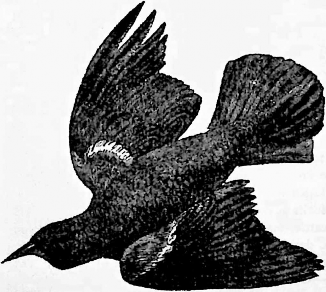
Chapter XV
The First Passover
Time—Jerusalem. Place—Tiberius Cssar, emperor at Rome; Pontius Pilate, governor of Judea; Herod Antipas, tetrarch (king) of Galilee.
And Jesus went up to Jerusalem.
References
John a: 13.
Here He began His ministry by purifying the temple, while His (6) disciples stood by as witnesses. This occurred three months after His baptism.
Pilgrims from the north entered at Damascus gate. The ' streets were crowded already with people from every land, with asses laden with crates of doves, bulging out on each side, great flocks of sheep with their noisy shepherds, immense droves of cattle, maddened with heat, dust, thirst and the lash of hired drovers; “ sellers of wares besetting pilgrims to buy, for the great feasts were the harvest time of all trades at Jerusalem.”—Geikie’s Life of Christ.
The temple presented a scene of greater confusion. Traders and money-changers, who had long been established from the eastern gate (Shusan) to Solomon’s Portico, had gradually crowded upon the temple itself, until that portion of it called the “ Court of the Gentilest (heathens, not Jews) had become almost as noisome as the streets.
* Friedlieb, Andrews, Geikle. f Greswell says sixty-four days, Friedlieb eighty-seven. See Andrews. t Farrar.—Into this court during the feasts, any one could enter unchallenged, heathens, cripples, beggars, any but Uptri.
. (162)

Here in the very “courts of the Most High,” in the “Tem-ple of the Living God," Jesus beheld a sight which aroused His utmost indignation, and called for immediate abatement In the broad arcades were crowded pens of sheep and goats, and stalls of oxen, and between the quadruple lines of tall
DAMASCUS GATE, JERUSALEM
Corinthian columns were piled the cages of doves for the sacrifices, and along the line of aisles sat the money-changers at their “ benches.” ♦ “ We learn from the Talmud, that a certain Babha Ben Buta had been the first to introduce ‘ 3,000 sheep of the Rocks * “ Benches,” long enough for a man to sit upon and pile his coins at his side. Hence s Bank.” If a man was dishonest, or could not meet his obligation, his bench was broken up—hence “ broken bank," and he precluded from doing further business.
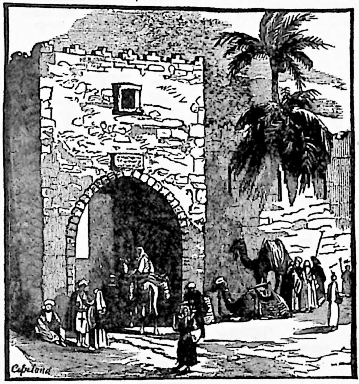
of Kedar' into this court of the Gentiles, and, therefore, within the consecrated precincts. This profane example was eagerly followed until here, in the holy temple, steaming under the heat of the burning April day (equal to our July) and fill-ing the temple with stench and filth ’’ (Farrar), were penned thousands of sheep, hundreds of oxen, and pigeons and doves without number, bleating, bellowing and cooing, while seller shouted to pilgrim and pilgrim to seller, in every namable
POTTER AND HIS WHEEL
tongue, Hebrew, Greek, Aramaic, Coptic and Roman, all combining the filth of the Augean stables, the den of robbers of the Haman caves, and the confusion of Babel.
" Nor was this all. Potters pressed on the pilgrims their clay vessels and ovens for cooking the passover lamb, and hundreds of traders recommended their wares aloud, wine, oil, herbs, salt and vinegar, and everything else needed for sacri-fice, while money-changers, giving out the lawful half shekel
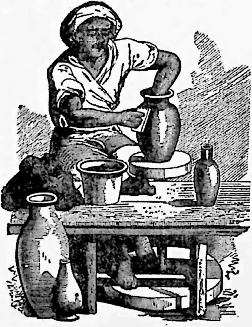
in exchange for heathen coin* which could not be received for temple-tax, or treasury gifts, bickered and wrangled in their dishonest trades, while their eyes twinkled with the lust of gain just as we see them at the present day.”
Such was the scene upon which Jesus looked. His disci-ples also.
What a Herculean task to cast all these out 1 Yet He did it. First—
He made a scourge (whip) of cords and drove out of the temple the sheep and the oxen.
He poured out the changer’s money. He overthrew (break) their benches. To the dove-sellers, He said, “ Take these hence. Make not my Father’s house a house of merchandise.”
What a scene of commotion and excitement followed I The drovers fled with their cattle!
The shepherds with their sheep I The greedy money-changers scrambled on the stone floor, searching for their scattered coins.
The sellers of doves hastened to obey Him, “ who spoke as one having authority, and as never before man spake." None thought of resisting. Beside, there behind Him stood six stalwart Galileans, ready to aid Him if necessary! Did they ever aid Him ?
The Jews stood amazed 1 + By what authority did this Man order away these things ?
What sign could He show for it?
This -was Jesus’ first conflict with the Jewish powers.
Since the chief sacrifice was offered on the evening of the first day of the feast, it is probable that the clearing of the temple took place early on that day (Lev. 23: 5).—Andrews.
Jesus remained in and about the city during the week of the feast, “and many believed on His name, beholding the signs which He did.” What these were we can never know. John #Coin strung, with hold in it, with devices of heathen gods, brass coin, etc.
+ Probably members of the Council-Sanhedrim, again refers to them (4: 45), saying, “ The Galileans received Him (on His return to Galilee), having seen the signs that He did in Jerusalem at the feast”
These “ signs,” whatever they were, attracted the attention of no less a man than NICODEMUS. This man bore a Greek name; was a Pharisee in sentiment and party, and a member of the Council.
He came to Jesus by night At Bethany, perhaps, for we do not know how early in His ministry Jesus made the ac-quaintance of those friends, Lazarus, Mary and Martha, but evidently very early. ’
Long and deep and earnest was that night’s conversation, respecting the new kingdom, between Jesus, the new teacher, and Nicodemus, a trustee in the old dispensation. To have gone over the ground, briefly laid out by John (3: 1-21), in the various arguments of the Saviour, in answering and ex-pounding the questions of the believer in Abraham’s seed, must have required the whole of the night—Night of Nico-demus. • We are led to understand that with the departure of the multitude from Jerusalem, at the close of the feast, Jesus and His six disciples also left the city for a tour through Judea (verse 22).
The phrase, the “ land of Judaea,” is understood as distin-guished from its chief city. He went "with his disciples” into the country of Judea (John 3: 22).
“ He tarried there with them,” His six disciples (22).
“ He there preached the word of good tidings of peace to the children of Israel ” (Acts 10: 36, 37).
" He published it throughout all Judea ” (verse 37).
It was the same preaching and baptism as John's (37).
It is in entire distinction from what He did while in Jeru-salem.
"And we,” says Peter, one of the six, “ are witnesses of all things which He did both in the country of the Jews and in Jerusalem.” This, Peter was afterward explaining, in that very “ country of Judea,”—Joppa—Caesarea.
This tour, therefore, we see, embraced the whole territory of Judea, ending at the borders of Samaria, for be it remem-bered at the close of this tour we find Him so near this latter country that “ He must needs pass through Samaria” (John 4: 4).
Judea: Its Extent.
This district extended from Jerusalem southward through Hebron to Beersheba; westward to Gerar and Gaza; thence northward on the coast of the Mediterranean sea, embracing the cities of Askelori—where Samson, in the " spirit of the Lord” (judges 14: 19), slew thirty men, in order to obtain thirty changes of linen with which to pay the expounders of his riddle—Migdal-gad, Ashdod (Azotus), Joppa.
JOPPA has always been a place of importance. It became the port of entry to Jerusalem in Solomon’s days, and is such
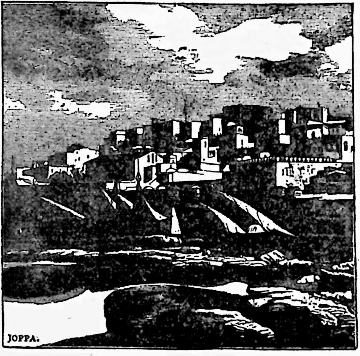
at this period, under the name of Jaffa. It is one of the oldest cities in the world. Jonah here " took ship for Tarshish,” but returned by the far more novel conveyance of a fish's maw. Here dwelt Simon the tanner, by the sea-side, and Peter was his guest (Acts 10: 32). Dorcas lived here, died and lived again.
Jaffa at present contains some 20,000 inhabitants. Its prin-cipal trade is in corn, fruit, silk and Eastern manufactured articles. It is the convenient landing-place for pilgrims to the Holy Land.
Jaffa has long been celebrated for her gardens and orchards of delicious fruit In March and April these gardens are in-deed enchanting. The air is laden with the mingled spicery of apple, apricot, lemon, orange, quince, plum and china trees in blossom.* Of course these are in the suburbs.
The one principal street of Jaffa presents to the eye of a stranger a most wonderful scene. It is continually crowded with people from every nation under the sun. Here are the Turk, the Arab and the Egyptian; the Frenchman, the Eng-lishman and the American; you may even discern among the wild jargon of the thoroughfare the gibberish of the Chinese and the brogue of the Irishman. These are promiscuously intermingled with horses, mules, camels, dogs and donkeys, equalled only in Constantinople.
Without the city walls the scene is equally strange. Jaffa is the paradise of beggars from all over Syria and Arabia; even from Egypt they come to attack the gentle pilgrim as he first lands, flush and unsophisticated, to do the Land of promise.
These, says Dr. Thomson, “ are noisy, quarrelsome, ragged and filthy.” Many are blind and some are leprous. The peasants hereabouts must be very poor, to judge by their rags and squalid appearance.
“ Simon the tanner ” must have lived outside the city walls.
. * Land and Book, p. 519; alo " Climate " in Part Second of this Book.
RAMLEH
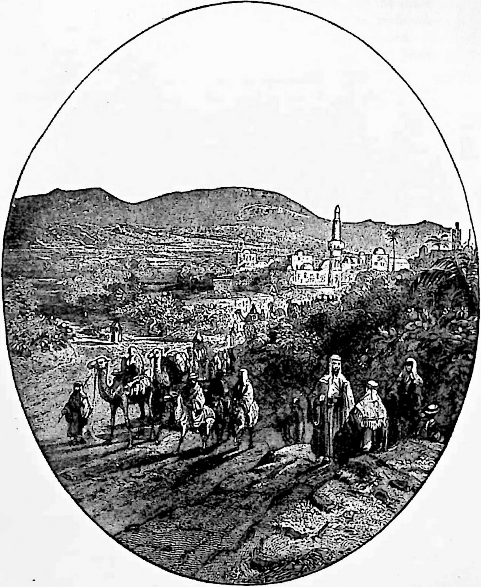
END OF JUDEAN MINISTRY. 171as these tanneries are now located. For a consideration you will be shown the site, if not the very house, where Simon lived and Peter lodged, by the seaside, and the place where Tabitha's (Dorcas') tomb was, which are as authentic as most of the famous places shown to Bible antiquarians.
Caesarea being a heathen city, it is supposed that Jesus would avoid it, as was His custom.
Turning southeasterly into the interior, there are many im-portant Judean towns—Lydda, nine miles from Joppa, RAM-LEH, and Ekron of Judah. Zorah was the birthplace of Samson; Ajalon lies due north to Beth-Horon, on the road to Gibeon. This lies west of Jerusalem. Northward lie Beeroth, Bethel, Ephraim, Shiloh, Lebonah and Corea.
Thus arriving at the extreme northern part of Judea, and wishing to avoid the vicinity of the Baptist, “Jesus must needs go through Samaria," to Galilee.—John.
Andrews sums up the Judean ministry much as follows:—
He begins the work of preaching and baptizing in the provinces.
The baptizing was done by His disciples.
He does not go about, so far as we know, preaching in the synagogues.
He works no new miracles.
“All this is in harmony with His position as one waiting for the recognition of the nation. The Baptist had pointed Him out as the Messiah." In the temple He had virtually asserted His power and authority as the Messiah. “ The whole Judean ministry is an appeal to the people to receive Him as the Messiah, through the divinely constituted heads."
—Andrews’ Life of Our Lord.
With this work completed in Judea, He returns to Galilee and awaits results.
“The burden of Christ’s preaching in His journeying throughout Judea, no doubt, was the same as that of His Galilean ministry a little later, and as that of John’s, viz.:
* Repent, for the kingdom of heaven is at hand.'
“ The time had not come for His openly proclaiming Him172 DID ALL JUDEA HEAR THE GOSPEL? self as the Messiah, though He acted from the first as such, without formally assuming the title."—Geikie, 512.
“After the feast, Jesus leaving the city, went into the terri-tory or province of Judea, as distinguished from its chief city.
.... Sepp supposes Him to have gone from place to place in Southern Judea, baptizing in all the principal fountains. . .
. . Perhaps we may infer from John (4: 4), ‘And He must needs go through Samaria,’ that Jesus was at the time (of closing His present work in Judea) in the northern part of Judea," next the Samarian border. Such is the natural infer-ence. • Results prove it was so, as developed in the next chapter.—Compare with Andrews, p. 154.
Those commentators who say that Jesus only went “ to the Jordan "with His Judean ministry are not worth following, in view of the fact that Peter affirms that "He went through all Judea'' coming out at its extreme northern border. ■ These are the facts—“ He preached to the children of Israel ‘ good tidings of peace ’—throughout all Judea—after the baptism (or style) which John preached.”—Acts 10: 36, 37-

Chapter XVI
The Return to Galilee
Time—December, A. D. 37. At Mid-day. PLACE.—At Jacob’s Well, Sychar, or Shechem.
Samaria lies
References
John 4: 5-41.
Luke 4: 4, 5.
between Judea on the south, and Galilee on the north. It begins at the district of Akrab-bin and ends at the northern boundary of En-Gannim, or ." Ginea.” Josephus calls this latter place Ginea. Samaria is of the same general char-acter as Judea. Both coun-tries are made up of alternate hills and valleys, and are moist for agricultural purposes, and very fruitful.* They each have abundance of trees, and are full of autumnal fruit, both wild and cultivated.
The boundary line of Samaria lay not more than eight miles south of Jacob's Well; but where Jesus may have started from on that morning we cannot say;-yet it was far enough south into Judea, to make the distance travelled quite tiresome.
“ Being wearied,” says John, “Jesus sat thus by the well.”
* Rest is sweet For the weary feet, And the soul that in faith reposes. When the night comes on, And the noonday sun its gateway of splendor closes.”
* This description is made up mostly from Josephus, and relates to his period.
(W8)

“ It was about the sixth hour," i. e., noon, Jewish reckoning, Roman time would make it 6 P. M., and quite dark in Decem-ber. It was during rainy season, and the travelling heavy, which must account, in part, for His fatigue. • Here He sat on the old familiar well-seat, resting, while His six disciples went into the city to buy bread and meat Why did they all six go on this errand ?
For safety. The Samaritans were hostile to the Jews, and there was greater safety in numbers. It was less than two miles into the town.
We have already given a description of this city. In com-ing up from the plain of Mukhna, at the east, you see two great mountains, with a valley between, extending westward. The north mountain is Ebal, the south one Gerizim.* The city lies between. " By the path, as we ascend from the plain, is a brook of fresh, clear water, which turns a mill, on its way into the plain.”—Geikie, Pal. Fund, Rep. 1873., THE WELL is on a knoll near the foot of Mt Gerizim. Over the well stood an alcove, the remains of which are still to be seen, such as are usually built over Eastern wells, to give shelter and seat to tired wayfarers. It is not a spring, hardly a well, but really a huge cistern, nearly nine feet in circum-ference and one hundred deep. It is exactly on the water-shed of the district; but as it depends on rain water (not surface, but filtered through the earth) it is often dry. Lieu-tenant Anderson, who has given us the most interesting ac-count of Jacob’s Well, descended to its bottom, in his Palestine exploring expedition.
When the disciples had departed on their errand into the city there came up to the well a woman, whose air, dress and speech indicated that she was a Samaritan. She bear a water pitcher in her hand, and a rope (John 4: 7-11-28) of grass coiled over one arm. She saw Jesus resting by the well, and by His features and garb, discovered that He was a Jew (verse 9), who said to her in a familiar language:
Respectively, 1,250 feet and 1,100 feet high.— Recovery of Jerusalem, 1871,
P. 465.
“ Give me your ‘ water-pot ‘ that I may drink.”
“ How is it that you, being a Jew, ask a drink from me, who am a Samaritan woman ? " she replied, " for Jews have no dealings with Samaritans.”
” If you knew the gift of God, and who has asked for this drink, you would have asked of him and he would have given you living waters.” *....................................................................
" Sir, give me this water, that I thirst not, neither come all the way hither to draw,” said the woman. She lived in the city, and it was a long way to come after water.
” Go call your husband and return to me,” said Jesus. . “ I have no husband.”
” True,” said Jesus. ” You have had five, and are now living with a man not your husband.”
This conversation was continued for a long time, during which the relative worships of Jew and Samaritan were dis-cussed, with their hopes of the Messiah, until the disciples returned (verse 27).
To this strange woman they heard Jesus, for the first time, acknowledge Himself the Messiah 1 Evidently they were greatly astonished, yet they dared not question Him, “ Why do you speak to the like of this woman ? ”
So the woman left her water-pot and went into the city.
The disciples brought the bread, and, drawing water with the woman’s rope and water-pot, urged Jesus to eat (verse 31). The conversation had greatly affected Him as well as the woman, so that He could not then eat The great Nicodemus, a teacher in Israel, had acknowledged Him a prophet, and this lowly woman of a despised race had said, “ I perceive that you are a prophet” None had gone further, save His few disciples, who only understood Him to be a temporal king. “ Thou art king of Israel,” said Nathanael. What work there was before Jesus and his six disciples I They had been in Judea from the middle of April to the last of December. The disciples as yet were not organized, * Wattri of a if ring—fountain, “ springing up.” Superior to well or cittern water. « Sir, thou batt no rope, and the well it vrry Gap}' the mid.
10 • nor ordained. They had no permanent call. They were tired as well as their Master, wandering over a strange land far from home. It was now the “ rainy season " in Palestine and travel difficult. Peter, always speaker of the band, pro-posed, it is very evident, that they return home for a season. He had a wife and an invalid mother, perhaps; he had left his fishing boats on the shore of Galilee to dry up and fall to pieces in the heat of the summer's sun; his nets to rot in the night dews and days of fervent heat. So with the other dis-ciples. Everything at home had been neglected. Further-more, he said, .
“ In four months comes the harvest" They would then have been gone a year.
There is no doubt, from the time, place and circumstances, that this was exactly the case, and these Peter's words.
“ Say not," replied Jesus, earnestly, “ say not ye, ‘ There are yet four months and cometh the harvest.’ ”
From the elevation where they stood, and Jesus sat, could be seen the busy farmers in the extended valleys below, sowing the seed, white with the lime in which it was always mixed, for the harvest four months hence. And at that moment also was seen the woman returning from the city, with a great multitude following, to “ see if this was not the very Christ ” (verse 29). .
“ Behold!" said Jesus. “ Lift up your eyes and look on the fields, that they are white unto the harvest."
Then were their future labors discussed (verse 36), and the very rewards (“ wages," 36) for that labor promised.
“ ‘ One soweth, another reapeth,’ is a saying true.”
" These peasants below in the fields are sowing. You shall reap and gather fruit unto eternal life."
I take the “ four months ” literally.* What occurred in four months ? This,—In four months John was imprisoned.
In four months “ Jesus returned to Galilee.” In four months He recalled these disciples.
* So Andrews, Baronius, Geikie, Lichtenstein, Meyer, Robinson, Stier, etc.
THE END OF THE “FOUR MONTHS," 177 In four months He began preaching the Gospel of the Kingdom of God, at Capernaum, saying, “ THE TIME is FULFILLED 1"
"What mean all these accumulating facts, unless they point to a matter which should transpire at a certain time ?
The only data we have by which to determine the time of the year when Jesus went into Galilee, says Andrews, is found in His words to His disciples when seated on the well:
“ Say not ye there are yet four months? ”
"The word ‘yet’ obviously refers to the time when the words were spoken.” There seems no contrary evidence to this fact of time, which will be found correct, we believe.
Those who came up out of the city of Nablus, Sychar, urged Jesus to come and abide with them.
"And he abode there two days.”
There were many converts as the result.
“ Now,” said these new converts to the woman who had first told them of Jesus, “we believe not because of what you had told us, but because we have heard for ourselves, and we know that this is indeed the SAVIOUR OF THE WORLD.”
This is not the “ city of Samaria” referred to in Acts 8: 5, 25, which so generally “ received the word that being the " city of Samaria,” on the hill of the same name, founded by Omri (B. C. 925). Herod the Great rebuilt it after its demoli-tion in B. C. 109, so that it was quite a “ city ” in Christ’s time. The evidence that Luke (above) refers to this “ city of Samaria” is found in the 25th verse, that the three returned to Jerusalem " through many villages of the Samaritans.” There are villages en route from Samaria, but few or none below Sychar, where Jesus taught two days.
From here Jesus and His disciples went to Galilee.
Chapter XVII
The Second Miracle
Time—Winter and Spring of A. D. 28. PLACE—1. Cana of Galilee. 2. Nazareth.
Jesus left Sychar, after two days’ successful work, and retired into Galilee, while His dis-ciples, except Nathanael, returned to their homes in Bethsaida and to their former occu-pation of fishing. With Nathanael, who would most naturally desire to return home, Jesus went to Cana, probably separating from Peter and the rest, at, or near, Capernaum, their home.
After His excellent reception at Sychar, Jesus re-entered “ Galilee in the power of the Spirit ” (Luke 4: 14, in good spirits?)
The evidence that He did not go via Nazareth, nor yet tarry at Capernaum, but went to Cana, lies in the testimony of John—4 : 45, 46 and 54.
At Cana Jesus performed a great miracle, the healing of a nobleman’s son (from Cana), while sick in Capernaum.—John 4: 46-54.
This, says John, was the second miracle done by Jesus, “having come out of Judea into Galilee" to do it. The report of this miracle (Luke 4: 23) spread all through Galilee, and reached Nazareth before Jesus arrived there.* " Whatsoever we have heard that you did at Capernaum * The only miracle (or work) yet done in Capernaum was the one at Cana.
—John 41 54(ITO)

do also here in thine own country," was what Jesus accused the Nazarenes of saying in their hearts.—Luke 4: 23.
Before going to Nazareth, however, it seems conclusive that Jesus went about Galilee teaching in the various syna-gogues (Luke 4: 4, 5). His disciples—the six former disci-ples—were not with him. He was not yet preaching the Gospel of the Kingdom. The word teaching (Greek) is used in the former case, distinct from preaching, afterward.
All that we have written about, so far, and all in this and the following chapter, occurred before the opening of the '* Gospel " in Galilee, as recorded by Mark—1: 14.
“After John was cast into prison (delivered up) Jesus came into Galilee preaching the Gospel of God.”
“ For John was not yet cast into prison,” says John (3: 24), on the former occasion of Jesus' return to Galilee—i. e., the present—therefore we see that at present (until after the April passover) Jesus is merely teaching in the synagogues of Gali-lee, in a quiet and unpretentious manner. The manner of this teaching will be shown at Nazareth, to which place He finally goes.
Before this, however, the healing miracle had been performed at Capernaum, while Jesus was at Cana. “ He was a guest of Nathanael,” Geikie suggests.
He seemed not to have gone " through all Galilee ” (Matt 4: 23), as on His circuits the year following, but “ through all the region round about ” (Luke 4: 14), where He was, viz., Cana. And thus he evidently passed the winter, not in idle-ness as some think, but in teaching. He was usually ad-dressed as “teacher,” an exception being in case of the nobleman from Capernaum addressing Him as “ Sir.”—John 4: 49.
His manner of teaching is shown at Nazareth. He entered the synagogue on the Sabbath.
The services began at 9 A. M. with the reading, or reciting, of the Eighteen Prayers, the congregation standing, with cov-ered heads, and responding “ amen " in the proper places (Talmud). Then followed the first lesson—The Law—all the congregation still standing facing toward Jerusalem (Dan. 6 : 10). All synagogues were so constructed that the congrega-tion entered and prayed with their faces toward Jerusalem.
After a second chant came the reading of the second lesson —the " haphtara " of the day. The Chazan, or ruler of the synagogue, in the absence of a regular priest, recognizing in Jesus one desirable to read the Prophets to them, handed Him the roll, or " book,” of the prophet Isaiah.
“ He opened the book,” rather unrolled the manuscript, and “ found ”—implying a search—the place where it is writ-ten—and in the original is as follows: * “ The Spirit of the Lord God is upon me, Because he anointed me to preach good tidings to the poor. He hath sent me to proclaim release to the captives, To bind up the broken-hearted, And the opening of the prison to them that are bound, The recovering of sight to the blind.
To proclaim the acceptable year of the Lord."
Having read thus far, Jesus closed the roll, gave it back to the attendant and sat down. This was equivalent to in-timating that He would speak on the subject. He sat to explain as was the custom.—Matt. 5: 1. See Jacobus.
They all listened attentively at first, for “ His words were full of grace.” They were delighted in Him, perhaps proud of their fellow-townsman. They had heard of His fame in Judea.
“ Is not this Joseph’s son ? ” said they.
Whereas Jesus did not directly claim to be the Anointed of God, He did claim (v. 21) that it was of Him that Isaiah spoke.
This was His offence. They would hear Him no more. “ Give us a sign,” was ever the cavil of these Jews.
“ What we have heard (but we don't believe it) that you did in Capernaum, do here in your own town ” (23).
* Inaiah 61: 1-2. It is from the Sinaitic and Vatican MSS.—Geikie, ch. 43 See Preface to R. V. t This is not found in Isaiah 61.
The clamor became great The whole congregation rose to their feet crying and shouting, using violence to eject Him. But He escaped them and went to Capernaum (v. 31). This was the first rejection. The second is recorded, Mark 6: 1, and occurred in the following winter.
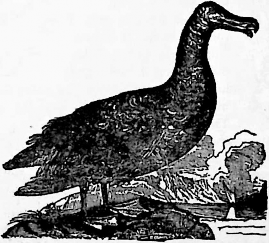
Chapter XVIII
The Second Passover
Time—First week of April, A. D. 28. A. U. C. 781, Place—Jerusalem.
After this there was . .
Beferenee
John 5: 1-47.
feast of the Jews, and Jesus went up to PO Jerusalem.” The article is wanting in the received text. If it had read “ the feast,” it would have meant, without doubt, the pass-over. Tischendorf inserts " the ” in one of his editions. Andrews, Lightfoot and many others also claim that it was the passover. The Sinaitic MS. has the uthe ''
The following are among the reasons favoring the passover:
The parents of Jesus went to this feast every year (Luke), and Jesus respected the customs of His people. 2. The pass-over would be the next feast after His rejection in Nazareth.
3. It was the only feast thereafter when He carried no dis-ciples in His train. 4. He had no disciples with Him at this feast. At least, none are mentioned, and at all other feasts they are.
If we admit this passover, it will complete the list of all the passovers during the ministry of Jesus. John mentions the next year's passover, but for fear of the Jews Jesus did not attend (6: 4 and 7: 1), and the Sanhedrin, immediately the feast was over, sent spies into Galilee to inquire into the matter. We think that the absence of His disciples is the strongest proof of this feast being the Passover.

STREET SCENE IN THE ORIENT
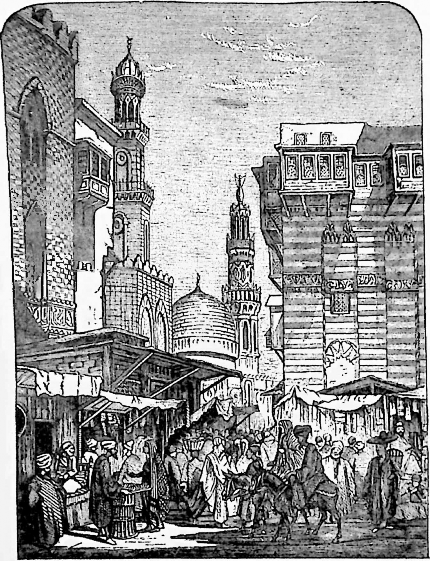
“This nameless feast," says Canon Farrar, “was in all probability the feast of Purim."
Nothing is more improbable.
Let us briefly describe the carousal, then and now, and let any reader say if it was a fit or desirable scene for our blessed Lord to travel a hundred miles to witness 1 It was not a " Feast" any more than the celebration of our national “ Day of Independence ” can be called a “ feast.”
It was celebrated at home, with no reference to the Holy city or the Temple. Like our own day, above named, it was celebrated anywhere where there were a number of people so inclined. 3. It was not really a national feast—if feast at all—and, unlike Passover, no one was required to observe it, much more go to Jerusalem for that purpose. 4. It was not a re-ligious affair, but one, as Stier admits, “ animated by a revenge-ful and extravagant spirit” 5. It was not appointed by Jehovah, or by Moses. It seems to have been instituted by Mordecai, at the suggestion of Esther, to commemorate the deliveranc*e of the Jews in Persia from massacre by Haman. This man having obtained a decree from the king, cast lots for a day on which to carry it into execution (Adar 14). How he failed is well known. In irony the Jews named this day (rather three days) Purim, “ Lots." It was rather a sort of “ Guy Fawkes Day ” than a religious festival. Eighty-five elders made objection to it as a Jewish festivity, being an innovation against the Law.—Lightfoot on John 10: 22; Andrews.
I have three times personally witnessed these celebrations.
On the morning of Adart 13 business was suspended by the principal Jews all over the city, and at 10 o’clock the syna-gogue was opened. I entered with the Jews, and with them stood, with hat on, and heard the Hazan read portions of the See Esther 3: 7 and 9: 2; “ Fasting and Cry."
+ The first day, so far from being a Feast, was kept as a fatt, as Either first enjoined (9: 31). In the Synagogue services the whole congregation responded in « caning Haman ” and blessing Mordecai and the hangman of Haman, one Harbonsh. book of Esther. Then there was a chanting, perhaps of Psalms, and if any prayers were read I did not recognize them as such. The remainder of the day was passed in visiting, attending shows, and social intercourse, until evening, when the “ fun commenced.”
The more wealthy Jews kept open houses all night, where their personal friends joined them in open festivities. Any one, Jew or Gentile, could enter any " open house,” but all were pleasantly supposed to be Jews; hence, all went in mas-querade.
On King street we rang at the illuminated residence of Mr.
K. Simons. We were seven in number, all in half mask, with a band of vocal and string music. We were therefore doubly welcome. There were present some twenty of the family, more than half of whom were Jewesses. These were in great expectation, and our musicians soon gratified them. What in ? “ The Grave of Washington,” vocal, and a “ Waltz,” instru-mental ! The house was brilliantly decorated and illuminated; the piano stood open, which we also used with the other in-struments in rendering the waltz, after which we were invited into a large dining-hall, which fairly glittered with plate-glass, china dishes and gold-bound mirrors. There were an elegant side-board and a circular table loaded with fruit, cake and wine. Other liquors were offered us, which were respectfully declined, at which the lord of the house expressed great sur-prise, and forthwith ordered coffee for " so rare a company.” The ladies served us, continually plying us with questions, en-deavoring, with much glee, to entrap us into tacitly or openly acknowledging our anti-Jewish proclivities.
Before leaving the residence of another Jew (Mr. Hart), a band of minstrels were introduced, in complete disguise, burnt cork faces, woolly wigs, singing Ethiopian songs and pro-pounding conundrums.
In the streets we met numerous parties going and coming, with music and jollity, and, I must acknowledge, before morn-ing a great deal of inebriety.
At one house, from some disturbance in consequence of a dispute about “ the house not being open," there were 'col-lected in the balconies, about the yard, inside the gate, and in the rooms from which the family had all fled in alarm, at least 1,000 people. Some were in mask, some in costume, and others in plain citizens’ dress; some sober, some intoxicated, wandering in and out, up-stairs and down, all endeavoring to ascertain if the house was open to receive visitors I On going out, our attention was especially attracted to a man crowded behind the gate—a large plank affair swung back on immense hinges. He was the owner of the premises, who, in trying to close the way on the flood of human beings pouring in, had become jammed behind the gate, where he stood, between gate and wall, calling loudly for his son-in-law:
“ Meester Koopman I Meester Koopman I comese here I"
The police were helpless in such a jam as was pouring into Mr. Koopman's premises. To have extinguished the lights would have had the much desired effect to stop the influx, but the dread of theft in such a Babel crowd terrifled Mr. Koopman’s father-in-law (Mr. Sumner) more than their presence under a brilliant light.
As we hastily retired, on learning the facts, the last sound distinguished above the hum of voices earnestly disputing whether or not the “ house was open," was the call of the man behind the gate—
“ Meester Koopman I Meester Koopman I Comese here I" Such is the modern celebration of the “ Feast of Purim," and if we acknowledge with shame the fact of our presence at such a carousal, what shall we say of him who accuses “ Our Example” of attending willingly a like scene?
Therefore, “ Jesus went up to the passover."
Before electing His disciples permanently, and beginning His Galilean ministry according to prophecy of Isaiah (Matt. 4: 14-16), Jesus gave the Jewish nation, as represented by the rulers in Jerusalem, one more opportunity to accept Him as the expected Saviour.
To this end He went at this time up to Jerusalem. We find Him at the pool “ Bethesda."
186 - THE POOL BETHESDA.
This, John says, was by the " sheep "—John does not inform us " sheep " what Perhaps “sheep-quarter." The “sheep-pens” and the “ sheep-gate " were near the northeast corner of the Temple.
—See Barclay, 326.
The pool was very large, and had five porches (porticos).
Herein lay daily a multitude of sick, blind, lame and pal-sied.
What for ? John tells us:
“ For an angel of the Lord went down at certain seasons into the pool, and troubled (stirred) the water (and), whoso-ever first stepped in was made whole of whatever disease he had.”
Of course this was a delusion, and the R. V. Committee have omitted this stanza. This omission I object to. It all ought to stand as it was, to show the very bottom facts of the whole thing and what followed.
Did not the waters move at certain times ? .
Certainly. Being connected, by aqueducts beneath, with other pools and fountain-heads, the sudden influx of one moved the waters of the other, beneath; hence the superstitious belief of the ignorant horde in angelic intervention. Barclay says that there is no proof of its intermitting.
Had the water, then, no curative properties? No more than any other filthy water.
Dr. Barclay* finds this pool at the LOWER SIDE OF THE SHEEP-PENS. It was a reservoir, not a spring, and may have caught the surface-water from these numerous sheep-pens. Here, at passover, were huddled thousands of sheep, for the feast, as near the temple as possible, beside thousands were taken into the “ Court of the temple ” itself. If this surface-water, which Geikie says was “ obtained by collecting rain-water in pools and cisterns, and by aqueducts which drained City of iht Grral Xing, 325. t The water tyringt op at the bottom of an artificial cave.—Porter, 1: 139. The pool is 360 by 130, by 75 feet deep.—Dr. Robinion, 1: 293. For another pool southwest of temple, see Geikie, 2 : 92.
A DELUSION—HEALING WATERS 1 187 distant hills,” was not sufficiently objectionable for sanitary purposes, let us look at it further.
Eusebius (264 A. D.) speaks of the Bethesda of his day, as being twin pools; one filled with rain-water, the other with water TINGED, in an extraordinary manner, WITH RED.
At this side of the temple were slaughtered 100,000 sheep. Their blood was caught and poured into troughs, which conveyed it away.
Where?
Into a PoOlI Jesus never intimated that the Pool Bethesda possessed healing properties. His act implied that it did not John tells the story as understood by the superstitious people there. He does not vouch for it. We object to the fourth verse being cut out of his narrative as in the R V. It shows the fallacy of the whole pool, by leaving that in. It implies super-natural agencies, not there. Lightfoot believes in the super-natural virtues of this pool (he calls it Siloam), yet he says—Andrews, 5 : 238:
“The silence of the Jews about the wondrous virtues of this pool is something strange I "
“ WONDROUS VIRTUES,” indeed I The surface drainage of a thousand sheep-pens! The blood from the slaughter of a hundred thousand sheep 1 Let us have the facts. It had anything but healing virtues, and so knowing, Jesus had compassion on the poor, deluded wretches sitting about it.
As in the case of the sale of doves in the temple,* did not the priests derive a large revenue from this deceptive pool, and hence, as in the former case, WERE ANGRY WITH JESUS FOR HIS INTERFERENCE? I should like to know this for a cer-tainty, as I so believe. Josephus, in describing other pools and the “sweetness of their waters,” says nothing of any curative properties in this pool under the five porches I He * The sale of doves was secretly in the hands of the priests themselves, Annas, the high-priest, especially, gaining great profit from . . . also the rent of cattle Malls in the temple.—Geikie, 1: 496. did not, like John, expose the fallacies of the Jewish leaders. Jesus spared them not He exposed their intrigues—in this and the doves and cattle—their hypocrisy in many instances, and held up to ridicule {lex talionis) their religious belief as derived from their captors far beyond the Jordan. “ What was highly esteemed of men (the Jews) was an abomination before the Lord."—Luke 16: 15, 19 to 31.
On the Sabbath of the feast, Jesus walked in these porches, and observed an infirm old man lying on his mat by the pool. This was a very pretty name given to this place by the He-brews—" HOUSE OF MERCY.”
Jesus saw him lying there and said to him, “ Would you like to be cured ? ”
“ Sir, I have no one, when the water is troubled, to put me into the pool, but while I am coming another steppeth down before me." This implies that there were steps down into the cistern, which was very deep—seventy-five feet Said Jesus to the impotent man, “ Rise! Take up your bed and walk.”
The man recognized the power, rose up and walked away with his quilted mat slung over his* arm. • “ Hold I" cried the Jews, seeing the man walking away, committing the sacrilege of carrying a bed on the Sabbath. “ It is not lawful to carry a bed about to-day."
“ But," remonstrated the cured, “ He who cured me told me to take up the bed and walk, so I have obeyed Him.”
“ Who is the man ? " they demanded. ■ “ I do not know,” nor could he point out Jesus to them, the place being crowded and He lost in the throng.
Never was a loving deed more lost on a mortal than on this greatly advertised wretch, who hailed Jesus before the council.
On the following day (not Sabbath, at least, for the San-hedrin would not have prosecuted Jesus on that day, verse 16) Jesus found the fellow in the temple and spoke to him, called his attention to the healing, implying the cause of his impotency, and warning him of the results if he sinned again.
Then the abject wretch, thus rebuked by the Saviour, knew Him, and hastened away and reported Him to the San-hedrin—that is, the Council *—who arrested Jesus.t “ The healing on the Sabbath day," says Andrews, “ gave the Jews (i. e., the rulers, Sanhedrin) the desired opportunity of accusing Jesus of a breach of the law.” More than this, says Lightfoot, “ He further commanded him to carry his bed," which was unlawful.
There can be little doubt that Jesus was arrested (verse 16) and brought before the Sanhedrin, and that the discourse given in John 5 : 17-47 was His defence before that tribunal (verse 19).
How He escaped punishment is not known, for not only did He, in Pharisaical opinion, deserve punishment for breaking the Sabbath, but He boldly declared, as the Son of man, that He was authorized by God the Father (27) to do this work even on the Sabbath.
“ My Father worketh on the Sabbath, so do I."
Then were the rulers angry, and marvelled at His words. “ I will do greater works than this,” cried Jesus (20).
“I will even raise the dead I Then will you marvel, indeed." Again were they enraged and astonished (28).
“ The graves shall open, and at my voice the dead shall live I Yet of myself I can do nothing," said Jesus (30).
After referring to His works (miracles) and promising even greater, Jesus called the attention of the Sanhedrin to the testimony of John. “ He testified of me.”
" You sent to him (1: 19) at Bethabara, and he bare witness of this truth ” (verse 33).
“John is shut up; and his testimony has ceased,” they replied.
It seems that here must have been the first knowledge that Jesus received of John’s imprisonment, for, in the next * Matt. 10 : 17 and 28—" Beware," said Jesus, “of men who will deliver you to the council» (verse 28); last word Greek,11 Ge-henna," place south of city, where condemned were destroyed in fire.
+ So Andrews, p. 184; Farrar, ch. 37; Geikle, 31 99. verse (35), He refers to him in the past tense for the first time.
“ You were willing to rejoice for a season in his light"
"John, then, can testify no more of me, but my works stand a greater testimony (36), and the Father who sent me has borne witness to me (37), and, lastly, the Scriptures bear wit-ness of me. All these—Elias* testimony (John), my works, and Moses and the prophets—these all shall accuse you before God my Father I"
“ I am come to my own in my Father’s name, and ye will not receive me."
Such was the summing up of Jesus* testimony.
In this awful accusation, so truthfully impressed, may not these hard-hearted Jews, for once, have been so overwhelmed that they forgot their lesser accusation against Him, and He thus escaped ?
"And when (in Judea) He heard that John was delivered up He (Jesus) withdrew (from Jerusalem) into Galilee.”—Matt 4: 12. .
Such were the facts in the case.
The penalty for Sabbath-breaking was death by stoning, according to the law of Moses. The punishment for blas-phemy was the same. Jesus was condemned on each of these counts. On this latter charge both our Lord and Stephen were condemned to death by the Jews.—Dr. Wm, Smith.
The passage in John 10: 31, "The Jews took up stones again to stone Him,"—Jesus—implies a former time when they so did, and at a time when no disciples witnessed it, for on this last occasion they had great fear, knowing the law of Moses. Of the former they said nothing, therefore knew nothing of the attempt to stone Him.
" Master I" exclaimed these disciples (a year and a half later), “ the Jews were recently seeking to stone you, and goest thou there again ?"—John 11:8.
This evidence, coupled with the statement of Jesus Himself, on His next appearance in Jerusalem, after an absence of eighteen months,—“YE SEEK TO KILL ME,”—points to the fact that the Jews did attempt to kill the Lord Jesus at the end of the passover of April, A. D. 28.
From this He escaped, as before stated, and fled into Galilee. Nor did He attempt to appear again in Jerusalem till the expiration of one and one-half years, at the feast of Tabernacles. Then He went cautiously, after the opening of the feast, and the first excitement in seeking Him (John 7:
XI, 12) had subsided.
I think no fact of His life appears plainer than this, that after the passover of April, A. D. 28, Jesus made a marvellous escape from the Jewsl ■
A POOL IN JERUSALEM
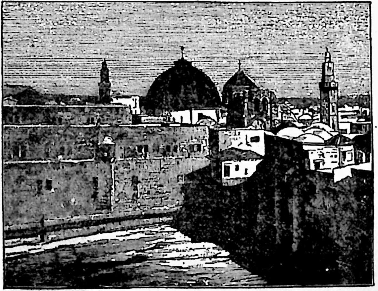
Chapter XIX
End of the “Four Months."
Opening of the Galilean Ministry.
TI—April, middle of, A. D. 28. A. U. C. 781. PLACE—Capernaum.
RULERS—Tiberius, emperor at Rome; Pontius Pilate, procurator (governor) of Judea; Herod Antipas, tetrarch (king) of Galilee; Philip, tetrarch of all upper Palestine north of Capernaum. These remain in power to the end of Christ’s earthly pilgrimage.
It™ Jesus heard that John was delivered up (imprisoned), He withdrew into Galilee, and leaving Nazareth He came and dwelt in Capernaum, by the sea.—Matt. 4: 12.
“ From that time Jesus began to preach.”
—v. 17.
Let us observe the difference between this word PREACH, and the term used by Luke—a former occasion.—4: 15.
“And He TAUGHT in their synagogues."
As at Nazareth, which we have already described.' No more “ reading" from the scroll, no more TALKING, as the word “ teaching " implies, but “ shouting " (as the word preaching means), by the sea-shore, with the noise of the sea and the wind, and to a great multitude, out of doors, restless and noisy, when and where, and to whom it was necessary to speak loud.
The fact of our understanding the difference between these

DDFACHING BY THE SEASIDE,
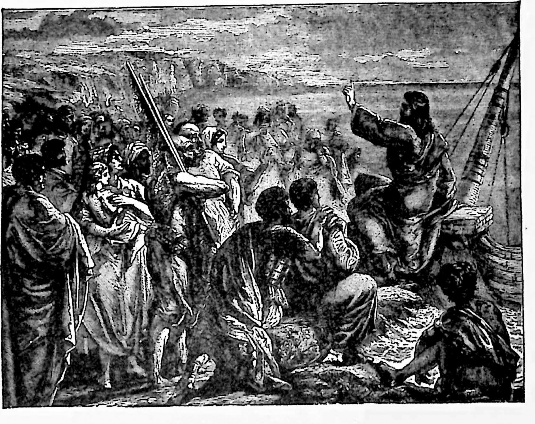
. • • 1 * * * • two acts, preaching , and shouting, or teaching and speaking, will give us a true conception of the time and place of the opening of the Galilean ministry.
Mark also says, ■ • " Now after that John was delivered up, Jesus came into Galilee PREACHING” (1: 14). His first preaching was by the sea-shore. Entering a small synagogue, He would speak, as there loud preaching was unnecessary, and out of place.
He was in Judea when He heard of John’s imprisonment To this He alludes in His defence before the Tribunal.—John 5:35. . . . '
He came at once into Galilee. . Galilee is used in contradistinction to Nazareth, which He left behind, as a “home.”
Those who endeavor to apply the words of Luke (4: 14-16), to this return to Galilee, as per Matthew, Mark and John, throw the Gospels into the greatest confusion.
Let us observe the language of Luke. “And Jesus returned in the power of the Spirit into Galilee ”—still used in distinc-tion from Nazareth. Carry this time back four months, and we can understand the source of His acceleration of spirits. After His long Judean ministry, Jesus had been openly de-clared at Sychar the true Messiah, and there He had made many converts. The fame of His Judean work and what He did at Jerusalem before, had preceded Him to Galilee; hence the Galileans received Him well, and His spirits were corre-spondingly raised. Do we not read at other times of His dejection, discouragements and groanings of spirit? So, also, could success elate Him, as another man, and of this elation of spirit Luke spoke. But if we attempt to apply it to this time of Christ's return to Galilee, we fail to find cause for such exuberance of spirit On the contrary, He had every reason for being dejected. He had been rejected of Nazareth, barely escaping with His life; “His own,"'the very pith of the nation, at Jerusalem had rejected Him, and so far from seeing a Divinity in His words and works, they had arrested Him for Sabbath-breaking, dragged Him before the council, con-demned Him for blasphemy, in saying that He was “ the Son of God" (John 10: 31), and set a price upon His head, He escaping out of their hands by some unknown cause, and fleeing for His life into Galilee.—John 7 : 1.
And He had not since (April 28) been in Judea, It could not be that Luke referred to this occasion, as returning to Galilee " in the power of the Spirit"
“ But it means ' Holy Spirit/'which should act on the hearts of men, not a moral state of mind, an inspiration," one says.
To this we reply by quoting John (7: 39) still later—“THE HOLY SPIRIT WAS NOT YET GIVEN.”
Therefore, leaving Luke in the past, we go forward four months to our present date, and follow Matthew and Mark in the continuation of our “ Journeys.”
First, Matthew 4: 12, 13.
“ Jesus came and DWELT in Capernaum.”
The wisdom evinced in His selection of this city for His future operations is very evident.
It was in the tetrarchy of Herod Antipas; hence He was here exempt from arrest by the Council of Jerusalem. They could only send spies here to watch Him and induce others in this vicinity to annoy Him. All of which they soon did.
It was away from Nazareth, the place of His rejection. Capernaum occupied a central position, second to none in Palestine. It lay upon the northwestern coast of the Sea of Galilee, on the direct route from Damascus to all lower Pal-estine and to the Great Sea and route to Egypt " Through this city passed the great caravans on their way from Egypt to Damascus, and the heathens who congregated at Beth-saida and Caesarea Philippi must have been constantly seen in the streets of Capernaum.”
In the time of Christ it was, for population and activity, the manufacturing district of Palestine, and the waters of its lake were sailed by four thousand vessels* of every description, from the war vessels of the Romans and the gilded pinnaces from Herod’s palace, to the rougher fishing-boats of Bethsaida * Farrar.—Josephus quotes 230 vessels, into some of which he placed four men! * Very small “ ships.”—Wars, 2: 21, 8. and the entire coast The sea was His grand highway be-
VICINITY OF THE SEA OF GALILEE
tween the flourishing capital of Philip, at Bethsaida, to the beginning of that of Pontius Pilate. At the very commence-
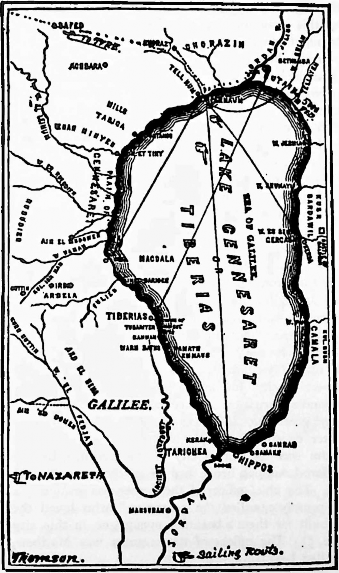
ment of His ministry at Capernaum, He caused a “ ship ” to be placed at His disposal, in which we find Him crossing and recrossing, this beautiful expanse of water, mid calms and storms, by night as well as by day. When exhausted nature could no longer hold , out,.He Would say to His disciples—“Let us take the boat and cross the sea," to which they would cheerfully respond, “ and taking Him as He was," would cross to the eastern shore.—Mark.4: 36...
Wherever they chanced to land, for a circuit into the coun-try, there they left their boat- until their • return. ■ After- their long sojourn in the Gentile land of Tyre and Sidon, we find them returning to their boat on the eastern shore, and crossing thence to Magdala, over the Sea of Galilee. '
On its waters a thousand fishermen cast their lines and nets at early dawn, and on its shores they spread their nets to dry and fish to cure. at evening’s quiet hour. So extensive and important was this occupation, that -sea-shore towns derived their names therefrom. .Bethsaida,at.the head of the sea, was named a 9 fishing-house;” Taricha, at the foot, was the “ pickling-town ”—the great fish-curing port of the lake; * and Chorazin derived its name from a fish peculiarto the waters of this inland sea. ... ■ A ready market for these fish was found at Capernaum, at Tarichaea—which city, Josephus says, contained 40,000 in-habitants—and at Jerusalem. Sinpe no ice is made in Pales-tine, of any great thickness,, fish could only be marketed during winter, except dried or pickled fish. ' 1 Capernaum was the border city of the' territory, on the north, of Herod Antipas, hence had .. its garrison and its cus-tom-house. The chief 'officer pf the former was evidently a Roman, a proselyte, called " a centurion," who loved the Jews, and built for them a beautiful synagogue, in this city (Luke 7: 2, 5). The officer of the customs was Matthew, formerly called Levit. .. . .....
•Hetzog; yr 7 j quoted-by Geikie, 488. f Corcin, a fish, named by Josephus, War*.
| Mark and Lake say “ Levi,” but Matthew, despising his former name and calling, calls himself Matthew. . . . .
THE CITY—HOUSES AND STREETS. 19V This “ seat of customs ” may have been as far east of the town as the west bank of the Jordan—perhaps near two miles distant from the centre of Capernaum. - ■ The houses of Capernaum were built of black basalt rock, or lava, which were generally kept whitewashed. The syna-gogue was built of white limestone. Its entrance was from the north, under a high portico, supported by immense col-umns, “of the florid and• composite style (of architecture) which marks the Herodianage" (Farrar). Some of these
RUINS
now lie half hid in the earth and rank .thistles and coarse grass, with blocks chiselled and carved, once the frieze, archi-trave and cornices, which help to make up the evidences of its former splendor.—Geikie. • .
The main street‘of the town extended north and south, about half a mile; as. indicated by its ruins, which are about one-fourth of a mile wide., A each xtends along its water front. ’ • * • '
The ancient name of this city was Kefr-na-hum. Under
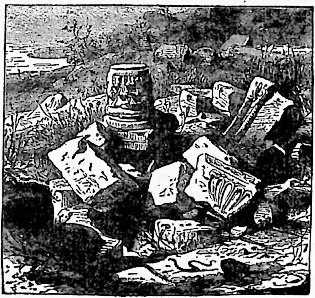
the depreciating influences of the lazy Arabs, it has dwindled down to " Hum "—or “Tell Hum.” ■ From Capernaum Jesus had ready access to all Galilee on the west, Trachonitis on the north, and Decapolis and Perea on the east, beside the numerous cities and villages lying on the immediate coast of the sea, as Chorazin, Magdala, Bethsaida and many others.
From this centre Jesus made numerous circuits into Galilee, and countries adjacent I think we may trace some ten of these circuits, made within about a year’s time.
This Galilee work seems made up of alternate sojourns in Capernaum and circuits into Galilee and other and northern countries.
Of these circuits we give the following outline, all of which were made from Capernaum, returning to the same point—except the last.—John 21: 1.
FIRST, to “ next villages.” About May, A. D. 28. SECOND, to the mountain—Hattin, probably.
] THIRD, to Nain; raised the widow's son.
FOURTH, over lake by boat, to the Gerasenes. FIFTH, to Nazareth, second rejection. Twelve. SIXTH, over sea, Batuha, feeds 5,000.
SEVENTH, to Tyre and Sidon. Matt 15 : 21-29. EIGHTH, to Bethsaida, Caesarea—Hermon. NINTH, Jerusalem to Tabernacles.
TENTH, final departure. Matt 19: 1; Mark 10: 1. • Luke 9: St •

Chapter XX
Preaching By the Sea-Shore
Time—Spring of A. D. 28. A. U. C. 781. Place—Sea-shore near Capernaum and city.
first notice given of Jesus after His coming to Capernaum to abide, places Him before us on the seaMeferences, Matt. 4: 11.
Mark x: 16.
Luke 4: 31. Luke s: x.
shore a little out of Capernaum. He was surrounded by a great multitude of people, “ who. pressed upon him to hear the word of God;" yet it was early in the day.
During the previous night four of His former disciples had been on the lake trying in vain for fish (Luke 5: 5), and had come ashore, fastened their two boats a few rods apart, and were in the act of washing and repairing their nets.
Seeing them landing, and recognizing Peter, His quondam disciple, Jesus spoke to him and bade him push, off the boat again while the two entered. Peter obeyed, and probably kept the boat still while Jesus spake to the people on shore. Andrew was also there, though not referred to by Luke until the letting down of the nets (verses 6, 7) to enclose the great body of fish.
Thesermons of the rabbis were usually short, after the hear-ing of which the people would wander away to speak and reflect upon what they had heard. So, doubtless, on this occasion.
Jesus closed his remarks, and for the double purpose of
compensating Simon and Andrew for the accommodation of their boat and to. convince them of the Divine power of the preacher, Jesus bade Peter put out a little into the lake and cast his net “ it is of no use," Peter replied, " for, Master, we have toiled all night and taken nothing for our labor; but at thy word I will again cast the nets."
Then the brothers cast out their drag-nets and enclosed a great shoal of fish, and, fearing their nets would break and they lose the catch, they called, by beckoning, implying that they were out of hearing, for John and James to come to their aid. They were all partners in the fishing business. These came in haste and secured both boats full-of fish. However, they gained the shore before the boats sank, and so' secured the haul. .
Having so done, Peter, in great amazement at the miracu-lous draught of fish, fell down on the. beach and worshipped the Master, as probably did the others.
After this Jesus called the four to become His permanent disciples. ■ • .
“ Henceforth you shall become fishers of men," He said.
_ Matthew and Mark only refer to the matter briefly. The first brothers were casting a net into the sea. They had sev-eral nets (Luke); they " cast them overboard " to wash them. The other brothers were “ sitting in their boat mending their nets." • . .
Luke says," The fishermen, had gone out .of their boats and were washing their., nets.” These are all different stages of the same proceedings. Some of the men—there were at least seven, including Zebedee and, two servants (Mark)—had al-ready gone out of the boats; others were throwing over the nets into the water to wash them; others were mending the torn meshes. Evidently the call was not until after the great catch of fishes. . .
. After these had been secured “ that nothing be lost,” as was Christ’s rule, the four fishermen—Peter, Andrew, James and John—went with Jesus. . . ..
THE GREAT DRAUGHT OF FISHES
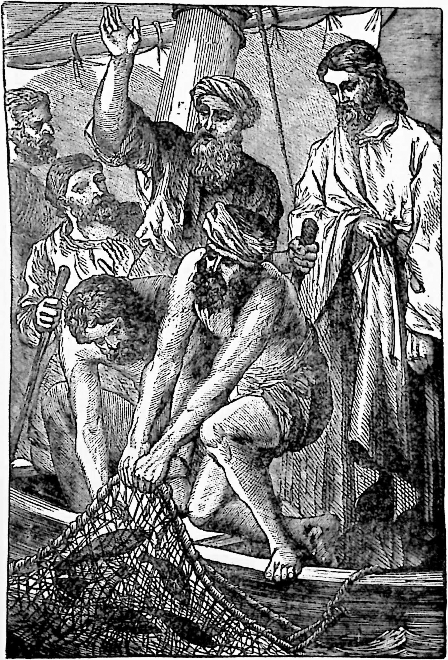
It appears to have been on Friday that Jesus recalled these four disciples.* ' ' " ‘ ' ' * The Jewish Sabbath began at sunset It was announced from the roof of the synagogue by three trumpet blasts. The first, half an hour before the Sabbath hour, called the peasants from their labors in distant fields and vineyards. The second warned the merchants to close their shops, and the third for all to kindle the Sabbath lights, which should burn till the close of the holy day.—Talmud.
When Jesus came to Capernaum He must have at once found a “ home," since Matthew informs us that He came and “ dwelt” in Capernaum. It was not with Peter at first Why?
He came preaching,'implying, as we find Him, “ preaching by the way.”
Preaching on the shore He found Peter. He did not go on that Friday night to Peter’s house, else He would not have waited till after the close of service at the synagogue, on the next day, before He healed Peter’s wife’s mother. If you say," She may not have been sick on the night previous,” we reply that a malignant fever could not have become “ a fever ” in so brief a time as one day. '
Therefore, on that night Jesus went to some other “ home ” than Peter’s house. Perhaps He never “ abode " with Peter.
Since we last parted with Peter, four months previous, he had removed from Bethsaida to Capernaum, where he owned a house, in connection with his brother Andrew.—Mark i: 29.
There may have been a longer period than one day between the call of these four disciples and the Sabbath mentioned by Mark, who says, “And they (Jesus and these four disciples) go into Capernaum.” Perhaps from Bethsaida several days after the recall, thereby giving Peter and Andrew sufficient time to close up their business and remove to Capernaum.
Nope of these evangelists have proposed giving us a chrono-logical account of the work of their Master. Luke’s account *Ewo!d’s Geschichte, 5t vol., 365 p.,‘ quoted by Geikie.* ■ *** + Talmud; Sepp; Geikie.
206 WHERE WAS JESUS' HOME?—FIRST SYNAGOGUE DAY. is greatly out of connection. Here he places (ch. 4: 31) the healing in the synagogue and of Peter's mother-in-law before the re-discovery of Peter (5 : 1). I am therefore inclined to give a longer period between the discovery of Peter on the shore and the Sabbath of Jesus’ first healing in the synagogue than one day. It harmonizes better. Since Jesus was to occupy Capernaum for a centre during a long period, as yet unknown how long, it would be most desirable that' His prin-cipal disciples reside near Him, hence the removal of these from Bethsaida. Heretofore they were only as private men following Jesus temporarily, * now they were called to engage in a lifetime work, which would be incompatible with their former pursuits. To this end Peter and the rest “ left house ” and friends “ for the gospel’s sake," or, as Peter sums it up, * Lo, we have left all to follow thee.”
The healing of the maniac in the synagogue was on the first Sabbath of our Lord's sojourn in Capernaum. Here sat the demoniac, quietly, through all the long prayers, eighteen in number; the singing, the reading of the law and the prophets, as was the custom of every Sabbath morning service, until Jesus began to speak, when up he sprang, howling only as a maniac can—
"Half What have we to do with thee, thou Jesus of Nazareth?
"Art thou come to destroy us ?
“ I know thee; thou art the Holy One of God 1 ”
‘ " Hold thy peace,” Jesus commanded, " and come out of him." And the man at once became rational, to the great amazement of all present This ended the service for that day, and with his four dis-ciples, Jesus went to Peter’s house, evidently for the first time.
“ If He can cure one possessed with a devil,” said Peter’s wife, on hearing of thesoone at the church; " He can heal my mother of a fever,” “ and immediately they told Him of her" (30). .
So Jesus took the invalid by the hand and healed her.
* Lightfoot. t Correct translation of Luke 4: 34. An exclamation.
This restoration was so complete that she served the dinner for the company. No cooking could be done on this day, but food, prepared the day previous, could be served up.
The dinner hour was at 12, noon.—Josephus, Life, 54.
After this there was quiet until sunset, then followed a scene indescribable. Mark graphically says, “All the city was gathered at the door ” bearing their sick.
All through the long twilight hours, into the darkness of night, did Jesus pass among that sickening throng, touching first one and another till " every one of them," says Luke; was healed. Then, exhausted and depressed, He retired for a few hours, but knowing what would follow at the dawn of another day, He arose before it was light in the house and secretly retired to the hills back of the town.
Simon, too, was an early riser, and, starting up, he missed the Master, and calling Andrew, James and John, they “ went out" in search of Him. Already were the diseased com-mencing to flock to Simon’s house to be cured, but Peter passed them and, hastening, “found" Jesus.
Chapter XXI
The First Circuit of Galilee
Tnz and PLACES equally uncertain. Probably the period was abort and the circuit very limited.
JME back, said Peter, on finding the Master in the desert place.
Eefereneem. Mark i: 37, 38.
Luke 4: 43.
Mark 1: 40, 45.
Luke 5: 12.
Matt. 8: a, 4
out,” Jesus replied.
"there is a great multitude waiting for you.”—Luke.
“No; rather let us go into the next towns, that I may preach the good tidings of the Kingdom of God to them also; for this purpose I came “ The next towns " were Chorazin, Magdala and Bethsaida.
Andrews makes the time to be in May, and the circuit a short one. Ellicott* makes this circuit four or five days only. Others make it a longer period. Doubtless it was brief. Since the primary object of the Galilean ministry was to gather disciples, Jesus may not have made any extended circuit until after the selection of the Twelve. .
Therefore we take the words of Jesus literally—“ Let us go into the next towns ”—and find this circuit very short; first to Chorazin, where He " did mighty works,” and to Bethsaida, the same, and where also He recalled Philip, who resided there, and who became the fifth disciple; and perhaps BarHistorical Lecture*, 168.
tholomew was also found there. We find them placed in this order by all the synoptists; Peter, Andrew, James, John, Philip and Bartholomew.
The language of Matthew (4: 23), that "Jesus went about in all Galilee," of Mark (1: 39) that " He went into all their synagogues throughout all Galilee,” and Luke that “ He was preaching in Galilee, and Judea,” as some ancient authorities read,* must apply to the general work of Jesus in Galilee, occupying eighteen months, and not to this first circuit Josephus incidentally mentions that there were, at that time, 204 cities and villages in Galilee, which we may not question even though he errs in saying that "the smallest of them contains above 15,000 inhabitants." t Under Adrian no less than 985 cities and villages were destroyed in Palestine (or " of the Jews "), and Galilee was its most densely populated part; therefore we may feel assured that the country was crowded with "towns," and that it was impossible that Jesus could visit a tenth part of them on this one circuit.
" I came forth to visit the next towns," said Jesus to Simon, and we will offset this evidence against all other, that on this brief circuit Jesus visited but a few places, and those were near Capernaum, as Chorazin, Bethsaida and Magdala.
Of His words and works on this circuit the disciples give us no account They were not as yet a complete and organ-ized body. Matthew was not yet called, and no more than the old six now followed Jesus.
Many able commentators have placed the healing of the first leper at this time. Evidence is in its favor, and against the time of the Sermon on the Mount There is no evidence that Matthew intended to connect it with the time of Jesus’ return from the mount, on the circuit later (8: 1), any more than he does the healing of Peter’s mother-in-law, verse 14. Verse 1 is the closing up of one narrative—the proceedings on the mount; while verse 2 is the beginning of a random, ♦See R. V.—Marginal note on Luke 4: 44. • t Wans, 31 3. a. long list of cures, thrown together as miracles, without regard to time or place.—See Andrews, p. 234.
Leprosy {Lepra Alphoides), the species which afflicted the Hebrews from their earliest organization, was an incurable disease. The being so afflicted was counted dead from its inception. If a case was doubtful, the person was quaran-tined for seven days (Lev. 13: 4); at the expiration of which time the priest examined him again, and if still doubtful, he was shut up another week, and so on until the case was cor-rectly diagnosed. It was a loathsome disease, and a special inheritance of the Jews and Syrians, No leper was permitted to dwell within the camp or city of the Israelites. No leper could approach a healthy person, much less touch him or eat with him. It is so at the present day. If any clean person approached unawares, the leper was required to throw up his hands, if indeed he had any left—to warn off, and cry, "Unclean! unclean!"
So it was with the ten lepers met by Jesus on the borders of Samaria (Luke 17: 12, 13) a year later, as He was en route to Jerusalem; they “ stood afar off, and lifted up their voices,” in warning. Those were outside a certain village, says Luke. Dr. Thomson describes the present leper quarter at Jerusalem, though inside one of the walls, as an exclusive “ Leper quar-ter, and positively a loathsome spectacle.”
“ Sauntering down the Jaffa road on my approach to the Holy City, I was startled out of my reverie by the sudden apparition of a crowd of beggars, ‘sans eyes, sans nose, sans hair, sans everything.’ They held up to me their handless arms; unearthly sounds gurgled through palateless throats —in a word I was horrified I Having never seen a leper, nor had my attention turned to the subject, I at first knew not what to make of it.”—L. and B.
It seems, in the lapse of time the Mosaic rules have become somewhat relaxed, and lepers may live in a quarter by them-selves under the city walls. One even at times ventures to enter a village, though forbidden under penalty of forty stripes.
—Geikie.
Therefore Jesus met the leper outside of some “ city,” and not in the midst of a populous place.
" Tame I tame I" cried the wretch, holding up his hands as a warning not to approach too near him, for 11 He shall dwell alone without the camp all the days of his plague,” said the law.—Lev. 13: 45,46.
How it was that this “ man, full of leprosy,” afterward ap-proached Jesus at the risk of great punishment, we do not know, but it seems he did, and falling on his face, begged the Lord to cleanse him of his loathsome disease. Perhaps he had defied all law, also, and having heard of Jesus, at Chorazin, or Bethsaida, followed Him to the city in order to be cured.
Having granted the prayer of the leper, Jesus bade him tell the cure to no man. It therefore was done in a secluded place, without public witnesses.
Jesus had touched him. This was contrary to law, and the act made Jesus “ unclean," in sight of the law, for seven days. Not that the disease was infectious, as Jesus well knew, but the Jews collectively believed it so to be, because Moses had so implied in his restrictions. Therefore, the man having disobeyed Jesus’ first command, not to tell it, and having gone and published it broadcast, "Jesus could no more openly enter into a city,” until the lapse of seven days, “ but was without in a desert place." Mark is implicit in this state-ment.* If the late leper disobeyed his benefactor in one command, he doubtless may have in the other: that was, to go to the priest, fulfil the law (of Moses), pay the price and obtain his certificate of cure, without which he could not be received back to pure society.
* Alford and many others follow Mark’s narrative
Chapter XXII
“Home Again.”
Time—About the first of June, A. D. 28. PLACE—Capernaum.
Beferenceu
Mark 2: 1-12.
After SOME DAYS,” says Mdke.g:Ez.“ Mark, "Jesus entered Ca- -----------------------pernaum.” Seven days after having touched the leper. Had He come in before, what an uproar the Jews would have made!
It was soon noised that He was “at home.”
Then came the sick and maimed, all who could walk; and those who could not walk were brought on beds to the Great Physician to be healed of their diseases. Among the latter was a paralytic man borne by four friends, or servants, who, finding the house full and a great crowd around the doorway, went around to the rear of the house, where there were stone steps leading to the roof, and carried the patient to the house-top. This was easily accomplished.
“The houses of Capernaum, as is evident from the ruins, were like those of modem villages in this same region—very low, with flat roofs, reached by a stairway from the court, or yard. Jesus probably sat in the open interior court, and the crowd around and before Him. . . . The roof is only a few feet high, with beams three feet apart, covered with bushes, mortar and a coating of earth.”—Land and Book.

“And they let the man down through the tiling on his couch into the midst before Jesus."—Luke.
Among this throng, hearing Jesus, were doctors of the law from Jerusalem (Luke). We expect that these had heard the “ noise” of the return home referred to by Mark, and came up to watch Jesus. It would require a week’s time to carry the news to Jerusalem and bring back these spies of the San-hedrin. Hence this healing of the paralytic was not the first -work of Jesus on His return to Capernaum. In vain I look to find what Mark, has omitted—therefore I fall into the order of Andrews, Geikie, and Peloubet, and place this as the first known cure after Jesus* return home, at the close of His first circuit So here were the rabbis from Jerusalem, watching Jesus as He looked upon the palsied man and estimated his faith.
“ Let down through the roof?” "You meant to be cured, at all odds! So be it—such faith shall be rewarded.”
He was a young man whom Jesus, not Himself very old, addressed as “ son ” (Child, R. V. on Mark 2: 5). He was doubtless a profligate, whose excesses had produced a collapse of the physical as well as the moral system. His sins—excesses—had produced the disease. Jesus saw it all at a glance, and said:
" Son, thy sins are forgiven."—Mark.
Then the rabbis laid their heads together, saying: “This man has blasphemed."
“Who but God can forgive sins?"
“Why do you reason secretly?” said the Master. “It is a mere matter of words. Which is easier to say, ’Thy sins are forgiven thee,’ or to say, 'Arise, and walk ? ’"
To this there was no reply.
Then said Jesus to the palsied man:
“Arise, take up your bed and go into your house.”
Then the man arose, gathered up the quilted cloth, by courtesy called a bed, and walked out before them all, “glori-fying God."
While all the people, full of fear and amazement, joined the healed man in glorifying God for His wondrous power among men, the rabbis retired in jealous rage, that the word had superseded the law.
Whati No sin-offering—no revenue or honor to priestcraft ! Shall this man do away with all the heavy parapher-nalia of the Mosaic law? From this hour emissaries of the Sanhedrin “watched Him" continually, but He utterly disre-garded them, permitting His disciples on an immediate Sab-bath (Mark 2: '23) to pick the standing heads of wheat, as they passed along, to or from synagogue, “preparing the food" by rubbing it in their hands to separate the kernels from the chaff before eating the grains. It could not have been much later than the present season, else no grain would have been standing.
From this time of healing the palsied man, “the house" was too limited to contain the immense audiences that gath-ered to hear the words of Jesus. From heathen Phoenicia on the north they came, from beyond the sea and river on the east, from Jerusalem and Judea on the south, and even from the far-off borders of Idumea, they came flocking into Caper-naum to see and hear the Lord’s works and words. The very “ inns " must have overflowed with strangers.
No, “ the house ” where He lived would no more accommo-date a multitude like this, and Jesus had “ again ” access to the sea-shore. To avoid pressing upon Him, as on the former occasion (Luke 5 : 1), He requested His disciples to place a boat at His disposal, that He might sit therein at a short distance from the shore, and there preach to the people.—Mark 3: 9.
From this time to the close of His Galilean labors we find that “ the boat," or " the ship,” was always ready for the Master’s service. Elsewhere we give a description of this famous “ Galilean ship."
So, from “ His house" Jesus went upon the sea, near the shore. He did not preach in the streets. His rule of conduct in this matter was laid down in prophecy: “ He shall not strive nor cry, neither shall any hear His voice in the street . . . He shall not fail nor be discouraged."—Isaiah 42: 2-4.
For this convenience—preaching from the boat—the shore just north of Capernaum is, even at this day, found peculiarly adapted.
“ I was delighted to find small creeks, or inlets, between this (the river) and Capernaum, where the 'ship* could ride in safety only a few feet from the shore, and where the multi-tude, seated on both sides and before the boat, could listen without distraction or fatigue. As if on purpose to furnish seats, the shore on both sides of these narrow inlets is piled up with smooth boulders of basalt"—Thomson.
Thus, with the great congregation about Him on three sides, Jesus could sit in the bow of the boat and speak, while His disciples grouped around in the stern, some with oars out at each side to keep her in position, drank in such words of their beloved Master as they could as yet comprehend, treas-uring up such as they could not master, that they might inquire their meaning when "alone in the house."—Matt.
36. . • Of the nature of these earlier discourses by the sea, we learn nothing save as outlined by the synoptists, that when Jesus came here to preach, at the first, it was of the gospel of the kingdom of God.
The parables by the sea were of His later teachings.
Doubtless this sojourn in Capernaum was of considerable duration, involving two Sabbaths, the plucking of the com * being on one, and healing the withered hand the other.
We have incidentally mentioned the “ plucking of the com," and the time on which it probably occurred. The place was in the suburbs of Capernaum, because I. It was on the Sabbath—probably the third after the (last) passover. No Jew was permitted to walk farther than three-quarters of a mile from town on that day. 2. Those who found fault with Jesus for permitting His disciples to transgress the law by preparing food on the Sabbath, were Pharisees of that town, for, after the defence in which Jesus referred them to the case of David, who, when hungry, ate ♦The wheat harvest is gathered before the close of June.—See Robinson. the “shew-bread,” which was not lawful, Jesus “entered into their synagogue” (Matt 12: 9). They were, therefore, Pharisees of Capernaum, and the field was in the neighbor-hood of that city.—See Andrews, 242.
It was allowable both by law and eastern custom for per-sons to pick as much grain, figs, or grapes on the Sabbath, or any other day, as was necessary to satisfy hunger, as they passed along, but none were permitted to carry' any away, nor prepare it on the spot for consumption. This latter, “ rubbing it in their hand palms,” was the offence to the Phar-isees.—Walks and Homes of Jesus.
Why were the disciples hungry at this hour?
The Sabbath breakfast hour was not until after the morning services (noon), which was a pretty long fast, particularly if they fell short of their supper the night previous, as no doubt the disciples did sometimes.
Chapter XXIII
The Call and Feast of Matthew
Time—Capernaum and vicinity.
PITTING by the sea-shore on the 9 great highway leading from Matt g: 9-26.
Luke 5: 37-36.
Mark a: 13-33.
Jacob’s Bridge into Capernaum, under a booth, open on all sides for the better inspection of all passers who might pass, was one LEVI, a Jew by birth and religion, and a publican by occu-pation. He followed the disreputable business of collecting the revenue from Jews for their masters, the Romans.
“ The traffic landed at Capernaum from across the lake, or shipped to it, and all that entered or left the city in any direc-tion, had to pay dues." Those who collected these dues were called publicans, all of whom, high like Zaccheus, or low like Matthew’s subordinates (Matt. 9: 10), were a despised race. The Jews classed them with highwaymen and murderers, and with harlots, heathens and the very outcast of earth and heaven. No strict Jew would eat or associate with them. “ If a publican was so hated, how still more intense must be the disgust entertained against a publican who was a Jew I" If a Pharisee, he was cast out.—Talmud, quoted by Lightfoot.
Such was Levi, or Matthew.
Sitting there day by day, he must needs have seen and heard Jesus preaching near by in the ship.

One day as Jesus passed by Levi's booth, they fell into conversation, the result of which was that Levi received a call from the new Teacher to join Him.
Levi gladly accepted, because he believed that Jesus was the expected Messiah. He left all for the new Master. He even left his old name behind and adopted a new name—Matthew—by which he will hereafter be known in these pages. It was the custom when a Jew changed his belief, to change his name also.
In doing all this, Matthew made a great worldly sacrifice. He was no " poor disciple,” as the world of to-day is wont to call the followers of Christ. I have yet to learn that any one of them was poor.
JACOB’S BRIDGE
Matthew was the recipient of a large income from his occu-pation, even if he had dealt honestly, which is doubtful.* He most likely was a "chief publican,” like Zaccheus, and also, like him, "a rich man.” These facts may be established by the words of the synoptists, as we shall see.
In his great joy, Matthew gave a feast FIRST, it was in honor of his new Master, Jesus.
SECOND, it was a farewell to his old friends and subordinates, the publicans and their associates, a low set of fellows in the estimation of a good Jew, who called them " sinners.”
"Can a man be rich and just?
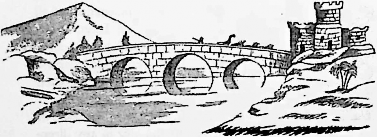
It was very natural, says Geikie, that Matthew should celebrate an event so unique as his “ call,” which he did by giving a great feast in his own house. . .
This " Great Feast" of Matthew doubtless followed the “ call ” as immediate as it could be arranged. Jesus called Zaccheus, Matthew’s brother in occupation, and the entertain-ment followed at once.
All the synoptists connect the “ call ” and “ Feast." Why, then, disconnect them, as some writers do? Let us not falsify these three witnesses; Matthew himself who was there, Mark and Luke, who each connect the call and feast, and especially Luke, who says Matthew forsook all and followed Jesus. If he returned to his house and friends he could not have " forsook all.” * Matthew was a wealthy tax-collector. The evidence of this is plain. 1. He owned a large house in the city (Luke 5: 29). 2. He gave a “ great feast.” 3. He had numerous friends—a great multitude, as we arc told by Luke. That the house was large, we find proof in its holding a great multitude, all in the “ guest chamber," for there only would the triclinium be spread. Only a wealthy man could support such a table.
A triclinium was the table and couches used by wealthy orientals. It was a hollow square open on one side for the entrance of servants, or those who served the guests. The guests lounged upon couches behind the tables, or the tri-clinium.
In order to accommodate a " great multitude," the table must occupy a large room. Beside Jesus and His disciples, of whom there may have been the full number, twelve, by this time, and the publicans of Matthew, all of whom reclined at the board at one time, there were many Pharisees standing At a time when Matthew had been absent and could not have gotten ready for it, Andrews makes it in the autumn, for which there is no authority or reason. fHe was ( eating with publicans and sinners" (Malt. 9: 11); also with the disciples and the above (Luke 5: 30). around behind the recliners, watching and finding fault be-cause Jesus and his disciples ate with these outcasts of society.
Then there also stood, behind these, another row consisting of the “disciples of John the Baptist (Mark 2: 18). These hungry, forsaken men did not wonder so much why Jesus and His well-faring twelve "ate with publicans and sinners,” as why they ate at all!
“ Why don’t you fest ? ” said they, standing looking longingly at the savory meal of the late tax gatherer, and the disciples of Jesus eating with their Master," Why do you not fast, as we poor, hungry fellows do ? Here you are eating and drinking like gluttons and wine-bibbers (Luke 7: 34), while we are starving! ”
In fact their support was so invisible that the Pharisees had accused them of being devils (Matt. 11: 18), who could live on nothing, and “ fast on fires,” like Hamlet’s poor ghost-parent.
Was ever honored guest so harassed at a feast as was Jesus at this meal ?
First the Pharisees, unbidden and unwelcome, came into the very “guest-chamber,” with easy oriental freedom, and indecently and openly criticised the company of the Great Teacher, in whose honor the feast was set What assurance! Jesus could scarcely have had time to answer these men, who rather deserved to have been cast out than respected with a courteous answer, and began the first course of the meal, when another source of annoyance occurred—the questions of John’s hungry disciples.
With great patience, and no little eloquence and rhetorical beauty, did Jesus turn and answer these unhappy men. He even illustrated the difference between the old dispensation and the new, them and his disciples (rather their teachings), by a parable of the new wine in old bottles, that the two could not go together, but henceforth there was to be new wine and new bottles. This was a figure purely oriental, but one within the comprehension of the men who should receive it They were intellectual men. No sooner was He done with these, in fact " while He was yet speaking these things ” (Matthew says, and he was there), there was a great stir outside; the common people stood back, or bowed in reverence, and there entered a man of the nobility.
There can be no doubt of Matthew's chronology in this whole narrative .of the feast, and what there took place. Matthew was a ready and methodical writer.—Dr. Abbott It was a great day for Matthew; he immortalized himself on that day, and being a writer and one familiar with putting down details in his peculiar business, made a business of writing the particulars in order of this his greatest day.
Jairus entered the guest-chamber.
He was a local dignitary. He directed the whole affairs of the synagogue (Talmud, quoted by Lightfoot). It was at an early period of Christ’s work in Capernaum. Jairus could never have overcome the rabbis’ accumulated prejudice against Jesus at a later period and come humbly to Him for a favor. • .
Jairus bowed before Jesus, saying:
" I have a little daughter at my house, who is about twelve years of age, who lies at the very point of death. Come, I pray you, and save her.”
"And Jesus arose (from the table)," and so did His disciples, and followed Jairus to his house.
It was a long walk, for when Jairus left the house the child was alive, but before he got back with the Physician—that was all Jesus was to him or his household—servants met him, saying:
“ Do not trouble the teacher further, thy daughter is dead ” (Farrar follows this order).
Jairus and those of his house did not expect Jesus to save her if dead / It never entered into the realm of possibilities in their world.
Such a thing was never heard I Nain was but a few hours away; Capernaum was the every-day market of her people. If the raising of the widow’s son had first occurred, would not Jairus and his household have known the fact, and not now “ despaired," as they evidently did? The report of such a mighty miracle would have travelled over all Galilee as by electricity—and did.
"Now great fear came on the ruler.”—Mark 54 36. All hope had departed: the child was dead!
" Fear not," said Jesus, encouragingly," she shall live; only believe.”
They reached the house.
What sounds are those greeting their ears ?
“The dirge of the flute-players," says Matthew (9: 23). "The mourners weeping and wailing," says Mark.
The poorer families must dispense with the former, but none were so poor as to do without the " professional wailers.” Here, however, with indecent haste, the musicians and wail-ing women had entered, and “begun the tumult"—FOR PAY.
" There was always a horrible clamor at Eastern funerals ; this had already begun, for early burials were usual.”—Dr. P. Schaff.
" Why this tumult and weeping? ” Jesus demanded. “Cease it: she is not dead, but sleeping.”
A loud and scornful laugh greeted this announcement “ Put them all out,” said Jesus, with authority.
Taking Peter, James, and John, and the child’s parents, Jesus entered the inner chamber, and taking the child by the hand, said, in the Aramaic language, the endearing words:
" Little maid, arise."* “And her spirit returned: and she rose up immediately,” says Luke.
Great amazement seized upon the parents.
Well may they have been “ amazed with a great amaze-ment,” as Mark says, for “ it was the first miracle which mani-fested the Master as Lord over death and life.”—Cook.
But Jesus, calm and commanding, said to the mother:
^Talitha Cum, a word of endearment to a young maiden, equivalent to " Rite, my child.”—Alford. “ Mark has the diminutive, ‘ little maiden? ”—Dr. Cook.
“LITTLE MAID, ARISE." 223 “ Give her something to nourish her."—Mark.
Next, “ He charged them (parents and disciples) to tell no man what had been done.”—Luke.
Nevertheless the fame of this first miracle of raising the dead spread all over the land. Matthew, who stood outside at the time, tells us of this later, while Peter, inside, re-ports through Mark (at a later date) what he saw there.—Dr. Schaff. ’
The works of Christ were progressive. His work of heal-ing “ may be contemplated as an ever-ascending scale of diffi-culty, each a greater outcoming of the power of Christ than the preceding.”—Trench.
Let us compare this with the raising at Nain.
This child was not dead when Jesus was called. It was not expected that if dead He could raise her. At Nain He may have gone on purpose to save the widow's only son and support He went secretly in to this child, when it was known that she was dead; * He permitted no witnesses save five.
At Nain He met a large funeral in a public way, and before them all, and His own retinue, probably a great throng,! He openly commanded the son to rise, though he had been dead a day at least. This child had barely expired when He raised her. There was nobody's certificate of her death save interested mourners ; whereas the widow’s son could not have been borne out of the city without a certificate of death.
The latter was the greater and stronger case.
So great and new was this miracle that all the synoptists record it minutely, while the one at Nain, ceasing to be so wonderful, being the second, that Luke only mentions it.
One more evidence that the Capernaum raising occurred before that of Nain lies- in the report of each. The first was * Death is spoken of in the Talmud, in a hundred instances, as “ sleep " (Lightfoot). See Ps. 13 : 3, “ The sleep of death." Job 3: 13, “ I should have slept.”
+ A great multitude, and His disciples, implying the twelve—Luke 7:11. soon reported in all that country (Matthew). The other was reported in Judea (Luke), as it would be a repetition to report it in Galilee, where a former raising was already widely known.
John’s disciples were present at the raising of the widow’s son (Luke 7: 18), whereas they were excluded from witness-ing the raising of Jairus’ daughter, though with Jesus at the hour previous (Matt. 9; 13). In the raising of the dead I fail to find the least proof that Nain was before Capernaum.

Chapter XXIV
The Second Circuit
Time—Mid-Summer of A. D. 28. PLACE—Capernaum and vicinity.
Having completed the num-ber of His disciples, Jesus appointed a place in which
References
Luka 0: 12-38.
Matt. 5,6, 7 Cha.
and 8: 1.
Mark 3: 13-20.
to meet them in the morning (Luke), while He went out over night to the mountain alone, to pray.
The phrase " the mountain ” implies a near and prominent one, and the fact that He merely “ went out,” also that the Twelve followed early in the morning, point to the same conclusion. “ He called whom he would.”
Tradition has chosen a hill, some ten or eleven miles distant, called the “ Horns of Hattin,” a hill with two horn-like heights rising less than a hundred feet above the plain be-tween them. It lies ” two hours west of Tiberias,” says Geikie. (Actually seven miles.) .
The village of Hattin lies under the base and at the north and east side of the mountain. The route and the village have already been described in these pages. From Capernaum it is a crooked and rough road, first down the coast to Mag-dala, thence through the once robber-infested gorge, up a steep and rocky ascent, and so on to Hattin.
The spot designated, where Jesus met the twelve, is said to . (225)

be on the southeastern slope of the second horn. Says Dr. Thomson, “ it is needless to add that there is not the slightest evidence in its favor," though he was taken to the very stone upon which the Great Teacher is said to have stood. Mat-thew informs us that Jesus “ sat," while teaching these disci-ples.—5: 1.
The selection of the Twelve Apostles marked another turn-ing point in the life of Jesus. These men were to represent a New Spiritual Israel. Their number corresponded with the old heads of the tribes of Israel.
The following list is from Matthew:
“The names of the Twelve Apostles are these—“ The first, Simon, who is called Peter, “And Andrew his brother." (These were sons of Jonas.) ” James and John, the sons of Zebedee.
“ Philip and Bartholomew, Thomas and “ Matthew the publican; James of Alpheus, and Thaddeus. “Simon the Canaanite, and Judas Iscariot, who also betrayed Jesus." Luke says, “ the traitor.”—See Disciples, Part Second.
With the exception of Judas Iscariot, all were Galileans; several of them were fishermen, and all were laymen, i. e., there was neither rabbi nor priest among them. They have been regarded as illiterate men (Acts 4: 13), but by this is understood not that they were specially ignorant, but that they were not versed in the rabbinical literature, the scho-lastic theology of the age (Dr. Abbott). Of their occupation four were fishermen. Philip is said, in the ecclesiastical legends, to have been a chariot-driver, and Bartholomew a gardener and shepherd (Geikie). .Like Matthew,whose name was changed from Levi on becoming a disciple, Nathanael's was changed to Bartholomew. Matthew was a tax-collector of the city of Capernaum. James the Less and Jude, called Lebbeus and Thaddeus, were also of Capernaum (Geikie). Philip was of Bethsaida, as also James and John, sons of Zebe-dee and Salome. Nathanael was a Canaanite, as also Simon the Zealot The Zealots were an extreme political party
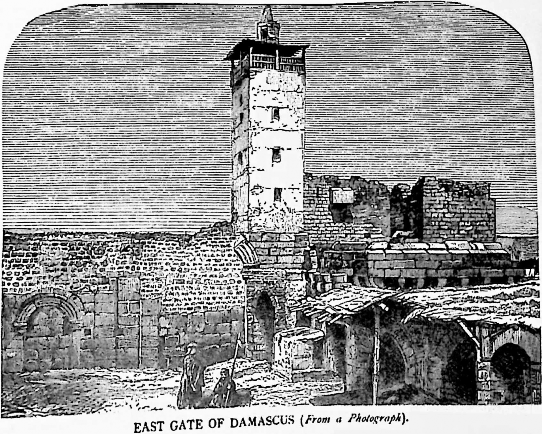
among the Jews, corresponding to our Fenians in Ireland, who were determined never to acquiesce in the Roman rule (Morrison). Thomas probably belonged to the vicinity of the Lake of Galilee. After the crucifixion we find him with Peter and those other disciples, who formed a fishing party on the lake.
“ I go a-fishing again," said Peter.
“ We will also go with you," exclaimed Thomas and the other five. So they launched forth.—John 21: 1-3.
Lastly, Judas Iscariot.
He was probably of a village—Ish-Kerioth, “ The man of Kerioth"—in the southern part of Judea (Joshua 15: 25). His father's name was Simon (John 6: 7), of Iscariot.
Such was, briefly, the band which Jesus organized early on that day in the mountain. It was a regular organization, of whom Peter was the chief and the speaker, or mouth-piece, for the rest. (See Smith's Bible Die.) John was the secretary (Rev. 1: 1,2 and 11), and Judas the treasurer. He doubtless entered the band with mercenary motives (John 6: 64). I think John so implies.
This band of thirteen could not well travel from place to place, their circuits sometimes embracing a hundred miles in space, and several weeks in duration, without money to bear their expenses. This fund may have been started by Matthew, in the sale of his business—always commanding a bonus—and his elegant house in Capernaum, all of which he forsook. We learn from Luke (8: 3) that this fund was augmented from time to time by contributions from those whose gratitude for life and health at the hands of Jesus led them to “ minister unto Him of their substance." Among the?- wealthy con-tributors were Mary Magdalene, Joanna the wife of Chuza, Herod’s steward at Tiberias, and Susanna, with many others, not named.
With this fund Judas Iscariot was intrusted.
“As soon as the twelve were recognized as a body, travelling hither and thither with their Master, receiving and dis-tributing money, giving to the poor (John 13: 29), it became necessary that somebody should act as the steward ” of this no inconsiderable fund. This stewardship fell to Judas.
—Wm. Smith.
In the excitement of the last journey toward Jerusalem, when the people were crowded so thick that they trod upon each other, all expecting Jesus, as the son of David, soon to take His seat upon the throne, as the successor of His father, many people must have cast their substance into the treasury of the disciples, until the fund increased to no inconsiderable sum. “Then the Judean peasant found himself intrusted with larger sums of money than before, and with it came covetousness, unfaithfulness and embezzlement.”—Smith.
John reveals his knowledge of this latter in very plain terms. He says of Judas, “ He was a thief, and having the bag (or money-box—see revised version), he took away (a mild term for stole) what was put therein.” This, plainly, was “embezzlement."—John 12: 6.
Judas was expected, by his Master, to distribute money to the poor (John 13: 29), but he cared nothing for the poor, and kept the money intended for them.
He was a hypocrite, and pretended to pity the poor. John understood this then (there was no way to learn it afterward), and Jesus too must have known it, but He rather mildly re-buked Judas—perhaps others present—saying, “ The poor ye have always with you, but me you have not always.” See “NIGHT OF JUDAS," in Part Second.
I consider Judas Iscariot the most infamous character named in the Gospels.
One question rises in every mind respecting Judas: Did Jesus select him as a disciple ? Or did he elect himself? To the eleven Jesus said, “Ye did not choose me, but I you'' Judas was then gone from them forever!—John 15: 16; 14:
31.
A great deal has been said and written about “ The Sermon on the Mount” But was there really any sermon? Was there actually anything but private instructions to the twelve?
Let us carefully examine and compare the synoptists.
Jesus left Capernaum at evening, to avoid the multitude, and sought seclusion in a mountain somewhere in that vicinity. This retreat He made known to His disciples, that they might come to Him early next morning, to be instructed as to their future course of conduct (Matt 5: 1; Mark 3:
13, 14; Luke 6: 12, 13). Very plain I The disciples came as Jesus appointed. (Do.)
“And seeing the multitude,” says Matthew, "He (Jesus) went up into the mountain, and His disciples came unto Him.” None others Just as John says on another occasion when Jesus wished to avoid the crowd and gain a bit of respite: “And Jesus went up into the mountain, and there He sat with His disciples.” As in this case, so in the former, Jesus went away from Capernaum to avoid the crowd. In neither case do the multitude " below ” follow Him and the twelve. In both cases Jesus seems to have looked down and discovered the multitude below, or at a distance. In both instances He, after a time, came down to them.
There are other instances, similar, in which Jesus took His disciples and went away at night, or early in the morning, in order to avoid the throngs of people—to Tyre, Sidon, Caesarea, etc.
Whom did Jesus teach on the mountain ?—Matt. 1: 5.
His disciples, and they only.—Matt, Mark, Luke.
Matthew mentions none other, except that multitude behind which Jesus would,avoid*—and says:
" His disciples came unto Him and He taught them, saying.” Then followed His instructions to them, such as He gave to none others during His entire ministry.
Matthew was a ready and concise writer, and of these in-structions—" teachings " really in the text—he has given us a full report We all understand that in chapters five, six, and seven, Matthew has recorded much matter not given at that time and place, nor to the twelve alone. The matter re-corded in chapter five (21-33) evidently was said at or near *« Now when Jesus saw a gteM multitude about him, he gave orders to depart into the other side,” Matt. 8: 18; just a parallel case with Matt. 5 : 1.
230 NOT A “SERMON ON THE MOUNT.”
Jerusalem, where the “council” sat, where the "altar" was, and where “Gehenna” was located.
Mark’s testimony, like Matthew’s, refers only to the dis-ciples being on the mount, and Jesus’ instructions to them only (Mark 3 : 13-19). “And He appointed twelve.” '
Luke also refers only to the disciples being with Jesus on the mount (Luke 6: 12-17). He says:
" Jesus went out into the mountain to pray, and He con-tinued all night in prayer to God (12.)
“And when it was day, He called His disciples, from among whom He chose twelve” (13), or had chosen.
"And He lifted up His eyes on His disciples and said” (20). Here Luke gives a synopsis of Christ’s instruction to His dis-ciples, as recorded by Matthew:
“ He taught them,” Matthew says. He did not preach as at the sea-side.
Where then was the much-talked-of “ Sermon on the Mount ? ” I utterly fail to find it.
The very reverend and learned Canon Farrar says:
" When the multitude were seated on the grassy sides of that lovely amphitheatre, He (Jesus) raised His eyes, opened His mouth (2), and delivered, primarily to His disciples, but intending through them to address the multitude, that mem-orable discourse, which will be known forever as ‘ The Ser-mon on the Mount.' ”
Will not the gentleman stick to the text, and observe that there were no “multitude” on the mount, but that Jesus had left them behind the previous night ?
Andrews labors heavily to follow the " tradition ” and ex-plain “ a Sermon on the Mount” Will not that gentleman also first prove a sermon anywhere ? He refers (Life of Our Lord, p. 250) to the "contradictions” of Matthew and Luke (as per Alford and Meyer, marginal note), and “discrepan-cies.” find neither “contradictions” nor “discrepancies” in the gospels; merely displacement of texts or want of chrono-logical arrangement of subjects. Nothing more I Matt 5: I A BEAUTIFUL HARMONY. 23] agrees with Luke 6: 20, ending with verse 45. Matt 8: 1 agrees with Luke 7: 1.
Luke says (17) that Jesus “came down and stood on the plain.” He never “stood" to preach. He “sat” on the mountain, in the boat, everywhere, when He preached or taught; but Luke does not intimate that Christ here did either. "He healed their diseases" (17). This should be after verse 20, where “Jesus lifted up His eyes on His disci-ples," not on a multitude.
“And when He was come (past tense, equal to 'after') down from the mountain (near Capernaum, Luke 7: 1) the multitude followed Him,” says Matt. 8: 1. There, on the plain, He healed them.—As per Lyke 6: 17.
The sense of the whole matter seems plain enough.
Jesus retires overnight to avoid the multitude. “Oh seeing the multitude He went up into the mountain,” to avoid the multitude, leaving them behind; but (2) His disciples knowing the place appointed (Mark and Luke) followed early "next day.” 3. After selecting (better, ratifying) His disciples, He instructed them, and them alone, in' their duties (Matt. 5: 1, 2; Mark 3: 13, 14; Luke 6: 13 and 20). “And He lifted up His eyes on His disciples, and said, Blessed,” etc. (as per Matt. 5: 1). The evangelists give no intimation of any but these disciples being present, and positively none others being there taught. 4. After this He, with His disciples, " came down"—first to His house (Mark 3: 19). "And the multi-tude cometh together again ” (20). "And when He was come down from the mountain, great multitudes followed."—Matt 8: 1.* His retirement was twofold: 1. To avoid the multitude; and (2), to ratify (instruct) His disciples. This accomplished, * I am well aware that Luke says, that “ after He had ended all these laying* in the ear* of the people, He entered into Capernaum" (7: 1); but I am also aware, as Dr. Abbott says, “ that Luke has inserted utterance* of Christ out of their original connections.” Luke may refer to some other occasion, as verse 42, ch 6, just before, implies, in “ Thou hypocrites,” as much. His disciples often erred, but He did not call them hypocrites.
He returned to His house in Capernaum, and to the sea-shore, and taught and healed.
Should we follow some modern commentators, we would be more astonished by the miracle of the people, in dragging so many crippled, maimed, blind, diseased, and “ possessed ” creatures up into the highest mountain west of the lake, there to be healed, than by the miracle of Christ healing them after they were there!
The multitude was on the plain Gennesaret, which to avoid a second time Jesus crossed over the lake.—Matt 8: 18; Mark 4: 36.
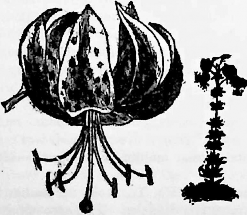
Chapter XXV
Capernaum.—A Short Stay
Time—Last part of Summer, A. D. 28.
We do not expect to trace all that Jesus did at this exciting period of His ministration. Evidently
References
Marks: 7-12.
Mark 3: 20-30.
Luke fl: fl, 11.
He was home again before the “ next Sabbath," or that His absence was less than a week in duration. Neither do we know what great cures He wrought at this time. " The gospels afford us no chronological sequence in this direction." Some writers think the healing of the man with the withered hand occurred at this juncture. We have placed it earlier, for good reasons named.
One remarkable feature of that occasion was the union of the Pharisees and Herodians, two opposite elements in Jewish society.
This we are assured of: that there was so great a throng gathered about Jesus from all Palestine, that he again resorted to the sea-shore for an auditorium, and “ the ship" for a pulpit. • In these early days of discipleship, and its importance to both themselves and the throng who observed the remarkable twelve continually waiting on the new Teacher, the excitement was so intense, it is not strange that the records were, at this time, meagre and uncertain. Evidently the daily events crowded upon the heels of each other so hurriedly that Matthew failed to record them under the excitement, or Peter to remember them, and John, having left them entirely to the Galilean dis-

ciples to record, gives us no help at this most active period of Christ’s ministry. .
Beside healing and preaching by the sea-shore during the morning of each day, we know that Jesus, as was His custom, would resort to His home when it came evening.—Mark 3 :
20. R. V.
"And He entered into His house," or home.
There the crowd followed from the shore, while others were continually coming, pressing one upon another, clamoring and bringing their sick and lame from everywhere, till the house was crammed and there was no opportunity to even eat a meal of victuals.
Among these last arrivals were the family and friends (i. e., relatives) of Jesus. They had seen, or heard, so much of His works, and such conflicting reports had reached them, believ-ing the evil reports of the Pharisees who said that Jesus was a demoniac, rather than the good reported by those whom He had healed, that they came trying to secure Him—“ Lay hold on Him "—and take Him away.
“Yes,” said they, " He is beside Himself!”
" Certainly He is,” declared the emissaries of the Sanhedrin of Jerusalem (Mark 3 : 22). “ He has the worst kind of a demon—Beelzebub, the very prince of devils, and this is the power by which He acts.* Seize Him and bind Him.”
But they did not seize Him. On the contrary, Jesus called His maligners to Him, and by argument refuted their charge.
“How can Satan cast out Satan? If his kingdom is divided against itself it will fall,” said Jesus.
By this argument He showed the weakness of the charge made against Him by the scribes and Pharisees. It was the very boldness of desperation which induced these maligners * The Jews entertained the belief that a power was conferred upon certain of them to exorcise demons (Acts 19: 13; Josephus, Ant. 8: 2,5; Wars, 19: 13). The expression of Jesus, “ By whom do your sons cast them out ? ” (Luke 11: 19) does not admit that they actually did cast out devils, but that they pretended to. Their whole religion and outward life were a pretence. The “sons ” may refer to “ seven sons,” or “ seventh sou,” as in Acts 19: 14. of Jesus to present such a miserably weak charge as they did at this hour of the Lord's prosperity.
But the people were weak also and very superstitious. The rabbis depended upon these two passions of humanity to ex-cite them against Jesus. They had believed it the power of God made manifest in the flesh, by which Jesus performed these miracles; but if they could be made to believe it the power of evil, a much easier task usually, Christ's works would come to naught Unless we understand this condition of the multitude, we shall fail to understand the importance at that time of the infamous charge brought against Jesus.
“ He hath Beelzebub.”—R. V.
It was by the power of the Holy Spirit that Jesus wrought His miracles, and to say it was by the power of a most filthy and wicked spirit—embodied in the explanation, " He hath an unclean spirit ”—IT WAS A “ BLASPHEMY AGAINST THE HOLY SPIRIT.”
It is useless to labor and write tomes and tomes, as has been done, on this subject—“ What is the blasphemy of the Holy Spirit ? ”—when the text explains itself—“ Because they said He hath an unclean spirit”
That was the blasphemy.
The scribes annihilated, what did Jesus do with His friends, or kinsmen, who came to “ lay hold on Him ? ”
Did they try to “ bind Him ? ”
“ But no one can enter into the house of the strong man, and spoil his goods, except he first bind the strong man ” (verse 27). He could not be bound.
Was this an answer to His kinsmen, or to the scribes ? Both, perhaps.
Probably at this same time came His mother and His brethren (Mark 3: 31), desiring to see Him. “They stood without, and sent in word, calling Him."
It was at a time when “ there was a multitude sitting about Him.” It was at a place called His house or home. It was with a multitude who came from all Galilee. It may be safely placed here at this season.
Chapter XXVI
The Journey to Nain, and Raising of the Widow's Son
Time—Autumn of A. D. 28. Place—Nain, about twenty-five mile* from Capernaum.
The visit to Nain is recorded by Meferences. Luke 7: r 1-35. Matt. xx: a-17.
Luke only:
“And it came to pass soon afterward that Jesus went to a city called Nain, and His dis-ciples and a great multitude went with Him." The same multitude as at Capernaum.
NAIN was a small walled city situated on the west and north slope of a hill called Little Hermon. The name means “ fair"—a fair city. Its fine prospect, overlooking the beautiful and fertile valley of Esdraelon, warrants the appellation.
Little Hermon forms part of the ridge of Palestine, from which all the water on the west flows into the river Kishon, and that on the opposite side, being the water-shed for the wadies eastward, swell the Sharar and the Jordan.
The route from the lake to Nain is as follows:
Leaving the landing at Capernaum, after the preaching and the dispersing of the multitude, Jesus set out for Nain. Just as on another occasion, mentioned by Mark—“And when evening was come He left them . . . and set forth."—4: 35.
On this occasion they probably took the boat and sailed to the foot of the lake, as described in chapter 14 of these jour-neys. Boats were very plenty at that day, and the great mul-

titude followed by sea and by land, as at the time of feeding the five thousand.
Landing at Taricha, the great fish-pickling place of the lake, they could there pass the remainder of the night, and on the “ next day ” (as per Luke, A. V.) could easily reach Nain by 2 P. M. This simplifies Luke’s statement The course would be down along the west bank of the Jordan. to. the Wady Sharar, thence westerly nearly eight miles to near Mount Tabor, passing it on their right hand. From here to Nain, past Endor, is only four miles.
Have we before noticed Mount Tabor?
I think so, but we may observe it from this point to advan-tage. Looking northeast from the wide plain north of Endor, you see a conical elevation of 1,400 feet above you. Looking at it from different points, it presents different appearances; from the north you have a rounded, woody hill, but this southern side is mostly barren and rocky.
If you climb to its summit, you have one of the grandest views in all Palestine. East, you have the river Jordan and the Sea of Galilee at your feet; westward the far-off blue waters of the Mediterranean glisten in the sunshine. Endor lies across a lovely valley a few miles southward, facing us.' It was in Christ's time a large and beautiful village, four miles south of Mount Tabor. Eight miles south is Mount Gilboa. '
We approach Nain from the east Here are the ruins of the very tombs of that day. " They are situated mainly on the east of the village, and it was in that direction, I presume, that the widow's son was being carried,” when Jesus met the funeral cortege. The Jews bury their dead on the day of the death. If this young man had died that forenoon, he would have been carried out by two o’clock in the afternoon.—See Thomson, 445 ; Geikie, Ch. 39.
Jesus met them near the gate of the city.
Doubtless Jesus knew the widow, and had been well ac-quainted with her son, the deceased, for they had been neigh-bors during thirty years. Nain was but five miles distant, and the next village, from Nazareth. In fact, I believe that Jesus knew of this death; hence His sudden departure from Capernaum, and His timing this funeral to a moment.
A great concourse accompanied the funeral. It was cus-tomary as a funeral passed along the street for every Jew, who saw it, to join the procession. The Talmud says, " Whoso-ever sees a corpse carried along and does not accompany it to the burial is guilty . . of reproaching his neighbor.” May not Christians here learn a salutary lesson ?
So it was a great funeral that Jesus met.
“At this bright and happy period of His ministry, He was accompanied not only by the Twelve, but also a large and rejoicing throng." What a contrast between this glad procession, full-of high hopes and erring beliefs in the coming king-dom of this Messiah, sing-ing praises and shouting hallelujahs, as they drew nigh the city gate, and the sombre funeral train, with the widow weeping by the open coffin of her only son, and a band of mourners wailing, coming out of the
A CITY GATEWAY
city I These tides meet in the narrow, winding pathway. "Haiti” said Jesus.
The bearers set down the bier. A mere open frame is still used as a bier in Palestine.
" Jesus came nigh and touched the bier.”
If He had touched the dead He could not have entered the city clean, and afterward dined (or supped) as He did with the wealthy Pharisees that same day. .
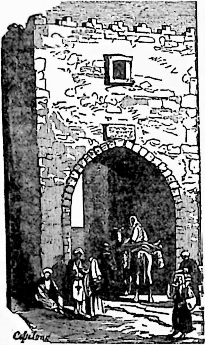
Speaking words of consolation to the mother, Jesus said to the dead: “ Young man, I say to you, arise.”
“And he that was dead sat up and began to speak.” “And He gave him to his mother."
Luke says that all glorified God.
“And this report went forth, in the whole of Judea, and all the country round about”
Evidently the whole company entered Nain, else Luke could not have said, in the outset, that “Jesus and his dis-ciples and a great multitude went to Nain,” implying that they went into Nain.
Before Jesus left Capernaum for Nain, we find in His pres-ence the Twelve, a large multitude, and the disciples of John the Baptist Following Him to the gate of Nain were these “ disciples and the multitude,” and, according to Luke, again, the disciples of John (Luke 7:11: disciples and multi-tudes; 18: disciples of John). Does not this evidence warrant us, in absence of conflicting testimony, in locating what next followed in Nain ?
We believe it does.
Further convincing evidence lies in what followed.
John’s disciples came (let us say here at this hour) at Nain, and asked Jesus in the interest of John, “Art thou the Messiah who should come ? Or, do we still look for Him ?—or look we for another? ”
Jesus detained them, while He, “ in that same hour," cured many of diseases. Then He answered them :
“ Go tell John what things ye have seen, and heard,” viz.:
“ The blind see, the lame walk, the deaf hear, and the dead are raised; ” " for ye have seen these things.”
When ? “ At that same hour.”
Where else and when did they see the dead raised ?
Not at Capernaum, for none, save James, John and Peter, with the parents of the child there, saw that raising of the dead. Therefore, they were in that throng outside of the gate of Nain and saw the raising of the widow's son. This is true, or words are of no value.
Having, therefore, by internal evidence, established the fact that John’s disciples were at Nain, at the raising of the dead, we may believe that they followed Jesus and the multitude into that city and witnessed what there occurred.
In his message to John, it seems that Jesus referred back to the prophecy of Isaiah, and what should come to pass when the Messiah came. John would understand it all—ex-cept the latter, viz.: (61 : 1): “the opening of prisons and setting the captives free.” Was this latter not to come to pass when the Messiah came? Had not Jesus already ap-plied it to Himself, at Nazareth, some six months previous (Luke 4: 18), and John all this time languishing in prison ? Could not John say:
"I am a captive; I am in prison. When the Messiah comes I shall certainly be set free. This is my consolation. Now if this is the Messiah, why do I languish in prison ? ”
Upon this point Jesus did not touch, but said:
“ Go back to John and tell him what you have seen, even to the raising of the dead. ‘And blessed is he if he shall not find occasion in me to stumble.’ ”—Luke 7: 23.
And they went back to John and showed him all these things, says Luke. Evidently, verse 18 belongs after verse 23.
Where was John imprisoned ?
In Tiberias, probably. Not in “ Machrus ” (as Josephus only says), as we shall show when we come to record the death of John.
Once there was a man who plowed and furrowed his meadow up and down, and year after year the rabbits ran up and down in these furrows; but if he had furrowed it cross-wise, the rabbits would have run crosswise instead of up and down. This is a very true fable. Josephus said that John was imprisoned in " Machrus,” a castle and prison owned by the enemy of John's captor and jailer, and many, without examining the ground critically, have since followed in the furrow of that boastful and unreliable Jewish-Roman historian. But we leave this for the present, and follow the journeys chronologically.
When the disciples of John had departed, which seems to have been at once after receiving the message of the Lord, He turned to the multitude—that same multitude that had kept with Him all day—and then and there delivered upon John Baptist one of the finest eulogies ever pronounced upon man (Dr. March). But to the Pharisees condemnation.
“ What went ye out in the wilderness to see ?
“A reed shaken in the wind? A man clothed in soft raiment ?
“ Behold, they who wear soft clothing are in kings’ houses.” “ Who went ye out to see ? A prophet ? ”
“ Yea, I say unto you: and more than a prophet. No greater man hath risen than John the Baptist. . . . And if ye are willing to receive him, this is Elijah which was to come.”—Mal. 4: 5. .

Chapter XXVII
Nain—The Dinner with the Pharisee
Time—Early Autumn, A. D. 28. PLACE—Nain.
The dining with a Pharisee and anointing are men-
Reference
Luke 7: 36-50.
tioned only by Luke, and are not to be con-founded with later events of a kind mentioned by Matthew, Mark, and John."
Among the differences are these—though each was a “Simon"—one was a Pharisee, the other a leper. A leper could not be a Pharisee (Talmud). One was in Nain, the other Bethany. Of the two women who anointed Jesus, one was a “sinner” in Jewish eyes, the other a pure and holy woman. One, at Nain, anointed Jesus’ feet (Luke 7: 46), the other, at Bethany, anointed his head (Matt 26: 7). The first necessarily approached Jesus from behind as He lay on the couch (Luke 7: 37); the other, being a mistress of her house and one who served at the triclinium, was free to approach before.
What called the attention of this Pharisee of Nain to Jesus, and why did he invite Him to his house?
Jesus had walked all the way up from the Jordan that day: He had raised the widow’s son, taught the people, and healed the sick for one hour; despatched John's disciples, and pro-nounced the eulogy on the Baptist. In this latter He had referred to John’s fasting, and His own and His disciples' custom of eating and drinking when they had an opportunity, which, indeed, was often denied them; following upon which

announcement (Luke 7: 34, 35) the Pharisee invited Jesus to eat at his house. This is all we can say as to “ cause of the invitation.”
This Pharisee was very neglectful of all social and sanitary customs of the Orient He failed of the “ six water-pots of stone set at the door, after the Jews’ manner of purification,” in which was the custom to keep water for bathing purposes; he failed to provide ointment and brush for the hair and beard, and had omitted the universal custom of the kiss of welcome.
Th is Pharisee had probably invited his friends and rich neighbors, and thought he honored the Prophet by the invita-tion. If so he was disappointed, for "harlots” and “sinners” were before him in honoring Jesus.—See Ellicott in loco.
The dinner-bed, of three couches, therefore called a triclin-ium, stood in the centre of the room, with a space between it and the walls by which the guests passed to their places. The side of the square next the door was open so that the servants could have access to the tables, which were in front of the couches. The guests, when placed, reclined at length on the couches, with their faces toward the tables, and their feet extended outward toward the walls.—Kitto.
While Jesus was in this position at the table, the woman with the cruse of ointment (rather, a perfume) came in and stood behind Him, and with her tears wet His feet (from which, as was the custom, the sandals had been removed at the door), and wiping them with her long dishevelled hair, applied to them the perfume.
When the host saw this performance, he said to himself, " I have been mistaken in this man; He is no prophet, for if He were He would know what character this woman bears who touches Him.”
Jesus did know. He had seen her before. He had already rendered her a great service, commanding her lasting grati-tude.* " The forgiveness (47), by implication at least, is de-clared to have preceded the occasion,” says Professor Riddle * Ellicott, Cook, Meyer, Godet, Schaff, so understand it.
This leads us to inquire, who was this woman ? To us forever nameless!
There is a mistaken idea gone out into the world that she was Mary Magdalene. Roman tradition holds that it was Mary Magdalene, and that Simon's house was at Magdala, where Jesus stopped on his return to Capernaum.—Friedlieb.
For this belief there is no sufficient ground.—Andrews.
This woman, of this city, Nain, was evidently a well-known common woman (Luke 7: 37-39), whereas Mary of Magdala was of another place, a village down on the lake, and a woman of quality and wealth.* Was not Joanna a lady of rank and wealth? The wife of Herod’s steward? Mary of Magdala is twice mentioned before her. The synoptists usually place her name before all others, from which it has been inferred that she was a woman of higher rank than others.—Grotus.
She followed in the train of Jesus with holy women, like His mother, and Salome, and others. She contributed of her wealth to the support of the gospel in Galilee, and to the ex-penses of his funeral in Judea.
I conceive of her as a woman of fine understanding, and known virtue and discretion, with a dignity of behavior be-coming her age, her wisdom, and her high station ; while it is generally admitted that this woman (of Nain), described as a “sinner,” was of unchaste character.—Lardner; Andrews.
“Simon,” said Jesus, “I have something to say to you.” “Master, say on,” replied Simon.
Then Jesus related the well-known parable of the two debtors.—Luke 7: 41, 42.
Simon heard and answered honestly, not seeing the point which it was to illustrate; therefore Jesus, turning to the woman who yet stood behind Him, at the head of the tables, said:
“Simon, do you see this woman?"
“Yes." Simon turned about also and looked at her.
“ Whatever you have failed in toward me as your guest, in courtesy and hospitality, this woman has supplied. Therefore *Dr. Lardner on “ Magdalene Houses.”
I say to you, her sins, which are many, are forgiven, for she loved" much: you loved me little, and little is forgiven you." Then He repeated His words to the woman direct:
“ Thy sins are forgiven."
Let us bear in mind this fact, that in Jewish opinion all dis-ease and deformity were the result of sin. This woman had then been diseased in some manner unknown, and at a pre-vious season had been healed—“ her sins forgiven " hence this show of gratitude on her part. Here then Jesus repeated a former pardon, probably unknown to Simon and by him misinterpreted, and applicable to a moral sin only. The woman did not come to Jesus to confess a moral sin and ask absolution. There is no evidence of such. Christ here had, seemingly to the Jews present, openly pardoned a “ woman who was a sinner,” which only God could have done; there-fore they said:
" Who is this that presumes to pardon sins ? ”
Then Jesus changed the phraseology of His speech—
“ Thy faith (belief) hath saved thee—go in peace." Go whole ?
Whether the language used by Luke (8: i) applied directly • to what " soon ” followed, viz.: that Jesus and the Twelve, followed by others (2), went about in other places preaching, or applied to another occasion of departure from Capernaum, is not known; nevertheless it is presumed that they did go “ through other cities and villages ” at this time before their return to Capernaum, where we find them very soon after, as recorded in the next chapter.

Chapter XXVIII
Opening of the Parables
Time—Autumn, A. D. 28. Peloubet’s Notes, 1882, p. 69. " Afternoon." PLACE—By the Sea of Galilee, near Capernaum.
And AGAIN HE BEGAN to teach by the sea-side.
He had therefore taught there before.
Referencen
Matt. 13 : 1-53.
Mark 4; 1-35.
Luke B: 4-18.
Luke 8: aa, 25.
"And a very great multitude was gath-ered.” Literally, the greatest multitude yet seen there. It was a turning-point in His public teaching since the parabolic instruction now began (Schaff). His lifework was continually progressive.
As a worker of miracles in healing diseases, Jesus had arrived “at the acme of His supremacy.” The dead had been raised, as He had promised before the Sanhedrin at Jerusalem, at the last passover, and nothing greater could be done in that direction.
He now began the Parables illustrating the coming King-dom. He particularly taught His disciples by these, yet not wholly; hence we place this previous to any great or ex-tended Galilean journey. Nearly all commentators agree in this: that the parables followed the time of the visit of the mother and brethren of Jesus to Him, as also on the “ same day ” (Matt) in which He healed the blind and dumb man (Mark 4: 1). Possibly it occurred at the time when He returned to His home, and the multitude was so great that He and His disciples could get no opportunity to eat, and the house being too-small to hold them all, He again had recourse to the sea-shore and the ship.
The last is very evident, for the sea-shore was the only pos-sible place where so great a multitude could be accommo-dated.
“ How many days did the parables occupy ? ” Three.
“ How many parables are related?"
Seven. There were others given, not related by Matthew, as we learn by Mark 4:21.
“ What were the seven parables, related by Matthew ? ”
The first was the “ Sower,” the second the “ Tares," the third the “ Mustard Seed," the fourth the " Leaven," the fifth the " Hidden Treasure," the sixth the " Goodly Pearl,” the seventh the “ Drag-Net”
The time of their delivery seems, to me, as plain as their number, and is divided as follows—Matt 13: 1:
In the afternoon He went to the sea-shore and delivered the first parable of the sower. “ The first of the wondrous series was fitly the sower, for the planting of the New Kingdom must needs be the first stage towards further truths respecting it.” “ His illustrations began with the most simple and intel-ligible, each feature of which lay before Him."
It seems clear, says Farrar, that the Lord did not on this occasion deliver all seven of these parables. .. Seven parables delivered at once without interpretation, to a promiscuous multitude which He was for the first time addressing in this form of teaching, would have only tended to bewilder and distract. Indeed the expression of Mark, that they were given “ as they were able to hear it,” seems distinctly to imply a gradual and non-continuous course of teaching.
The first parable was even more than the Twelve could digest, and at its close—for short, compact sermons were the rule among the Teachers, as we have before observed—they came about Jesus “ when He was alone” (Mark 4: 10), and asked Him what was the meaning of “this parable” (Luke 8:
9) . Not all the parables, but this one of the sower. He could not have been “ alone " at the sea-shore; therefore, at the close of the first parable, He and his disciples returned home, and there He first explained the “parable of the sower” (Matt. 13: 18; Mark 4: 10; Luke 8: 10). “ Not unto them without" the house.—Mark 4: 11.
Another point of demarcation is found in the opening and closing of this first and important sermon. He began by-calling the people to order—“ Hearken! "—Mark 4: 2.
He next called their attention to the peasant in the field on yonder hill-side, not a quarter of a mile away, toward the west, in the very act of sowing the winter wheat. October was the time (Newton). This was the opening.
Next observe the closing:
Such is the result of the good sowing; “ and some an hun-dred-fold. He that hath ears let him hear." Rather let him digest and understand. All the synoptists give this closing of the first parable.
The first parable ending, closed the first day.
The second day of parables began with the “ Tares.” “ While men slept an enemy came and sowed tares."
Since the sowing of the previous day they had slept How apt, then, was the illustration! The enemy had been awake I Another parable of this day was the “ Mustard Seed.” The third parable of that same day was the “ Leaven." “All these parables Jesus spake to the multitude." “Then He left them, and with His disciples went into the house” (Matt 13: 36), and explained these parables “to the disciples.”
THIS ENDED THE SECOND DAY, and four parables. Observe now, that they are in the house.
“ Where did He deliver the last three parables ? "
In the boat—“ On one of those days—of parables—he en-tered the boat."
“ When He had finished (i. e., completed) these parables * (verses 44, 45 and 47) He departed thence.”—Matt 13:53 Therefore, on the third day He entered the boat, and His disciples, and delivered the last three parables—“ The Hidden Treasure,” “The Goodly Pearl,” and "The Drag-Net”
Then He and His disciples departed across the lake. Mark says, “ When evening was come, on that day,” i. e., of the closing of the parables (4: 34), “ He left the multitude and went with His disciples to the other side of the sea.”
This agrees with Matthew, who says, that, when Jesus had finished the parables, “ He departed thence.”—13: 53.
On the passage, He explained all the yet unexplained para-bles : “ Have ye understood them all ? ” He inquired on the boat.—Matt 13: 51.
“Yes," they replied.
This was after their departure (53), because they “ left when He had finished the parables.”
I have no doubt about there having been portions of three days occupied in the parables, nor that they were all—the seven and others referred to by Mark (4: 11)— spoken to the multitude, or "those without,” as per prophecy (Matt 13: 14), for Jesus said in privacy to the twelve—“ I spoke to them (without) in parables, because seeing they see not, and hearing they hear not, for unto you (11) it is given to know the mysteries of the kingdom of heaven, but to them it is not given.” “And without a parable spake He not unto them.”
—34.
It is plain, therefore, that Jesus spoke all the parables to the multitude, but only made explanations to His dis-ciples.
The net which would gather fish of every kind would be the drag-net. This was the kind used on the Sea of Galilee. While two men rowed the boat, others cast the net; while one, at least, swam around the craft and beat the water to scare the fish into the net. Usually a light was carried at the prow to attract fish, for it may be observed that this fishing was by night After this they rowed to the shore, and drawing up the net. selected the good fish therefrom, “ casting away the bad. So shall it be at the end of the age."—Matt. 13: 48, 49.
This style of fishing is still carried on at Tyre and other places on the great sea to this day.
Heatn-cock.
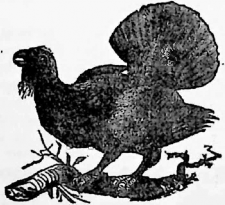
Chapter XXIX
A Journey Over the Lake
Time—About November, A. D. 28. 781. PLACES—Capernaum to Eastern Shore and Return.
i MMEDI ATEI Y on closing
References
Matt. 13: 53.
Matt. 8: 18-34.
Mark 4: 35-41.
9 the parables, the disciples of Mark 5: x-ax. Jesus “took Him as He was Luke 8: aa-40.
A in the boat," and crossed over the Sea of Galilee.
2 “ it was at evening,” about sunset 4 Now we are sure that the same boat which 0 had been placed at His disposal, and in which He usually sat to preach at the shore near Capernaum, is the one in which He and the twelve used to cross and recross the lake; and also, doubtless, to go up and down to Bethsaida and the lower end of the lake.
With due respect to the learned Dr. Schaff, who says “ it was a small boat,” we shall show that it was a large boat, compared with those other boats used on the lake.
This is the character of that boat:
It was a large boat It carried a sail, one, or more.
It was also a “ row-boat”
4 It was partially decked over, or had a cabin in the stern where Jesus slept.
The first request to His disciples, as per Mark 3: 9, was for a little boat—a very modest request Mark uses the di-
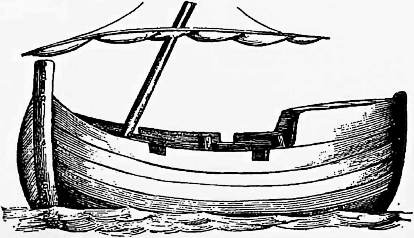
minutive where the other synoptists do not, as in case of Jairus’ daughter. Possibly the boat belonged to Peter or the sons of Zebedee, and was always at their Master’s service.—Ellicott But the boat carried safely thirteen men, with room for rowers in the centre, and a bed in the stern. It was compared favorably with the "little boats” which put out from Tiberias on the Sabbath morning after feeding of the five thousand (John 6: 22-24). It reads thus (R. V.):
“ On the morrow the multitude which stood on the other
THE GALILEAN BOAT, CARRYING THIRTEEN MEN
side of the sea saw only one little boat there, and that Jesus entered not (i. e., over night) with his disciples into the boat (little boat is not here used), but that His disciples went away alone."
“ But there were little boats from Tiberias nigh to the place where they ate the bread;" that is, at the shore where He fed the five thousand. “Therefore, when they found that Jesus was not there, they took these little boats and went to Caper-naum."
The multitude were evidently looking for a large boat—the boat of Jesus and His disciples.
It carried a sail, or was a sailing “ship.”
At the time of crossing, at evening, after the parables, they set sail: there being no indications of the gale that soon burst upon the ship. Luke says, “As they SAILED, Jesus fell asleep” (8: 23).
It was also a “ row-boat” When the “ wind " was contrary (Mark 6: 48), or blew a gale, “ the sea rising because of a great wind,” they took down their sail and " rowed."—John 6: 19.
It was lowest in the middle, so they could use their oars, but higher and drier astern, where Jesus "slept upon the cushion ” (Mark 4: 38, R. V.) " The cushion" implies a permanent one, or the cushion belonging there; it therefore follows that it was in a cabin, or safe place, comfortable and dry, while the rowers’ place, the centre of the boat, was filling with water. It was at a distance from them and out of sight, so they “ went ” to Him, and awoke Him.
Other boats started out with them (Mark), which either put back when the gale came down on them, or were lost in the terrible tempest. They are not again mentioned. It seems that Mark’s only object in mentioning them was to show that they could not withstand the storm. If it was a gale which they could have withstood, then there was no cause for the great fright of the disciples, crying out, “ O save us, Lord, or we perish ! " (Matt.); hence no miracle was performed in their being saved.
But it was a terrific gale.
What labors Jesus had performed “ at the house " mornings before going to the sea-shore to preach in parables, we do not know, but it seems that He did perform very exhausting labors during “ those days ” previous to going over the lake.
—Luke 8: 22.
There was no preparation. Jesus said, “ Let us go over the lake.”
“And they take Him with them, even as He was."
His sleeping amid the howling of the wind, and the roar-ing of the waves, dashing clean over the boat and flooding her, shows how great was the exhaustion of the blessed Saviour!
But the hoarse voice of Peter awoke Him—that voice at-tuned to the howling of the blast and breaking of waves on the rocky shore!
“ Master 1 Master! Awake or we perish I "
That voice awoke Him.
“And He arose and rebuked the winds and the sea, and there was a great calm " (Matt.) Then He rebuked His disciples :
“ Why are ye so fearful ? Why have ye no faith?”—Mark.
And while Jesus turned and looked out over the calm sea, Peter said to the others, for Peter was always the speaker:
“ What manner of Man is He, that even the wind and the sea obey Him ? "
As to proper reflections on “this stupendous miracle," let the faithless read Canon Farrar’s remarks in Life of Christ, chapter 23, on this miracle. They are excellent. Also Trench and McDonald on the miracles.
The wind coming down the lake from the north, as those winds always do, drove the boat out of a direct course, across the sea, and the disciples found themselves in a heathen coun* try at the southeastern corner of the lake. It matters little that Matthew calls this place Gergesa—“ the country of the Gergesenes;” or that Mark and Luke call it Gadara; the geographical and topographical conditions of the country have decided for us the place of the landing and the remark-able scene following.
The story runs as follows: * On the morning following the storm, as Jesus and his dis-ciples landed, a maniac who had been watching the unusual occurrence of a boat coming to that remarkable spot when “ afar off,” ran down the mountain nigh (Mark), and as soon as Jesus had landed hailed Him wildly as—
“ The Son of the Most High God."
" Hold your peace ! Jesus commanded, for He would never allow those maniacs to declare Him. How soon would the * Observe that Luke says " There came drum a storm of wind," whereat it it customary in common ph rate to say “ There 'comet up a wind,” as “ A storm it coming up." wicked Jews catch it up, and fling it into His teeth, that" Only those possessed of devils acknowledged Him as Son of God?"
" What is your name ? " Jesus asked the maniac. “ Legion: for we are many," he replied.
There is a species of insanity which leads the poor victim to believe that legions of devils constantly surround him.
Tacitly admitting the delusion of the maniac, Jesus com-manded this “ legion of demons ” to come out of the man. There may have been two of these maniacs, as Matthew says, or, as for that, a half-dozen may have lived together in these caves. Geikie says of the tombs of Umkeis, the supposed site of ancient Gadara, “ There is still a population of about 200 souls in these tombs! ” * “ I beseech you, do not torment me I" the maniac replied to the com-mand of Jesus. " He delayed to argue the case.”—
Trench. A SYRIAN BOAR.
Now there was a herd of some two thousand swine, under herdsmen, feeding on the mountain-side in full view.
“ Let these devils not fall into the abyss (Luke), but let them go into yonder swine-herd," was the insane request of the maniac, when Jesus had ordered his restoration.
“And forthwith," says Mark, " Jesus gave them leave."
Then followed a terrific stampede of the entire herd of swine.
“And the herd rushed down the steep into the lake, and were drowned,” says Luke. Mark says that the whole herd of about two thousand swine ran violently down a steep place * See note to chap. 42 in Geikie's Life of Christ.

and were choked in the sea. Matthew, who was there, says : “ I behold: the whole herd rushed down the steep into the sea, and perished in the waters." Or, “ Behold! ”—Matt 8 : 22.
Jesus and His disciples were Hebrews, to whom swine were an abomination, subjects of destruction as much as vipers. As a food they were only fit for such as “ Live among the tombs and lodge among the monuments, like these maniacs, who eat swine’s flesh, and broth of abominable things ” (Isa. 45 : 4). The law forbids the use of swine’s flesh as food, and * the heathens used it only as sacrifice. Therefore the destruc-tion of a herd of two thousand of these vile beasts was of little consequence, at least to the disciples. Even Judas did not seem to stop to estimate their moneyed value, or how much their sale might add to his cash-box. Yet “he was a thief” from the first But to the keepers of the swine it was a serious matter, and they fled in consternation, and told the story both in country and town. Meantime the nudity of the late maniac was hid by clothing from some pitying hand, and, in his right mind, he sat at the feet of Jesus worshipping, and praying that he might follow Him over the sea.
In this situation the owners of the swine found him whom it was impossible before to bind with the strongest fetters.
These heathen “ dogs ” regarded not the benefit to the re-stored. “ The man was saved, but what of that, considering that some two thousand unclean beasts had perished I Their precious swine—if any remained I—were in danger . . . there-fore with disgraceful and urgent unanimity they entreated and implored Jesus to leave their coast.” It was no difficult mat-ter for Him to comply, since He taught His disciples “ not to give that which was holy to such dogs, nor cast their pearls before swine," so Jesus gave the order to depart to the other side.
It was then that the restored man, no doubt a Jew, made his urgent request to accompany Jesus.
“No," said Jesus, kindly; “return to your home and friends, and declare how great things God has done for you."
“And he went and began to publish in Decapolis how great things Jesus had done for him."—Mark.
The location of this scene was near the lake-shore.
Mark informs us that immediately as Jesus came out of the boat the maniac met Him. Therefore it was Gerasa and not Gadara. Gadara was some twelve miles southeast of the lake. Its modern name is Umkeis—“ Mother of Cunning." Dr. Robinson takes it for granted that Umkeis marks the site of Gadara; it was therefore about three hours’ travel from the extreme southern shore of the lake. Josephus also locates it there. Gadara was a famous fortified city, as its name indicates, east of Jordan, on the hill above the valley of the Jarmuk. It was the capital city of Perea, and in Christ’s time had a large population (Josephus), its location was too far from the lake to answer the description of Mark; for the city where the miracle was wrought lay on the lake-shore.
In the next place it was “ opposite Galilee."
There is a ruined city opposite Galilee and Tiberias, called Kersa by the Arabs, which we believe to be the true site of the miracle.
First—it is near the shore.—Mark 5 : 2. Second—A high mountain rises above it Third—There is feeding-ground there. Fourth—The very tombs are there yet The Revised Version reads, “ The country of the Gera-senes.” Gersa, then, was the real name of the city near by, which the nomads of that region call Kersa.
“ There the bluff behind is so ’ steep ’ and the shore so narrow, that a herd of swine, rushing violently down, must certainly have been overwhelmed in the sea before they could recover themselves.”—Tristram’s Land of Israel. He might well add, “ especially if a legion of devils possessed the swine.” This fact should not be forgotten in concluding the swine’s destruction. * The immediacy in which the “ whole city came out to meet Jesus,” shows how near the lake-shore it was situated.
There lay the swine in heaps in the sea. “ Their swine;
that settled it in their minds " (Cook), and they begged Jesus to get into His boat and depart from their coast speedily.
He at once complied; sending away the healed man, com-missioned to preach the gospel through Decapolis.
During the next summer, after His return from the coast of Tyre and Sidon, Jesus with His disciples visited the whole coast, or “ borders ” of Decapolis.
Now, He returned to Capernaum in the "ship.”
Chapter XXX
A Journey to Nazareth
Time—Early Winter, A. D. 28-29.—Andrews, Peloubet, 1882. PLACES—Capernaum to Nazareth. Circuit of Galilee.
The first thing which Matthew records after the return from Gersa, over the lake, is the
References
Matt. 9: 27-35.
Mark 5: at.
Mark 6: t-6.
Luke 8 : 1, 40.
Matt. 13:54-58.
healing of the man of the palsy, which took place in the spring previous, while Jesus was teaching in the house, before the crowd be-came so great as to send them all to the sea-shore. Therefore we cannot follow the chro-nology of Matthew.
The first event recorded by Mark and Luke is the raising of the daughter of Jairus. That is also an event of the past. This could not have occurred on the arrival of Jesus from over the sea. Mark says that on the return of Jesus, " a great multitude gathered unto Him, and He was by the sea." There is no doubt of this, but there is of the order of the next (22d) verse. Jairus came into the house, at Matthew’s feast (Matt 9: 18). 2. Jesus rose up as did His disciples, from Matthew's table, and followed Jairus (19). Do not these expressions refer back to the feast where Matthew says, “ as he sat at meat in the house ? ” (10.) Therefore, Jairus went to the house of Matthew for Jesus, and not to the sea-shore.
We have shown that the feast of Matthew followed his call, 16 (259)

and there is more than a probability that the raising of Jairus’ • daughter was the first of its kind, and occurred in the spring of this year:
Those who place the feast of Matthew at this late period, viz., after the return from Gersa, find themselves in a laby-rinth, and Andiews makes no less than five “ Arrangements” in the vain effort to extricate such as follow that error, whereas by placing the feast in its natural order after the call, as Zaccheus’ feast follows his call, we find no “contradictions,” no labyrinths, no five arrangements or ways of escape there-from. The harmony is perfect.
What did occur after the return of Jesus to Capernaum, or, as Matthew says, “ unto His own city ? ’’—9 : 1.
“ And He was by the sea ” (Mark 5 : 21). Not on it: not in the boat Not sitting. Then He did not rise up, as when He followed Jairus.
It will be remembered that Jesus went over the lake in order to gain time for rest, and, perhaps, to give further in-struction to the twelve. In that He failed, and now returning to Capernaum, a great multitude sought Him at the very landing. He could not avoid them in this city, therefore “ He passed by " this crowd, healing a blind man or two, and, with His disciples, went into the country of Galilee. Can we not easily trace Him ?
“ He passed by ” the crowd and went into His house.—Matt 9: 27, 28.
“ He went forth with the twelve,” stopping merely to heal a deaf mute (32), not replying to the Pharisees’ accusation (34), and “ went into the villages and cities of Galilee."—36.
How wide a circuit Jesus and the disciples made in Galilee before arriving at Nazareth is unknown. We believe it to have been very wide, however.
It included both “ cities and villages."
What cities and villages He passed through is mere con-jecture. What cures He wrought on the route is equally uncertain.
He and His disciples arrived at Nazareth, “ His own country.” .
It was winter. The rainy season had set in and the trav-elling was wet and disagreeable. There would be many days in which they could not travel, and would necessarily be housed.
As formerly, a multitude accompanied them whenever and wherever they moved (Luke 8: 4). Their journeys involved expenses. Did Mary Magdalene, Joanna and Susanna accom-pany them thus early in their journeys, and contribute to those expenses, as they certainly did at some time during the Gali-lean ministry of Jesus? Evidently; for when we have the first notice of Jesus and the Twelve travelling, those women were with them. It reads thus:
“And it came to pass soon afterwards that He (Jesus) went about through cities and villages preaching the good tidings of the kingdom of God (or the gospel), and with him the Twelve, and CERTAIN WOMEN which had been HEALED of evil spirits and infirmities—Mary, who was called Magdalene, from whom seven demons had gone out, and Joanna, the wife of Chuza, Herod’s steward, and Susanna, and many others, who ministered unto them of their substance."—Luke 8: 1-3.
Here, then, we have the first time of Jesus and the Twelve going through Galilee. We have the first notice of the women falling in their train, and we have the first intimation of how and by whom they subsisted.
So, then, this was the throng that entered Nazareth: Jesus and His Twelve disciples, A band of ministering women, And a great multitude.
Quite an imposing throng!
Here we have occasion to draw a distinction between the two visits of Jesus at Nazareth.* Mark does not mention the first visit, because he commences his record with the opening of the Galilean ministry, and that first visit of Jesus to Naza-reth was previous to that time, when, according to Mark I: 14, "Jesus came into Galilee, preaching the gospel of God." There we have already placed the first visit The simplicity * Geikie commits the error of combining the two visits in one. was in the character of His work on that first visit shows Esw early in His career it occurred .Luke 4: 17, 21). There but one miracle to which they could then refer—that at Cara." None other could be referred to John 4: 54/. Now, on the second visit, wonderfui works had been shown forth in Him (Mark 6: 2,1, and at “His words many were astonished."'
The following table wil show the more plainly the distinc-tion between the first and second visits at Nazareth:
FIRST, RECORDED BY LUKE
r. It occurred in e-r’y sreing.t Jet.s was then unattended.
He $..p‘y ten'll and explains a paisage of S.rip’ure, as per " custom."
The topie were wrathful at His assurance in applying the prophecy to Himvelf.
Jo-eph is mentioned, as if alive—hence Jet n is railed “Joseph's son."
His lrethers and sister are omit-ted. They had not then oppo-ed Him.
The people laid violent hands on Jesus, ms He was unprotected.
Je-us healed none, but barely escaped with His life!
SECOND. RECORDED BY MAT-
THEW AND SLARK
It occurred in the winter f:Cou-ing.
His disciples and others aztend Him.
He does De read, bat preaches in the synagogue, to the atonishment of all. It was without precedent They were amazed at His pro-gress, and stumbled (not “offended "i at the seeming contradiction.{ Joseph is dead—hence Je-us is “ Mary's Sun." This was the custom.
Brothers and sisters are mentioned by both Matthew and Mark.
Jesus was unmolested. His dis-ciples were at His back.
He remained at His leisure and healed a few of His townsfolk.
These are differences which cannot be explained away, while the points of likeness are natural ones, such as might come up had there been three or more years' time between the visits. The reference back to Jesus being “a carpenter’s son " (Matt 13:55) only draws a comparison between that fact and the present one, of His "mighty works.” Mark’s inquiry was?
"The cure was done iu Cana, while the invalid was in Capernaum.—Luke 4: 23. t Andrews makes the first visit to Nazareth in April. It should be earlier.
Robinion says in January. See Schaff in loco.
{Being Mary’s ion, how could He be a prophet and worker of miracles ? See R. V. 6: 3, 3.
“Is not this the carpenter ? " which seems to me to have been the correct inquiry, for all writers admit that the death of Joseph occurred before this period. There is an old tradition which says that Joseph died when Jesus was eighteen years of age; but I had rather rely upon the reference to Him, as if living at the time, by Luke (4: 22) than to trust to traditions, which also say that the four brothers of Jesus were Joseph’s children by a former wife, which could not have been, since it would have cut Jesus off as the first-born and heir to David's throne ! Do not forget the fact that the father, on presenting the first-born, as Jesus was presented, has to affirm before God that it is his first-born, and the first-born of the mother. There was no other theory promulgated than that those four brothers and two sisters were children of Joseph and Mary, and uterine brothers and sisters of Jesus, until Jerome’s time. He first denied that they were Joseph's children. The Latin Church adopted Jerome's views, seconded by Augustine, and the dogma is thus supported to this period.—See Andrews, 106.
We may take it for granted that Joseph lived up to the period when his name was used by Luke, and that he was dead when his name was dropped (by Mark) and the mother’s name used as the head of the family. It is equally evident that at the time of Jesus’ last visit Joseph was dead, as it was at the crucifixion when, as the lawful support of the widow, the first-born made provision for His mother.
In view of His having raised the widow's son from the dead almost at the very door of Nazareth—namely, at Nain, not five miles away—Jesus may well have repeated His former proverb:
“A prophet is not without honor save in his own country,” adding on this latter occasion: “And among his own kin, and in his own house.” For even His brothers did not believe on Him (John 7 : 5). These brothers, and His mother, had been down to Capernaum and seen and known, positively, of the great works done by Jesus. Perhaps it were the former who, as " friends,” came to bind Him as a maniac, whose works were the works of " Beelzebub," as the Pharisees reported.
I understand by Mark's words, “ and in His own house,” which is used in contradistinction to his household, i. e., “kin," that Mary's house was still in Nazareth. As the eldest son, he was the support of the mother and the head of the family—hence it was nominally “ his. house," as Mark says (6: 4). Matthew uses the same term.
From Nazareth Jesus and the Twelve, probably the women also, continue their unknown circuit of Galilee, and return to Capernaum.
“And He went round the villages teaching."—Mark 6: 6.
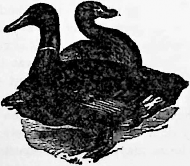
Chapter XXXI
Jesus Sends Out His Apostles
Time—AU Galilee.
At, or immediately after, the time of leaving Nazareth, Jesus was aroused to com-passion at the sight of the multitude, whose condition References, Mark 6: 6-13.
Matt, to: 5-15.
Luke g: 1-6. Luke g: xo, Matt, xo: 40-42. Matt. XI: X. reminded Him of sheep harassed by ene-mies, and without good shepherds to lead them into safe pasturage.
For this cause He sent out the Twelve.
But from whence ?
On this point we derive light from the instructions given them by the Master previous to their departure.
Shall we follow Mark ?—6: 7.
The apostles were sent out in couples.
They were to leave behind their accustomed overshoes, wearing only sandals; as also their wallets in which they were accustomed to carry bread; their “ scrip " for containing coins, gold and brass; and all superfluous clothing. The text implies the custom of carrying these articles, else it were a waste of words to now direct that they be left behind.—8: 9.
This leads us to observe that their homes were in Caper-naum, and there they would be very likely to leave their prop-erty for safe-keeping. Their return was to Capernaum (Luke

9: 10-12; all the Twelve), therefore it seems most probable that their departure was also from there.
They had left Nazareth before being sent out' on that mis-sion, for Mark says that Jesus marvelled because of the Naz-arenes’ unbelief, and He went thence to other villages teaching (6: 6). Greswell thinks they were sent from Capernaum. After this follows the mission of the Twelve. So also Matt.
9: 35-38.
"THE WORK OF THE TWELVE in their mission corresponded in its main feature to that of Jesus Himself.”
They were sent to the Jews only.—Matt 10: 6.
They were to preach the gospel of the kingdom.
They were to heal the sick.
They were to domicile with some believer during their stay in each village, and, seemingly, thoroughly canvass every place. They were directed to take a house, and there make their headquarters while they labored in that town.—Luke 9:
With these instructions they departed.
Their circuit extended over every " village in Galilee,” while Jesus Himself went into the "cities."—Matt. 11 : 1.
One couple would take a southern route, to Magdala and all the villages on the western lake-shore and river Jordan, and any Jewish villages lying cast of Jordan, but not to enter any heathen towns (Matt. 10: 5). Another pair would depart to the southwest, over the hills, to Hattin, Kerf-kawna, Daborah, Endor, where Saul by night visited the spir-itualist woman; leaving Nain on the right, on to Shunem, famous as the natal village of the lovely virgin Abishag (1 K. 1: 3). and perhaps also of that more lovely Shulamite, im-mortalized by Solomon in his Love Song—and thus onward close to the border of Samaria, but not to enter any Samaritan town.
A third pair would proceed directly westward, up the Wady Haman, to Jotaputa and Cana of Galilee. Perhaps Nathanael and Philip went this route. From Cana they would proceed on to Bethlehem, near Sepphoris, which crowns the hill “ like a bird," 900 feet above, to Jokneam arid other places under the shadow of Mount Carmel and the sea. Thence they might turn and trace the many villages down the great valley of Esdraelon to their point of departure without crossing the track of any other two of the apostles.
Another couple would cross the wilderness northwest of Capernaum, pass through “ the desert place," through Huk-kok, Hazor, Rumeish, Kerf-Buriam, Ramah, Gabera, to Ach-zib (Josh. 19: 29), on the shore of the Great Sea, turning
MOUNT CARMEL AND THE SEA
southward to Misrephoth-maim, the place of “ hot springs ”—perhaps Zarephath, the residence of Elijah, at whose gate he met the widow gathering twigs to light her last fire before she and her son lay down to die of starvation. Thus they would traverse the southern half of the ancient land of Naphtali.
The fifth pair might go to Chorazin, and Safed, set on an oval hill, high up in the mountainous district of Naphtali. Safed signifies a “ watch-tower." It is situated 2.650 feet
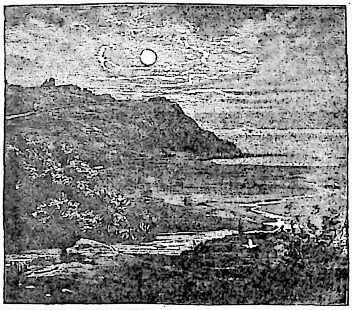
above the Mediterranean. From its giddy height you may look down on Tabor and Hattin, Carmel and Samaria, Bashan and Gilead! The Sea of Galilee seems sleeping at your very feet. Sepphoris, on its hill, looks on a level with Batauf on one side and Esdraelon on the other. Yonder is the moun-tain-coast of Plcnicia and the blue Mediterranean. Village upon village lie all around it—Giscala, Rehob, Beeroth, a city of upper Galilee, not far from Cadesh, to Abel-Beth-Maa-chan, in the extreme northwest of Galilee.
The last pair might go northward, cross Jacob’s Bridge, over Jordan, and proceed through all the villages to Caesarea Philippi. There evidently were many of them (Mark 8: 27). Josephus says that there were two hundred and forty towns and villages in Galilee, and the ease with which " he raised a hundred thousand troops of Galileans seems to indicate an immense population, estimated at two million souls.” Galilee included the districts of Asher, Naphtali, Issachar and Zebulon.
And the apostles returned and rejoiced at their success, telling Jesus of all, whatsoever they had done and what they had taught.
The Galileans were a more tractable people than the Ju-deans, inasmuch as they were more intelligent and less bigoted. As agriculturists they were far ahead, also as mechanics and manufacturers. In intellectual vigor Galilee was before Judea, in spite of their contempt for unlearned Galileans. The earli-est poets of Israel rose among these hills, and Deborah, the poetess, the prophetess and the judge of Israel, was a native of Issachar (Judges 5 : 13). Hosea and Jonah and Nahum all came from Galilee. I have yet to learn that any of the eleven apostles were ill-bred, ignorant or even poor men ; and to be " poor ” in Jewish eyes was to be dead.—Talmud.
Jesus evinced much wisdom in selecting eleven of His apostles from intellectual Galilee.
THE DURATION of the mission of the apostles is uncertain, because we do not know just when they set out. John Baptist was beheaded in March, during the apostles’ mission : therefore they were absent all the winter, at least. The rainy season includes all these months; the route was extended, as we have shown; hence we may believe that their mission occupied not less than three months, nor more than four. “ That it was extensive and occupied a considerable period, may be fairly inferred from Matthew's language (9: 35) that Jesus went about all the cities, or that during their absence (11: 1) " He departed to preach in their cities," i. A, cities of Galilee, where His labors were confined.
In view of the lengthy instructions given the Twelve by the Lord, the importance of their commission, to heal the sick, cast out devils, raise the dead, and preach the gospel every-where, in Galilee, except among Samaritans and heathens, the number of villages open before them, and the great diffi-culty of travelling fast during winter, we know that their circuit was large and occupied many months. Nevertheless, what shall we say to others' opinion, who limit it to “one day " (Tischendorf), or to “ two days ? " (Ellicott) Kraft ex-tends it to some months, Andrews to several weeks, at least; which is confirmed by their labors while absent, as reported to the Master on their return, especially as represented by Luke (9: 6, 10), who says that they went preaching throughout the villages everywhere, and healing the sick.
They preach that men should repent.—Mark 6: 12.
. They anointed with oil the sick, and healed them. They even cast out evil spirits, or devils.
T astly, they were “ to preach the Kingdom of God.”
Four months—December to the end of March—was a very limited time in which to fulfil all this mission.
Chapter XXXII
"Murder, Most Foul.”
Death of John the Baptist.
TIME—March-April, A, D. 29. A. U. C. 782.
PLACE—Tiberias.
OHN the Baptist, beheaded at Tiberias?” you exclaim! You
Meferences
Matt. 14: i-ia.
Mark 6: 14-29.
Luke g : 7-9. are surprised that we do not follow in the fur-row plowed by Josephus and followed by so many writers since he committed that blunder, which placed John's decapitation in the castle of Machaerus in Arabia.
We shall follow the gospel, substantiated, if allowed the term here, by history, and show that John could not have been killed at Machaerus, but in a prison, near the person and family of Herod Antipas.* Herod’s palace, family, “ high captains," and all his imme-diate interests were in his new city Tiberias. This city was situated on the western shore of the Sea of Galilee, two-thirds of the way down, following the shore from the ingoing to the outgoing of the Jordan. It was built upon the ruins of some ancient city and grave-yard, and populated with heathens, slaves, and convicts. Because of these four facts, the Jews avoided it, and “Jesus never entered into it”—Andrews, Geikie, Earrar.
Herod became tetrarch of Galilee B. C. 4, at the age of 17. (270)

In the last recorded of John, before his imprisonment, we find he had gone from near Jericho to "Enon near Salim” (ohn 3: 23), which is supposed to have been within the ter-ritory of Antipas, else he could not have arrested him and lodged him in prison. Herod Antipas and Pilate, ruler of Judea, were “long-time” enemies, hence a citizen of Judea, as John was, could not have been arrested by Antipas for mere words, unless within the territory of Antipas.* Does not this fact settle the place of John’s arrest? Most certainly ?
It was in Galilee that John was arrested. To whence was the prisoner taken ?
Josephus says to Machrus.—Ant. 18: 5, 1.
This was a lonely fortress in Arabia, east of the Dead Sea. It was a very little later, if not at the hour of John's arrest, in the possession of Aretas, king of Arabia, a king at war with Herod Antipas. This compels us to go back for a bit of Herod’s history.
Herod Antipas was a son of “ Herod the Great,” by a Samarian woman named Malthake. Antipas was educated at Rome. His father had destined to make him his successor in all the kingdom of Judea, but by a last change in the will, left Antipas only the tetrarchy of Galilee (and Perea ?) (Matt. 15: 1; Luke 3: 1-19, and 9: 7. "Tetrarch,” one-fourth). Luke (3: 1) says: “ Pontius Pilate being governor of Judea, Herod (Antipas) tetrarch of Galilee, and his brother Philip (2d) tetrarch of Iturea and Trachonitis, and Lysanias tctrarch of Abilene.”
The southern border of Galilee, in Christ's time, ran along the base of Carmel and the hills of Samaria, the southern border of Esdraelon to Scythopolis to the Jordan.—Smith's Bib. Diet I find no proof that Antipas’ territory ever reached the * Luke 23: 7. Jesus was sent to Herod because He belonged to Herod's jurisdiction. The very cause of the enmity between Antipas and Pilate was the slaying of Galilean subjects in Jerusalem.—Josephus’ Ant., 20: 5, 3; Ewald, 5:
90; Geikie, a: 176; Luke 13: 12.
“ district east of the Dead Sea," where Machrus was situ-ated.
“ The northern border of Arabia never has been well defined."—Kitto, Die.
Whereas there is no evidence (see Josephus’ Ant., 18 : 5, 1) that Antipas' kingdom ever extended as low as the head of the Dead Sea, we may even admit that it might have reached the outpost of Machrus, and then show that John Baptist was not there imprisoned or there beheaded.
Herod's first wife was an Arabian princess, the daughter of Aretas, king of Arabia. She was a proud, high-spirited woman, and her father a warlike and revengeful king. Early during John's career, Herod went to Rome to pay honors to the emperor, and to endeavor to flatter Tiberius into giving him the whole kingdom of Judea, yet ostensibly for the special benefit of his Hebrew subjects.
While in the city, Herod was the guest of his half-brother, Philip I., a son of Herod the Great by Mariamne, one of the fairest women in the empire. Herodias was the wife of this Philip.
In spite of the laws of hospitality, or of consanguinity, Herod Antipas became entangled in the affections of his half-brother Philip’s wife, and on his departure for his government in Palestine, Herod carried away Herodias and her daughter Salome to his new palace in Tiberias.* Herodias being the daughter of Aristobulus, was the niece of Antipas as well as his sister-in-law.—Farrar.
Herod’s lawful wife at once fled to her father, king of Arabia, whose capital was Petra. In just indignation at the disgraceful treatment of an Arabian princess, Aretas precipi-tated a war against his quondam son-in-law, invaded his king-dom and took away his southern strongholds, and captured all his territory in that direction.
War with this fierce Arabian emir was no trifling matter with the weak Antipas, who was so shamefully beaten that he * Tiberias was not built until after A. D. 14was obliged to send to Rome for help, by which he barely saved his government in Galilee.—Josephus.
Did not Jesus refer to the folly of Antipas in going to war with Aretas, by asking: “What king going to war against another king, will not first sit down and consult whether he is able with ten thousand soldiers to meet him who comes against him with twenty thousand?"
This was the exact case with Herod and Aretas.
Antipas never recovered from the loss incurred in this war.
If Herod Antipas ever held Machaerus, which is very doubtful, he lost it before John's decapitation.
Consider the time it Would require in those days to send to Rome and obtain aid in Syria.
If this is not sufficient evidence to show that the country beyond lower Jordan and the Dead Sea did not belong to Antipas, let us quote a bit of gospel history, which will most effectually set Josephus' evidence aside.
By Matthew we learn that Judea extended over Jordan. " When Jesus had finished these words he departed from Galilee and came into the borders of Judea beyond Jordan" (Matt 19: 1). Mark says the same (10: 1), which is well known to have reference to Jesus' being in that part of the country east of Jordan, called Perea, " beyond." John refers to the place (10: 40) as being “beyond Jordan, where John was at first baptizing,” before he went to “ Enon ” and into Antipas' territory. Luke refers to it less directly by there referring to John the Baptist, being reminded of that prophet by being at the time in the vicinity of John’s first work. All admit that Jesus was there, east of Jordan, and in the very place that Matthew calls “ Judea beyond Jordan."
Now we come to internal evidence that John was near the person of Antipas. While at liberty, “ not yet being cast into prison,” John was near Antipas, and often corrected the king in his faults (Luke 3 : 19), which he "received gladly" (Mark), but when John went still further, and reproved him for having his brother’s wife (6: 18), it became a serious matter.
Coming to the ears of Herodias, she swore to kill John, and Antipas was compelled, “ for Herodias' sake,” to lock the Baptist up, " to keep him safe ” from the wrathful Herodias. This is the sense of Mark's record.
The matter was “very perplexing” to Herod, as he "feared John,” and he also feared Herodias, under whose thumb he certainly was. Herod’s perplexity was this: “ How shall I keep this holy, righteous man from.being killed by my unlaw-ful wife, Herodias, because her fury is great at John for saying1 she is not my lawful wife?" (Mark 6: 19, 20, with verse 17.) The king had no intention of harming John, as his " exceed-ing sorrow " evinced, when he found himself entrapped into murder (v. 26). He revered him and “ grieved " at his death.
—Matt 14: 9.
But Herodias waited for a convenient time to revenge her-self on John. Evidently she had often importuned Antipas to despatch him, but he feared to (Matt 14: 5), for, if he thereby gratified the-hatred of Herodias, " he feared the mul-titude” who counted John a prophet, and, also, his own con-science for killing a holy man.
Herodias' time at last arrived.
We learn through the Jewish historian, as well as by the gospel, that Herod was a lover of ease and pleasure.—An-drews.
“ Herod Antipas was about as weak and miserable a prince as ever disgraced the throne of an afflicted country. Crafty and voluptuous, like his father, he was unlike him also, being weak in war and vacillating in peace."—Farrar.
A whole year went by, in which Herod “ kept John safe’’ from the fury of Herodias, and in which also she nursed her wrath against the prophet She continually " set herself against him, seeking an opportunity to kill him.” This is the sense of the language of Mark.
“ But a convenient day came ” for her to avenge herself. It was the occasion of Herod’s birthday.
He made a great feast, inviting his " lords and high cap-tains (that is, captains of thousands), and the chief men of Galilee.” Mark makes no mention of men of Perea, or of over Jordan—only Galileans. Herod's household was present.
Where would Herod prepare this “magnificent banquet, this splendid anniversary feast," but in his new palace, and in his new city, Tiberias? Indeed, nowhere else!
Would he, during an inclement season of the year, drag the elite of his court, “ the chief men of Galilee," and his own household over the hills and across swollen rivers, a hundred miles down into the dreary country behind the Dead Sea, and into a cheerless castle and prison-house to hold this, his first anniversary, after the completion of his new city and palace, the pride of his heart? Come out of the old furrows and see the inconsistency, the improbability of the thing.
Who said that he did such an improbable thing? Noone! Josephus (Ant. 18 : 5, 1) says that he there imprisoned John; but he at the same time tacitly denies Christ, and that “ John was the Elijah who was to come,” as all Jews expected, as the forerunner of the Messiah. He also denies the gospel, by giving a false reason for John's imprisonment, solely on polit-ical grounds. He avoids mentioning the reproval of Herod by the Baptist, which was the true reason of John's incarcera-tion by Herod, according to the synoptists. Therefore we see the unreliability of Josephus, when compared with the facts as recorded in the gospel.
Andrews, while tacitly following the furrow of Josephus, says, “Machcerus .... was in the hands of Aretas, king of Arabia, when his daughter, the disgraced wife of Herod, fled from him.” If so, Herod could not have recovered it, as he had to send to Rome for troops to save his kingdom. More-over Josephus contradicts his intimation, accepted by the world, that John was kept at Machaerus, for he says, that, when the first wife of Herod fled from him to her father, Aretas, king of Arabia, this fortress belonged to the Arabians.* Therefore we see the impossibility of John being kept in * Ant. 18: 6, 1,2. Quoted also by Andrews, 293. Yet Mr. Andrews seems to fall into the old error as to where John was beheaded.
Machaerus, or being there beheaded, or that Herod could there hold a banquet, all of which was after this date 1 Some have supposed that the feast was held in Tiberias while John was beheaded in Machaerus! This is still more improbable.
This leads us again to the gospel narrative, and to observe the immediacy between the demand for the head of John by Herodias, through her daughter, and its production on the charger—a household dish.
Herodias was there, and directed the entire matter.—Matt. 14: 8.
In the midst of the revelry, when her lord was in his most happy and munificent state of mind, Herodias forwarded her plans. Her beautiful young daughter, Salome, the descend-ant of “ the fairest woman in Jerusa-lem," dressed for the occasion, or shall we truthfully admit, undressed for the occasion, like a professional ballet girl of the times, with tamborine in hand, with bells on her ankles and her graceful wrists, as was the custom, suddenly sprang into the banqueting hall, into the presence of the king, his lords, captains, and the chief men of Galilee. This, the daughter of SALOME IEFORY HEROD. Herodias !
“ Her own daughter," says Professor Schaff, “ was put to the degrading office of a common dancing-girl for the accom-plishment of her malignant purpose."
“ The oriental dance," says Dr. Morrison, " was of a liber- • tine character, and seldom appreciated unless it made irrup-tions across the borders of decency.”
“A luxurious feast of the period,” says Canon Farrar, “ was not regarded as complete unless it closed with some gross pantomimic representation; . . . but Herod had not antici-

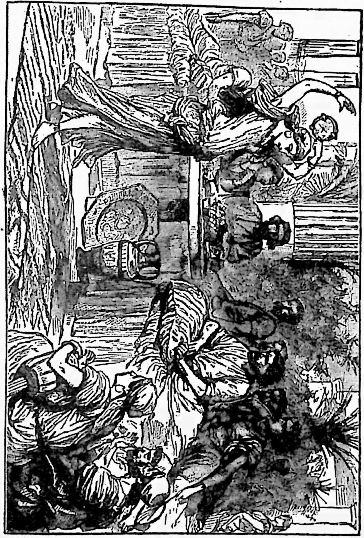
pated for his guests the rare luxury of seeing a princess, his own niece, a granddaughter of Herod the Great and of Ma-riamne, a descendant of Simon the high priest, and in the great line of Maccabean princes, a princess herself, who after-wards became the wife of a tetrarch and ... a king,* honor-ing them by degrading herself as a scenic dancer I ”
But in the vocabulary of Herodias, there were no such terms as immorality or indecency. What cared she for the exposition of her daughter? “For the dress of this per-former, like that of the dancers of our ballet,” says Geikie, “ was planned to show off the beauty of the figure to the greatest advantage." , Judge of the surprise and admiration of the convivial Herod, and his no less licentious guests, on beholding this vision of beauty floating beiore them in the giddy mazes of the oriental dance I “And she pleased Herod and those who sat at meat with him,” Mark informs us. We have shown what Sort of an ex-hibition a female dancer must needs present in order to “please” this profligate ruler and his dissolute lords and captains.
After having witnessed this exposition of the graces of his niece, the king (so called by courtesy as son of King Herod the Great) arose from his recumbent position at the head of the table, and said to the damsel:
“ You have rejoiced my heart, you have honored my guests by this exhibition of your graceful charms in the dance. Now “Ask of me whatever you desire and I will give it to you.” “ Flushed with flattery, inflamed by wine, he felt in his most magnificent mood, and wished to make the elegant danseuse the very best present she could desire."—Dr. Morrison.
She hesitates. The words which she had been instructed to repeat, like a parrot, paralyzed her tongue.
With an oath, the king reassures her.
“ Whatever you ask I will give, even to half of my kingdom.”
* She was soon after wed to Philip IL, who dying, A. D. 37, left her to many the king of Chaicis.
Though previously instructed (Matthew) by her mother what to demand, Salome retired under pretense of consulting her on so momentous a subject.—Mark.
Returning immediately and in haste she said, “ Give me forthwith the head of John the Baptizer in a charger " (Mark 6: 25). She implies great haste for it.
The shock following this request was terrible, even to a drunken king, but for his oath’s sake, before his court, he immediately (27) called a body-guard standing in the rear, “and commanded him to bring in the head of John in a charger.”
The very household dish in which the head was brought shows that it was carried to no great distance.
First, it was brought into the banqueting-hall, and presented to Salome, and next carried by her to her mother, waiting without to receive it—28.
Such is the gospel account of the ghastly affair, showing that the whole transaction occurred without delay, and on the premises.
In view of these gospel truths, is it not astonishing that there have been so many false theories put forth in the vain attempt to reconcile them to the error of Josephus, who sends the whole family and court, and all the principal men of Gal-ilee, down into the territory of an exasperated and revengeful enemy to hold a banquet ? Was there ever another such his-torical error ?
And here we leave it for the reader to decide upon the evi-dence in the case, as to where John was slain.
This horrible tragedy has scarcely a parallel in the annals of history. Its nearest approach is recorded by Herodotus, as occurring away back in the dark ages.
At a birthday festival of Xerxes, his wife, Amestris, took similar advantage of the exhilarated condition of her lord, and the joyousness of the occasion, to demand of the king the surrender to her jealous hatred the wife of Masistes. Xerxes felt, like Herod, that the occasion warranted the sacrifice, even though she was the wife of a prince, and he immediately 1 URY OF A WOMAN SCORNED. 281 ordered the execution of the lady. To make assurance doubly sure " that her hated rival was out of her way forever, she stood by and saw the body cut into bits and fed to the dogs of the kennels! Well has Shakespeare said that “ Hell has no fury like a woman scorned."

Chapter XXXIII
Over the Sea of Galilee—Subject: Feeding of the Five
THOUSAND
TIME—April, A. D. 29. A. U. C. 782.
PLACE —Capernaum to Butahia and return. u disciples of John, faithful and loving to the last, came and took up the headless body of their late Master, “ and laid it in a tomb.” This could have been done only by Herod’s
References
Mark 6: 29-53.
Matt. 14: 12-34
Luke g: 7-17.
John 6: 1-26.
AB to Time and Place,
John 6: 59.
consent. Did he, in his “grief” (Matt 14: 9), provide this tomb ? It is not impossible.
The disciples then went and told Jesus. Where did they find Him ?
Evidently at Capernaum.—Matt. 14: 13.
There He was accustomed to return after each of His Gal-ilean circuits. It was still His " home.”
It is supposed, with good reasons, that the immediate cause of His return, as also His disciples, was the report of the death of the Baptist (Andrews). Official notice, however, came from John’s disciples, who had entombed the body.
“And when Jesus heard it, He withdrew from thence in a boat” Where had the boat been left ? At Capernaum.
Where did the disciples of Jesus meet Him ? At Capernaum.—Mark 6: 30; Matt 14: 13.
“ They gathered themselves together unto Jesus.”
This seems to imply a gradual returning, in pairs, from .time (282)

to time, as they went out, and according to the length of their respective circuits. It is not probable that they were all timed to return, to a day. It may have been weeks between the arrival of the first and last couples.
As usual, the return of Jesus at Capernaum was soon known, and the city was again inundated by people from all the surrounding towns and villages. These so increased that, as before (Mark 3 : 20), Jesus and the returned apostles could get no time to eat.—Mark 6:31.
During these days the same excitement prevailed, the same marvellous cures were wrought by Jesus, until the whole pop-ulation of the city and country was lashed into the greatest fever of excitement.—John 6: 2.
This came to Herod’s ears. “At that very season," Mat-thew says.
It could not have been that he had not often before heard of Jesus, but knowing that He was not a political reformer, " only a religious enthusiast," and a benefactor to the sick, Herod gave no heed to Him until now.
Why now ?
Because his conscience upbraided him for the murder of an innocent man and a great prophet Herod was alarmed, and, calling his servants, he asked : “Who is this of whom I hear such marvellous reports?” “ It is Elijah," one replied.
“ It is one of the great prophets," said another.
“No," said Herod, “it is John whom I wickedly beheaded.
He is risen from the dead!" • How quickly he repudiated his religious belief, for, if like the Herodian family in general, Antipas was a Sadducee, who denied the resurrection I Then Herod desired to see this worker of miracles, at Capernaum, that he might be convinced if He were John Baptist But Jesus withdrew with the Twelve over the Sea of Galilee, to a desert place. Whether He went to avoid Herod (Matt 14: 13), or the multitude (Mark 6: 31), the reader must decide for himself, but the evidence is in favor of the latter.
" Let us go by ourselves," said Jesus to the Twelve, "to an uninhabited place," for, Mark adds, “ there were so many coming and going that Jesus and the apostles had not even leisure to eat.” This is corroborated by the fact that the dis-ciple.; took provisions with them.
There was an expanse of five or six miles to cross before reaching Butahia, a suburb of Bethsaida, during which time of sailing over they could, and doubtless did, supply their want, and satisfy their appetites with food.
Then they had left enough for themselves over night.
Evidently Jesus gave the order to depart privately from the western shore, but the people knew the boat, and so far from His departure being “ private," a greater and more enthusias-tic multitude than ever followed Him. They saw Him sail-ing away in the boat, and “ followed on foot" around the shore. Those from Capernaum had a distance of about three miles to travel to the sand-bar, or ford, over Jordan, thence into Bethsaida and down on the eastern side of the lake some three or four miles, making in all about six or seven miles. There were also people from “ other cities," including a great many pilgrims from the northeast, coming down toward Bethsaida, en route to attend the passover at Jerusalem.—John 6:4. .
Here John resumes the narrative, after a year’s silence, and furnishes us with a correct date. It was a week before the passover. It was on Friday, the day before the Jews’ Sabbath.
—John 6: 59.
The importance of this stupendous miracle, near Bethsaida, was such that all, four Evangelists have recorded it. Dr. Porter has well defined the location, and Butahia fills the re-quirements summed up as follows :
It belonged to and was near Bethsaida.—Luke.
It was on the sea-shore, near a mountain.
It was an uninhabitable place.—Mark 6: 35.
There was a grassy amphitheatre near, capable of seat-ing ten thousand people. " Five thousand, beside women and children."
The order of the whole day’s proceedings—if we may con-fine it to one day—seems to have been as follows :
Arriving on the shore, Jesus spoke to the gathering throng of the kingdom of God, and healed what sick there were at the time (Luke). SECONDLY, He retired to the mountain, else John could not have said that He retired "again into the mountain” (6: 15). THIRDLY, “ the day began towear away,” that is, in the afternoon, and the multitude still in-creasing in the presence of the apostles, they went up to Jesus and said to Him, “ Send away the multitude, that they may go into the villages round about and obtain food and lodging, for this is a desert place” (Matt.) It was well understood that at sunset th: Jews’ Sabbath began, and this great concourse of pilgrims would be compelled (by their law) to remain where they were until the Sabbath ended.
“ They have no need to go away ” (hungry), said Jesus.
“ Give them food to eat."
“ It will require two hundred pennyworth to feed them," said Philip (John 6: 7); to this the other disciples agreed.—Mark.
“ How much bread have you?" Jesus asked; "go and see.”
—Mark.
A boy had charge of the boat and the loaves.—John.
They went, and returning, answered, “ Five loaves of bread and two fish."
“ That will do. Command the multitude to sit down on the grass, in companies of fifties."—Luke 14.
The disciples gave the command, and the hungry multitude obeyed, and there were an hundred ranks of the files of fifties who sat down. “And they sat down in ranks, by hundreds and fifties."
One hundred ranks multiplied by fifty files would make the five thousand fed.
“And they who ate of the loaves were five thousand men.”
" Beside women and children," Matthew adds. Women and children were excluded from public feasts among the Jews; but Jesus having blessed the “ loaves," and the men having eaten till satisfied, the fragments were gathered up—“ about twelve basketfuls; " * and given to the women and children, as was the custom.
There were men present with sufficient intelligence to un-derstand that a mighty miracle had been wrought Their enthusiasm rose to the highest pitch, " and they would have taken Jesus by force and anointed Him king,” had He not “again withdrawn into the mountain."—John 6: 15.
Evidently the multitude did not see Him depart, and to get rid of them, Jesus resorted to no little tact. The disciples came to Him, and He constrained them to enter the boat and row along the coast, northward, towards Bethsaida, while He Himself sent the multitude away. These watched the boat (John 6: 22), and seeing it depart, were the more easily per-suaded to go away, before they were caught by nightfall, when they could not get away without doing violence to the Jews' Sabbath law.
"After He had taken leave of them," Mark informs us, “ Jesus retired into the mountain to pray.”
At last He was alone with His Father. How much He had to tell Him! Hour after hour rolled by, and still He com-muned with His heavenly Father!
But lo I a storm has risen on the sea! The waves are lashed white with foam! His disciples have labored hard at their oars, but have failed to reach the rendezvous, off Bethsaida.—Mark 6: 45. ’
“ The wind is contrary," it drives them out to sea!
* in the two miracles of feeding the multitude, the following differenees are observable :
5,000 persons; 5 loaves; 2 fishes; 12 basketfuls remain.
4,000 persons; 7 loaves; a few fishes; 7 basketfuls remain.
In the first case the baskets were those small osier baskets used by the Jews in carrying holy bread as they journeyed, thus avoiding the unpardonable sin of eating of the heathen's bread. In the second case, the boskets were the large rope baskets of the heathen. " Every Jew carried his osier-twig basket when travelling,” says Geikie, note, page 632. Mark's (6: 44) are wicker-baskets, i e.,.osier-twig, whereas Matthew’s (15 : 37) are rope-baskets, used by the Gen-tiles.
Midnight, dark and perilous, came and past, and harder yet the tempest raged, and harder they labored at their oars, in turns. Now it was the fourth watch of the night, and others took the oars and rowed for life “ against the wind." They desired to reach Bethsaida, not Capernaum, for in the former place they believed their beloved Master awaited them. Now they were thirty furlongs out at sea, surrounded by darkness impenetrable, the waves momentarily threatening their over-throw, and, more than all, there was no Saviour within call to rise up and say to the winds, “ Peace! be still!” and to the waves, “ Cease thy motion!"
But there comes over the sea a gleam of light, and in its midst a " human form divine," which only adds to their fears.
“ It is a spirit! " Peter hoarsely whispers, " else it could not walk upon the waves.”
He was about passing the boat, when the disciples gave their cry of alarm.—Matthew, Mark. “ Be not afraid: it is I, your Saviour,” He said.
“ If it is you," Peter joy-fully replied," bid me come to you on the water.” Pre-sumptuous Peter!
“ COME ! " was the one word of Jesus.
Then Peter stepped down from the boat into the seeth-ing waves, and moved to-ward Jesus; but as he reached Him, his faith oozed out at his feet, and down went poor Peter into the sea, crying out, " Save me, O Master, or I perish I"
Immediately Jesus reached out a helping hand, and raised Peter, and together they entered the boat, when Jesus said to him:
“ What caused you to doubt, O faithless Peter ? ”
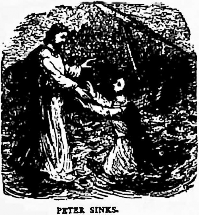
To this Peter made no reply. He was ashamed. Then the wind ceased as they entered the boat Matthew only records this circumstance of Peter’s ambition to walk on the sea. It was his first and only attempt to ac-complish this miracle.
He was a better swimmer in the sea than walker on it They were now about four miles from the eastern shore, and within one or two of Capernaum shore, where they soon landed.
We learn from John (6: 59) that it was on the Sabbath that they arrived at the place of destination, which must need have been within a “ Sabbath-day's journey” of Capernaum. This would be. within 2,000 paces of the wall of the city.—Num-bers 35:5.
Maithew and Mark say that they arrived at or near Gen-nesaret, which must in a general sense include the western shore of the “ Lake of Gennesaret" This is very probable, and reconciles the whole narrative.
Of course the multitude for Capernaum had returned as they went, on foot, around the shore. Once over Jordan, they were safe from the penalty of the Sabbath law, but they were greatly surprised to find Jesus at the synagogue on the next morning.
Several small boats from Tiberias had gone over the lake that morning (John 6: 22-24), but not finding Jesus or His boat, they returned to the western shore seeking Him, and found Him at Capernaum.
" Rabbi, how came you here ? ” they asked in amazement Could He not have gone around the shore also, as thousands of others had that night?
No; not after sundown. If He had attempted it He would have been arrested in Bethsaida for Sabbath-breaking, so strict was the law.
Their surprise at finding Jesus on the west side is another proof, besides John’s evidence, that the feast at Butahia was on Friday—the Jew's Sabbath being Saturday.
But there was no law on the Hebrew statute-book against walking on the sea on the Sabbath.
So Jesus crossed over on the sea!
The Jews could understand no " sign,” no miracle, which did not promise to them temporal prosperity. “ Thus,” says Andrews, “ the effect of the miracle (over the lake) was to con-firm their false Messianic hopes, for they interpreted it as a pledge of the highest temporal prosperity under His rule, who could . . . feed five thousand men on five barley loaves," and have more remaining than- they began with! This was the sort of prophet that they were looking for. “ This of a truth is the kind of prophet that should come into the world,” they enthusiastically exclaimed.
Hence Jesus, at the synagogue on the next day, accused them of following Him more for loaves and fishes than any higher sign of His Messiahship.—John 6: 26.
This explains what has seemed to some as a harsh accusa-tion—“ Ye seek me not because ye saw signs (verse 14), but because of the loaves of which ye ate and were filled.”
Every Israelite found here what best pleased him. " The young tasted bread, the aged honey, and the children oil ” (Lightfoot; Geikie). " When Messiah comes He would re-store all things”—that is, temporal things.
Chapter XXXIV
Two Weeks* Respite in Capernaum
Time—During Passover, April, A. D. 29. PLACE—At Capernaum and vicinity.
Matthew and Mark make no mention of the Sabbath day’s proceed-ings "in the synagogue
References
Matt. 14: 34-36.
Matt. 15: 1-20.
Mark 6: 53-56.
Mark 7 : 1-23.
Luke 13: 1-5.
John 6: 25-71.
at Capernaum" on the day following the return of Jesus and the twelve (at night) from Butahia ; whereas John has given us a full account thereof, commencing with the expressions of surprise by the people, who found Jesus at Capernaum giving a complete report of the great sermon on the "bread which came down from heaven:” the disaffection of the disciples—not the Twelve (67)—and His direct address to the apostles, closing the whole at verse 59.
From this point Matthew (14: 34) and Mark (6: 53) take up the narrative, going back to state the fact of their landing —probably a little farther south than they were accustomed—in consequence of the wind having blown them out of their regular course.
It must have been yet dark when they landed—"the fourth watch of the night”—and the people did not see Jesus until after leaving the boat.—Matthew and Mark.
"The passover of the Jews was nigh,” we learn from John

(6: 4). and doubtless Capernaum was crowded again with pil-grims from the north, referred to in the last chapter of these journeys. * Thus Jesus preached the sermon on the Bread of Life to a new congregation, in part. These pilgrims had wit-nessed the miracle of the feeding on the previous day, and now they heard from the apostles of the more wonderful mir-acle of Jesus crossing the sea on foot in the storm I “ In those two incomprehensible miracles, Jesus had reached the culminating point of His labors." Never was His popu-larity so great He carried all opposition before Him, and the people ran wild with enthusiasm.
On the first day of the week the pilgrims in the city, and those encamped on the hills above and the plains below, re-newed their journey toward Jerusalem to attend the passover. What marvellous stories they rehearsed along the various routes to the Holy City, and with what astonishment and amazement were these stories there received by the multitude and the Sanhedrin! The effect on the latter was, immediately on the close of the feast, to send a new and more powerful deputation of scribes and Pharisees to watch Him, and try to apprehend Him in His career.
During the passover our Lord remained in and about “ home.” Probably the disciples went up to Jerusalem mean-time to attend the feast It would require six days for the multitude to go and return, and eight days to attend the pass-over; and thus we find the 0 two weeks' respite ” for Jesus referred to at the head of this chapter.
The Pharisaical spies sent from Jerusalem after the feast found Jesus at Capernaum (Matt. 15: 1). It is scarcely to be supposed that they left the city until the close of the passover.
—So Andrews, Greswell, and Tischendorf.
It would seem from the language of Mark 6: 56, that, dur-ing a portion of this respite, Jesus went about many villages and cities, and into the country and market towns, doing good. There were plenty of sick folks still to be healed. Where these places were it is impossible to know, but this we do know, that—
"Wherever the people heard that Jesus was, they ran around about the whole region, bringing in all who were sick, laying them in the market-places, beseeching Him that they might but touch the fringe of His garment as He passed along among them, and as many as did so were healed.” What faith was this!
What a marvellous scene was that which marked the clos-ing of His labors in this country! Words utterly fail to convey to the mind of man the immensity of the scene. For this was the zenith of the Lord’s popularity. Henceforth His pathway will not be strewn with roses. “ The time of the crisis of faith had come, and the gathering opposition had gained in strength, and the fair-weather friends of peace and righteousness waxed cold."—Rev. F. A. Malleson.
Jesus did not go to the passover, for it would have been unsafe to have shown Himself in Jerusalem (Geikie); but His disciples may have gone, since no Jew neglected this duty when possible to comply with its requirements.
There is no mention made of the Twelve during this pass-over; but a few days afterward, with the return of the pil-grims, and arrival of the Pharisees and scribes from Jerusalem at Capernaum, the disciples are again brought forward. Therefore we think that they went up to Jerusalem to attend the passover of April, A. D. 29.
The presence of this new and strong deputation of spies may well be attributed to the reports of the pilgrims who attended the feast, of the increasing power of Jesus in Galilee, espe-cially as regards the last two miracles, and His Messianic claims shadowed forth in these miracles, as also in the mar-vellous sermon on the Bread of Life, preached in the syna-gogue of Capernaum.
Arriving in the city, these bold spies openly pressed into the very presence of Jesus and His. disciples, invading what should have been the privacy of their domestic hearth, and criticising the latter in the manner of taking their food. They had observed that some of the disciples ate their bread with unwashed hands.—Mark 7: 2.
In Pharisaical eyes this was an unpardonable sin, and with a bitter complaint they came to Jesus, asking:
“ Why do your disciples transgress the tradition of the elders ? " , " Wherein ? ” Jesus well may have asked.
“ Inasmuch as they eat bread with unwashed hands.”
The answer of Jesus was full of just severity and rebuke for the hypocrisy and littleness of these great rulers in Israel, as recorded in Matthew 15 : 3 to 9.
This occurred in the house, and Jesus, calling the multitude (without), said to them, perhaps as He stood in the doorway:
" Hear, and understand, all ye people.”
He then explained to them, in the Pharisees' presence, the weakness, folly, and hypocrisy of the ‘accusation.
"Then He entered the house" (Mark 7: 17), and there came the disciples to Him (Matt. 15: 12) and said:
" Do you know that the Pharisees are highly offended with you for what you have just said without to the multitude?” for He had left them outside.—Mark.
“Are you also without understanding?”
“ Yes,” said Peter. “ Declare unto us the parable spoken to them.”
Evidently they were, for Jesus at once proceeded to explain to them the whole matter of purification, saying, in conclu-sion:
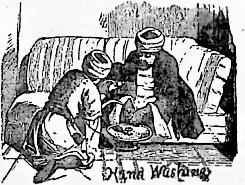
FINAL SEPARATION FROM THE PHARISEES
" Let the Pharisees alone: they are blind guides; if you follow them, all will fall into the ditch together.”
In this final rupture of Jesus with the Pharisaical party, He had scathingly accused them of making void the- command-ments of God in following traditions.
“ To honor thy father and thy mother,” was one of the “ ten words of Sinai,” and even the Talmud said : "A son is bound to maintain his parents when old and helpless, even if he beg to do it.” ' Yet by the magic word “ corban,” do you absolve yourselves from all responsibility.
“Ye hypocrites! Well did Isaiah prophesy of you: “4 This people honor me with their lips, “ ‘ But their hearts are far from me.’ ” And so He left them forever!
If Herod Antipas had any designs against Jesus, other than as we have said, to ascertain if ” He was John risen from the dead,” that ruler made no effort to carry them out Here Jesus had remained two weeks, at least, in Herod’s jurisdic-tion, since he had expressed the desire to see the " prophet,” as he believed Jesus to be, and had not arrested Him. Neither did Jesus fear the Pharisees from Jerusalem while in Galilee, for there they had no jurisdiction.
Therefore it was not because of fear that He was about to leave the country, but for rest and opportunity to instruct the Twelve.
His work was done in Galilee.
Chapter XXXV
A Journey Into Heathen Lands
Time—Tyre, Sidon, and Return.
The life of the blessed Lord presents to us a continually changing scene. It went Heferences, Matt. 15 : 31-39.
Mark 7: 34-30.
Marky: 31. from step to step, higher and wider, with few repetitions, and nothing wearisome or monotonous in its history. When one class of work was completed, He went rapidly on to another. From the simplest acts He advanced to the most astounding miracles, and when nothing higher, within the comprehension of man, was left for Him to perform, He retired from the country.
I am well aware that this act has been attributed to His fear of Herod Antipas and the Pharisees from Jerusalem. Says Andrews, to this: “ We see no evidence that any fear of hostility from Herod or the Pharisees actuated Him.” His first object seems to have been to find that rest which was de-nied Him in Galilee. Here every one knew Him. He would go where He was unknown.—Mark 7: 24.
Therefore immediately after the break with the spies from Jerusalem, Jesus took His twelve apostles and went away into the Gentile province, or cities of Tyre and Sidon. • “It has been questioned," says Andrews, “whether the Lord went merely to the borders of Tyre and Sidon, or actually crossed them.”

In favor of the latter, we have Alford, Bleek, De Witte, Greswell, Thomson, Farrar, and Geikie.
If I had the least doubt in regard to the facts, I would rely upon Mark to set me right What does he say ?
"And again He (Jesus) went out irom the borders of Tyre.
“And came through Sidon unto the sea of Galilee”
(7: 31).
Does not the " out ” of Tyre and the " through Sidon ” show us the direct route ?
Through Galilee the route is as follows:
Leaving Capernaum from the north gate, they would pro-ceed over a rough country toward the northwest, passing Safed on the right, reaching Gischala the first night A few hours’ walk from here they would reach the highlands and the spine of the water-shed of northern Palestine. From thence westward all the streams (now quite dry and passable) flow, during rainy seasons, into the rivers that empty them-selves into the Mediterranean Sea.
By following the wooded valleys directly toward the north-west, still, Kanah could be reached on the second night from Capernaum. Kanah is a village of two thousand inhabitants, struggling down the eastern slope of the mountains, at the base of which flows a rapid river to the sea.
“The country round about is well wooded and watered, and is a favorite range for sheep. All along the sheltered side of the valleys are seen numerous sheep-folds, built of lime-stone, roofed in with light timber and boughs of trees, all surrounded by a strong stone-wall crowned with thorns, which the prowling wolf and panther will rarely attempt to scale.” At least he gets pretty hungry before hazarding the attempt At night the sheep are called in and secured from the depre-dations of “ thieves ” and wild beasts. How true to nature and the present custom did the Saviour draw the picture of His “ Good Shepherd," on His next visit to Jerusalem, which leads us to question if He did not here, at this very season,
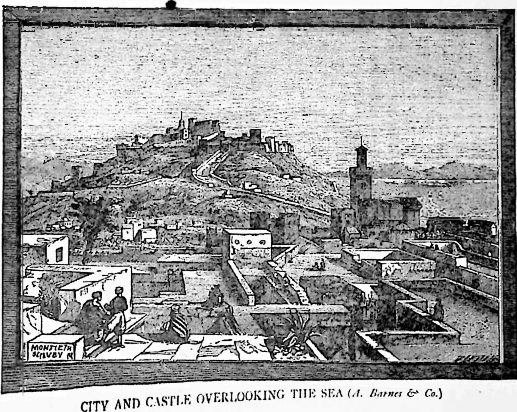
study the habits of these faithful mountain shepherds, in the land where they summered their flocks. , You will find it pictured in John 10: 1-10.
“A porter " watches with the sheep by night (v. 3), In the morning he hears the shepherd’s call, He knows the voice and opens to him the door, He calls each sheep by name which they know, He goes out before them and they follow (4), For they know it is his welcome voice;
If a stranger called they would not follow (5), But flee into the inner fold.
The true shepherd leads them into green pastures (9); He watches by and defends them with his very life (11). “A hireling" would not do so, being a hireling, Who beholding the wolf coming would fly, Leaving the sheep at the mercy of a wolf (12). But the “ Good Shepherd"—
“ He shall feed His flock like a shepherd;
“ He shall gather the lambs tenderly and carry them in His bosom.
“ He shall gently lead those that are with young."—Is. 40:
11.
Again we turn to the westward.
What do we see which we have not before seen ?
The beautiful city of Tyre, nestling at our feet, and the glad blue waters of the “ Great Sea " beyond, dotted over with a thousand sails.
Jesus and the Twelve had never before reached this point ■ How they must have lingered and looked upon that renowned city, and talked of its remarkable history1 When the Israelites invaded the “ Land of Canaan," Tyre was an ancient fortified city (Joshua 19: 29). This is the earliest scriptural notice which we find of her.• At the time of this visit of Jesus and the Twelve, Tyre was a very large city. It is believed by some ancient writers (Strabo, Pliny) that her population was equal to that of Jerusalem. Four hundred years before Christ she had, for the third time, gone back to her original rock, when fishermen huddled about her shores, dwelling in wretched hovels erected on the ruins of palaces 1 Under the Seleucidea and the Ro-mans she had, however, recovered. Tyre has now a popula-tion of about five thousand souls. * The advice of Jesus to His disciples when about going out on their first mission was, to enter into some one house in each village, and there abide until their departure from that place In every place which He Himself visited, to any known extent, He took “ a house; ” at Capernaum, in Perea, over Jordan; and while at Jerusalem " He taught in the tem-ple each day, and every night He went out to the Mount of Olives,” that is, to the house of Lazarus in Bethany.
So, coming to Tyre for a long rest, His first act was this:
" He entered into a house, but would have no man know it.” He would prefer that none should know His abode, else there would be no rest for Him, nor opportunity for instruct-ing His disciples, " not even time to eat bread,” as was the case repeatedly at Capernaum.—Mark.
How long He went out and in before His disciples at Tyre is unknown. At the first He could, with them, ascend the hillside, and sitting there where His eye could sweep the dis-tant horizon, look far out over the blue sea, its islands, and the white-winged ships plying between distant and unknown ports, while He opened up to them the picture of the joyous future, when yonder sea should be the great highway, and those ships the vehicles, and these apostles and others the messengers for conveying the glad tidings of the gospel to all the nations of the world. While Jesus contemplated these possibilities to His disciples, it might seem like an idle dream.
Returning, perhaps, from one of these delightfully refresh-ing excursions, the Master was discovered by a Canaanitish woman, who in some way had found Him out “ For He could not be hid,” as Mark informs us, even here, though He much desired (7: 24).
And thus she cried after Him:
" O Lord, thou Son of David, have mercy.” At first Jesus answered not a word.—Matt Then she began following the disciples about, "crying after them” (Matt.), until at last they besought Jesus, saying: “ O, send her away, for she crieth after us " (23).
His reply implies that they desired Him to answer her prayer.
" I was sent only to the lost sheep of the house of Israel.”
Then the woman came, and falling down at His feet in adoration, importuned Him with her story of her maniac daughter at home.
To the Hebrews these idol-worshipping Canaanites were only "dogs" (see,Lightfoot—Geikie), and Jesus said to her:
" Let the children first be filled, for it is not well to give the children’s bread to the dogs.”
"Yes, Lord, I know; but the dogs under the table eat of the children’s crumbs."
“ O, woman," Jesus replied, " great is thy faith! Be it as you desire.” And her daughter was healed from that hour.—Matt After this kind act there could be no more rest for Jesus in that city, and He left “and went through Sidon."—Mark 7 :
31. (This order agrees with Alford, Andrews, Lichtenstein, etc.) Who first planted the gospel in Tyre ?
Some writers infer that she early became Christianized, more particularly because Paul in passing through that city found a large number of disciples, with whom he remained a week; and on his departure they, with their wives and children, ac-companied the apostle out of the city along the sea-shore, "where, kneeling on the beach, they prayed, and bade each other farewell.”—Acts 21: 4-6.
It may be that Jesus personally started the first church at . Tyre, for we learn that among the multitude thronging Caper-naum (A. D. 28) there were hearers of the gospel from Tyre, as well as from Sidon where He was now going. It was im-possible that He and the Twelve, so similar and remarkable in 302 SAREPTA—ELIJAH—THE “WIDOWS CAVE.” appearance and costume, should not be recognized in this far-off heathen land. "He could not be hid,” as Mark says.
Therefore we may believe that at this time He left converts behind.
The only road from Tyre to Sidon led along the coast, past Sarepta, where the prophet Elijah once lived, and where he recruited the widow's oil and replenished her flour, and, fi-nally, whose son he raised from the dead. It is believed that Jesus actually visited this place, and why should He not?
The present ruins, both on the sea-shore and the hill above.
SIDON
indicate the extent of that ancient city. Of course the “ Widow's Cave," and all that, are readily pointed out to gul-lible travellers of to-day.
SIDON.—“She looks beautiful enough, sitting in the sea and blushing with the warm rosy light of the evening sun,” says a modern resident and traveller, riding along the beach from the north, at which point our view is taken. The finest view, however, of this ancient city is from the hills above, as we take our leave of her. Sidon is the oldest city of Canaan.
The name of this ancient city, which in the days of Joshua
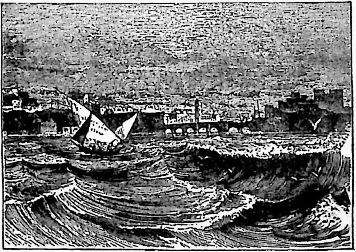
ANOTHER "CITY OF THE. SEA." 303 was called "Tsidon Rabba," or “Great Zidon,” indicates its origin. Justin derives its name from the Phoenician word “ fish."
"Yes, this proud city of the sea began as a " fishery," just as did Tyre; it went on step by step the same, until it became a mighty ruling power. She planted powerful colonies in Asia-Minor and the adjacent islands, and along the coast of the “ Great Sea " in Thrace, Sicily, Sardinia, Spain, Africa, and Cornwall. The manufacture of linen, dyes, perfume, but more particularly GLASS, was to her a source of immense wealth; beside which she had "divine” workers on bronze, gold, ivory, and silver, which were marvels in their day. The. world’s kings and great warriors were arrayed in gorgeous robes of Sidonian or Tyrian purple, as they wielded the famous “ Damascene blade,” also imported through her merchants. “ Homer’s heroines also arrayed themselves in Sidonian robes, “ * Which from soft Sidon youthful Puris bore, With Helen, touching on the Tyrian shore.'
While from Sidon came that chased .
“ * Silver bowl, the Urgent of its kind, The pride of kings, and labor of a god.'”
During the thirteen years in which Nebuchadnezzar sat down before Tyre, nearly all of her traffic fell into the city of Sidon, greatly to the latter’s prosperity. Another source of no small wealth was derived from her trade in slaves; nor was she at all scrupulous as to the source of supply, " not even shrinking from selling into servitude the inhabitants of neigh-boring Palestine.” The finest ships which were contributed to the enormous fleet of Xerxes came from Zidon, and were manned by her sailors and fitted by her merchants.
When Alexander invaded the coast of Phoenicia, Sidon dis-creetly opened her gates to the great conqueror, and was spared. She had already suffered the loss of " forty thousand of her inhabitants by revolt ” (351 B. C.), and was illy pre-pared for resistance.
She gradually recovered under Persian regime, and was probably nearly equal to Tyre in extent and population at the time of the visitation of Jesus and His disciples, A. D. 29.
The present population of Sidon is about ten thousand. Of these three hundred only are Jews, and six thousand eight hundred are Moslems.
She presents little to interest the antiquary. Nothing save a few ancient tombs and portions of the old sea-wall, and ruins strewn among her beautiful gardens.
To Jesus and the Twelve Sidon could present but little his-toric or religious interest As they left the city in a northeastern direction, they may, in common with all travellers in her borders, have taken a last lingering, look down on her ancient houses, decaying walls, neglected harbor, but lovely and extensive suburban gardens. From among piles of stone and mortar, some in shapeless masses, others in forms of dwellings, rise up in gorgeous array forests of trees of almost every kind mentioned in Scrip-ture. Some are in blossom, but most are now ripe and lus-cious, for it must needs be as late as August, which is the principal fruit month in Palestine. Among the fruit of these gardens of Sidon are almonds, apples, citrons, dates, figs and grapes, ripe and luscious now; pears, plums, peaches, pome-granates, olives, oranges and lemons.
“ Can anything be more rich and ravishing than those orange and lemon trees, loaded with golden fruit, in compact clusters, garnished with leaves of loveliest green, and spangled all over with snow-white blossoms of sweetest fragrance? Then those bananas, with extraordinary leaves a dozen feet long, and drooping like great pendant ears, strike my fancy exceedingly. . . . The fruit when green looks like our paw-paw of Ohio, and when ripe has a sickish sweet taste, and a doughy feeling in the mouth.”
The flora of this section is also very extensive, among which is the rose in several varieties, geranium the same, pinks, pan-sies, and among climbing vines the honey-suckle, the ivy, and the clematis erecta. And there are perennial blossoms and vines and fruit, for no chilling winds, with snow and sleet and ice (and seldom frost), visit this sunny land.
Jesus did not return directly home, but took a long detour toward the northeast, thence east over upper Jordan, and through much (or all ?) of Decapolis. His departure from Capernaum being in haste, with the main object evidently of gaining immediate rest, has led us to believe that His journey to Tyre was direct The text warrants it, as the same author-ity warrants us in saying that the return was delayed.
Taking a last look upon those heathen cities of the sea-coast, with their lingering splendor of temples, amphitheatres, warehouses and palatial residences, which within a few gener-ations were again to be in dust and ashes, and their idolatrous inhabitants to perish in fire and blood, Jesus and the Twelve finally turned their faces eastward.
The great caravan route lay along the bank of the river Bostrenus, as it flowed westward at the foot of the mountains. This river rises in the fountains of Baruk, thirty miles away. Half-way up the stream we may take the southern branch, as it dashes down through “ a sweet little" vale called Mirj-Bisry. This southern branch plunges down a precipice at Jezzin, two hundred and forty feet perpendicular. In winter it is a splendid cataract, and there are several others almost as grand between there and “Ammatur, where rattling torrents from Lebanon's heights leaped down giddy precipices into the chasm of the main stream. The route is rich in the very finest scenery of this goodly mountain. The pathway winds along a lofty line of hanging terraces, with the river far below, and the perpendicular cliffs towering hundreds of feet above, the favorite resort of eagles and savage beasts."
In Christ’s time it would be impossible to cross these moun-tains without encountering wild beasts. There were no cities along this route, as the absence of ruins attest The road ascends the western and southern spur of Leba-non through woody mazes, along winding cliffs, and past noble mountain scenery, till it reaches the height of six thou-sand feet. Eastward the traveller encounters the great and 306 ROADS?—CEDARS OF LEBANON.” romantic river known as the Leontes, or Litany. It rises in Coele-Syria, runs south and southwesterly, emptying into the Great Sea five miles above Tyre. It is about one hundred and twenty miles in length, and its fall is estimated at four thousand feet!
The highway passes over this river by a “ natural bridge” at Nihah, and plunges down the eastern slope of the moun-tain into the valley between Lebanon and Anti-Lebanon, to Wady-et-Teim. Here the road divides, leading in all direc-tions.
“ In those days, when Sidon possessed Dan and the fertile plains of Merom, this was an important highway over the mountain, and was well kept, furnished with cisterns of water and paved in places requiring it” (L.andB.) Yet, let not the reader suppose that this, or any other, so-called " road ” in Palestine or Syria, was a macadamized, grand turnpike high-way, such as we have in America or England. Oh, no!
Another article which you may not find over this route, though much desired, is the “Cedars of Lebanon.” This route runs through a zone of oak, mostly with mountain pine and terebinth, but no cedars, though travellers have often mis-taken terebinth for cedar.
The cedars are situated in higher latitude, on the western slope of Lebanon, some thirty or more miles from Beirut, on the very loftiest peaks of the Lebanon chain. Dr. Thom-son’s map shows them in their true location. He says:
“ The platform where the cedars stand is more than 6,000 feet above the Mediterranean sea, and around it are gathered the very tallest and grayest heads of Lebanon. The forest is not large—not more than 500 trees, great and small, grouped irregularly on the sides of shallow ravines.” The writer above has repeatedly visited these ancient, and we may almost say “ sacred ” trees, and knows whereof he writes.
Probably Jesus and the Twelve did not go so far north as this zone, and never saw the famous “ Cedars of Lebanon.” "We may see them, however, for they have been planted all over our country, and “ within fifty miles of London there are more of these trees, propagated by seed, than in all Lebanon.” Some of those are said to be 3,500 years old.
We now come to the most uncertain of all the route.
He came “ through the midst of the borders of Decapolis,” says Mark, in his meagre description of the return of Jesus.
Decapolis, as the name indicates, includes a circuit of “ ten cities.” Their names are not in the Scriptures, as such, but Pliny has named them for us. The most northern of these cities was Damascus, due east from Sidon fifty miles; Canatha
DAMASCUS
was the most eastern, Philadelphia (Allah-sher) on the south, and Scythopolis on the west, the latter being west of the Jordan, and twelve miles south of the Sea of Galilee. This country of Decapolis was very populous and prosperous in Christ's time, but now almost depopulated.—Farrar.
If Jesus passed through the “midst” of this region, He came down past Mount Hermon, through Banias—Caesarea
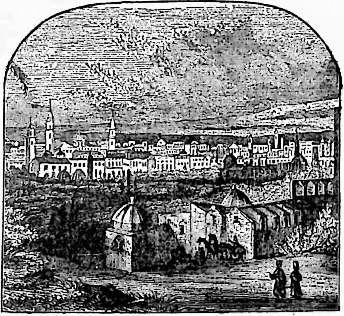
308 DID JESUS VISIT DAMASCUS?
Philippi—crossed the upper Jordan, and proceeded by a cir-cuitous route to the east side of the Sea of Galilee to near its southern end. This is Rev. A. P. Stout’s preferred route. If Jesus followed the “ borders ” of Decapolis, He crossed the mountains by the great caravan route described, to Wady-et-Teim, and proceeded north and east over the same continued caravan road to Damascus.
Did Jesus and the Twelve really visit Damascus? It is not impossible. She was the most ancient and important of all the cities of the world; she was situated but two or three days’ travel from Sidon, over a most delightful route, and a safe one to travel, especially during summer. The best Roman road in Syria extended from Damascus southward past Caes-area Philippi to the east side of the Sea of Galilee (Matthew), by which Jesus and the Twelve might return. “His final pur-pose by this wide circuit was to reach His old haunts without passing through Galilee, and this brought Him, apparently for the first time, into the wide territory of the ten allied free cities.”—Geikie.
Tischendorf, Alford, Andrews, Meyer, and Lichtenstein are in favor of the route from Sidon, as we have followed it; thence over Jordan to Dan, Panias, and so forth, to east side of Galilee, omitting a journey to Damascus. But if Jesus was at Caesarea Philippi on the return home, why did He almost immediately go back to that northern city ? Did the opposi-tion of the Pharisees compel Him ? Or is that matter (Mark 8: 11) out of order? We cannot say. This we know, that we find Jesus and the Twelve, on their return, “nigh unto the Sea of Galilee, on a mountain” (Matt. 15: 29). This evidently was in a heathen country, and one where He had never before Wrought cures.
The reception of Jesus in this semi-pagan country seems to have been favorable, says Canon Farrar, where He cured a deaf mute, upon whom He enjoined silence, but which the happy man disregarded as soon as out of sight of his Saviour. The result was, as usual, to call about Jesus an immense throng of ardent worshippers, who, in a desert place, continued with Him three days without food.
Then Jesus called His twelve disciples, and said to them:
" I have compassion on this multitude, because they have continued with me three days and have nothing to eat, and I cannot send them away fasting, lest they faint on the way."
Therefore He repeated the scene of Butahia.—Matt 15 :
32-39.
This scene was on the eastern side of the lake, else it could not be said that “ after sending away the multitude He entered the boat and came into the borders of Magadan ” (as in R. V.), or Magdala, which is most probable.
It was among a people who were at least partially pagan, as implied in the expression, “And they glorified the God of Israel” (Matt. 15: 31). They gave the praise to Jehovah in contrast with their own gods, and as their superior in power.
—See Andrews’ Com., p. 312.
Taking “ the ” boat, implies their own boat, and its capacity to carry thirteen men shows it was not one of the “little ships ” in ordinary use. How their boat came on the eastern side of the lake is a mystery unsolved.
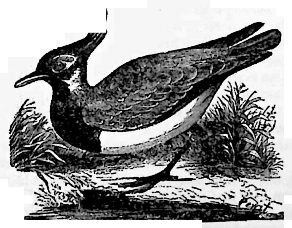
Chapter XXXVI
Another Journey Northward
Time—September, A. D. 29. 782. PLACE—Capernaum to Caesarea Philippi.
Was it not to avoid great publicity that Jesus, with His disciples, crossed the lake to Magdala, rather than directly to Caper-naum ?
References
Matt. 16: x, 20.
Mark 8: 10, 13.
Matt. 17: 1-28.
Mark 8: 14-38.
Luke 9 : 18-27.
Matthew says that they came to Magdala; but the R. V. translates it Magadan. Mark says “to Dalmanutha,” mean-ing a “ shady place,” but there are no such known places on the western side of the lake. We must therefore accept Mag-dala as the landing-place.
Magdala was never a large town. It is now known as Mejdel, and is a wretched hamlet of a half score of huts, the abode of squalor and wretchedness. The children sport in the sunshine in cherubic nudeness about the highway and in the lake, swimming like fish, now under water, now above, rolling in the hot burning sand to dry themselves. See Mary Magdalene in Part Second.
We have called attention to the fact that the people knew the boat in which Jesus was accustomed to sail over the sea, therefore they could follow Him. Had not some of the dis-ciples been sent to Capernaum to take the boat over to the eastern shore ? Evidence of this lies in the fact that no sooner had Jesus arrived on the western shore, by the boat, than the Pharisees and Sadducees pounced upon Him. “ It seems that

EVIDENCE OF “TIME" AND •‘PLACE,” 311 they had been keeping a lookout for Jesus’ arrival; as though they had been watching from the tower of Magdala for the well-known sail of His returning vessel, for barely had He set foot on shore when they came forth to meet Him.” So much for the place of landing.
As regards the time of the return, we have named Sep-tember.
FIRST. The only positive datum for this assertion is found in going forward to the next feast at Jerusalem, named in John 7 : 1-10. This was the feast of Tabernacles, occurring October 6th, if we reckon the preceding preparation of Atone-ment; or from October nth to the 18th, the regular period of this feast.—Andrews.
SECOND. From the time of Jesus’ landing on the western shore till this feast, we find a record of the following labors: He made a very brief stop in Galilee, perhaps Capernaum, when He again took His departure for Caesarea Philippi, via the lake, Bethsaida, and the eastern road, to the above vicin-ity. After that He went about the villages of Caesarea Philippi (Mark 8 : 27), evidently healing and teaching—at least teach-ing His disciples, all of whom accompanied Him—and taking a long detour, probably on to Mount Hermon, He returned secretly to Capernaum, through the midst of Galilee.
This would require a month in its accomplishment.
Now we proceed to a more definite description of this last circuit of Jesus and the Twelve from Capernaum, before their final departure to Jerusalem. In this we are happy to find ourselves in almost complete harmony with all these superior commentators who have gone before. . Wherever Jesus may have landed, it is most probable that He soon made His way home to Capernaum, as He did on the end of all other circuits therefrom.
The meeting with the Pharisees, Sadducees, and Herodians, would indicate His presence in Capernaum also. The com-bination of these formidable religious and political elements to oppose Jesus was a new feature, and one planned during His absence, for His overthrow when He should retnrn.
No doubt that this attack was severe and simultaneous. Matthew mentions only the religious sects, Mark names the political sect, the Herodians, in the caution given the disciples as they sailed away.
The “ sign" demanded by His enemies was one in the heavens—a political as well as spiritual sign.* Observe the Lord’s answer:
“ When it is evening (as now) ye say ‘ It will be fair weather because the heaven is red.’ In the morning (ye will say) ' Foul weather to-day, because it is red and lowering.’
“Ye may know how to discern the face of the heavens, but not the sign of the times1’ (Matt) “And He sighed deeply”
—Mark.
Not a year hence Jesus told His disciples, on Mount Olivet, what these signs in heaven should be, but to " this evil and adulterous generation" (offsprings of) He would give no sign, “save that of Jonah."—Matt 16: 4.
With this rebuke to all His foes, Jesus turned, re-entered the boat with His disciples, and set sail for the other side of the Sea of Galilee. The departure was immediate.—Matt. 16: 4.
That this continuous opposition of His foes grieved the Lord exceedingly is evident, for as He turned away from them “ He sighed greatly in spirit"—Mark.
The course was not directly across, but toward Bethsaida.
It was probably toward nightfall. All that is recorded above seems to have transpired in one day, which must needs bring it toward evening as they departed. So Farrar.
We may think of this as the last “ Journey of Jesus ” over this beautiful sea! No later is recorded, and in view of these facts, I forever picture the dear beloved Jesus standing in the boat, with sad and sorrowing heart, surrounded by His few faithful followers, who, silently grouped around Him, await the expression of His awful grief.
So, in the silent hours of closing day, ere night's sable * Luke ar: 7 end i r. "And there shall be great signs in heaven," Jesus re-plied to the disciples’ question mantle hides them from view, as they float away over the calm waters, we see them for the last time so, and imagine our-selves with them, sailing on blue Galilee, while we softly chant:
" O’er the waters gliding, Our bark pursues her way. Onward nobly riding Beneath the twilight's ray.
“ Stars will soon shine o’er ns, And cast their gentle light ‘ On the waves before us, To guide us through the night " Summer's breath is blowing Upon our snow-white sail, While the tide is flowing Along our native vale.
′ Daylight fast is fading Along the smiling main, Darkness all pervading , Above our homes again.”
After this great calm did not there fall a storm, awful and terrific in its force ? Did it not fall upon those cities along that northern shore, those three cities in full view from the boat ere night closed them in from His sight ? Capernaum first, which had rejected His counsel and scorned His mercies? Chorazin but a little toward the north, in whose precincts He had performed such mighty works as Tyre and Sidon never witnessed; and lastly, Bethsaida, at the head of the waters of this glad blue sea, alike unmindful of the many blessings which were conferred upon her by the Master, now nearing her borders for the last time ?
Was it not at a moment like this, while His heart was em-bittered by the memory of all these unrecorded deeds, in the full knowledge of all their ingratitude whom He would serve, and that His work with them was at an end, and that He now was looking back upon them for the last time, as He sailed away—“ was it not at that supreme moment of sorrow that He uttered those woes against those unrepentant cities 314 "WOE" TO THE LAKE CITIES. wherein many of His mighty works had been performed ? ”—Farrar.
“ Woe unto thee, Chorazin ! “Woe unto thee, Bethsaidal”
He had just returned from Tyre and Sidon, and the recol-lection of the prophecy against those idolatrous cities was fresh in his mind. But their sins were light in comparison with the sins of those present cities, and their punishment should be correspondingly light.
How true was His prophecy!
Tyre and Sidon still exist The former has a population of four to five thousand,' and a Christian community, while the latter has some ten thousand inhabitants, and rests in peace and loveliness on the shore of the blue Mediterranean.
But how about Chorazin and Bethsaida ?
Their very location is unknown! They long since have been blotted from the face of the earth and the memory of man I
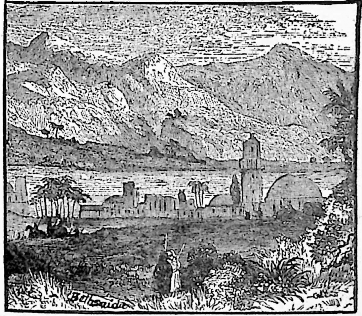
"And thou, Capernaum . . . shall be brought down to hell.” “ Helion," a place of covering over, hidden, buried from sight.
So she wasI As proof, men have dug down and found portions of her " covered over," hid from sight—two thousand years after the utterance of that awful denunciation i Is it therefore not more tolerable, for Tyre and Sidon, than for those lake cities which rejected Christ, and is not Caper-naum—His “ home ”—“ brought down to Hades ? ”
The denunciation of Jerusalem was when He sat over against her, on the Mount of Olives—at evening.
The denunciation of those lake cities must have been when He last sailed away from them on that ever memorable night!
As they reached the eastern shore that evening, the occur-rences of the day (Matt. 16: 1) were still occupying the mind of the blessed Jesus, while His worldly disciples were won-dering how they could make out a supper on “ one loaf of bread ” (Mark 8 : 14), in the boat.
“ Beware of the leaven of the Pharisees and Sadducees,” exclaimed Jesus.
“ It is because we took no more bread," thought the Twelve.
“ Oh, ye forgetful I Do ye not remember the matter of the feeding of the five thousand? and if we now lack bread, I am able to provide for you; but rather beware of the Pharisees, and of Herod.”—Mark.
The disciples were prone to giving literal interpretations to all the figurative expressions of their Master. At Jacob’s well He had said, “ I have bread that ye know not of." _ “ Has any one brought him bread in our absence?” they exclaimed. The parables were literally received by them, and without an after-explanation would have been so many fire-side tales to them. So in this case.
“Do you not understand?” He exclaimed to them.
No, they did not To them it was only a reproach because they had neglected to provide for themselves food. With their minds, and also by this hour their appetites, fixed on the bread for their supper, this may not be wondered at. The candor with which the disciples record their own dulness and errors, and lack of appreciation of the Master's high charac-ter, is offered as the best proof of the genuineness of their writings.
Philip belonged to Bethsaida, and since they all must eat, he may have been despatched to that city to buy for them the necessary supply of food for their contemplated journey to Caesarea Philippi.
In passing on, they would necessarily enter a suburb of " the village ” of Bethsaida, where they may have encountered the blind man, referred to by Mark only. Bethsaida was called a “ city" (John i : 44), but this portion where “ they” found the blind man was in “ the village," which may have been the eastern or suburban portion of the city. The text so implies.
After the cure had been completed, Jesus said, " Do not even enter into the village,” and He sent him home (Mark 8: 26).
From there Jesus and the Twelve went “ to the villages about Caesarea Philippi," a distance of thirty miles north of Bethsaida.
Of the villages we know nothing, but the city was very ancient, under its several names.
First, as BAAL-GAD—“ The God of Fortune."
Joshua has located it for us thus: " Baal-gad, in the valley of Lebanon, under Mount Hermon ” (Josh. 11: 17).
From the first it was an idolatrous place, as its name indi-cates. Baal was the supreme male divinity of the Canaanites and Phoenicians, as Ashtoreth was their supreme female di-vinity.
The hills all about here, and at Dan, four miles westward, are heaped with ruins of ancient temples, and the rocks of the mountains’ sides carved and engraved over with images of gods and demi-gods, and various Phoenician and Greek in-scriptions.
The great antiquity of some of these temples is shown by the Phoenician bevel on the stones, and the Ionic style of ar-chitecture, which was introduced into Asia Minor 1000 years B. C- Dr. Thomson describes one of these ruins near Caesarea Philippi, as follows : " The temple at Rakhleh is eighty-three feet long by fifty-seven wide ... A double row of Ionic col-umns extended from the altar to the entrance ... In the south-east corner is a stone belonging to the original wall, about six feet square, having a circular wreath five feet in diameter, within which is a colossal face of a handsomely carved image, cut in bold relief. The face is three feet four inches by two feet four. It has been purposely disfigured, but is still striking and distinct, and was probably an image of the god of the temple, here in ruins, and perhaps the face of old Baal him-self.” And there are scores of these temples, some much larger, some smaller, all over this country, which was always given to idol worship.
With the destruction of the principal Baal temples there arose the worship of the Greek god Pan; hence the name of ' “ Baal-gad ” was changed to Pan-ias, and latterly to Banias, as being easier of pronunciation by foreigners.
Pan was the chief god of pastures, woods, and flocks, whose original seat of worship was in the hilly and solitude parts of Arcadia, but gradually extended over all Greece, and eastward into Syria, southward into Egypt, and westward perhaps as far as Britannia. “ Banias was always celebrated for its wor-ship of Pan,* and as we follow up the country we meet with heathen temples all over these mountains."—L. and B.
Nineteen years before Christ, Herod the Great adorned Panias with a magnificent marble temple, and sixteen years later Philip rebuilt the city, and changed its name to Caesarea in honor of Caesar Augustus, adding “ Philippi," to designate it * With the establishment of Christianity, the heathen deities were degraded to “ fallen angels," but with the rural people Pan held to firm a place, that his char-acteristics, the horns, the pointed eant, cunning face, crooked nose, cloven hoofs and long, slim, forked tail, were all retained and transferred to the “ Devil," and thus the • old homie ” of popular superstition is amply Pan in disguise.—Cham-bers’ Encyclopedia—" Library of Universal Knowledge."

from the Caesarea on the Mediterranean Sea.—Josephus, Wars, i: 21, 5.
But the place was so given to idolatry, that after the de-struction of the Jewish power in all Palestine, during the first century of the Christian era, Caesarea Philippi relapsed into Banias, and Pan worship was again resumed. The principal source of the Jordan is at Banias.
Josephus has excited our interest in this mountain and cave by his graphic description, in which he says: “ The place is
THE JORDAN NEAR ITS SOURCE
called Panium, where there is a mountain raised to an im-mense height, and at its side beneath, a dark cave opens itself, within which is a horrible precipice which descends abruptly to avast depth. It contains a mighty quantity of water, stagnant, which no cord can fathom." Again he says, "Over it hangs a vast mountain, and under the cavern arise the springs of the river Jordan."
“ There can be no doubt, I suppose, but that this is the
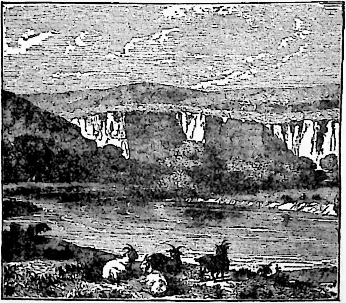
greater source of the Jordan, mentioned by Josephus, and this mass of ruins below the cave, through which the fountain pours its hundred streams, is the debris of the temple of Panium.”
Darkly and mysteriously the river Jordan bursts from the darker earth, flows on its marvellous, winding course for nearly 250 miles, and as mysteriously disappears in death and darkness under the waters of the Dead Sea!
On the side of yonder hill arose the magnificent temple of the supreme divinity of the Canaanites, within which they worshipped their god Baal with rites solemn and mysterious. And within the “ still waters " of yonder dark cavern, they sacrificed thousands upon thousands of human beings to appease his wrath and ensure a bountiful supply of “ living waters ” from the fountains beneath during the heated season, when all other fountains would fail under the burning sum-mer's sun. Another source of the Jordan lies in the moun-tains, far away to the north. It is called El Laddan.
The city probably extended from the narrow plain up yon-der mountain-side, terrace on terrace, while still behind rose higher and higher, to the extent of ten thousand feet, termi-nating in Mount Lebanon—the " SIRION " of the Sidonians, the “ SHENIR " of the Amorites, the “ BAAL-HERMON " of the Canaanites, and the “ CHIEF MOUNTAIN " of the Arabs—“ Jebel-esh-Sheik."
Under the shadow of this “ Tower of Lebanon that looketk towards Damascus," came Jesus and His disciples, and sat down for an unknown period. What was His work here we do not know, but from the language of Matthew we are led to believe that He mixed with the people, taught and wrought cures to a great extent, so that He was regarded as a great "prophet," as “John the Baptist," as “ Elijah," or as “Jere-miah." We read in Mark 8: 34 that “ He called the multi-tude unto Him and said, ‘ If any man would come after me, let him deny himself/ ” etc. Again, in chapter 9, verse 15, we learn that the multitude knew Him well, and ran and saluted Him, and immediately He was appealed to in behalf of the boy with the epilepsy, whom He cured.
All this indicates a period of activity on the part of Jesus and His disciples while in this country. Ellicott infers that the object of Jesus was public teaching and preaching.
For all this, it is indisputable that Jesus had turned away from His enemies in Galilee as He had the year previous from them in Judea, and was now a “ fugitive and outlaw,” rejected of the very nation to which He was sent, and now in this heathen land about Banias ” was only safe because beyond the bounds of Israel."—Geikie.
As He and His disciples were walking one day here in these places, Jesus asked them in course of conversation by the way:
" Who do the people say that I am ? ”
The reply of these disciples was honest; just as they had heard it talked over they now answered. Some say the " Baptist," others say “ Elijah,” or some other prophet, but not one had acknowledged Him the long-expected Messiah.
“ But who say you that I am ? " He asked. Promptly Peter answered for them all:
“ THOU ART THE CHRIST."—Mark 8: 29.
While Jesus tacitly admitted this, He immediately said: “ Tell no man that I am the Christ.”—Matt.
Notwithstanding this serious charge to keep silent on so momentous a matter, the disciples were highly elated at the announcement, and seized upon the first opportunity to argue who among them should be the “ greatest in the new king-dom.”
Peter thought it was he.
James .and John seized their first opportunity to ask the Master to grant them beforehand the highest honors in the kingdom.
On each occasion, Jesus announced His own sufferings and death, asking, in the latter case, if these who desired such honors with Him were able to share also His sufferings.
Nothing could convince these Jews, His disciples, but that til is “ coming kingdom ” was a temporal one, to be established in Jerusalem, and for the benefit of Jews only I Over and again did Jesus teach to the contrary, but they still clung to their false Messianic hopes and aspirations, abandoning them for a time at Calvary, when they knew their Master was dead and buried (Luke 24: 21), but resuming them unaltered after tiie resurrection, and in their last earthly interview with Jesus asked Him, as they met Him by appointment:
" Lord, doest Thou at this time restore the kingdom to Israel ? ”—Acts 1 : 6.
So here, at Csarea Philippi, these peasants and fishermen began aspiring to the seat of honor in a NEW KINGDOM OF ISRAEL.
“ Then Jesus began to show ‘ gradually ‘ to His disciples how He must go to Jerusalem and suffer many things of the elders, chief priests and scribes " (who constituted the Sanhe-drin), and be by them condemned and killed, but that He should rise again on the third day.
This greatly excited Peter, who exclaimed:
" God have mercy on thee 1 This shall never be I"—R. V. See Matt 16: 22. R. V. Notes on margin. John 18: 10, where Peter was as good as his word.
It was a worldly kingdom only to Peter, who meant to fight to the death for his Master. His intentions were honest, as the sequel shows.
But Jesus rebuked him and sent him behind till he should become better informed as to his position.
Jesus spoke openly to all the people (32), and for the first time defined His future position and its perils.
“ Now, if any man will follow me, let him do it with the full knowledge that he must take up his cross in so doing." This was the condition by which any could become His dis-ciple in those perilous times.
These spontaneous outbursts of honest Peter are very inter-esting to careful gospel readers. They are entirely unguarded, and reveal the innate honesty of the writers of these books, who record alike what told for or against the disciples of the Lord with equal sincerity.
Now, it is an encouraging promise received in its most literal sense by them; and almost immediately an open rebuke from the Master upon Peter's impetuosity, who was ready to fight an entire nation to save that Master's life.
Poor Peter! So recently a rock upon which to build a church, is now a scandalon, i. e., a “ stumbling-block 1"
“ Go behind, Peter.” But you shall yet come to the front.
All this matter, recorded by Matthew 16: 21-28, occurred when and where Jesus and the Twelve were alone by them-selves, and involved very great promises to them, and encour-agements to stand fast to the end, which some of them should live to see.

Chapter XXXVII
' the Transfiguration
f TIME and PLACE nearly some is in last chapter.
T is not here necessary to enter into any lengthy argument respecting time and place of
References
Matt. 17: 1-23
Luke 9: 28-45.
Mark g: a-30. a Peter x : 16. the transfiguration. Neither can it be expected that I shall give a learned dissertation on the object and character of that remarkable event.
After about a week, reckoning from the oc-currences of the last chapter, apparently with-out any extended geographical change, Jesus and the Twelve wandered as far north as the base of “ the mountain.” In the gospels the phrase “the mountain" has always referred to the principal one nearest the present loca-tion of the story involved. Jesus was at, or near, Banias, i. e., Caesarea Philippi, with no evidence of any change of location until going up into “ the high mountain.” When next, after descending, we learn His position, He is travelling down through Galilee to Capernaum, the way in which He would return from “the high mountain" in the vicinity last reported at—Mark 9: 30.
“ The high mountain,” then, was Mount Hermon.* “ There can be little doubt that Mount Hermon (' the chief mountain’) is intended, in spite of the baseless tradition which * Andrews, Farrar, Geikie, Robinson, Stanley, Lightfoot, Porter, Lichtenstein, and Cambridge Bible.

points to Tabor." Cyril (A. D. 400) started this tradition, seconded by Jerome, and to give it further credence, * three tabernacles " were built on the ruins of the castles there men-tioned by Josephus, A. D. 63. These tabernacles were erected during the latter part of the sixth century, followed a little later by a Catholic monastery erected by the Crusaders. Arcuff (A. D. 700) describes the latter as "being in a meadow on the very top of Mount Tabor,” which place Stanley, as well as Dr. Robinson, show was occupied in Christ’s time by a fortified city. This is further authenticated by the present
MOUNT HERMON
ruins. In Joshua’s time it was fortified. There Barak and Queen Deborah assembled the hosts of Naphtali, to swoop down on the hordes of Sisera. Josephus strengthened these fortifications for the Roman and Jewish wars; and, in fact, it has always been occupied by some warlike people, as Canaan-ites, Hebrews, Macedonians, Romans, Crusaders, Turks, until the present period, when “ the Greek Church, with the aid of Russian gold, has recently fitted up two or three vaults, as a chapel and residence of a solitary priest and keeper, a for-eign monk, whose appearance is not over-saintly, nor his cell particularly sweet”
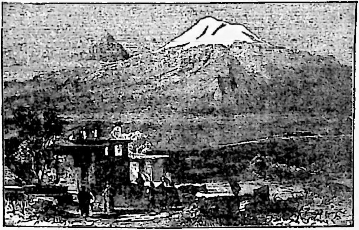
The following reasons are in favor of Mount Hermon: i. It was near Caesarea, where Jesus was last known to be.
It was out of Galilee, into which He afterward went—
Mark 9: 30.
It was well named "the high mountain,” being between ten thousand and twelve thousand feet in height.
4- It required two days in its ascent and descent, and its way was so steep and long as to completely exhaust the dis-ciples*, who succeeded in surmounting it—Luke 9: 32.
Tabor is easily ascended in a single hour!
Leaving nine of the disciples at some village, or at least thickly populated place (10), Jesus took Peter, James, and John, and ascended " into some convenient recess of the mountain.”
While the Master prayed the three disciples slept.—Luke.
Meantime the whole semblance of the Saviour became “ altered: His face shone as the sun.” His coarse, gray cloak (John 19: 23), or upper garment, became shining, and as white as the pure snows of the mountain peaks above Him.
As this exceeding glory shone round about Jesus, the sleeping trio awoke, and discovered that He was not alone.
Two men were holding conversation with their transfigured Lord. • These seemed to be Moses and Elijah. How did the disciples recognize them?
By their personal characteristics and ancient costume.—Numb. 12: 3; 1 K. 18: 46.
When coming up from Caesarea Philippi, the disciples had seen the whole way lined by heathen temples: at Banias itself, at a “ place called Bustra (now in ruins), another on the high point of Mutaleil, one at Sed Dan, farther in the mountains. A short distance northward is the fine temple of Habbariyeh, two miles farther north is another (also in ruins), and higher up still is the temple of Aim Hershah. Then come those of * Asleep, as from exhaustion. They were always good sleepers; they slept in Gethsemane while their Master sweat great drops of agony.
Ai hah, Kerf-Kuk, Kakhleh, Deir ‘Asheir, Burkush, Bekkeh, Munsch, and several others.”
Many of these temples were magnificent, with their lofty Ionic columns of purest white marble, set on carved granite bases, with beautiful* adornments of many colors of precious stones and burnished gold.
Never in their travels, even to Tyre and Sidon, had these disciples seen such beautiful tabernacles; rivalling the temple at Jerusalem, which was their special admiration, as expressed by the enthusiastic Peter in these words:
“ Master, see what manner of stones are here 1 and what adornments! and what a splendid building I"
Doubtless all these magnificent temples of Banias and Mount Hermon had had special attractions with Peter, and half-dreaming, half-waking thoughts of them drifted vaguely through his brain, and knowing not what he said, he cried out:
" Master dear, it is good for us to tarry here ”—here where such glory shines about us, and where we receive such daz-zling glimpses of heaven—“ let us build three tabernacles; * one for Thee, one for Moses, and one for Elias.” He would gladly perpetuate to them this earthly paradise.
Alas, poor Peter 1 Such glory could not last in this world 1 While he was speaking the glorious vision gradually faded from his sight, the intense gleam which had momentarily il-luminated the distant snow-clad peaks, and the green moun-tain herbage below, was superseded by the darkness of night, enshrouding the late 11 glorified form of his Lord " and His two spirit-land visitors, while the voice of thunder rolled along the craggy peaks in tones most awful and sublime:
“ This is my well-beloved Son I Hear ye Him.”
The shock, as from an earthquake, prostrated the three disciples to the earth. Then came Jesus, and touching them, said: “Arise; be not afraid."—Mark.
And when they arose, they found Jesus only present * Booths, as at the feast of tabernacles. “ Succoths ” of wattled boughs.
The departure of Elijah from the world is described in that flowery, descriptive language of the Orient, by which the vivid lightning and the rolling thunder are synonymous with “a chariot of fire, and horses of fire," and amid which Elijah was parted (or hid) from his companion, and borne on a “ whirl-wind up to heaven.” So now, the intense lightning (“abright cloud ”) and the terrible thunder peal of this midnight moun-tain scene in the " Tower of Lebanon," are described as a light of dazzling brightness, and a voice a? of Jehovah, proceeding out of the cloud.
The late confession of Peter was fully confirmed.
Years and years afterward he confidently referred to this scene, wherein he was eye-witness of Christ's majesty, in being “ honored by God, the Father, in a voice of excellent glory, coming out of heaven ” (II Peter 1: 17, 18). It is not given to earth to have more than brief glimpses of heaven.—Geikie.
As they descended the mountain “ the next day ” (Luke), Jesus commanded the three “to tell the vision to no man, until the Son of man be risen from the dead."—Matt 17:9.
Falling behind their Master, they asked one another pri-vately, “ What the rising from the dead should mean!"—Mark.
Obtuse disciples I How many times had Jesus already told them ?
He had talked of it to them by the way (Matt. 16: 21; Mark 8:31; Luke 9 : 22), it was the theme of conversation between Jesus and Moses and Elias the night previous on the mount, still it was beyond the disciples’ comprehension, and they wondered, “ What does He mean by rising from the dead?" Another equally serious question exercised their minds:
“ How is it that the scribes say that Elias must first come?" The Messiah was certainly here, and apparently before Elias; how, then, could Malachi say that “Elias must come first?” With this question they came to Jesus.
“ Elias has come," Jesus replied, and then He gently led their untutored minds back to the fact that John the Baptist was the true Elijah. This they understood, and it confirmed their belief that Jesus was indeed the true Messiah. This made the first question all the more difficult.
“ Being, then, the Messiah, how could He be put to death ? ”
A few days later, apparently, He endeavored to explain this matter more fully, but while it made them “ exceedingly sor-rowful” (Matt. 17: 22, 23), they did not, even then, compre-hend their Master's meaning. “And He upbraided them with their unbelief and hardness of heart, because they believed not them who had seen Him after He was risen.”—Mark 16: 14.
And now the scene becomes marvellously changed.
During the two days' absence of Jesus and the three, those other disciples, left behind, had been surrounded in the village below with a great and excited multitude, upon some of whom they had been exercising their too feeble powers of healing. The special subject was a lunatic boy.
Seeing Jesus approaching, the people, with the father of the boy, ran to the Master and saluted Him —Mark.
“ Why do ye question my disciples ? ” Jesus demanded.
“ One of the multitude,” the father of the demoniac boy, stepped forward, and replied—
" Master, I brought my boy, who is an epileptic, to thy dis-ciples, and they could not cure him ” (hence the taunts of the scribes—Mark 9: 14). " Now, therefore, O Lord, I beseech thee to look upon him, for he is my only son, and behold the spirit that taketh him and teareth him, and he crieth out and froths at the mouth, and falls into the fire and into the water.”
“ Bring him here,” said Jesus.
He was brought forward while in one of the fits (Luke), followed by the nine disciples.
" How long has he been in this way?" Jesus inquired. We are following the combined narratives of the three synoptists.
“ From childhood—but if thou canst, have compassion on us and help us,” cried the father, fearfully.
“ If thou canst,” Jesus repeated. “All things are possible to him who believeth.”
" I believe, then," exclaimed the father; "help my belief!"
Then Jesus, before His faithless disciples, the taunting scribes, and the waiting multitude—taking the boy by the hand, said:
“ Come out of the child, thou deaf and dumb spirit” “And from that hour the boy was cured."
“ Then were the people astonished at the majesty of God.” We may understand by this last expression that the cure was wrought out of Galilee, and in a country where they had not previously witnessed the many cures wrought at the hand of the Lord Jesus.
At the first opportunity, when alone with their Master, the disciples asked Him why they could not cure the maniac boy.
" Because of your little faith," He promptly replied.
” See you yonder mountain ? " pointing to Hermon, tower-ing with its snowy head into the blue heavens. “ If you had the faith of a grain of mustard-seed, you might say to this mountain, ‘ Remove hence to yonder place,' and it would be done, for nothing is impossible unto you."—Matt. 17:20; R. V., omitting verse 21. See marginal note. .
“ From thence they went through Galilee," to Capernaum, “ and would not that any man should know it."—Mark 9: 30.
Chapter XXXVIII
Jesus Arrives Home with His Disciples
Time—First of October, A. D. 29. 78a. Place—Capernaum.
And they departed thence, "And passed through Galilee.”
References
Mark g: 30.
Matt. 17: 10-14.
Mark 9: 33.
Matt. 17: 35.
Privately, "so no man should know it" “And they came to Capernaum." * “And went into the house"—their own home.
Not even a sceptic could ask for any plainer statement than this, which describes concisely the departure of Jesus and the Twelve from the north (Mark 8: 27), where they were last, down through an unaccustomed part of Galilee, where they were comparatively unknown, to Capernaum.
While passing down through Galilee (Mark 9: 31), and also in their own house at Capernaum (9: 35), Jesus labored to instruct His disciples in their future duties.—Luke 9: 47.
" There was something intensely human in the return of Jesus to Capernaum in the face of imminent peril." It was His home yet • “ He longed to see the old familiar spot once more, the hills behind the town, over which He had so often wandered; the This route would be from Csarea to Dan—four miles—where they would cross the upper Jordan, and proceed down on the west side of that stream, and Lake Merom, pass east of Safed, thence directly to Capernaum.

AMBITION" OF THE DISCIPLES. 331 shady woods, the orchards and vineyards, rich in foliage, or glowing with ripening fruit, in the past summer months, and look out again upon the sparkling waters " of the blue Sea of Galilee.—Geikie.
The first question to settle with the disciples after their arrival home was the one in dispute on the way through Gal-ilee : “ Who is to be the greatest in the new kingdom ? ”
The Israelites had no king for a long period, but were anxiously looking for the time, according to promise, when a new anointed ruler, called by them the Messiah, should arise and sit in judgment on the throne of David. The rabbis taught this. “ All literature, education and politics began and ended with the great thought of the Messiah."—Geikie.
But he was to be a temporal Messiah, most assuredly 1 With the Twelve apostles, especially Peter, James and John, this expectation was about to be fulfilled; hence it became a question of personal interest to each who should occupy the highest position in the new government. Perhaps the prefer-ence shown by Jesus to the three whom He took with Him upon the mount, and whom He had before specially honored at the raising of Jairus’ daughter, for instance—may have provoked envy and occasioned the dispute.—Andrews.
But this dispute was general—among the whole Twelve.
—Mark 9: 35.
Peter, who was chief speaker, and already had the promise of the keys, expected to be the Lord Chancellor or Lord Chamberlain of the household, and so be the greatest Judas carried the bag, or rather money-box (R. V.), therefore ex-pected to be Lord Treasurer, which might dominate him the greatest Simon and Jude, being nearly related to Jesus, hoped to take their places as the greatest, as princes of the blood. John, the beloved disciple, is the favorite of the Prince, therefore hopes to be the greatest Andrew was first called, why not he be preferred ?
Evidently this dispute rose high (Mark 9: 33), but Jesus gave it no heed until they were all together in the house at home.
332 WHO IS FIRST IN THE KINGDOM?
Then said He to them:
" What was it that you disputed about on the way ? " " But they held their peace,” for very shame.—Farrar.
“And Jesus sat down,” as teachers did while instructing-, and taking a child that chanced to be in the house as a living illustration, He endeavored to teach them that such as were free from pride, undue ambition, bickerings and covetousness, could ever have a part in the coming kingdom. But it was all lost on these obdurate, yet unconverted, disciples; they still held firmly to their national belief in a temporal kingdom only. As proof of this truth, we again refer to the occur-rences of the following spring, when James and John came boldly to Christ, near Jericho, and asked for the highest seats in the new kingdom of Israel, which they believed would “ immediately appear.” Again, at the ” supper” in Jerusalem, the quarrel was renewed for the highest seats at table, and, finally, at the last meeting of the Eleven with Jesus, just be-fore His ascension, came Peter, and in behalf of the rest, asked :
“ Lord, dost Thou at this time—this meeting—restore the kingdom to Israel ? ” (Acts i: 6). How long He bore with them I—Matt 17: 17.
The next question to adjust was that of taxes.
It was the temple-tax (Ex. 30: 13), which was due from every Israelite at about the time of the passover. Jesus not having been present at that feast, and having been abroad almost continually since to the present hour, the collector had not before demanded the tax. The Twelve were probably at Jerusalem at the passover (of the last April), and had paid their “ didrachme,” therefore they were not directly asked to pay it now.
Now the collector (shelihim) came to Peter, as the promi-nent disciple of Jesus, and said to him :
“ Peter, does your Master not pay the half-shekel ? ” “ Yes,” Peter promptly answered.
This was by the sea-shore or in the street, and Peter re-turned to “ the house,” when Jesus immediately addressed him:
« Simon.”
Jesus always so addressed Peter when he had gone wrong.
“ Simon, what think you, do the kings of the earth receive tribute from their sons, or from strangers ? " “ From strangers," replied Peter.
“ Then the sons are free," said Jesus. “ But,” he added, " lest we offend them, we will pay the tribute. Go to the sea and cast in a hook, and take the first fish that comes up, and, looking in his mouth, you will there find a shekel ”—enough for two taxes—" that take and give them for me and thee."
There are some very curious facts in connection with this
HEBREW COINS
“ temple tax," which must be interesting to the common reader.
FIRST. The collector, or shelihim, was a messenger sent out from Jerusalem by the sanhedrin to gather in this tax.
SECOND. Every Jew over twenty years of age, wherever he may be, is obliged to pay this tax annually, in lawful silver, about one shilling three pence, English. In the aggregate it amounted to millions. This was poured into the temple treas-ury annually, and so great was this collection from the Jews of Babylon alone, that its conveyance across the desert re-quired a guard of several thousand soldiers for its safe trans* mission.—Geikie. •
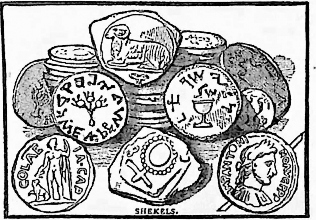
The money was kept in strong iron-bound chests, in a chamber of the temple, and was used (i) for keeping the buildings in repair; (2) for cleansing the temple, grounds, and the linen used in the service; (3) to pay the rabbis, who doubtless appropriated much of it; (4) to also pay scribes, collectors, bakers, and (5) to provide temple sacrifices, and supply water and the ct eceteras needed in and about the tem-ple.—See Josephus' Antiquities.
This didrachme was the only silver coin of the Jews. It was coined after Simon the Maccabee, and this only would be received for the tax; hence “ money-changers" had their benches in the temple to exchange this coin for all others brought from every land by the stranger pilgrims.
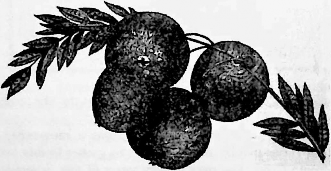
Chapter XXXIX
The Brothers of Jesus Visit Him
Time—First of October, A. D. 29. PLACE—Capernaum.
The enemies ot our'Lord would
References
John 7: a-10.
not long permit Him to remain in peace and quietude, even in His own house in Caper-naum. They would find Him out and return to embarrass Him, as is evidenced in the matter of the tax collection. This being the only recorded annoyance from them at this time, is evidence that He did not long remain at home.
That Jesus went to Jerusalem at about this time is shown by the absence of any record of Him by the synoptists, be-tween this and the close of the year, with the exception of an account of His journey out of the country, probably in De-cember.* They record nothing which transpired while Jesus was, meantime, in Jerusalem. John (7: 10) here comes to our assistance. He alone has recorded the several “ Journeys of Jesus ” up to Jerusalem, and what there occurred.
The feast of tabernacles drew nigh.
Jesus was yet in Capernaum when the northern pilgrims began to gather preparatory to the start for Jerusalem to at-tend this great festival. This is corroborated by John (7: 9), where he says, after the departure of Jesus' brethren for that feast, Jesus " still abode in Galilee,1’ i. e., Capernaum of Galilee.
* Luke 10: 1, and 18. 18; Matt. 19: 1; Mark 10: 1.

Galilee (in general) was no longer open to Him. He was out-cast from all the rest of Galilee, where “ He would not be known," i. e., seen, and where He never again went. His work was there completed. Those Galileans who had rejected Him could only see Him by going up to the feasts at Jerusalem.
This annual festival of the Jews was called " The Feast of Tabernacles ” because, during its continuance of a week, the Israelites all dwelt in booths, “ succoths," consisting of thickly woven boughs of pine, palm, olive, or other dense foliage, built upon light frames. Necessarily these were very small, and scarcely permitted standing-room for a family. They were pitched all about the city, in courts, side streets, upon house-tops, and down the hill slopes, over Kedron as far as the western declivity of Mount Olivet, facing Jerusalem. These booths were numbered by the thousands. It reminded the Jews of their forefathers' forty years' wandering in the wilder-ness of Arabia. It was a festivity of gratitude also for fruitage and vintage.
The time of this feast was at the end of the year.
It commenced on the 15th Tisri, corresponding with our 1st of October, and lasted eight days—the first and last days being the Sabbath of the Jews (see Farrar, ch. 39). It was wisely convened before the rainy season set in, as the passover was after the rainy season closed in Palestine, thereby ensuring pleasant weather and good travelling. The exercises consisted of singing psalms, shouts, responses, marches of Levites, cere-monies, offerings, and music and dancing.—Bib. Lexicon, Lightfoot.
Before departing directly to Jerusalem to attend this feast, the brethren of Jesus came down to Capernaum for the special purpose, seemingly, of persuading Jesus to go up to Jerusa-lem with them. They knew, of course, that He had not at-tended the last great feast in April, and feared that He might not attend this feast They came a whole day’s journey out of their way in com-ing from Nazareth, their home, to Capernaum.
It must have been three days before the opening of the feast when those four stalwart Galileans entered the presence of their majestic brother. I imagine them saluting Him with a kiss, and making that obeisance due to Him as the elder brother and a learned rabbi, without the honors, but not as the Messiah. This they, in common with the Jews, " did not believe.”—John 7 : 5.
" Go you not up to the feast? ” they inquired.
" I go not up to this feast; my time is not yet fulfilled.”
He evidently did not intend, at the first, to go. There was a price set upon his head in Jerusalem, but it seems to me, after sending away His disciples to the feast. He changed His plan and went, for if " His time was not fulfilled " the enemy at Jerusalem could not harm Him! He changed His views. He often did, seemingly. At Tyre He changed His first view in regard to a Canaanitish woman, and " because of her say-ing,” to take His own words, He healed her child. There are many instances of this, and why not?
There are numerous opinions on this passage. Alford says it is “ I go not up at present.” Others add the word " yet," and in many other ways try to avoid the plain statement, ” I go not up to this feast." .
Then His brethren began to use argument on Him. “ Come up to Judea, that they there may behold your works, which you are doing here in secret." Jerusalem was the great ecclesiastic centre, and if Jesus desired recognition, He must go there for it • This expresses their opinion of the disciples whom He had made in Galilee—a few peasants and fishermen of marked dialect, and unlearned in the schools, whose adherence was weakness to His cause. In Jerusalem alone could they ex-pect Jesus to be recognized as anybody.
Having answered these arguments, Jesus still declined to accompany the brethren to Jerusalem, and they went on with the caravan, accompanied by the disciples also.* Now the scene of activity is transferred to Jerusalem.
John 9: 2. They are mentioned as being present, while Jesus went “ se-cretly,” L alone.
The great Galilean caravan had arrived, and with' it the Twelve apostles, well known far and wide. On seeing this the rulers became greatly excited, and looked diligently for Jesus (11).
"Where is this Jesus of Nazareth?" they inquired, not seeing Him.
And the excitement rose higher. There was great mur-muring among the multitude (pilgrims) from various parts.
“ He is a good man," said some of them.
“ Not so, for He leads the people astray,” said others. Thus the dispute went on day by day.
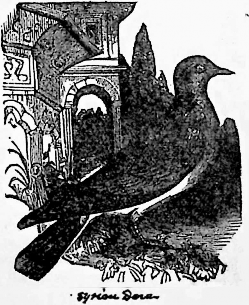
Chapter XL
Jesus Arrives at the Feast
Time—Wednesday, October 16, A. D. ag. PLACE—Jerusalem,
First Day of fesus at tiu Feast. References,
John 7: 10-36.
John- 7 i 45-52.
UT when it was now the midst of the feast, Jesus went up into the temple and taught" This we take literally. The feast be-gan on the Jewish Sabbath, Oc-tober 11, our Saturday, and lasted eight days. The “ midst," or middle, would be Wednesday.
The matter of the first day, as above, will be found in the texts, as above, the evidences of which will appear in the four remaining days of the feast All excitement regarding Jesus would naturally subside by the fifth day of the feast: His brothers would report His non-attendance, and other subjects would engross the attention of rulers and people.
On the fifth day, however, when the scribes, Pharisees, and elders came into the temple to show themselves before*the people, judge of ‘heir astonishment on finding Jesus there, seated on the stairs leading to the “ Court of the Men," address-ing the multitude I (Josephus describes stairs—they were cir-cular.)
Drawing nearer their astonishment increased to amazement at the words of wisdom which this “ Galilean ” teacher was uttering.
" Where did He acquire this learning, having never learned ? ”
He belonged to no school such as Paul boasted of, and the Jews taunted Him with want of rabbinical lore, such as pro-ceeded from teachers like Hillel and Shammai. This He overheard.
His reply charged them with ignorance of common law.
" Moses gave you a law—* Thou shalt not kill ’—and you transgress it by seeking to kill me." In this charge Jesus re-ferred back to the secret council of the Sanhedrin a year and a half before (John 5: 18), of which the ” multitude” (19) were ignorant, and in surprise they cried :
“ Who seeketh to kill you ? You are beside yourself.”
Disregarding this interruption Jesus continued His reply to the rulers:
“ I did a great work on the Sabbath, at which you marvel. You do a less needful work on that day that you may not break a law. Yet are wroth at me for making a man every whit whole on the Sabbath."
The citizens of Jerusalem (25), better informed than the outside multitude (19), came in, and seeing Jesus exclaimed:
“Is not this He whom the council'seek to kill?"—John 5: 18.
“ Lo, He speaketh openly, and they do not hinder Him! ”
" Can it be that they—council, or 4 rulers ‘—(26) know that He is indeed the Christ ? However we know whence He came.” We know Him I There was a certain irony in the reply of Jesus which mad-dened some of His hearers, for which they wanted to take Him, but dared not (see Farrar). This, with His claim as one sent from God (29), which many believed (31), was reported to the Sanhedrin (32), who doubtless held repeated sessions in a convenient room, and they at once, in order to stop His ca-reer, sent officers to arrest Him. These came into the temple, and being recognized by their official badge, Jesus immediately comprehended the whole matter and said to them:
“ Ye shall seek me (by-and-by) when ye cannot find me, for where I go ye cannot come."
The Jews thought to make a little joke on this expression, and while they tucked one another under the ribs—a Jew's trick—said:
“ Where will He go ? Perhaps into Dispersion among the Greeks, and teach them Greek.”
Jesus was a Galilean, a people despised, laughed at by Ju-deans for their guttural speech; but Jesus evidently was teaching in the Greek language (cf verse 15,“ How knoweth He letters ? ” languages, etc.)
The great Sanhedrin had fallen very low when their only defence was no higher than ridicule. Yet, while they tried to cast derision on Jesus, their officers, awe-stricken and amazed, returned the writs unserved, saying (47):
“ Never man spake like Jesus."
“Are you also led astray ? " the rulers wrathfully exclaimed. “ Have any of the rulers believed on Him ? ” (12: 42).
While the Sanhedrin were holding a stormy session in their secret chamber (7: 45-52), and the day began to close, Jesus and the Twelve might, unmolested, retire from the upper temple. .
As they passed through the upper gate and down the fif-teen steps into the “ Court of the Women," the preparation was begun for the joyful termination of the day’s festivities.
The golden lamps around the walls of this apartment alone contained one hundred and twenty pints of oil (Lightfoot), in which were numerous wicks, made from old linen robes of the priests. These were lighted by four young priests, while without the court “ rose immense candelabras, in whose huge cups the illuminations of the feast were kindled that banished night from the city.” Under these the religious and devout, torches in hand, danced and sang psalms. The Levites, with harps, cymbals, and other instruments, stood on the steps leading up to the “ Court of the Men,” playing and singing.
Two priests, standing at the gate at the top of the stairs, now advanced, sounding trumpets at intervals, till they reached the eastern gate of the temple, where all passed out.* This was the "Beautiful Gate,"t outside of which, in the “ Court of the Heathen," beggars were permitted to sit or “ lie daily.” These would retire before sunset; hence, when Jesus passed out after lamp-light, all these beggars, lame (Acts 3: 2), blind (John 9: 1), etc., would have gone. For this reason we shall find the curing of the blind man to have been
CANDELABRAS
on the last day of the feast (9: 1), and to have occurred in the morning as Jesus entered the temple, and not, as some sup-pose, at night as He passed out.
We have placed the first attempt to arrest Jesus, and the report of failure by the officers to the Sanhedrin (7: 43), at * Lightfoot gives this as the closing scene of the first day. t Acts 3: 10; called “beautiful" or “gulden gate," because overlaid with mas-live gold, richly chased. It seems to have once been the outer gate, but adding courts and porches left it between Women’s Court and Court of the Heathen — Lightfoot, C. C., 66-69.
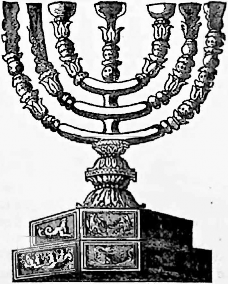
the close of the first day, because we find at the last day another " division” among these rulers (9: 16) which is differ-ent from the former. There were two “ divisions,” and two causes for those divisions.
John’s record of the second day begins with these words—"And early in the morning, Jesus again came into the temple, and all the people came unto Him, and He sat down and taught them."—John 8: 2.
The word "again” implies a former day of teaching there. He “ sat,” probably on the stairs leading up to the " Court of the Men."
He taught in the “ Court of the Women.”
No female was permitted in the other courts, except the “ Court of the Gentiles,” which was outside of the women’s court A prowling night-watch had found a female, probably an attache of the camp, as such-like followed all great concourses of men in those days as ever since, and this one may have crept into some strange man's booth unlawfully. She was first taken to the council, who thinking it a good case by which to ensnare Jesus, carried her before Him in the temple, and sat her on the floor.
“ Master,” said they, “ this woman was taken in the act of adultery. Now Moses commanded us to stone such. What say you ? "
Here was a dilemma I If He said “ Let her go,” as He had at Nain, to the woman, they would charge him with lax mo-rality; if He condemned her to death, as Moses gave com-mand, He would be condemned by the procurator for sedition. “ Heresy or treason."—Farrar.
Jesus feigned not to hear them, and stooping forward as He sat on the steps, occupied Himself in writing on the dusty stone floor.
Meantime the unfortunate woman, half naked (4), her hair falling in heavy masses over her face, neck and shoulders, her feet bare, and her whole form trembling with fear, whose exposed and unhappy condition the gentle Saviour declined 20 . to witness, hence turned away from, sat weeping at His feet The Pharisees urged Him for a reply.—-8 : 7.
“ Come, what think you of her? shall she die? "
He calmly raised His sacred head, and looked upon those corrupt, lecherous rulers in Israel—how well He knew them!
—and said:
“ Yes—according to Moses’ law she dies." .
How then must the wretched woman have quaked with fear at this voice of condemnation, and what utter despair of life must have seized her, laying her prostrate on the cold stone pavement (10), as Jesus continued to pronounce judgment on her (7). .
“ He who is without sin (of the kind) among you, let him first cast a stone at her," and again he bent forward as before.
—8.
Now as a standing warning against like sin, a heap of stones was kept in the temple for ready use, but instead of running and gathering them to cast at the offender, these self-accused rulers looked ashamedly around, and finding them-selves unobserved by this righteous Judge, Jesus Christ, they slunk out one by one, till the very last of them was gone.
The multitude (2) had fallen back in the presence of the great Sanhedrin, as they entered with the woman (3), and now when Jesus again raised His head (io), there seemed none present with Him but the fallen woman, to whom he said, in a voice which must have surprised and reassured her—
“ Woman, where are your accusers ? “ Did no one of them condemn you ? ” “ No, Lord; no man.”
They had fallen into the pit set for Jesus!
“ Neither do I condemn you. Go your way and sin no more.”
Some ancient manuscripts omit this story of John (8:2-12), but, says Canon Farrar, “ I have no shadow of a doubt that the incident really occurred.”—See R. V. in loco.
In view of the fact that a publican was one of Jesus' chosen disciples, that sinners supped with Him daily, that a harlot had washed His blessed feet, wiped them with the hair of her head and perfumed them from her own alabaster box, and that He himself had said to these same scribes and Pharisees—" Pub-licans and harlots go into the kingdom of heaven before you," I think no over-nice scruples on our part should erase from the gospel this great lesson, so full of charity and so Christ-like in its teachings.
For the above reason, we accept it as wholly true. The time, place, and circumstances all point to its truthfulness. The night-watch would only bring her in at early morning, after the night’s detection; she could only be brought as far as the “ Court of the Women; ” it is all in order; the law, as it stood, obsolete, on the statute-book, favored the circumstance; and lastly, it is too Christ-like for any over-nice scruples to effectually expel from the gospel.
We may easily discover the next in order, I think.
It was at the close of the second day in the temple. The Jews having been put to shame in the matter relating to the adulteress, by whom they hoped to entangle the Lord (6), did not renew the attack till nightfall.—Cf 12 and 20 vs.
We resume the narrative at chapter 8, verse 12, when Jesus came down into the “ Court of the Women.” Here was the treasury (20), the same apartment where the ” widow cast in her mite,” showing that it was the women’s court where Jesus now was (8: 12). Here He found the lights brilliantly burning, as on the previous night, and as the priests came down the steps, with “ flourishes,” followed by the Levites and ‘the multitude, toward the lower gate, the " Beautiful Gate,” Jesus stood up and cried, in a loud voice—
" I AM THE LIGHT OF THE WORLD 1 He who followeth after me, shall not walk in darkness, but shall have the Light of Life.” “ Light" is the name of Messiah.—Talmud.
This was a plain, open avowal of His Messiahship. The Jews (13) could no longer keep silent, and there followed a long war of words, in which Jesus came off conqueror (20).
"These words,” from v. 12 to 20, “Jesus spake in the treasury,” as the people rejoiced in song and dance before the lights. Necessarily there was a suspension of festivities while Jesus and the Pharisees (13) held controversy, after which the people all passed out at the Beautiful Gate.—Light-foot Thus ended Jesus’ second day in the temple, which was the sixth of the feast The next day was yet more perilous.
There seems internal evidence that the 20th verse of the 8th chapter of John closes the day’s lesson. Compare the language with an ending of Jesus' discourse at Capernaum (John 6: 59), which was the finale of that day.
Again, the 21st verse of the 8th chapter begins a new dis-course, wherein Jesus reminded the Jews “ again ” that He should depart and leave them to perish in their sins (24), as in 7: 34.
The result of the discourse brought out in this day’s con-troversy with the rulers (24-30) caused many to “ believe on Him ” (30).
Each day John records the result, in that many believed on Him (7: 31, and 7*. 41), some even saying:
" This is the Christ.”
All which John has recorded from 21 to 59 of chapter 8, belongs to this third day. It contains Jesus’ most severe de-nunciation of the rulers, commencing with verse 33. “They” refers to the rulers (40), who were seeking the arrest and death of Jesus, and not to the “ Jews who believed on Him,” as in verse 31. "They” also refers to the Sanhedrin, which had condemned Him to death (5 : 18), as is shown in Christ’s ad-dress to them in 8: 46: “ Which of you convicteth me of* sin?”
At the end of this day’s controversy with His enemies, they took up stones to cast at Jesus, but amid the crowd and ex-citement among men, women, and children in the lower court, He escaped out of the temple (59).
In making His hasty exit, it is not very probable that Jesus stopped at the "Beautiful Gate” to converse at leisure with His disciples (9: 2), or that He took abundant time to heal the blind man (9: 3-7). All this was done on the following morning.—See Andrews, 336, Alford, and others.
SATURDAY.— The text of the last day is found in John 9: 1-40; 7: 37-44; 10: 19, 20, 21, and 7:1. If we take the last by itself alone, we find it senseless, without connection either before or after it, but place it at the end of any of the feasts, it becomes plain, consistent, and chronological. The verse reads thus: , "And after these things Jesus walked in Galilee, for He would not walk in Judea because the Jews sought to kill Him ” (7: 1). He was (as the verse is placed) then in Gali-lee, had been, and was likely to remain; therefore it is out of place and worthless. If we try to connect it with what fol-lows, it is still the more inconsistent, because Jesus at once, seemingly, went into Judea. See Preface.
Now place it at the end of this feast (after John 10: 21), and we have sense and order, as well as enlightenment as to the Lord's conduct after the feast.
John’s narrative takes Jesus from Galilee (7: 10) to the feast, tells us what He did and suffered there during four days, and at the close returns Him safely to Galilee (7: 1).
Chapter 10: 1 to 18, we place at the feast of passover. We now return to the last day of the feast of tabernacles.
The morning opened with the healing of the blind man, as Jesus and the Twelve came early toward the temple.—So Far-rar, ch. 41; Lichtenstein, 299.
As we turn to Luke 22: 39, we learn that Jesus and the Twelve were accustomed to go to the Mount of Olives to lodge, and in 21: 37, that “ He taught every day in the tem-ple (as now), and went out every night to lodge in the Mount of Olives." That is, to Bethany, as Bethany was at the Mount of Olives.
When Jesus fled from the temple the night previous, with the murderous Jews pursuing to stone Him, and He barely escaped, as some think by a miracle (Winer), it is not sup-posed that the Twelve were compelled to flee in like manner, but soon followed, as they were with Him on the following morning when they discovered the blind man. The expres-sion "as He passed by” (9: 1), is elsewhere used to represent "Jesus and the Twelve coming to the temple in the morning” (Mark 11: 20), as they now were.
The blind man was healed on the Sabbath day.
It was “ day” and not night, for Jesus said to the Twelve, " We must work while it is day: the night cometh when no man can work.” Did He ever heal at night time? No.
No beggars were allowed out at night Evidently, then, this healing was in the morning.
Jesus sent him to the pool Siloam to wash, before the cure was completed (v. 7-11). The priests and multitude were then there drawing water. This pool was situated at the lower end of the Tyropean valley, outside the wall, and near the southeastern corner of the same. It was fed by a subter-ranean aqueduct.—Robinson.
Pending the blind man's absence, Jesus entered the temple (7 *• 37)- Soon came the rabbis and the multitude, returning from the pool Siloam, bearing the golden vessel containing the water “ to be poured out at the great altar at the hour of morning libation” (Geikie). This ceremony was performed every morning during the feast, “ amid great rejoicing, sing-ing, and dancing,” as at evening they rejoiced before the lights.
“ When the first streak of dawn appeared, shooting up the eastern sky over the ridge of Olivet, the priests sounded the silver trumpets three times, long and loud, and the answering shouts of the people welcomed the Great Hosanna day. A procession of priests started immediately to bring water from the fountain Siloam, which flowed at the foot of Mount Mo-riah, outside the city wall. .
" When the procession returned, the brief twilight had re-solved into day. Their appearance was greeted with another blast of silver trumpets. They ascended the steps of the temple, bearing the golden beaker full of water in their hands, chanting the song of degrees as they went up, keeping time with their steps:
POOL OF SILOAM
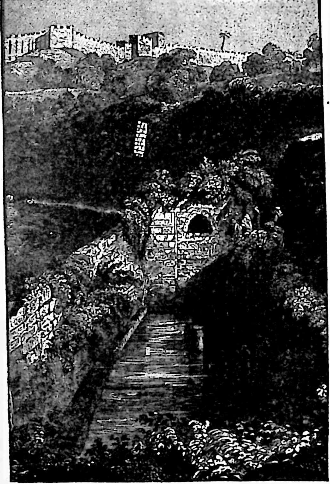
" ‘ Our feet shall stand within thy gates, O Jerusalem I ‘ "
Then, in the presence of all the people, they poured out the consecrated water (at the foot of the altar), in commemoration of the fountain that flowed from the rock in the wilderness, and again they sung, and the people took up the chorus with thundering voices:
* ' The Lord Jehovah is my strength and song, “ Therefore with joy shall ye draw water out of the wells of Salvation."
Amid the song, the sounding of trumpets, the waving of palms, and the great rejoicing of the multitude, so impressive to every Jewish heart, Jesus stood up in some conspicuous place, and when there came a lull in the tempest of voices, He called in a loud tone:
“ If any man thirst, let him come unto me." . .
“ The time, the place, and all the attending circumstances conspired to give meaning and power to the words spoken.”
—Dr. March’s Night Scenes of the Bible.
On each of these joyous occasions, Jesus improved the opportunity to speak boldly to the people of the coming king-dom. It was doubtless at the hour of bringing in and pour-ing out the water on this “ last and great day of the feast, that Jesus stood up and cried (7: 37):
“ If any man thirst, let him come unto me and drink,”
It being the same spiritual truth as expressed to the woman of Samaria, at Jacob’s Well, and which was so beautifully forecast by Isaiah (12: 3-6):
“Therefore with joy shall ye draw water out of the wells of salvation.
“And on that day shall ye say, ’ Praise the Lord; ’
“ Call* upon His name; declare His doings among the peo-ple;
“ Make mention that His name is exalted.
“ Sing unto the Lord, for He hath done excellent things; “ Cry out and shout, thou inhabitants of Zion, “ For great is the Holy One of Israel in your midst” Because of this well-known reference to Himself, to' the Messiah, many of the people present believed in Jesus, some of them saying:
"Truly this is the Prophet"
"The man who has not seen the joy attending the drawing of the water, does not know what joy means.”—Talmud. Every day had its “ drawing,” but the last was “ the great day."—So John 3 : 37.
Some said “ This is the Christ; ” but others, not knowing His origin, said, “ Doth Christ come out of Galilee ? Hath not the scriptures said that the Christ cometh of the seed of David, and from Bethlehem, the * city of David ? ’ "—7 : 40—42.
" So there arose a division among the multitude.”—43Meantime the “blind man” was creating a greater furore outside. He had been to the Pool of Siloam and washed, as Jesus had commanded, and gone home to his neighbors (8) and friends.
" Is not this the beggar who sat at the gate and begged ? " said some.
" It looks like him," others replied.
“ Moreover, it is he," others declared.
“ I am he," cried the man who was blind, now seeing. “ How then are your eyes opened ? " they asked. “Jesus opened them, so I received my sight”
“ Where is this wonderful physician ? " “ I know not," the man replied.
So he was taken before the Council, to whom he told his story. Now it was on the Sabbath, and the enemy thought to make a point of this, for they said:
“ If He was from God He would keep the Sabbath.” Others replied:
" If He were not of God, He could not open the eyes of the blind."
“ What say you ? " they asked of the restored man. “ He is a Prophet," he promptly replied.
The Jews were bound not to believe, and therefore sent au-thority for the man's parents. They came, but for fear of the Sanhedrin testified cautiously.—9: 20-23.
The result was the excommunication of the late blind man, because he defended right bravely the Christ who had made him whole.
After this—very soon—“ Jesus found him," and revealed Himself to the man, who gladly believed on Him as the Son of God.
All this conversation between Jesus and the saved man (9; 35-4 1) was overheard by some of the Pharisees (Sanhedrin), who asked Jesus (9: 40), "Are we also blind ?"
" Not so: for if you were blind, you would have no sin (spiritually speaking), but you say, ‘We see,' therefore your sin remaineth.”
These passages—briefly paraphrased—close up what is marked off as the 9th chapter of John. The continuation of the same subject will be found at verse 19 of the 10th chapter, closing with the 21st verse.
The matter, John 10: 1-18, includes another subject, and is entirely out of order here.
With the 21 st verse of chapter 10, John ends his account of what transpired at the Feast of Tabernacles, adding (7: 1), “AND AFTER THESE THINGS, JESUS WALKED IN GALILEE, FOR HE WOULD NOT WALK IN JUDEA BECAUSE THE JEWS SOUGHT TO KILL HiM.”
Six months’ time expired before He again went into Judea, in Jerusalem. Of this period, John says nothing. See Preface where it treats of this passage.—John 7: 1.


Chapter XLI
The Farewell to Galilee
Time—Late Autumn, A. D. 29. PLACE—Capernaum.
Not only do we learn by John 7: 1, that Jesus returned to Gali-lee, after the Feast of Taberna-
References
Luke g: 51-62.
Matt, 19: 1,2.
Mark 10: 1.
Luke 10: 1-16.
cles, but all the evangelists place His final departure from there, when they next report His doings.
First, Matthew's account is very brief—"And it came to pass when Jesus had finished these words "—probably instructions to the seventy, as per Luke 10: 1-12—" He departed from Galilee, and came into the borders of Judea beyond Jordan."
This corresponds with Mark 10: 1, while Luke, beginning* at 9: 51, enters largely into details of this journey.
Remember, that John does not take up the narrative again until into December, when Jesus returns to Jerusalem to the Feast of Dedication (John 10: 22-40),at which time and place the synoptists omit it There is little or no doubt that Jesus returned to Galilee and to His home, still in Capernaum, and there, soon after the Feast of Tabernacles, elected the seventy,* instructed them, and sent them out before Him toward Jerusalem, soon following in person with the Twelve.!
* “ Seventy-two," R. V., note.
!So Andrews, 338; Farrar, Ch. 41. He could not have remained in Judea till “ Dedication ” (John ro t 22), iecauie the Jews taught to kill Him.

While Matthew and Mark distinctly proclaim the starting place and route—Galilee—over Jordan—into that part of Judea east of Jordan (Perea), Luke indicates the time of the starting, and all the circumstances respecting it, as well as occurrences before reaching the temporary destination named by the others, as “ Judea beyond Jordan," where Jesus remained so long, teaching, that He is said to have " abode " there.—John 10: 40.
With this plain outline of time, place and work of our Lord, we return to particulars, as recorded by Luke.
In one instance the brothers of Jesus had hit upon the truth, viz., that He must go up to Jerusalem to substantiate His claims to recognition. This fact Jesus had well recog-nized, and so told to His disciples (Matt. 16: 21). But His brothers must not dictate the time and manner of His going.
If Christ was to take the place of the Passover sacrifice in all future,* He must fulfil the indication in time and place. It could not be that He could perish out of Jerusalem, He had himself said, and of this he had conversed on the holy mount, with Moses and Elijah. Nothing was better understood by Him than this; hence He had said to His brethren, “ My time is not yet come."
Now that time was fast approaching.
Before, He went up " not openly, but as it were in secret" (John 7 : 10), now He would proceed openly and heralded by messengers corresponding in numbers with the great San-hedrin, viz.: seventy. These were to precede and herald the coming of the Messiah. This had never been done in Galilee. Jesus had forbidden his disciples to tell any man that He was the Christ. He had also warned the maniacs whom He healed not to announce Him, one as effectual as the other on the in-credulity of the Galileans.
Therefore in Judea, Jesus would first be openly proclaimed as the Messiah. To this end He had opened the way at the late feast in Jerusalem (John 8: 12). To further this, the sev-enty were sent before Him into such places as He should •Ex. 12: 15; I Peter 1: 19, 20; and Heb. 9: 12-14. follow. It required no little time in which to instruct this large body of messengers, and synchronize their labors and route. This was probably done at Capernaum.—So Andrews, Farrar, etc.
That this was the final departure from Galilee appears (i) from the fact that no later departure is mentioned. (2) That Luke (9: 51) so very explicitly states. (3) It is so proven by the terms, “that He should be received up," at this time of going; meaning, according to Mark 16: 19, " received up into heaven,” Therefore it is very positive that Jesus did not, after this departure from Galilee (Matt., Mark, Luke), return until after the resurrection.
Nor were His last days here free from annoyance from His enemies, who doubtless readily learned of His preparation for the departure, which they tried to hasten, if we read aright Being in Herod’s jurisdiction (Meyer says in Galilee), the Pharisees came to Jesus with pretensions of consideration for Him, warningly saying:
" Get thee out and go hence, or Herod will kill thee.”
" Go to that fox,” Jesus replied, " and say, 1 Behold, I cast out demons, and do cures to-day and to-morrow, and the third I am perfected.’ ”
Place this incident where we will, it cannot be taken as three literal days. He did no " cures " two days before His “ perfection,” call it His death, resurrection, or ascension. He did not “ get out" of Herod’s territory in three days, evi-dently.
What then ?
We learn from the result its true meaning: “ My work will be continued from day to day till I am perfected in Jerusalem, for not even a prophet can perish outside of her ” (33).
What was foreordained would be, and Herod's cunning could not alter it “ Judea beyond Jordan " was not Herod's territory, therefore do not the very words (31) imply that Jesus was in Galilee still?
Christ’s reply explained His intention of going to Jerusa-lem (33).
Then, to alarm Jesus, they told Him that Pilate mingled the blood of Galileans with their sacrifices, i. e., at a passover feast. (Jesus was counted a Galilean.)
To this Jesus prophetically replied, as is become true: " Think you that those Galileans were sinners above all Gali-leans, because they have suffered these things ? Nay, I tell you (Galileans), except ye repent, ye shall all in like Manner perish 1"
And so they did I It was passover when their destruction came upon them, and these unrepentant Jews, to whom Jesus spake, were gathered from Galilee, as " from the four corners of the earth,” and in their city, walled about, “as in an oven” (Mal. and Luke 21: 20), where amid camage, fire, and sword, they perished forever as a nation, " mingling their blood with their sacrifices.”
These plots to alarm Jesus, and cause Him to flee, were failures.
When Herod came to see Jesus, as he did in Jerusalem in the following April, he merely expressed his gratification in seeing one of whom he had heard so much, and declined to condemn Him, though offered the opportunity by Pilate.
Having sent forward His messengers, Jesus now bid fare-well to His home and haunts in Galilee, and gathered up His Twelve apostles preparatory to a start upon His final journey out of the land that had never fully known Him.
No more in the “sweet mountain village” of His child-hood, youth, and early manhood, could He dwell in peace and safety, yet He left no curse upon her ingratitude beyond this: she stands forever on the map of Palestine as the only city of His complete rejection. The city of His adoption failed to appreciate Him, the pagan city of Gergesa, over the sea, could only request Him to depart, preferring their swine to a Saviour, and Jerusalem, though hostile to Him, was now “ divided ” regarding Him, but it was for Nazareth, His home, indeed, to wholly reject Him I What tears He shed, what sighs and groans He mingled with His yet fond farewell of Capernaum and the few discipies to be left behind, we can never know. As He ascended Olivet and bid adieu to Jerusalem, so may He not have gone up the hillside behind Capernaum, or over Magdala, and there taken a last fond look upon the scenes below and beyond Him ?
Around Him are grouped His Twelve disciples, and per-haps those devoted women who ministered unto Him in Gali-lee, and who followed Him up to Jerusalem, at last, among whom are named Mary, His mother, Mary Magdalene, Salome, and the other Mary, all listening in adoration to His parting words.
Bethsaida and her new palace of kings, bright and glisten-ing in the sunlight, on the northern shore, the royal pinnace of Herod, decked with the golden eagles at her prow and the Roman standard at her helm, were objects of but momentary interest, doomed soon to become as little in the eyes of this group on the hillside, as these now were to Philip and Herod and their partisans.
The calm blue Sea of Galilee, whose waters Josephus boasted of as “ pure and sweet,” now dotted over with fisher-men's crafts and traders’ barges, shall within this generation (Mark 13: 30) foam and lash under the prows of destruction, as ship meets ship in deadly combat, and redden with the blood of thousands, men and youth of Galilee, while her shores shall reek with the stench of decaying carcasses, vic-tims of the Roman eagles. " For where the carcass is, there are the eagles gathered together.”—Matt. 24: 28.
Where now are the many sails which once enlivened and graced these peaceful waters ? Not a craft of any description is to be seen on this lake at the present day, nor a carpenter on her shores who can construct one. “The semi-savage Arabs, who only frequent this shore, have no occasion for ships,” where the stork and the ispida are the only fishermen.
Below them lies the sweet vale of Gennesareth, “ a smile on the brow of the waters,” rich in the fairest products of nature, decked with the sweetest of flowers, shaded with the rarest of olive and palm-trees, and watered by no less than " five sparkling streamlets, gushing from the hills above her.”
Capernaum! From the dome of yonder white marble-columned synagogue, the priest with silver trumpet announced the approach of the holy Sabbath to all the inhabitants of the fields and shore: the fisherman hastened to land his boat and
CRANES
nets and repair to his cabin home; the husbandman left his plow in the furrow and tarried not till within the city's pre-cincts; the merchant closed his shop, the publican turned over his seat, and the busy thousands who thronged Caper-naum’s busy streets retired for the preparation of the Jewish Sabbath morn. • Where now are they ? With all their pretensions to holi-
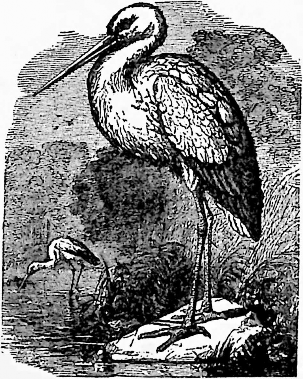
ness, they were as “ whited sepulchres,” and the corruption within undermined them. Their synagogue lies low in the dust, with their priests, peasants, and merchants. They are all in Hellan I Covered up!
“ Woe unto thee, Chorazin ! " Woe unto thee, Bethsaida !
“And thou, also, Capernaum! . . . Thou shalt be brought down unto hell l"—Luke 10: 13-15.
What a farewell to the home of His adoption! And sweet Magdala! Twenty squalid huts now represent hen Was she too accursed ?
Desolation now sits queen of all Galilee’s borders.
In sadness and sorrow indeed must Jesus have turned away from contemplation of the unhappy scene. Alas! that He might only go away recalling it all as it first broke upon Him in the bright spring-time of His ministry. Then on parting could He have said to "The fields, the shores, I bid you all farewell, With hope, with joy, the heart can never tell."
If Jesus turned His blessed eyes toward the west, they met no responsive tenderness. Galilee was actually closed to His mercies. For all His works, His stupendous miracles there performed, the most that any would say for Him, was, “ HE is A PROPHET.”
Not one, save Peter, had said, “ Thou art the Messiah who is to come."
In His last journey through Galilee He had gone secretly. Therefore His work was done there, and He now would bid her farewell and traverse a brief portion of her border to Samaria, while “ He steadfastly set His face toward Jerusa-lem.”
“ Falling leaf and fading tree, Lines of white on a sullen sea, Shadows rising on you and me;
The swallows are making" them ready to fly, Wheeling out on a windy sky—
Good-bye, summer, good-bye I " Hush ! a voice from the far away!
1 Listen and learn,' it seems to say, ' All the to-morrows shall be as to-day.' The cord is frayed, the cruse is dry, The link must break and they must die—Good-bye, forever! good-bye, good-bye!"
— WHYTE-MELVILLE
“ The direct route towards Jerusalem, from Galilee, lay through Samaria."—Schaff.
In consequence of the great number in His train, at every point mentioned,* and because of His following the route laid out by the Seventy (Luke 10: 1), Jesus and the Twelve did not go down the lake in the boat, but probably followed the most direct route out of Galilee. No mention is made of stopping in any Galilean village on the way, and it is not sup-posed that He did.—Andrews, 351; Lichtenstein, 299.
“ Many thousands.”—Luke 12: 1.

Chapter XLII
On Samaria's Border
Time—November, A. D. 29. Place—En-Gannim,—Farrar, Geikie, Lichtenstein.
ROUTE—Out of Galilee into the border city of Samaria (Luke 9: 53), where, being repulsed, He turns eastward, passing along the mountain border between Galilee and Samaria (17: 11), past Scythopolis, over Jordan four miles eastward, into Perea (meaning “ beyond "), thence south through “ Judea beyond Jordan ” (as per Matt. 19: 1,2; Mark 10: 1), journeying slowly toward Jerusalem.—
Luke 9:51.
FTER a careful study of all which I could find, during six years, bearing on this last “JOURNEY OF JESUS" out of Galilee, I have written the above as being the most probable. It agrees with all the circumstances of the gospel narrative, and the conclusions of the wisest commentators. This is based upon the gospels, and a complete knowledge of the geography and topography of the country here indicated.
We take as conclusive evidence of the starting-point of this, our Lord’s final departure from Galilee, the words of Luke (9: 51), that “Jesus steadfastly set His face to go to Jerusalem,” and that verse 52 locates the first section of the route, south of the valley of Esdraelon, as the first Samarian city; and that chapter 17, verse 11, shows it still fartheron, since it could not as usual lie directly through Samaria (Jesus being forbid to go that way, Luke 9: 52), thence into Perea —Matt. 19: 1.

THE FIRST “VILLAGE” OF THE SAMARITANS. 363 " We find no grounds to believe that after this departure Jesus ever revisited Galilee ” (Andrews). Therefore all of Luke from 9:51 relates to that journey to, and the after life and works of Jesus in Judea. We reckon Perea as Judea.
En-Gannim, called by Josephus “Ginea," and by the Arabs, now, “ Jenin,” is the first town, or " village,” on the northern border of Samaria, lying on the direct route from Galilee to Judea. “It is now the chief town between Nazareth and Nablus, and contains about two thousand inhabitants, nearly all Moslems. Its people are fanatical, rude, and rebellious. They are always quarrelling among themselves, or with their neighbors.”—Thomson. ■ In this “ fountain of gardens " rises the most distant branch of the river Kishon. We have already described this village as the probable tenting ground of Galilean pilgrims en route to the feasts at Jerusalem. • If it was the custom of these pilgrims to pass this way, as Josephus says, why was Jesus now repulsed on His way to Jerusalem ?
The Samaritans were expecting a Saviour (John 4: 25), and the ground of Christ's repulsion now, was that He was going, with His apostles, disciples, and grand retinue, to Jerusalem to be crowned king, rather than to Gerizim and the holy mount of the Samaritans. Luke makes this very plain: “And they did not receive Him because His face was stead-fastly set on going to Jerusalem " (51 and 53).
In what rude way these semi-savages repulsed Him is not known, but evidently with much indignity.
James and John were foremost of the Twelve in resenting these Samaritans’ rebuff, and to Jesus they said:
“ Lord, let us bid fire to come down from heaven and con-sume them.”
Sons of thunder indeed I “ No," replied Jesus, gently rebuking His fierce and zealous disciples, “ I came to save, not to destroy."
"And He turned to another village.”
What forbearance was here! What patience, what long suffering I To James and John it was utterly inexplicable.
“Art thou not the Christ ? The very anointed of Jehovah ? And are not you going to Jerusalem, the ‘ holy city of the king,' there to sit on David’s throne, and * put all enemies under your feet ? ’ Then why not destroy these, thine op-posers, in the very highway as you journey ? "—Luke 3 : 17.
"The character of Jesus is wholly inexplicable on human principles," said Dr. Channing, of Boston. And so it was to James and John eighteen hundred years before Channing.
Leaving En-Gannim behind, Jesus and the Twelve turned down the hillside path to the southern border of the great F.sdraelon Valley; and, with this on the left, and the moun-tains of Samaria and far-off Ephraim on the right hand, ” He again went on His way through cities and villages, teaching and journeying toward Jerusalem.".
This valley, now silent and deserted, save when the bands of Bedowin robbers sweep through it, from Jenin to Beth-shan, was teeming with life and prosperity in Christ's days.
The largest city encountered before crossing the Jordan was Scythopolis : Gilboa lay at the foot of the mountain of that name, on the left hand. Still on the right rose the mountain wall of hostile Samaria, with here and there a little village visible through the oak and terebinth at their base.
While passing one of these villages, nearer the route than others, there suddenly burst upon Jesus and His band of fol-lowers a sight most appalling. Without the town, perhaps at the foot of the hill, among the tombs, or the caves of the limestone forming them, were a band of lepers, who, “afar off,” lifted up their shapeless hands, and in hideous, guttural voice cried out in that terrible, alarming way of all lepers, as strangers approach them:
“Unclean! Unclean! Come not near us!”
But Jesus did come near, and nearer still, until the ten lepers discovered whom He was that approached.
By what power they knew Him is not vouchsafed us. Per-haps the whole village had heard of Him, and came out to •'WHERE ARE THE NINE?" 366 meet Jesus. This we know, it was not actually “ in the vil-lage ” where He met the lepers, because all such were ex-cluded from cities and villages. However these knew Jesus, and cried out in a louder voice still:
“ Jesus, Master, have mercy on us."
Sad experience warned Jesus not to touch these wretches, but he said to them collectively:
“ Go show yourselves unto the priests,” well knowing that they would be cured before they reached their destina-tion.
And so it was; " and as they went they were made clean."
It seems to have been immediate, for one of them finding himself restored, turned back, and with a loud voice glorified God, and, falling on his face at Jesus' feet, poured out his most heartfelt thanks for his restoration.
And he was a Samaritan! One of that very nationality that had so recently scorned the Lord Jesus I Was this the fire which James and John would call down on their heads?
“ Were there not ten cleansed? ” Jesus inquired. “ Yes; there were ten cleansed."
“ Where, then, are the nine? Were there none who re-turned to give glory to God save this one, and he a stranger? "
Did this imply that he only was a Samaritan? an alien? Possibly.
Daily the multitude increased.
About this time “A certain man," * for selfish ends, hoping to obtain a high position in the “ coming kingdom," said boast-fully to Jesus:
" I will follow wheresoever you go."
“ The foxes—of yonder mountains—have dens; the birds ’ of the air have nests in the trees over our heads, but I have not even a place in which to lay my head." Now will you follow me ?
It is evident, by the absence of a reply, and the refusal of * Luke 9: 57. We place the lepers before this case because the first were in the Samaritan country. others immediately afterward to follow Him, that this “ cer-tain man" was never seen in the “ kingdom of heaven ” (9: 62).
The great highway from the western sea to Perea led through the lower portion of this valley, through Scythopolis, or Bei-san. In chapter fourteen we have already described this route as well as this city.
Beisan was a very ancient and powerful city of the Canaan-ites ; given to Manasseh, but never by the latter possessed. * It stands on elevated ground overlooking Jordan and the vil-lages beyond, for a long distance into Perea.
Into this " City of Rest," doubtless, Jesus came, accom-panied by a mighty host, as He journeyed toward Jerusalem. His messengers having gone before and prepared the way for Him and His followers, perhaps the whole city went out to meet and welcome Him. How long He may have tarried, or what works He performed before passing over Jordan, we do not know.
Three miles east of this city was a bridge spanning the river, over which they all passed into Perea.
From this point the synoptists give us no geographical aid. It was to the disciples a strange country, and, probably, with an eye wholly on Jerusalem as the goal, they gave no heed to the places en route. Luke, to whom alone we look for cir-cumstances of this journey through Perea, or "Judea beyond Jordan,” as Matthew, Mark, and John name it, seems not to have known anything of the places en route. We say this because in countries where he was familiar, particularly through personal experience, he gives minute geographical accounts. When he sailed for Italy t he named the ship in which he and Paul took passage, the people and places en-countered by the way, and many particulars of the voyage and the arrival in Rome.
Again, in his first personal experience with Paul, Luke par* I Chr, 7: 39; Judges 1: 27. Joseph us calls it Scythopolis; also in 2 Macc. 12: 29, Beth-shan—"House,” or City, “of Rest.” t Acts 27: 1-44; 28: 1-16. ticularizes in regard to time, place, and circumstance quite consistent with a personal presence and knowledge of all of which he writes (Acts 16: 10). Not so in his gospel, which he openly acknowledges at the outstart was only derived from other witnesses.
The honesty of Luke's gospel is hereby well authenti-cated, inasmuch as not knowing the places which Jesus passed through going to Jerusalem, Luke passed them over in silence. His gospel having been written after Matthew's and Mark’s, both of whom pass in silence from " Galilee to Judea beyond Jordan,” he derives no help, geographically, from them. Since Luke was writing to his friend Theophilus, an Italian, solely to instruct him in Christianity (Luke 1: 4), geographical consid-erations were entirely unessential. Peter's epistles are wholly devoid of geographical bounds; therefore if Mark derived his aid from Peter, as he is said to have (Hist Eccl. 3: 39—John Kitto), we need not look to Mark for much help in this direction.
There are certain lessons in the gospels which we cannot understand fully without we know the time, place, and circum-stances (one or all) under which such lessons were given, as in the repulse from the Samarian village, the healing soon after of the Samaritan, lepers, and in some of the parables; but in the teachings of this “Journey of Jesus,” as recorded by Luke (10: 17 to chap. 18), the omission of geographical boundaries is of secondary consideration.
If desirable, let us look for them in the words of the texts themselves, but not for chronological order.
For instance, the matter of 13: 22 is placed after 10: 38, which cannot be chronological. The latter relates to Bethany, a mile and a half from Jerusalem, while the former places “cities and villages " between.
When Jesus says, “ Behold the lilies" of the field, we naturally, and in accordance with His custom of seeking il-lustrations, look for Him standing by some meadow as He spoke. Again, when the scribes and Pharisees came in a “ press ” upon Him, we look for Him approaching Jerusalem, from whence the enemy came. By the gathering of publi-cans unto Him, we may know that He had arrived near a border, as the ford of Jordan, cast of Jericho, where publi-cans would necessarily abound to transact their business.
Thus we are enabled to follow Jesus on this protracted journey.

Chapter XLIII
Jn “Judea Beyond Jordan."
Time—Autumn and Winter of A. D. 39. 782.
where He remained until the ----------------- —-----
Feast of Dedication, mentioned by John (10: 9). After that feast Jesus “ again " returns to the same location, viz., "Beyond Jordan, at the place where John first baptized.”—10: 40.
What portion of Luke's record, as above, re-lates to the first of the “ abode ” in Perea (which is “ beyond Jordan "), or what part occurred in the second “ abode in the same place," we cannot designate. Nor is it at all material.
We have designated that matter of Luke 17: 11-19 as being on the boundary of Galilee and Samaria, while that re-corded in 13: 22-30 we are very confident occurred much later, as Jesus journeyed down through Perea. Again, from 31 to 35 carries us back to Capernaum, while 14: 1-24 very probably occurred in some large city of Perea—beyond Jordan.
" PEREA ” is not mentioned as such in the gospels. It embraced a territory larger than Galilee, commencing opposite Scythopolis, where the great highway extended over Jordan to Philadelphia, the ancient Rabbath Ammon, some thirty miles toward the east. This city once boasted of possessing the great iron bedstead of Og, king of Bashan (Deut. 3 : 11).

One province of Bashan contained “ six walled cities,” beside numerous “ unfenced towns.” After many vicissitudes, all this densely populated country fell into Roman hands, and on the death of Herod the Great, tin's eastern territory, under the name of Batanea, formed a part of Philip’s tetrarchy.* It was in the “ Land of Manasseh.”
The country was very fertile, as its name, “ Bashan,” im-plies. She had a large trade with Tyre (Ezk. 27 : 6); her oaks were mentioned in connection with the cedars of Leba-non, and the country was most famous for its fine breed of “ rams, lambs, bulls, goats, and all of them failings of Bashan.” Cyril and Jerome speak of the exuberant fertility of Bashan, and modern travellers corroborate their assertions.
The caravan road traversed this country, which in the be-ginning of the Christian era must have been thickly peopled. Bozrah was one of the largest cities east of the Dead Sea, or Jordan, " while its magnificent ruins still show that in Christ's day it was the finest city of Decapolis.” (?) Two hundred and thirty pillars still standing, and the wreck of its public build-ings, baths, theatres, temples, circus, forum, and triumphal arch are evidences of its former splendor. Colonnades adorn miles of streets, crossing at right-angles like those of an American city.
“ It must have been a gay as well as a busy and splendid scene when Jesus passed through the country on His Perean journey."—Geikie.
In some one of these great cities He doubtless made His centre during some weeks, or perhaps months, as at Caper-naum. Philadelphia, Gadara, Hesbon, Pella, Bozrah, and a score of other lesser cities lined the great route from Damas-cus to the lower Jordan ford, and to Jerusalem.
Of the inhabitants of this country many were Jews, but by far the greater number were pagans.—Life of Josephus, 65; Ant 17: 11, 4.
If Jesus, as is supposed, and as the texts imply, remained a long time “ beyond Jordan, at the place where John first bap* Bib. Encyc., Kitto, Art. Bashan.—Gen. 14 ; 5. pat.)
RUINED CHURCH AT LYDDA,
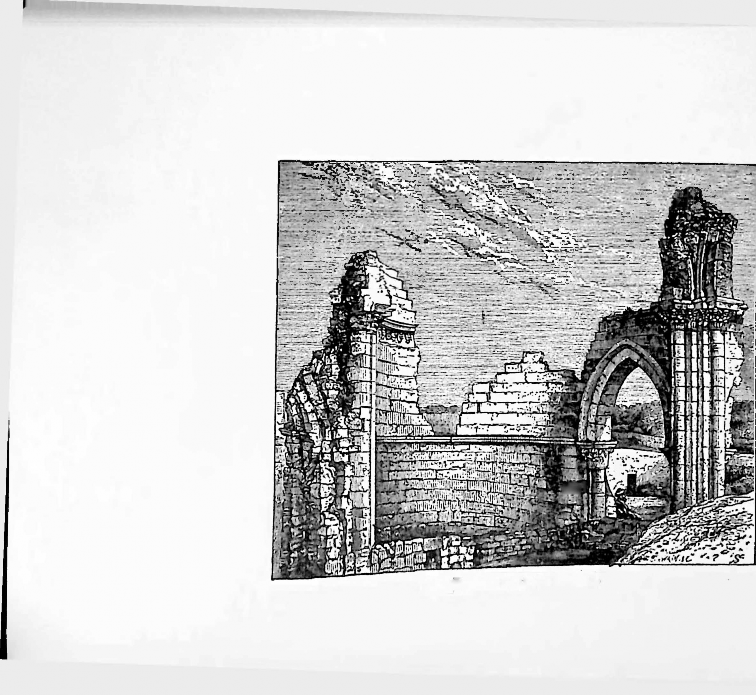
tized," it must have been under the very shadow of old Baal-Peor, up into which Balaam ascended and overlooked the camp of Israel below. Jericho, the first walled city over Jor-dan westward, lay in full view. " Livias " was built on the opposite side, a new city in Christ's time. Mount Nebo, that elevated sarcophagus of Moses, and the lookout from whence he took his first and last surveys of the Promised Land, with a village at its base of the same name, may have marked the extreme southern boundary of Christ’s journeyings over Jor-dan. “ Nebo ” was the name of a well-known god of the Assyrians, Chaldeans, and Babylonians. He was a deity of the highest moral attributes, presiding over education, as BaalPeor was of the lowest.
None of Jesus' discourses, as He passed along, seem to have been directed to these idol-worshippers.
The character of teachings, and the illusions drawn in the parables during this " abode ” of our Saviour “ beyond Jor-dan,” would seem to indicate the locations mostly in cities rather than in the country.
One parable may imply that He was at the time in a large agricultural district (12: 16-21), another in an extensive graz, ing and sheep-raising country, and some again by the way-side, yet the most seem to have been in thickly populated regions. At one time we find Him in the house of a wealthy Pharisee (14: 1), at another in a synagogue, and again in “ the house " probably of some private individual.—Luke 11: 37.
The teachings on this journey through Perea were all in accordance with the prevalent Messianic expectations of the people, who had evidently been prepared by the seventy for His coming. There is very little mention made of miracles of healing along the route; nor, indeed, were the demands of the people presented so much in that direction as they had been in Galilee, but the burden of all honest inquiry was:
“What shall I do to inherit eternal life?"
The young and the aged, the lawyer and the ruler, and publicans and sinners hastened to Him to inquire of the “ kingdom of heaven,” and the time of its appearing.—Luke 17: 20.
There is no indication of any Jewish hostilities toward Jesus during this period.
With one exception.—Luke 13: 10.
Sabbatism was the Jews’ pet institution, and that nation which ceases to regard the Sabbath will cease to be a nation. At the same time, a people who make all mankind subservient to a certain day and its prescribed institutions, are too bigoted to govern the masses.
A woman bowed with infirmity during eighteen long years may not be healed on the Sabbath, said those bigoted Jews (Luke 13: 10, 17). We began by calling this thing bigotry. Jesus rebuked the “ ruler of the synagogue " and his backers by terming them “ hypocrites."
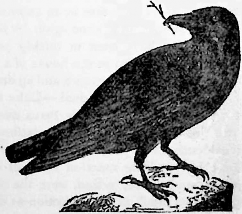
Chapter XLIV
At the Feast of Dedication
Time—December, A. D. 29. PLACE—Bethany—Jerusalem.
Referencen
1 Luke 10: 38-42.
Luke 19: 29.
. — I John 10: 22-39. us went on His way He J entered a certain village— 1-------- --------------Bethany—and a certain woman called Martha received Him into her house.
This is believed to have been just before ■ the Feast of Dedication referred to by John (10: 22) thus—“And it was at .the (feast of) dedication at Jerusalem; and it was winter; and Jesus was walking in* the temple in (that part called) Solomon’s porch."
Andrews (p. 370) places the visit to Bethany on the way up to this feast—Farrar and Geikie also, with many others; but if it was not this very visit which Luke so pleasantly describes, wherein Jesus abode a day with His dear friends in their quiet retreat, there need be no doubt whatever that He did at this very feast of dedication make His home, as also the disciples (Luke 10: 38, "They") at the house of Martha, in Bethany. Such was His custom when in Jerusalem, as we have already learned from John-(8: 1), which is corroborated by Luke.—
21: 37“And every day he was teaching in the temple, and every night he went out and lodged in the Mount of Olives." Bethany is called the “ Mount of Olives." Olivet included Gethsemane and Bethany. Again Luke says (22: 39) that
Jesus was accustomed to go to the Mount of Olives with His disciples. This special visit was His last, however. There was a footpath leading front Gethsemane directly over the top of Olivet, to Bethany, and to the house of His beloved friends.
MARTHA appears in the text as the head of the household, while MARY, her sister, and Lazarus, her brother, lived with her. Socially and pecuniarily the family seem to have held a position above the average. That they all were very pious and lovable there is the fullest evidence, and that their hospi-tality was as unbounded as their love and their means justi-fied is equally certain. Jesus and the Twelve always found a glad welcome at their home, and the Jews of the city seemed to have been familiarly if not cordially received there also. Beyond this all is conjecture, such as the traditional " widow-hood of Martha,” or that she was " the wife of Simon, the leper,” or that she was only the housekeeper of her brother Lazarus. The latter is most probable. .
Into this happy household Jesus and His disciples came, on their'way up to Jerusalem to dedication.
Necessarily, the arrival of such a royal guest, as Martha and Mary knew Jesus to be, with the Twelve followers, created no small commotion in that family, particularly in the person of the active lady ” Martha, who hastened to provide suitable entertainment for the Lord and His followers,” while the gentle, loving Mary * sat at her Saviour's feet drinking in the words of eternal life.
Now Martha, half " distracted ” t with the great prepara-tions for the meal first to follow the arrival, came into the Lord’s presence to get her sister's help in “ serving.”
" Lord,” said she, unable to move her sister from Jesus' presence, ” Lord, dost thou not care that my sister leaves me to serve alone? Bid her come and help me.”
Did not this freedom in approaching Jesus show a former acquaintance ? Without doubt •The tradition that Mary was “the woman taken in adultery” (John 8: 3), and whom Jesus pardoned (11), is groundless. t True translation, rather than “ cumbered.”—See R. V., notes.
“ Martha, Martha:” how lovingly He repeats her name I " Thou art anxious and troubled about many things, when few things are needful. As for Mary, she hath chosen the good part, which shall not be taken from her."
"What more proper and refined, than that one sister should remain to entertain the respected guest, while the other should prepare the necessary refreshments for Him? The further and yet greater love for her Master will be shown in Mary’s last act, just before the crucifixion.
“ The point,” says Kitto, " which the evangelists bring out most distinctly with respect to Martha, lies in the contrariety of disposition between her and her sister Mary.” At the res-urrection of Lazarus, and also at the last supper in Bethany, we shall find this same remarkable distinction.
“And it was winter.”
Thus John briefly announces the season.
One hundred and seventy years before Christ, Judas Mac-cabeus appointed this festival in commemoration of purify-ing the temple, and reconstructing the altar after their pollu-tion by Antiochus Epiphanes, the Greek barbarian. He captured Jerusalem, pillaged the temple, and made an offering to the Greek divinity, Jupiter Olympas, on the Hebrew's holy altar. Jupiter, or Zeus, was the national god of the Hellenic race, and the first divinity of the heathen world, and as such formed the true opposite of the Hebrews' Jehovah ; therefore Antiochus, in great national zeal, forbade the worship of the latter in Jerusalem, and set up his own god instead. The books of the Maccabees record this whole terrible transaction. The New Testament mentions this Greek divinity Jupiter but once: on the occasion of the visit of Paul and Barnabas to Lystra, in Asia-Minor. Paul there restored a congenital crip-ple, whereupon the superstitious people cried out:
“ The gods are come down unto us in the likeness of men,” and they named Barnabas as “Jupiter,” or Zeus Olympas; and Paul “ Hermes," the Greek for Mercury; and the temple of the former god being just then in the square of the city, the priests of Jupiter hastened to the stalls and brought out the sacred oxen, crowned with garlands, and was about to sacrifice them to the gods who had dropped down from heaven among them, as they sincerely believed Paul and Bar-nabas to be.—Acts 14: 12.
This god Jupiter was soon cast out of Jerusalem, and the temple purified and reconsecrated by an eight days’ festival of the Jews. It occurred on the twenty-fifth day of the ninth month, called • “ Chisleu ” (December), and continued eight days. Josephus says this feast was called " LIGHTS."
It is not our province to explain Christ’s reason for all His doings, but may we not here give additional explanation to the many, of various writers, for His visit to Jerusalem at this feast? FIRST, because He had said, “I am the LIGHT of the world,” and it might give particular emphasis to this declara-tion by His presence at the “ feast of lights.” SECOND, it occurred upon or very near to, Jesus' birthday anniversary; and, THIRD, His numerous messengers may have already reached Jerusalem, and there openly announced His coming as the long-expected Messiah. Andrews suggests the latter; and if the seventy did not precede Jesus at Jerusalem, there is no ques-tion but that they must have already given great publicity to the last movement of the Lord, in proclaiming His Messiah-ship, and near approach to the holy city, “ the city of David,” and the place of the expected crowning of David's successor.
There was nothing more universal than this expectation among Israelites.
It was winter, the rainy season in Palestine.
Jesus entered the temple, perhaps from the east, coming over Olivet, descending the western slope, passing through the gardens, over the little foot-bridge spanning the brook Kidron, now full and flowing; up the western declivity, ascending the long flight of steps from the valley into the eastern side of the temple. ’
Here the Jews found Him walking under the protecting canopy of11 Solomon's Porch.” This was the arcade extending the length of the east side of the whole temple enclosure, with a roof supported by handsome rows of Corinthian colHE WALKS IN “SOLOMON'S PORCH.” 379 umns, and a floor of marble and other rare stones set in Mosaic. This part of the temple was so named from a frag-ment of Solomon’s old temple here left standing by Nebu-chadnezzar.—Josephus’ Ant. 20: 9, 7.
Jesus was walking here in this arcade overlooking the Kidron, the gardens beyond, and the hill-side of Olivet, perhaps.
PLAN OF TEMPLE
shrouded in mist and rain, Himself wet from recent exposure, when the Jews suddenly came about Him with the ready question: • “ How long do you keep us in suspense ? ”
“ If thou art the Christ tell us plainly."
"I told you, and you believed me not," Jesus answered. “ But the works which I have done (or do) in my Father’s name, bear witness of me. Not being mine, you cannot be-
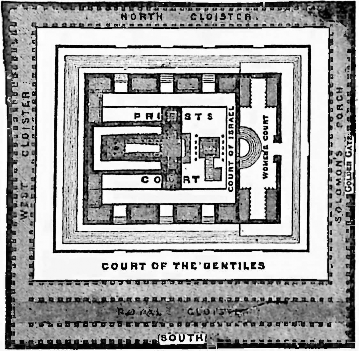
lieve." Verse 25, chap. 10, “I told you,” refers back to the last feast, when Jesus said, " I am the light of the world.”—John 8: 12. ■ Here we would consistently insert what is written in John 10: 1 to 18 inclusive, as also from 26 to 39. It is all of one character, and completes the illustration begun at verse 26. It is about the sheep and the good shepherd.
Around Jesus stood his twelve apostles, and, doubtless, many of the seventy (27) recently returned to Him. This being the end of the route proposed at starting, viz., “ that they should go into every city whither He Himself was about to come,” and this being one of the cities into which He surely did come, we may expect that many of the seventy had reached Jerusalem in advance of their Master, hence the Jews' readiness with their question, “Art thou the Christ?”—So Andrews.
These disciples, then, with the Twelve, were the “ sheep ”
(27) which the Father Jehovah had given Him, and which no power was able to take from Him (28, 29); and “ I and my Father are one,” He added (30).
Then the Jews “ again” took up stones to stone him, accus-ing Him of blasphemy in comparing Himself with God.
" Sayest thou I blaspheme because I said, ‘ I AM SON OF GOD ? ’ If I do not the works of my Father, believe me not If I do them, believe me through the works which I do, that ye may know that the Father is in me, and I in the Father.”
“ They again sought (by officers) to take Him, and He went forth out of their hand.” Out of their reach.
Chapter XLV
Christ’s Abode in Judea Beyond Jordan
Time—Perea, or "Judea beyond Jordan."
From the very first of Christ’s preaching in Jerusalem, away back in April, A. D. 27, until now, the Jewish rulers had been fixed in References, John 10 : 40-42.
Luke 14.
Matt. 19:1,2,3.
Mark 10: 1-31.
their purpose to deny and destroy Him.—John 5: 18.
This last attempt on His life was organized before Jesus’ arrival in Jerusalem, and immediately attempted in execution. Of course the act of stoning one to death, though promul-gated according to the law of Moses, was obsolete and un-lawful now, under Roman government, and such an act would be by the procurator regarded as an insurrection, and create a great public disturbance, as in case of Stephen or of Paul. The stoning could only be done, under the old regime, outside of the city walls, and after the condemnation by the full council.—Acts 6: 15, and 7: 58.
In this last case of the attempt to stone Jesus the Jews “ sought to take Him ” by writ from the Sanhedrin, as that was the only process by which they could " take Him," and while attempting this Jesus escaped “ out of their hand.” No miracle is claimed in this escape,—Andrews; Meyer.
" To stay among them was but daily to imperil his life.” Judea was closed to Him, Samaria and Galilee had rejected Him, therefore He returned to the half-heathen land beyond

the river Jordan, where He had been teaching before He went up to Bethany and Jerusalem, as described in the last chapter. This harmonizes the synoptists and John’s gospel, and agrees with most commentators.
It was yet in December, evidently, when Jesus first went back to the regions over Jordan, since He did not remain in Jerusalem even to the end of the late seven days' feast. It is believed that the attack was immediate on His arrival at that festival, and that He was compelled to retire as far as Bethany, at least, on the very day of His arrival at the temple.
The time from the Feast of Tabernacles to dedication was above two months. Within that period Jesus had organized His band of seventy and sent them on before Him toward Judea. He had bid farewell to Galilee, taken the Twelve apostles, and crossing the hills of Naphtali, the valley of Esdraelon to En-Gannim, turned eastward down the valley to Beth-shan, crossed the Jordan into Perea, and traversed that whole region nearly to its southern extremity. Going to the last-named feast, He had been compelled to return to the same place where He had left off teaching last, and where He last left the multitude, over Jordan.
This seems evident from John’s words (10: 40-42), that Jesus went “ again " to the place, and " abode there,” and that many believed on Him.
With every considerable change of circumstances, if not in location, Jesus made a marked change in the character of His teachings. May we not trace out His works in Perea, after dedication, by His teaching there again in parables, as He did on His second long sojourn in Capernaum ? Different writers have assigned to this period various incidents and teachings, all, or nearly all, as recorded by Luke alone, seemingly with-out any chronological authority derived from the gospel teach-ings.
Now, if we can consistently assign to this period, probably of several weeks’ teaching “beyond Jordan," the principal parables recorded in Luke, in chapters 14 and 17 : 10, going back for the parable of the “ Rich Man " to 12 : 16-21, and of the “ Fig-Tree "to 13: 6-9, we may proceed with very much satisfaction.
By chapter 13: 22-30, we learn that Jesus was then “ on the way,” probably through Perea; hence assign that matter to an earlier period. All that from 12: 22 to 53 relates to a dis-course to His disciples, in the presence of others (54).
It is presumed that He had a short respite after His return to Beyond Jordan (John 10: 40) before the Jews from Jeru-salem again found Him, and came out with fresh annoyances. To that brief period we can only safely assign the record of John 10: 41, 42. Herein we learn that Jesus, with great ear-nestness and success, proclaimed the Kingdom of Heaven to a large and interested multitude, many of whom became be-lieving disciples.
Then came out the scribes and Pharisees from Jerusalem to annoy and tempt Him, with the sole object of entangling Him in a multitude of subjects.—11: 53, 54.
From this time till the final going up to Jerusalem (18: 31) the character of Christ's preaching was altered so as to tell against His antagonists. There was nothing left untried by them, in which there was the least prospect of bringing about the object which the Sanhedrin had in view. For the Sanhe-drin it was that instigated all of the present and future annoy-ances heaped upon Jesus.
To this end a chief Pharisee is made a cat’s-paw, in asking Jesus to dine with him and a select party of friends, consisting of scribes, lawyers, and Pharisees.
It was on the Sabbath. Jews often took this day for social intercourse. A feast could be enjoyed on that day, but it must be prepared on the day previous. “ Their tables were usually better spread on the Sabbath day than during the week days.”—Lightfoot.
The whole matter had been well arranged, the Jews be-lieved, to entangle Jesus in some one of several plans. The smartest lawyers were invited, to entangle Him in knotty questions; the Sabbath was selected as the day, that He might be induced to trespass thereon; a dropsical wretch was called in, as a fit subject upon which He might exercise His powers unlawfully, on the Jewish Sabbath. All of which plan was evident to Jesus, who eagerly seized upon it, in order to baffle and shame them in their evil designs.
Jesus at once assumed the aggressive, thus giving them no opportunity to develop their own plans. Seeing how these self-lovers strove, even here, at the house of a friend, for the highest honors at the table, He immediately rebuked them.
The Jews, while claiming to be a peculiar and independent people, had copied from their despised pagan neighbors and captors, when in captivity, all that they possessed of either good or evil—of the former, THEIR VERY ALPHABET,* and the name of their country, Palestine ; and of the latter, their sac-rifices and their present belief in future rewards and punish-ments, as ironically held up to their view by the “ derided " Lord Jesus, in the story of “ Lazarus and the rich man." f Among other things of neither good nor bad in particular was their present mode of reclining at table. They no longer stood, cap-a-pie, as when in the wilderness, or sat, as from the times of Solomon; but since the return from their last cap-tivity, they reclined like their late indolent masters, whom they so heartily despised.
The table, or Triclinium, was formed in a hollow square, with a centre, or head; which was the seat of honor, where sat the host, and the immediate positions were the next highest in honor.
For these second places the Pharisees and lawyers, of the very elite of the Jews, disgracefully contended, while the guest of another 1 And these were the sort of men who came here with the expectation of tripping the Lord Jesus in His holy ads and conversation 1 How He brought about their confusion instead, is well known, and need not here be re-peated.—Luke 14: 1-24.
* There is no proof offered that they could read or write until after the exodus, and their letters are copies of the hated Phoenicians—* Philistia.” t This exactly represented the Pharisees' religious belief, and was an offset to th-ir sc ffings of Him immediately before; V«. 14 and 15.—See in Part Second.
As the hostility of His foes,. the Jews, became more and more avowed, the discourses of Jesus became the more pointed, as He drew the line sharply between them, as the abandoned of Jehovah, doomed to speedy destruction, and His believing hearers, even though these consisted in part of publicans and sinners, who, as the saved, would go into the kingdom of heaven before the seed of Abraham.* In defence of His subjects, “ publicans and sinners,” Jesus delivered the parables of the “ Lost Sheep,” the " Lost Piece of Silver,” the " Profligate Young Man," and others, perhaps.
As John did not claim to write of all that Jesus did, neither can we claim to explain all that John and others have written.
A TERRIBLE REBUKE To THE PHARISEES.
In making up chapter 16 (of Luke), it is greatly to be re-gretted that verses 16, 17 and 18, which any reader may see belong to another chapter and subject, should have been in-serted in the middle of Christ’s discourse against the Phari-sees. For “ the parable of the rich man and Lazarus has plain reference to that sect.”—Andrews, 378.
Canon Farrar says, in this connection, that while this parable admits of more than one application, the Pharisees could not miss the one plain and obvious application—to them-selves.
" There is a sublime irony in the mention of his (Dives') burial, connected as it is with what immediately follows, namely, • in hell (hades) he lifted up his eyes, being in tor-ments,' but such was the Jewish popular belief"t " Notice that the popular language of the day is used, without correc-tion."—Prof. Riddle.
Let us next notice that this is a PARABLE and not a revelation.
That it is a parable, see Abbott, Clarke, Barnes, Scott, Schaff, and others.
* Chapter 15 contains three parables, all enforcing the same general truth—God's mercy to sinners.—Prof. Philip Schaff. t Dr. Trench. See also Paradise; Notes by Dr. Abbott in Peloubet’s Notes, 1881, page 119, on verse 43.
To suppose it a revelation would be fatal to orthodoxy, it referring only to a material body in the grave (hades) and not a disembodied spirit or soul in Gehenna.
The text plainly asserts (1) that the rich man died, that (2) he was buried, and (3) that he fell to talking! Notwithstand-ing that the scripture tells us “ in the grave they know noth-ing," it was no uncommon thing for the inspired writers to represent inanimate things as feeling, knowing, and talking.
The 14th chapter of Isaiah gives a dramatic representation of rejoicing in sheol (the grave) over the fall of a king of Babylon. Here both dead men and trees are represented as in conversation, a parallel case with this parable of our Lord. Let us remember that He was addressing Hebrews, who. familiar with this kind of figurative language, could not fail to understand Him, however the world, at this period, may misconstrue the parable.
Therefore this parable cannot admit of a literal interpreta-tion.
Being then a parable, it cannot be the basis of a doctrine. " It is a well-established principle of scriptural interpretation, that parables may be used to illustrate but never to ground a doctrine."
Dr. Trench thus observes:
“ The parables may not be made first sources of doctrine.
.Doctrines, otherwise and already grounded, may be illustrated, or indeed further confirmed by them, but it is not allowable to constitute doctrine first by their aid. They may be the outer ornamental fringe, but not the main texture of the proof. For from the literal to the figurative, from the clearer to the more obscure, has ever been recognized as the law of scripture inter-pretation. This rule, however, has been often forgotten, and controversialists, looking around for arguments with which to sustain some weak position, one for which they can find no other support in scripture, often invent for themselves supports in these."—Trench, on the Parables.
Is not this learned divine sound on orthodoxy? Assuredly.
A MAN OF JERUSALEM
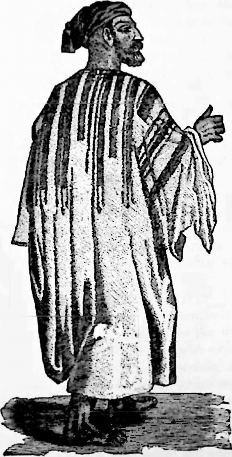
To make the position perfectly clear, let us make three propositions, as already established.
That this was a parable.
That it was uttered against the Pharisees.
That it illustrated the absurdity of their religious (?) belief, and was given in reply to their derision of Jesus (14).
The contrast drawn is not, as we may observe, between sin and holiness, since in the person of Lazarus nothing good, pure, or virtuous is claimed by the Lord. So far from it, he is utterly despicable; a parasite on society, a loathsome thing, full of filth and sores, the natural results of a life of idle men-dicancy. He is too helpless of self to walk, hence is brought and laid at the rich man’s gate; too helpless to drive away the hungry dogs, his companions, that worry his sores.
But he represented the Gentile world, viewed from a Jewish and Pharisaical standpoint “The Pharisees as lovers of money” (v. 14) were plainly served up as the “ rich man " of the parable, while as plainly, Lazarus was the representative of the outcast Gentiles, the “ publicans and sinners," who were flocking to Jesus, and hence into the kingdom of heaven. • These the Pharisees desired kept out (15: 1), while them-selves should go in, as the sons of Abraham, only. But Jesus had changed the balance, and upon this the whole parable turned, while it held up in ridicule those who were "ridiculing Him” (16: 14), in that immediate connection, showing how their religious belief would work in the future world’.
The lesson of the parable need not be lost to us, even if plainly directed to an evil people who lived and died in a ridiculous faith, some two thousand years ago, " That the decision of the next world will often reverse the estimation wherein men are held in this, for God is no re-specter of persons.”—Farrar.
“ There was grace for the ten, What a marvel that nine Should have turned from the gift, The trea-ure divine!»
Chapter XLVI
The Raising of Lazarus
Time—Probably the middle of February, A. D. 30. PLACE—Bethany, one and one-half mile east of Jerusalem.
Two days before Jesus closed His labors “ beyond Jordan," while in the midst of some intense discourse, maybe, a
Referenceu
John xx : 1-16.—Perea.
John ix : 17-53.—Bethany.
John xi: 54.—Ephraim.
messenger arrived bringing a brief and hasty message to Jesus, informing Him of the seri-ous sickness of one whom He loved, Lazarus of Bethany.
" Lord, behold," the messenger cried, pre-senting the message of “ the sisters of Lazarus,” " he whom Thou lovest is sick."
“ Nay,” Jesus replied, ” but the sickness is not unto death.”
Thus reassured the messenger might return to console Mary and Martha, but Jesus added:
“ It is for the glory of God, that the Son of God may be glorified thereby."
During two days Jesus yet tarried in Perea, closing up His labors there forever, while away in. Bethany, nearly thirty miles distant, Lazarus groaned and tossed upon his feverish couch, and then expired.
Had Lazarus been already dead when the message reached Jesus—a full day, at least, after it was written—He need not have waited two days before He announced the death of His friend to the Twelve, and before He started to go to Bethany.

At the end of two days He startled the disciples by saying: " Come, let us go into Judea again " (7).
" Master I” they exclaimed, in intense alarm, “the Jews were but now seeking to stone thee, and goest thou there again?"
" His answer was that during the twelve hours of His day's work He could walk in safety, for the light of duty which was the will of His heavenly Father would keep Him from all danger.”—Farrar.
As yet the disciples seem not to know that Lazarus was even sick, and Jesus began to explain to them:
" Our friend Lazarus.” Observe that He calls Lazarus the disciples’ friend, as well as His own. His hospitality extended not only to Himself, but to all who were His.
" Our friend Lazarus is fallen asleep, and I go to awake him.”
This the disciples, as usual, took literally, notwithstanding death is spoken of as “sleep” in Job (2: 13), Psalms (13: 3), Jeremiah, Daniel, Matthew, and “in the Talmud, a hundred times."—Geikie.
“ If he is asleep, Lord," said Peter, always the speaker, “ it is well. He will recover.” Don't go so far to waken a sleeping friend, and at the risk of your life I Stupid Peter! (13.) Dull disciples! Then said Jesus unto them plainly:
" Lazarus is dead ! ” This they understood.
Jesus had fulfilled all his promises but one. While before the Sanhedrin, under charge of Sabbath-breaking for healing an “ incurable disease" on the Sabbath (John 5 : 18, and 5 : 21-25), He assured the council that they should see greater works than healing an impotent man (5 : 5) at which to mar-vel : they should see Him raise the dead!
Then said Jesus, “ I am glad for your sakes that I was not there (when Lazarus was sick) that you may believe. Come, let us go to Lazarus."
Now for the first time Thomas became the speaker, saying, in despair:
"Well, fellow-disciples (16), if He must go again to Judea, let us go also, that we may die with our beloved Master.”
Therefore they all went after their Master.
The Arrival at Bethany.
“ So when Jesus reached Bethany, He found that Lazarus had been entombed four days already " (17).
Moreover the house was full of mourners, and among them many Jews from Jerusalem, who had come to offer consolation to the bereaved sisters, Martha and Mary. “About fifteen furlongs off" These Jews' presence indicated the high social position of this Bethany family.
It was only a half-hour’s walk over the hill to Bethany.
Martha had been anxiously expecting Jesus, sending out her messengers, who finally reported His coming (20), when she hastened outside the town to meet Him (30).
" Lord," cried she, on greeting her dear Master, " if you had been here my brother had not died. And even now I know whatsoever you shall ask of God, He will give you."
Jesus said unto her, " Thy brother shall rise again." " Yes, I know that he will rise in the resurrection."
" I am the resurrection," He answered her," and the life: he who believed on me, though he die, yet shall he live (again). And whosoever lives and believes on me, shall never die. Believest thou this, Martha ? "
“ Yea, Lord, I believe that thou art the Christ, the Son of God, that should come into the world."
Jesus said, " Go call thy sister Mary."
For fear of the Jews Jesus did not enter the house or pres-ence of those there; but Martha returned, and privately call-ing Mary aside, said:
" The Master is here and calls for you ”
Gladly Mary arose and ran out to where Jesus waited.
It was in the direction of the tomb, and the Jews, seeing Mary depart, followed her in that direction.
Mary fell at Jesus' feet weeping and repeating the very words of her sister: “ Lord, if you had been here, my brother had not died."
Then came up the Jews, imitating Mary’s weeping. Their hypocrisy must crop out even in this sacred scene. It moved Jesus’ sincere soul with indignation, but with a groan He sup-pressed His rising anger, and inquired of the sisters the way to the tomb of their brother.
They led the way ; Jesus following, weeping (35).
“See how He loved Lazarus," said some of the Jews, mocking. “Could not He who opened the eyes of the blind, have saved this man, His friend, too, from dying" (John 9: 15). We recollect how they were offended at that miracle.
Again was the spirit of Jesus moved with indignation; but He had arrived at the mouth of the cave where the tomb was.
“ Take away the stone," He commanded.
But Martha remonstrated, assuring Jesus that only corrup-tion, and not the sweet face of His beloved friend, must meet His gaze by so doing.
Jesus reminded her of His promise (verse 35), when the servants were permitted to remove the slab.
Uttering a short prayer, in the presence of an augmenting concourse of people, Jesus looked into the tomb.
What followed is briefly summed up by John as follows: “And He cried with a loud voice:
“ Lazarus, come forth ! ”
“ He that was dead came forth, bound hand and foot, with grave-bands and a napkin over his face.”
“ Loose him and let him go," said Jesus.
Once afterward, and but for a brief moment, do we hear of the risen Lazarus. It was at the supper given the Lord and His disciples at Bethany, two days before the Passover follow-ing. It is as follows:
“And Lazarus was one of those who sat at meat with Him.” Some of the Jews who had followed Mary out believed on Jesus from this, but others hastened away to the city and re-ported the matter to the Sanhedrin, who immediately went into secret council over the matter.
This council consisted of “ the chief priests and Pharisees,” which, for convenience, and because there had existed in Jemsalem such an honorable body, we call the “ Sanhedrin ; ” but this did not constitute a legal court, for the Jews had no legal authority within themselves. This body (John 11: 47) could not convict. Any judgment which it pronounced would be illegal, save for some petty ecclesiastical offence affecting the Roman government neither one way nor. another.
However, they hastily convened as a " court of inquiry.” " What shall we do ? ” they demanded of each other.
‘ For this man Jesus does many signs."
This they were at last compelled to acknowledge.
“ But," said they, “ it is not of a kind to restore to us our rights. Let Him go on thus, and we are forever slaves of the Romans." They had no conception of a Messiah who did not bring revolution in his train, and lead them on to victory over their present masters, the Romans. " What can this peaceful man do, with His little band of peasant disciples, to-ward throwing off the galling Roman yoke?" His signs amounted to nothing in that direction. This was the true sense of the complaint of the Sanhedrin now convened in Jerusalem.
Joseph Caiaphas was chairman of that body. He was a rash young man of only about twenty-five years of age, having been appointed to his present office by Valerius Gratus in the year 25 A. D.
This youthful high-priest thus addressed the council, not very complimentary to their dignity perhaps:
“Ye know nothing at all."
With this arrogant prelude, Caiaphas, in both his capacity as a high-priest and a prophet, assured the council that their only safety as a nation lay in the death of this man—innocent or guilty.
“ He prophesied,” adds John, " that Jesus should die for the nation, and not for the nation only, but that He might also gather together into one the children of God (Israelites) that are scattered abroad” (John 11: 51, 52). Caiaphas, as “high-priest," was supposed by the Jews to have that gift of proph-ecy which was still believed to linger in the persons of the descendants of Aaron; hence the great bearing on the San-hedrin of his words at this time, for they at once accepted them as the voice of God! Such was the result of their false teaching during a thousand years: " Thus saith the Lord."
“ Therefore from that day forth," it was with the council only a matter of expediency when Jesus should die.
The great miracle at Bethany had brought about this crisis. To Bethany, therefore, the council sent a spying officer to' look for Him (John 11: 56-57), but He was gone.
Then was promulgated openly a reward for His apprehen-sion. “ Henceforth He was living with a price upon His head.' ’—Farrar.
Chapter XLVII
Jesus Retires to Ephraim
Time—Last of February and first of March. Place—"A city called Ephraim," sixteen miles northward from Bethany. Route taken entirely unknown.
This is the text of John:
“ Jesus therefore no more walked openly among the Jews, but departed thence into the country near to the wilder-ness, into a city called Ephraim, and there tarried with the disciples.”
John IX 54-57.
Luke 17 : 5-10.
Luke 17: 22. Luke 18 : I-8.
S The phrase “ He departed into the country," is used in contradistinction to city. Bethany was reckoned as be-longing to Jerusalem, and so included in the Sabbath-day's journey; all else in Judea was called "the country" (54). But the exact place where Jesus tarried in Ephraim was a “ city ” (54). Now the Sanhedrin had given command that if any man knew where Jesus was he should make it known to them that they might take him.—John 11: 57.
With this imperative command promulgated, how long could Jesus and twelve men, His disciples, remain hid in a “ city " within twenty miles of Jerusalem ?
Perhaps a week or two.
Where was this little “ city called Ephraim ? "
We may reach it by going north from Jerusalem to Bethel, ten miles, thene north and east, over the mountains to the western border of " the wilderness,” toward the Jordan. The

distance from Bethel is about six miles. It was away from the main route from Jerusalem to Sychar, Samaria, and thence on to Galilee.
Ephraim is first mentioned in II Chronicles (13: 19), and also named by Josephus (W. 4: 9, 9), in each case in connection with Bethel. Lightfoot thinks these Ephraims are one with the text, as mentioned above. Jerome thinks it is twenty miles northward from Jerusalem. Sixteen is better.
Jesus must needs have gone away from Bethany at night, in order not to be seen and followed by a multitude. As it was, only His disciples followed Him.—John 11 : 54.
Here he passed the time till near the first of April, teaching His disciples. While journeying through Perea, when the multitude were “ continually thronging Him," so that they “ trod one upon another," He had little time to instruct His disciples ; therefore much of the matter addressed to them, as recorded by Luke, in the latter part of his gospel, may well apply to this period of teaching the Twelve in Ephraim. It is recorded as follows: Luke 17: 1 to 10; 17: 22 to 37;
18: 1 to 8, inclusive. • It is not probable that Jesus did any preaching or miracles while in concealment, for the whole text implies that He did not, but as was His custom, “ took a house, and would have no man know it," as He had done at Tyre, and there quietly instructed His disciples.
Those writers who would send Jesus back across the terri-tory of Samaria, after being rejected there, and refused a pas-sage over that country into Judea, and He return to His former preaching and healing in Galilee, have not the least authority for so doing. Says Andrews (385), referring to this period, “ Jesus leaves Ephraim . . . passing along the border line of Samaria and Galilee . . . He meets and heals ten lepers," etc.
This is not only improbable, but impossible. How could He safely reach that country? Only by crossing Samaria, where He had already been rejected and compelled to turn back, or by going down to Jordan near Jericho, and recrossing that river, journeying up on the eastern side, crossing again some fifty miles northward, and passing back into Galilee, by Scythopolis, get again onto the “ border of Samaria and Gal-ilee."
Provided He was not arrested before reaching Jericho! This was a theological city, where there were quartered 10,000 or more priests. The Talmud says that there were 24,000 settled in Jerusalem, and half of that number in Jericho! The fords of Jordan were continually watched by guard, and by publicans, and no thirteen men could pass without being seen, and, if wanted at Jerusalem, as Jesus was, would be appre-hended (John 11: 54). The Sanhedrin, which had sent its emissaries away to Capernaum, and into Perea, to look after Jesus, as they had before this final condemnation, would not now fail to send them to Jordan’s fords to apprehend Him, should He attempt to escape that way.
Neither could He safely return to Galilee by any route over which He had formerly travelled. In obscure Ephraim, He, for a short time, was in perfect safety.
, According to Mr. Andrews, Jesus went on, day after day, speaking with Pharisees and rulers, asking and answering questions, boldly denouncing some, as like the Pharisee who went up to the temple to pray, and rebuking others, as the lawyer who came to entrap Him on the question of divorce, all of which occurred weeks previous !
There need be no doubt that Jesus desired to avoid all pub-licity, " therefore He walked no more openly among the Jews,” as John informs us (11 : 54). Certainly not till His appointed " hour.”
" How could He [then] go about the country teaching ? ” Who asks this pertinent question ?
Our friend Mr. Andrews, who, in the foregoing page, so makes Jesus to “ go about the country teaching and preaching."— 386.
Let us see how far Jesus must travel out of His way in “ going up to Jerusalem ” (Mark 10: 32), by taking this round-about, impracticable way back into Galilee to heal ten lepers
FACTS v. THEORIES. 399
(healed by Him months previous), and how long a time it would require to perform all the work assigned, by Mr. An-drews, to this period.
First—Jesus could not recross Samaria.
The Samaritans had rejected Him once and forever; therefore.
Second—He could only go by the way of Jericho, in order to reach that far-off Samaritan country.
From Jerusalem to Jericho ford is twenty-two miles; one day’s travel. Ephraim was no nearer. From the ford to the bridge next north of the Samaritan line is forty-three miles. Crossing the Jordan here, passing again Scythopolis, and on to any known Samaritan town and " village" (Luke 17: II, 12) such as where He met the ten lepers, is fifteen miles more.
He has travelled in the face of great peril, over a public thoroughfare where He is well known, and one completely thronged with pilgrims going in an opposite direction, a dis-tance of eighty miles into a hostile country, Here He and the Twelve are made to turn about and retrace their steps to the camping-ground below Jericho, where we have the first evidence of their presence, according to the gospels (Luke 18: 31-35), since leaving the seclusion of Ephraim.
Here Jesus passed one day. He consumed two days in or about Jericho, and one on the road to Bethany, where He ar-rived “ six days before the Passover."—John.
To accomplish this would require the loss of TWENTY-ONE DAYS, including three Sabbaths on which He could not travel. Did Jesus thus expose Himself three weeks before Passover? And to what end ? Any reader may see the improbability of this, after the Lord had retired to Ephraim to avoid arrest by the Jews.
Therefore, let us come to scriptural facts.

Chapter XLVIII
Emerging from Obscurity
Time—Some ten or twelve days before the Passover—March. PLACE—Ephraim to Jordun near Jericho.
Jesus and the Twelve left Eph-raim at least ten days before the Passover, which commenced at Jerusalem on Thursday evening,
References
Matt. 20: 17-28.
Mark 10: 32-46.
Luke 18: 31-43.
Mark 10: 13-34.
Luke ig: x. John 12: x.
April 6. They went down the rough mountain pass and through the wady (brook bed), which comes out on the north side of the plain, between Jericho and the Jordan. There they would meet the Pilgrim caravan from eastern Galilee, Perea, and that vicinity, ex route for Jerusalem.
This was on the camping-ground of the Israelites, described by Josephus as being " fifty furlongs from the river and ten from Jericho.” It was a favorite spot of the Pilgrims.
Here Jesus met the Pilgrims from Bethsaida and about the shores of the Sea of Galilee, among whom were Salome and probably Zebedee and others. We now arrive at the point of Matthew’s record.—Matt. 20: 17-20.
From the conical hills of Ephraim Jesus could see the pil-grim bands as they began to stream down the Jordan valley toward Jerusalem, to purify themselves before the commence-ment of the great feast. The time had come for Him to leave His hiding-place, and He descended from Ephraim to the high-road, in order to join the caravan of Galilee pilgrims—Farrar.

Meeting His Galilean friends here, Jesus joins their camp, and with them, perhaps on the next day, turns His face toward Jerusalem.—Matt. 20: 17.
Evidently here was a great multitude, from whom Jesus separated the Twelve long enough to say to them (Cf. 17 and 29) :
" Behold ! We go up to Jerusalem—” and much more.
This first was all that they comprehended (verses 18 and 19), for their minds were exalted with hopes of the new govern-ment about to be established at Jerusalem by their Master, in
PILGRIS, TENTS, HORSES, AND CAMELS
which they had received encouragement from Him that they should participate.—Matt. 19: 28.
It was over the river, and but a short time before, when Jesus said to them :
" Truly I say unto you, that ye who have followed me, in the regeneration when the Son of man shall sit on the throne of His glory, YOU ALSO SHALL SIT UPON TWELVE THRONES, judging the twelve tribes of Israel."
In view of this promise, little else could they understand.
Since this promise had been made, James and John had not seen their mother, Salome, until now, and doubtless they im-
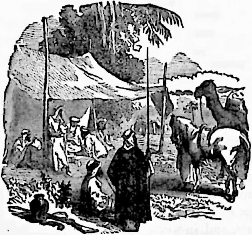
proved this the first opportunity to inform her of their great future prospects.—Matt. 20: 20.
The ambitious mother was not quite satisfied with even this honor to her noble sons, but with them she immediately con-fronted the Lord, and with James on the right hand and John on the left, they bowed before Him in the manner of subjects presenting their petition to a monarch.
" What do you desire ? ” He asked.
" That these, my two sons, may sit one on Thy right hand and one on Thy left hand, in Thy coming kingdom,” Salome petitioned.
Mark says that the sons presented the request. The three presented it, inasmuch as they all bowed before Jesus.
" You know not what you ask," replied Jesus, sorrowfully.
“Are you able to drink of the cup that I am about to drink?"
“ We are able," they confidently answered.
“ My cup indeed you shall drink, but to sit on my right hand and on my left, is not mine to give, but my Father's.”
The ten were not present, but soon hearing of the incident, they were indignant at the secret attempt of the two brothers to secure for themselves a pre-eminence of honor, and so ex-pressed themselves to Jesus, who said in reply:
“You know that the rulers of the Gentiles lord it over theft subjects, and, in turn, higher officers do the same over them. Not so shall it be among you, but whosoever of you would become first, let him be the servant to minister to the others, as I, the Son of man, came to minister to you, and not to be ministered unto, and to give his life a ransom for many."
The whole moving camp of pilgrims, the “multitude" which was continually being augmented on the way, believed that Jesus was now going up to Jerusalem to be “ crowned king,” and doubtless great enthusiasm prevailed, especially among Galileans who were present.
The new kingdom was the whole theme of conversation by the way. “ Blessed is he who shall eat bread in the new king-dom,” cried some of them.
The Pharisees heard the rumor, and they came and inquired :
" Master, when is this kingdom of God coming into power ? ”
" It cometh not with observation. You cannot say of it, * Lo, it is here! or lo, it is there! ’ For lo I the kingdom of God is within you.” In the midst of you.—R. V.
It was a beautiful custom of the ancient kings and rulers, and one handed down to very modern times, even in England, to lay hands on little children and bless them. Especially was it expected of a new king, that he, in his early accession, would bless the children of his common subjects, and under the general impression that Jesus was about to become king of Israel, parents crowded about Him, bringing their babes for His royal blessing.* The disciples thought this might become annoying to Jesus, and ordered the parents to desist—Mark 10: 13.
But when Jesus observed them He was indignant at the disciples, and said to them: , “ Suffer the little children to come unto Me, and forbid them not, for of such is the kingdom of God"—Luke.
“And He laid His hand on them," “ and blessed them.”—Matt; Mark.
This act was of sufficient importance to find place with all the synoptists. In tenderness Jesus often called His disciples “ little children,” and told them that to inherit the kingdom they must become like little children. • After blessing the children, according to Mark, Jesus went into the (high) way.
Perhaps it was in a house that He blessed the children.
If we follow the synoptists' order we shall find an earnest inquirer for the "kingdom” in a certain wealthy young Jew-ish ruler. His question was as follows:
“ Good Master, what shall I do that I may inherit eternal life?”
* Rabbis, in absence of a king in Israel, had assumed this office. Simeon blessed Jesus in the temple.
“Why do you call me good?" Jesus kindly inquired. “ God only is good. You know the commandments."
Certainly he did. All Jews knew them by heart.
“ Master, these I have kept from my youth. What else do I need do ?the young man inquired.
Then after Jesus had said to him, “ If you would be perfect, go sell all that you have and give to the poor, and thou shalt have treasures in heaven, and come and follow me,” the young man went away in sorrow, for he had great possessions.
This may have occurred, and probably did occur, some time before the time here assigned. It is not easy to tell just when and where these beautiful lessons and loving words of the blessed Jesus were given: it matters not, but they are all too heavenly to be omitted. Jesus improved the opportunity to give a lengthy discourse on the subject, even to His dis-ciples.—Matt. 19: 23. .
Matthew connects this matter and the blessing of children with the immediate departure for Jericho and Jerusalem, as also Mark and Luke; and, considering the “ expectation " of the people (Luke 19: 11) in the immediate kingship of Jesus, we have connected them with this departure also.
On the way toward Jerusalem, and before reaching Jericho, great fear fell upon some of the followers of Jesus, knowing that He was going to His death.
Were these the disciples, or some of the multitude? Some unusual alarming occurrence here took place.
Then Jesus “again" took the Twelve aside and told them of the things which should befall Him in Jerusalem, resulting in His death and resurrection.
Then they came to Jericho.
This was a city of high antiquity. Dr. Robinson identifies the present ruins on the south and east side of a hill, as those indicated by Josephus. Dr. William Thomson says of these ruins:
“Whether these mark the site of old Jericho, of course cannot at present be decided; but they are evidently more ancient than the ruins of Tyre or of Czsarea, and there are
JESUS BLESSING IIIS OWM
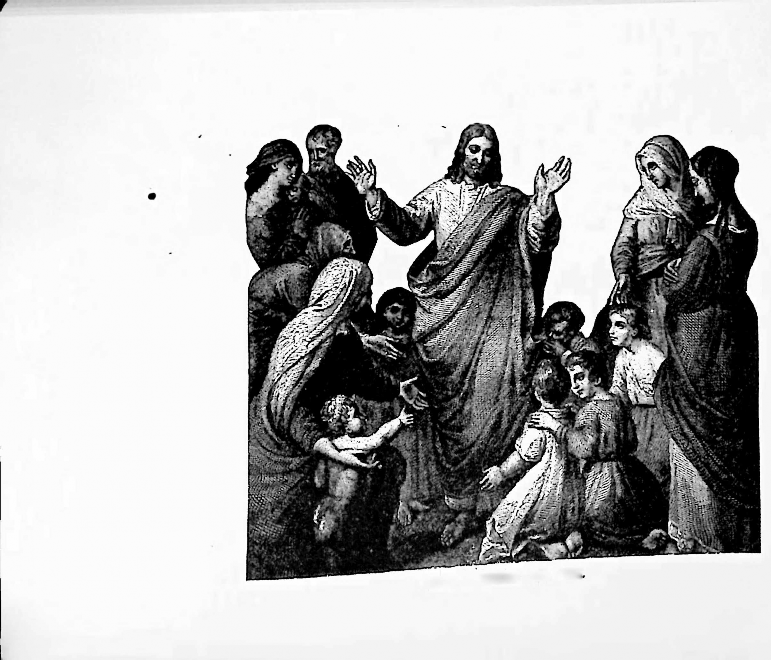
"THE CITY OF PALM TREES." 407 no others visible in this vicinity." The plain below was then (1834). as in Christ's day, and in the times of the Israelites encamping there, used as a camping-ground.
“ The scene was very picturesque. Spread abroad over the plain, lay men, women, and children of almost every nation under heaven, in every variety of costume, and of all colors from the black of Africa to the white of Poland."
“ Rising like an amphitheatre from (and above) this scene lay Jericho, the chief place east of Jerusalem, on swelling slopes seven hundred feet above the bed of the river, from which its gardens and groves, thickly interspersed with man-sions, and covering seventy furlongs from north to south, and twenty from east to west, were divided by a strip of wilder-ness.”—Sepp. 5 : 393 ; Geikie, 384.
The history of Jericho is one of intense interest Joshua found it a city of great wealth defended by a king and a large population, behind remarkably strong walls, some fifteen feet in thickness, with houses on top, and guarded by iron gates, imposing towers and castles —Josh. 3: 16 and 2: 16.
The spies sent out from Israel's camp below came over Jordan, crept up the Wady-Kelt, and entered the city before the gates were closed for the night, and found lodgings and refreshment at the “ house on the wall,” kept by " Rahab the harlot."—Josh. 2: 1-21; Hebrews 11: 30, 31.
They were seen by the city officers, and chased into this house; but Rahab hid the spies under some flax on the roof, telling their pursuers a wholesome falsehood which sent the latter away, while she, at night, let them down over the wall, when they escaped. She was a large, powerful woman, as her name (Rachab) implies.—Kitto.
For the good service done Joshua's spies, in the subsequent sacking of the city, and the general massacre of its inhabitants, Rahab’s family were all spared. Afterwards she married Sal mon, son of a prince of the children of Judah, and father of Boaz, husband of Ruth, parents of Jesse, and grandparents of David (Matt. i: 5). Thus Rahab was the direct ancestress of Jesus, the Messiah.—See Smith's Bib. Diet, Bib. Encyclo., Kitto.
Joshua not only destroyed “the city of palm trees,” but cursed it with a terrible curse; but in spite of both it arose, prospered, and became the central school of the prophets. . . . Herod the Great did much to increase its importance. The magnificent palace of this ruler arose amidst the famous grove of palms, second only to the old palace of the Asmonean ♦ kings in the royal gardens of this tropical city. Cypros was a fortress erected by Herod and named in honor of his mother; another was named for his brother Phasaelis. He also erected here an immense amphitheatre, in which this tyrant in his last hours caused the elders of the Jews to be convened and shut up, to be executed at the hour of his death, that the nation might be compelled to mourn, if not for him. Soon after this miscarriage, on Herod’s death, his slave Simon arose and burned his late master's palace, and plundered the city; but Archelaus soon rebuilt the palace of his father, and made other improvements in and about the place, so that Jericho was once more a “ city of palms,” when Jesus and His apostles visited her.—Dr. Smith.
As He approached the gate He was followed by the twelve apostles and numerous disciples from Galilee and Perea, and also a great multitude of pilgrims bound to Jerusalem for the preparation of the Passover.—John 11:55 and 12: 12.
Along the wayside, at the gates of the principal cities and about Jerusalem, numerous beggars from all Palestine came and sat down to ply their profession among the pilgrims at-tending the great annual feasts. Among these beggars, at this time, was one, who, seated near the entrance to Jericho, hearing an unusual commotion near, inquired the cause.
"And they told him that Jesus of Nazareth was passing.”
The beggar had heard of Him. He it was who restored sight to one who was born blind. Here was his opportunity!
" Jesus,” he cried at the passer-by, “ Thou Son of David, have mercy on me. I am blind.”
* A royal family that reigned over the Israelites during 125 years.
" Hold your peace!" some one commanded.
But the beggar would not lose this one chance, and he cried louder and louder yet: “ O, thou Son of David ! have mercy.”
" Bring him here! " Jesus commanded. “ "What is your wish?" He inquired.
“ Lord, grant that I may receive my sight"
“Receive your sight, according to your faith," said Jesus; or, “ Thy faith hath made thee whole," according to Luke's exact words (Luke 18: 42). Who adds:
“And immediately he received his sight and followed Jesus, glorifying God. And all the people, when they saw it, gave praise unto God ” (43).
Let us not confound this case of healing the blind beggar with that recorded by Matthew (20: 29), as having taken place when Jesus left Jericho on the following day.
Chapter XLIX
Zaccheus and Bar-Timeus
Time—The very last of March, A. D. 30. PLACE—Jericho and Bethany.
A0TO3
References
Luke xg: I-28.
' Mark1o:46-52. a9ld —l U w entered and passed through Matt. 20: 29-34Jericho.”
C He was expected. Perhaps John i a some two of the seventy had been here before Him, heralded His coming, and made prepara-tion for Him and His retinue. “ To make ready for Him,” are the words of the text.
Jericho was in great commotion as He en-tered. The streets were crowded with people (Luke 19: 3). They filled the doorways and windows, and gazed down from the very housetops. Moreover, some climbed the convenient sycamore trees on the roadside. At least, one unfortunately short man did. He could not get a glimpse of Jesus in that throng, and his house was in another street (7), so this “ little man" got hastily up into a tree, for he was spry, if little.
There may have been many others in the tree, but this was the man at whose house Jesus was to stop that night, and ar-riving under this sycamore tree, Jesus halted, and, looking up, recognized the man.
” Zaccheus,” said Jesus, “ make haste and come down, for to-day I must abide at thy house.”
The little man obeyed, and made haste to descend. Syca-(410)

mores were easily climbed, having short trunks and wide, drooping branches.
And he ran to Jesus, and greeted Him joyfully (6).
This man Zaccheus was a publican—a tax-gatherer for the Roman government He demanded taxes alike from Jew and Gentile, and was cordially hated by the former. He was a Jew, also; hence the more despicable in the eyes of all Jews. A Jew who turned publican was unceremoniously cast out of the synagogue, and from all society. He was a hardened sinner.
As such he was not a suitable host for one who laid claim to the Messiahship. The Jews saw this, and said, contempt-uously, “ He has gone to become a guest of a man who is a sinner! " The R. V. says, “ To lodge with a man who is a sinner."
The day therefore was far spent, and no Jews seemed to have followed Jesus into Zaccheus’ house, as they certainly could have done had it not been late. That they were unin-vited was nothing; oriental freedom permitted them to enter any house by day. That Zaccheus was a despised publican would not have hindered them.
It may be presumed that the Twelve followed Jesus, and were also provided for by the wealthy Zaccheus.—Luke 19:
8.
The houses of that period were usually enclosed by a porch, or high wall, and on arriving within this enclosure, before sit-ting down, at least, Zaccheus relieved his conscience of its burden of wrong upon his former victims, of which wrong no publican was believed to be guiltless. The very nature of the system was “ extortion."—Luke 3: 13.
“And Zaccheus stood.” His confession was immediate.
“ Behold, Lord ! One-half of my goods I give to the poor, and if I have wrongfully exacted aught of any man, to him I will restore fourfold.”
, Jesus must have believed in his sincerity, for He replied.
“ To-day is salvation come to this house.” (They were then at the house of Zaccheus, may we not understand ?)
Luke here adds, “ Forasmuch as he (Zaccheus) is a son of Abraham.” As a son of Abraham only he was lost with the whole tribe, but in forsaking that claim, the same as put in by the Jews to John the Baptist (Luke 3 : 8), and the same as made, evidently, by Nicodemus, this publican turned from an Israelite to a Christian, i. e., a repudiator of the old, and a convert to the new kingdom. Every Jew who did not so do, jeopardized his chances of salvation when the general destruc-tion came upon that people. As both the Baptist and the Christ had said, being the sons of Abraham could not save them, for the very fact of their so being brought their destruc-tion upon them. Unless Nicodemus was (in this sense) “ born again,” he certainly perished in the destruction of Abraham's children, when Jerusalem " burned as an oven.”—Malachi 5 ; Luke 21: 20; Mark 13: 30.
Tradition says that he openly declared for Christ after the resurrection, and was expelled from the council, and later baptized by Peter.—Bib. Encyclop., Kitto.
What more occurred at the house of Zaccheus is unknown. It is presumed that Jesus tarried there only till the following morning, when He and His followers left the city of Jericho on their way up toward Jerusalem.—Luke 19: 28.
“ The Parable of the Pounds ” may have been given at about the time of the departure from Jericho. Perhaps it was later, when nearer Jerusalem.
“As they heard these things” (11). What things? It is plural—" things "—implying many. At Jericho only one inci-dent is recorded—the call of Zaccheus. What Zaccheus said, and the reply of Jesus (8, 9, 10), took place after He had “ gone to lodge with Zaccheus ” (7). Then the Jews stood without and said, " He has gone to lodge,” etc. All this im-plies a separation of Jesus and Zaccheus from the multitude, 1 whereas the parable was spoken to the caravan of pilgrims going up to Jerusalem. This latter is given as the very reason of His speaking the parable of the pounds, and also because they (the multitude) expected Jesus would there, in the Holy City, be anointed king of the Jews.
“ The lessons of the parable could hardly be misunder-stood,” says Geikie. “To the Jewish people, who would not receive Jesus (27) as the Messiah, they spoke in words of warning alarm, while the Twelve themselves heard a solemn caution.”
. Plainly the " ten servants " of the parable (13) were repre-sented by the disciples, more or less in number, who receiving a sacred trust were held responsible for its increase until His return, while " His citizens,” His proper subjects, were repre-sented by the mass of Jews, who were His “enemies” (27), and who having entirely rejected Him, should on His return be utterly destroyed before His face.—See Schaff, in loco.
Departure from Jericho.
Here we return to the records of Matthew and Mark, who tell us about the restoring of certain blind men to their sight, as Jesus went on His way, followed by the Twelve and a great multitude, en route to Jerusalem to attend Pass-over.
“ There are three apparently discordant accounts of this miracle in the three gospels,” says Peloubet (Notes, 1882). “ Some writers decline the attempt to harmonize these contra-dictions" says Andrews, 394. Alford says, " The only fair account of such differences is that they existed in sources from which each evangelist took his narrative.” Meyer thinks " these are discrepancies invincible.”
“ These differences are entirely unimportant,” says Norton.
We claim that they are important. These accounts are either true in the whole or false. We claim that there are no discrepancies in these several gospel accounts of healing at Jericho.
FIRST1. Luke records the restoring of one blind man, name unknown, in the entry into Jericho. Very good. Let that so remain. It is a case by itself.—Luke 18: 35-43.
SECOND. Mark says that when Jesus went out of Jericho, a blind beggar, named Bar-Timeus, was sitting by the wayside. He speaks of him as of one well known, “ the son of Timeus.”
24 • Bar means " son.” According to the R. V. he is not begging, only " sitting.”
THIRD. Matthew says that there were two sitting. Matthew was present, and having written it out soon afterward, ought to have known if there were two men sitting. There might not only have been two, but a half dozen, for blindness and mendicancy were very common in the East. Now as the blind often went in couples for company’s sake, and " the blind often led the blind,” Matthew could not have told, in the crowd, that both of these men, “ sitting by the wayside," were blind. He does not even say that they were begging!
FOURTH. We find then, by both Matthew and Mark, that one really was a beggar, and that his name was Bar-Timeus. Mark has had time to look this up, since Matthew wrote his gospel, and names the one.
Who then was the other with Bar-Timeus ?
He was the man whom Jesus restored to sight the day be-fore 1 He had followed Jesus into Jericho, “rejoicing and glorifying God ” (Luke 18: 43). He knew of this Bar-Timeus, begging at the other gate, and when Jesus was about to pass out the next morning, this happy man ran ahead, and sitting by his late companion, hastily told him of the wondrous tiling which Jesus had done for him, and prompting him with the very word he himself had cried out the day previous, as Jesus was passing by.
Nothing could be more probable; nothing more natural. The words which had been the means of procuring his salva-tion, he promptly imparted to another in like blindness. What a beautiful example! Would we not have done the same? Shall we not, who have received light from Christ, impart the knowledge to others ?
Evermore I Observe that Luke's blind man had inquired the cause of the unusual commotion of the crowd entering Jericho, whereas this blind Bar-Timeus does not. His friend, now seeing Jesus, prompts Bar-Timeus when and what to cry:
“ Jesus, thou son of David, have mercy on me.”
He is cured, but does not enter the city “ glorifying God,” as had the other. Perhaps he felt that he owed so much to his friend who showed him the way to his Saviour, that he gave the friend praise instead of Jesus. We hope not.
Thus each narrative is independent, and neither contradic-tory ; while both are natural and so simplified that no one hereafter may again say that the gospels are inharmonious, at least in this instance.
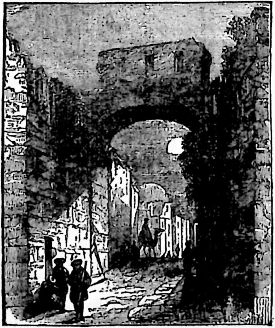
Chapter L
Jericho to Bethany
Time—Friday, March 31st, A. D. 30.
days before the Passover Jesus came to Bethany where
Refereneem
John 12; 1.
Luke 10: 25-42.
Luke ig: 38.
Lazarus was, whom He raised from the dead. Thus John takes up the thread of the narra-tive just where the synoptists drop it.
Matthew and Mark leave Jesus, " His disci. pies, and a great multitude," between Jericho S) and Bethany.
- What took place on the way after restoring blind Bar-Timeus?
Perhaps they rested in the great ghor, under the trees, for the way was steep and rough, and the days very hot. If so, Jesus most assuredly improved the opportunity to impress upon the multitude some great lesson. These lessons were always deduced from surrounding circumstances, which fact leads us to briefly describe this wild and dangerous pass.
It is well said in the parable—which we are approaching—that “A certain man went from Jerusalem down to Jericho," for the latter city lies more than two thousand feet below the former, and if the Mediterranean Sea should be let into the valley of the Jordan and Dead Sea, Jericho would be six hun-dred feet under water.
When snow flies in Jerusalem (January) orange-trees are full of fruit down in tropical Jericho.

THE ROAD.—After leaving the plain, going up, “the moun-tains wear a more doleful appearance, the ravines become more frightful, and the narrow passage less and less passable."
The path is very zig-zag, now rift through the earth, with walls of trap and lime-rock on each side, towering far heaven-ward ; now following the slippery, rocky stream-bed; now parched in the pouring sun of April; now climbing up the steep rocks, in which are worn deep foot-prints of horses, asses, and camels that have travelled over it for 4,000 years ; holes six or eight inches in depth, into which your feet will slip, unless you are continually on the alert Sometimes horses broke their legs in them, “ Highway robbers were numerous in that vicinity. Ac-cording to Jerome, the road was called the ‘ Red, or bloody way,’ and in his time a Roman fort and garrison were needed for the protection of travellers " (Dr. Schaff). “ Not a house nor a tree is to be seen, and the only remains are those of a large khan (perhaps the fort above), said to have been the inn to which the good Samaritan brought the wounded Jew. Not far from here, in a narrow defile, an English traveller was shot and robbed in the year 1820."—Thomson.
What an admirable place in which to relate the parable of the wounded Jew! How suggestive of this story;
“A certain man—a Jew, no doubt—came down through this dangerous pass, when the robbers fell upon him, wounded him, stripped him of everything, even his clothes, and left him half-dead.
“A certain priest, who chanced to be going down from the temple,” where he had been officiating in his “ course " of eight days, to his home in Jericho—a city of priests—discovered the wounded man, and turned aside, or, “ passed by on the other side."
That is, he went around the other side of the ravine.
“And in like manner came a Levite, who looked on the wounded, naked man, and passed over the mountain,1 on the other side,’ that he might not be polluted by even a touch of the body in the narrow ravine.
“ Next came a Samaritan, riding on an ass. This man was on a journey (33), therefore, far from home, not in Samaria, not near Samaria, down here in this ghor. He saw the wounded Jew, and had compassion, heathen as he was, and dismounting, he dressed the man's wounds with oil and bandages, gave him some wine to revive him (34), and laying him across his beast, carefully conveyed him to an inn." This was a different inn than that named in Luke 2: 7, implying the western type of hostelry, where the landlord provides for guests, whereas the other, in Bethlehem, was an Eastern caravanserai, where guests simply find shelter, arranging their meals for themselves.—Ellicott All night this Good Samaritan remained by the invalid, and in the morning, when he must go on his way, he said to the landlord:
“ Here are two pence; take care of this poor man till he recovers, and whatever it costs more, I will pay on my re-turn " (35)' “ Two pence,” equal to 30 cents, several days’ keeping, then. .
This parable was told to a Jewish lawyer, who had been questioning Jesus on the way, finally asking Him—
“ Who is my neighbor ? "—29.
Jesus had answered him by another question—involved in the parable—“ which was neighbor to the wounded Jew ?—priest, Levite, or Samaritan ? ”
Forced to answer his own question, the lawyer replied : “ He who showed mercy on the needy.”
“ Go and do thou likewise,” said Jesus.
After relating this parable, Luke’s next record is this— "
“ Now as they went on their way. He (Jesus) entered a cer-tain village . . . into the house of Martha . . , and Mary.”—Luke 10: 38, 39.
That was, into Bethany.
This connection with the parable shows that the latter was told in the place where we have assigned it, on the road from Jericho to Bethany. But we are aware that the whole of chapter 10, from verse 25, is out of place in the book. Long after this record we find Jesus still journeying toward Jeru-salem " through cities and villages " (13 : 22), whereas,having arrived at Bethany (10: 38), we know that there were no “ cities and villages " between there and Jerusalem. Therefore, Luke IO: 25 to 42 belongs after 13 : 22, and not only that, but right after 19: 27.
We would, to arrange it chronologically, place Luke 10:
25—42 immediately after Luke 19: 27. It would then read (28): “ And when He had thus spoken, He went on before going up to Jerusalem."
Chapter LI
Jesus and the Twelve at Bethany
Time—Friday evening, March 31st, to Sunday morn, A. D. 30. PLACE—Bethany. Place—Tiberius Csar, emperor of Roman Empire, at Rome; Pontius Pi. late, governor of Judea; lierod Antipas, of Galilee; Philip, of Perea, etc.
Reference
John ta: 1-9. ndd distance from Jericho to Bethany is about fifteen miles, and the j’ourney is accomplished in one day. There was no village en route at which Jesus and the disciples might stop over night; besides, they were accompanying the great caravan of pilgrims, whose destination was Jerusalem. These came thus early be-cause of the “ preparation, which was before the Passover.”—John 11: 55.
They all arrived at Bethany, a village behind Mount Olivet, before six o'clock on Friday afternoon, for the Jewish Sabbath commenced at that hour. Here Jesus and the Twelve would separate from the caravan, and while the former would stop with His friends Lazarus, Martha, and Mary, at Bethany, the pilgrims pressed on toward Jerusalem, two miles further, around the southern end of Olivet There was a foot-path over the hill, which was half a mile shorter.
" This was six days before the Passover.”—John. It was the eighth of Nisan, Jewish reckoning.
"On the fourteenth day of the first month (Nisan), at even-ing, is the Lord's Passover.”—Leviticus 23 : 5.
When was the supper given at Bethany?

WHEN WAS THE SUPPER? 421 A careless reading of John’s record (12: 2) might imply that this supper was given immediately on the arrival of Jesus at Bethany, “ six days .before the passover." The same read-ing would also imply that it was given in the house of and by Martha ; but by reference to Matthew 26: 6, and Mark 14: 3, we learn that it was at the house of " Simon, the leper,” and also, by the same authority, that it occurred " two days before the passover.”
Let us be guided by the stronger evidence.
If we say it took place two days, and not six, before the passover, we shall find a complete harmony of the gospels.
At this supper, Mary anointed Jesus for His burial (Matt 26: 12). His death was not passed upon until two days be-fore the passover (Matt. 26: 2, 3), nor did the council know where Jesus was till then.—John 11: 57.
At this supper, Judas took offence, and went out at night, passed over to Jerusalem, and changed the minds of the coun-cil from their decision just passed (Mark 14: 2), “not to kill Jesus till after the feast,” to a decision to kill Him (14: 11) as soon as Judas found the opportunity to deliver Him up.
What changed their minds?
The offer of Judas to betray Jesus to them.
This was not fixed until “ two days before the passover."—Mark 14: I.
Certainly the offence to Judas and the betrayal were immediate.—Matt. 26: 14.
The Jewish Sabbath began at six o’clock on Friday even-ing, very soon after the arrival of Jesus and the Twelve at Bethany. There was then no time in which to prepare a special supper for Him, as this supper evidently was (John 12: 2), and while a feast could be enjoyed on that day, it could by no means be prepared on the Sabbath.
The day following His arrival in Bethany was the “ day of rest for all Israel," and notwithstanding the " great expectation of the people " that the kingdom of the Messiah was about to appear (Luke 19: 11), Jesus must remain quiet at Bethany on this day, as must the anxious, waiting pilgrims over the west-ern slope of Mount Olivet.
This leads us to say that Jesus being at this hour looked upon by the common people as this long-expected Messiah—certainly so by the Twelve—no counter demonstration could have been entertained at this time by Judas or the Sanhedrin. The circumstance which developed the treachery of Judas was yet to supervene, viz., the failure of the Jews to recognize Jesus on His grand entry into Jerusalem, to be accomplished on the morrow.—John 12: 12.
Until this hope of Christ's recognition should be taken from Judas, he would not betray his Master. This took place after the following day.
We now come to “ Palm Sunday.”
MARY OF RRTHANY
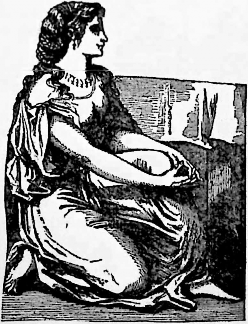
Chapter LII
The Entry Into Jerusalem
Time—Sunday, April 3, A. D. 30. Called “Firstday of the week.” PLACE—Bethany, around Olivet to Jerusalem, and return.
The day of sweet repose in Beth-any was over.
The hour for action had ar-rived. Jesus well knew that
Reference
Matt at: 1-11. Mark xx: i-xo. Mark xx: xg. Luke ig: 29,44.
John 12:12, xg.
so ordained.
His last Sabbath with those loved friends in Bethany had ended. He had no longer any motive for concealment, for on the next Sabbath His body would rest in the tomb. It was Heretofore He had come to Jerusalem quietly, on foot, and even secretly. Now He would enter heralded by a mighty concourse of people. Furthermore He would excite expecta-tion, among the Jews particularly, by riding upon an “ ass-colt,” according to the prophecy of Zachariah, which every Jew understood to relate only to the coming of Christ:
" Rejoice greatly, O Daughter of Sion I . " Shout, O Daughter of Jerusalem!
“ Behold! Thy King cometh unto thee; “ He is meek, and having salvation;
“ Lowly, and riding upon an ass, " Upon a colt, the foal of an ass."—Z. 9: 9.
Nothing could touch the expectancy of the common Jew-ish heart more than the fulfilment of this well-known proph-

ecy. King David had come riding upon this lowly beast, the judges of Israel had ridden white asses, and the prophet had declared that the Son of David, and the new, Righteous Judge of this last day should enter the Holy City riding upon an ass’s colt.
To this end Jesus left Bethany, perhaps later in the day than was His custom, that the people might have time to learn of His coming triumphantly into Jerusalem. Certainly they had been well informed of His proposed entry, and prepared to receive Him on the way with cloaks and branches to carpet the road, as was the oriental custom on the entry of a king into his capital.
He started on foot, but soon discovering the necessary ass’s
HEBREW WHITE ASS,
colt bed in the public square (Mark 11: 4), He sent two of the disciples to engage it for the occasion.
" Go,” said He, “ and bring hither the colt”
"And if any man asks why you loose him, say you:
" * The Lord hath need of him, and will send him immedi-ately back hither,1" when done with him.—Mark.
The two nameless disciples went as directed, and found the animal tied in the street before a door. The owner saw the two well-known disciples untying the colt, and inquired:
“ What do you want of him?"
"The Lord, our Master, hath need of him, and He will send him immediately back when done with him.”
It was an eastern custom for persons having asses to hire,
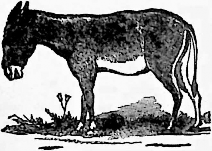
to hitch them in public streets, and there await for customers. In Cairo, Alexandria, and Jaffa this is the custom to this day.
I have seen as many as a half-dozen donkeys tied about a public square in Cairo at once, while the lads, their keepers, played at games of marbles while waiting for customers. May not this man of Bethphage have had these two asses ex-posed for hire ?
Having obtained the right beast, the two disciples led him to the place where Jesus and the augmenting crowd awaited, and laying their cloaks over the animal, seated the Lord thereon. He mounts no fiery war-horse, He sits no capari-soned steed, with royal purple saddle-cloth and trimmings of gold, but He rides upon a lowly beast of burden, the symbol of meekness and peace, covered with the outer garments of despised Galilean fishermen. Not a very royal equipage I Not a very royal retinue!
But to them He is the king of Israel, the long-expected Messiah, and the beast which He rides fulfils the last require-ment of prophecy.
“ Behold, thy King cometh, riding upon an ass-colt."
Bethphage is named before Bethany, because reckoned from Jerusalem. It was a mere hamlet, now entirely unknown. Barclay (65) and Porter (188) think its site is over a mile from the city, and just out of sight around Olivet. This answers the indication.
Amid the joyous acclamations of the disciples and multi-tude, Jesus starts on toward the “ City of David."
The road winds along through green fields and leafy trees, gradually ascending the southern spur of Mount Olivet, till turning northward the city of Jerusalem suddenly bursts into view. Present imagination cannot overrate the splendors of this scene, for Jerusalem was then in her pride.
First in view, rising high over the valley of Hinnom,* came the southern wall of the “holy city," behind which rose the elegant mansions of the rich, amid lofty palm trees and glit* Ge-henna, translated six times in Matthew as “ hell.” tering spires, gradually rising higher till terminating in Zion's hill, crowned with a royal palace, turret, and dome.
On a step farther, and there, straight before, high over the green valley of Kidron, rose the long line of the eastern wall, above which shone the high, white columns of Solomon's porch; and still above all the holy " Temple of God,” with its "walls of snow" and dome of gold, resplendent in the glori-ous beams of the morning sunlight.
Tenting in the valleys below, and along the hill-sides, were thousands upon thousands of pilgrims. These had heard of the approach of Jesus and His followers, and were coming out to them, bearing palm leaves to carpet the way.
"The two streams met midway: half of the mass, turning about, preceded (Jesus); the other half followed ” (Stanley).—As per Matt. 21:9.
“And the multitude that went before Him and that followed, cried, saying:
" Hosanna to the Son of David:
" Blessed is He who cometh " In the name of the Lord!
“Hosanna, in the highest"—Matt. 21: 9.
The enthusiasm of the multitude knew no bound. The day which prophets and kings had so long desired had come at last. The Messiah, the “ King anointed,” was com-ing into His kingdom! Of this there seemed no question.
These enthusiastic pilgrims tore off their garments and spread them in the pathway, and cast down the branches of trees lining the roadside and fields adjoining, to carpet the royal highway into Jerusalem.—John 12: 12.
Their exultation burst forth in repeated hosannas!
Amid this throng were several Pharisees, to whom this ex-ultation of the multitude was an offence. “ What folly was this! These pilgrims and Galileans heralding Jesus of Naz-areth in 1 Messianic cries and kingly titles ! ’ ” It could not be permitted. The whol: nation would yet believe in Him. And turning to Jesus they said :
“ Master "—they would give Him no higher title—
“ Master, rebuke these, thy disciples."
" Nay," He replied. " I tell you that if they hold their peace, the very stones will cry out"
The Pharisees were thus unable to stay the flood of enthu-siasm, and did not again interfere.
But what is this which suddenly checks them a moment later ? The Master has halted. He gazes on the holy city at H is feet. And as He looks on the city of His fathers, into which He is about to enter as the supposed temporal King, no pride or exultation swells His heart 1 No, no, no! So far from it, He wept over the city! .
“And as He drew nigh, He saw the city and wept over it, saying:
" If thou hadst known in this day, even thou, the things ■which belong unto peace I but now they are hid from thine eyes.
“ For the days shall come upon thee, when thine enemies shall cast up a bank about thee, and compass thee round, and keep thee in on every side, and shall dash thee to the ground :
" 'And thy children within thee.'—See Children of Jeru-salem.
“ ‘And they shall not leave in thee one stone upon another, because thou knowest not the time of thy visitation.’ "
The fulfilment of this prophecy is a well-known matter of history. On this very spot, where Jesus sat upon the ass and wept bitter tears over the thought of the desolation which should come upon this beautiful city, Vespasian and Titus, under the Roman eagles, set up their engines of destruction to hurl red-hot shot into Jerusalem, while a "bank" was thrown up around her, and armies encompassed her, while she burned within “ as an oven."
As to the precise spot where Jesus halted and wept over Jerusalem, Mr. Stanley says, of the place just described:
" It is hardly possible to doubt that this rise and turn in the road, this rocky ledge, was the exact point where the multi-tude paused again, and where 1 He wept when He beheld the city.’ ”
From this point the route lay down the western slope of Mount Olivet, into the valley of Kidron. Here were two roads leading into Jerusalem; one sweeps off toward the valley of Hinnom, passes under the southern wall, leaving Herod's palatial amphitheatre on the left, as described in the first jour-ney ; thence to the southwest corner, through the gate Gen-nath, under the shadow of Hippicus, and across the city eastward, to the temple. The other lay along the valley Kidron, northward, past Gethsemane to the northern angle of the wall, thence over Kidron, up the sharp ascent, into the St Stephen’s Gate, or the " Fish Gate.” This latter route was the shorter, as it brought Him into the temple at once, but being on a "Triumphant Entree," He may have gone the other way in order to traverse the whole city, followed by His disciples and the enthusiastic multitude. Indeed, the text of Matthew would, possibly, infer the latter.—“And when He was come into Jerusalem, all the city was stirred, saying: l‘Whout/lisr, " It is Jesus, the Prophet, from Nazareth of Galilee.”
This reply came not from the disciples, but from the “ mul-titude.” Had His disciples replied, they would have said, “ He is the Messiah, who was to come.”
Leaving the borrowed animal at the temple limits, with the explicit command for its immediate return to its owner in Bethphage—for His promise was good—Jesus and His disci-ples entered the temple.* Here the enthusiastic multitude evidently followed, con-tinuing their shouts, as along the way from Bethany.
In the temple were employed a band of children to assist in the musical service, probably, who hearing this familiar quo-tation from the Psalms, caught it up and, with their high soprano voices, made the temple ring.
“ Hosanna I Hosanna to the Son of David."—Ps. 118:25.
“ The chief priests and scribes,” on witnessing this last ful* All beasts of burden, walking staves, and dusty sandals must be left outide the temple enclosure—Shushan Gate of the temple. filment of Scripture (Ps. 8: 2), foamed with madness, saying angrily to Jesus:
“ Hearest thou those children, what they chant?” “ Yes.”—He heard and understood.
“ Did you never read in your scripture—
“ ‘ Out of the mouth of babes and sucklings Thou hast per-fected praise ? ’"
“And so saying, He left them and went forth out of the city to Bethany, and there lodged."—Matt. 21 : 17.
Notwithstanding that Matthew records the (second) clearing of the temple before the chanting of the children, it is best arranged by reversing, because it seems plain that the children caught up the chorus from hearing it shouted by the multitude on the first day of entry.
Mark mentions neither incident, but says :
“And He entered into Jerusalem, into the temple, and when He had looked round about on all things, it now being even-tide, He went with the Twelve out unto Bethany ”(11: 11). Luke makes no connection, referring to the casting out of the brokers, and, in general terms, to the daily teaching in the temple. John refers to none of these things, but tells of the despair of the Pharisees, on that first day, who said:
“ Behold, how we prevail nothing, for lo, the world has gone after Him!"
This being so early in the week, the first day, and the passover not to be “ killed " until Thursday, the fifth day, no cattle or sheep would be likely as yet to occupy the temple, which is the obvious reason why Jesus did not remove them on the day of His triumphal entry.
In earlier times, when the Jews were less scattered, this sacrifice had been selected on the 10th of Nisan, which was not now binding, " as it was impossible.”—Geikie 1: 213.
Chapter LIII
Second Day in the Temple
Time—Monday, April 3. Jewish time, Nisan II. PLACE—In the Temple, Jerusalem, and vicinity.
Beferencem
Matt. ai: 18-22.
Mark xi: 12-19.
the morrow "— Luke 19: 45-48.
What a disappointment Matt, ax: 12-47it brought to the disciples Mar" of Jesus—that great body of Galilean pilgrims who, on the previous day, had followed Him into Jerusalem, shouting, " Hosannah to the Son of David! ”
So far from a "Triumph,” the whole thing had fallen flat! As a national demonstration, as His followers certainly believed it to be at the time, it was a total failure. They had truly believed that the time had come when Jesus " would restore unto them the kingdom of Israel," for, recovering from this disappointment, did they not, forty-five days later, say to Him, as they gathered around Him in Jerusalem—
"Lord, dost thou at this time restore the kingdom to Israel ? "—Acts 1: 6.
He had, indeed, entered the holy city on the “ special Jewish ass," according to prophecy, amid the acclamations of a host of peasants and pilgrims; but the citizens of Jeru-salem and the rulers of the nation had totally failed to recog-nize His Messianic claim, and as for a revolution, and a shift-

"NOTHING BUT LEAVES." 431 ing off of the Roman yoke, the Roman authorities did not so far notice Him as to ask, “ Who is He ? ”
Yet it was a " triumph; ” it overthrew Judaism.
“ On the morrow ” we find Jesus and the Twelve coming quietly out from Bethany, where they had “ lodged," but where, for some unknown reason, Jesus had not broken His fast, for “ He hungered,” Mark says. And seeing a fig-tree afar off having leaves on it, He came to see if perchance He might find any fruit thereon; but He found nothing but leaves, for it was not the season of figs.—Mark II : 12, 13.
No ! Like the result of yesterday’s labor, it bore no fruit I Upon this fact the whole moral of the lesson turns.
The fig-tree was truly typical of the Jewish nation. The parable of Luke 13: 6 fully illustrates this truth, it having direct reference to the Jews. FIRST, this fig-tree was planted by the owner (Jehovah). SECOND, He came seeking fruit: “ Behold, these three years have I been seeking fruit, and found none." (Three years Christ had been trying to gather some harvest from the Jews.) THIRD, it shall be cut down. Why doth it cumber the ground to the hindrance of better trees ? " It shall be burned up root and branch.”—Malachi. Many have stumbled over the words of Mark, “ It was not the season of figs.” True, it was not. August was the month for ripe figs. Why then expect figs out of season ?
First, because the tree had put on a fair show of fruit; the fig-tree being one of those “ peculiar" trees which set the fruit before the leaves appear. Second, because being “ full of leaves,” in order to fulfil the indication of a true fig-tree, it should have had some fruit thereon, even out of season. Third, in some parts of Palestine figs are found hanging to the trees during ten months of the year (Josephus). Fourth, be-cause Bethphagt—" House of Figs"—was particularly a fig-raising section, and there, of all places, some fruit should be found, even if not just in the full season.
This particular tree was therefore typical of this nation because they were hypocrites, pretending holiness which was only a cloak for sin; because they cumbered the ground, hin-dering others who might be fruitful to occupy (Luke l i : 52); because they possessed all the advantages, under heaven, as long years of cultivation, and occupying the great ecclesiasti-cal centre, yet they brought forth no fruits of righteousness, “ in season or out of season."
Failing in all these points, they were cursed.
"Verily, I say unto you, All these things shall come upon this generation." It is all very plain.
Peter may even take this literally 1 " This wild, wayside fig-tree proved only a fit emblem of the lavish profession of Jewish pretensions and barren per-formances. The tree was made a channel to convey a solemn warning to an erring nation. It was in fact more than a mir-acle: it was a parable unspoken."—Rev. F. A. Malleson.
" Nothing but leaves—nothing but leaves.”
Matthew relates the cursing of the fig-tree, and its withering, as if one immediately followed the other. Some of the disci-ples observed it withering then ; others, according to Mark, observed it the next morning. Matthew only speaks of its commencing immediately to wither, whereas Mark relates that by the next day it “ had withered to the roots."
In the astonishment of the disciples that the tree, by word of mouth, should wither away, they lost sight of the lesson which the incident truly taught. Neither Matthew nor Mark-understood the lesson when they wrote the incident, else they would not have mistaken the object of Jesus in looking for the fruit, and attributed it to " hunger."
After this Jesus and the Twelve passed over Olivet, crossed the dry bed of Kidron, and entered the temple from the east.
Here we have an illustration of the disorder of the gospel of Matthew, inasmuch as what follows the 2 2d verse is found at the 12th verse, namely, the clearing of the temple of brokers and money-changers. He necessarily must have done this before “ He sat down to teach,” which he afterward did, as we find at verse 23. Therefore verse 23 does not follow in order verse 22, but all that from 12 to 14 comes between. .
This second purification of the temple will not be con-founded with the former, as recorded by John (2: 13). The first occurred at the passover of 27 A. D. He had attended but one passover since (viz., A. D. 28), until the present, A. D. 30.
. In attempting to arrange the order of occurrences of this memorable day of our blessed Lord, in the temple, we would commence as follows, being guided wholly by internal evi-
STRIKING A BARGAIN IN THE GATEWAY (JAFFA)
dences of the gospels, and a knowledge of the locations and fixed customs.
Entering from the valley of Kidron by the long flight of steps leading up to the eastern side of the temple, Jesus, fol-lowed by the Twelve (Mark I! : 15), would pass through the centre of " Solomon's Porch " into the outer enclosure of the temple, a broad space, called the " Court of the Gentiles.” Here He would encounter the dealers in cattle and sheep hig-gling with buyers; and the dove-sellers; and further on the
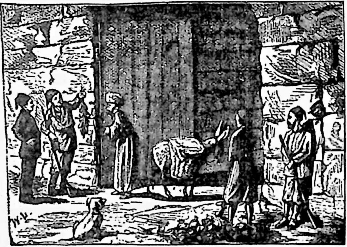
money-brokers, sitting on their benches, exchanging- the law-ful half-shekel for foreign coins of pilgrims; but there were no oxen and sheep present, nor even doves, as on the former occasion, as recorded by John, 2 : 15.
This fact marks the distinction between the two occasions.
The former purification and stern rebuke had therefore wrought some salutary results, and now Jesus again drives out the traffickers with equal reproof. He even went farther on this latter occasion, forbidding the servants and porters carrying ves-sels through the temple court which should have been car-ried around. “ They evidently were making a highway of the Court of the Gentiles.”—Geikie. The house of prayer should no longer be turned into a den of thieves.
"The chief priests and scribes," who doubtless had a pecu-niary interest in all this temple traffic, and who witnessed the expulsion of the traders and money-lenders, were very angry with Jesus, and would have “destroyed Him” on the spot, but for their fear of the multitude who believed on Him.
Having cleared the “Court of the Gentiles ” of the offensive traders and their customers, Jesus crossed the court toward the "Beautiful Gate,” which opened into the “Court of the Women " and the temple proper, where a most affecting scene met His sight Here lay a great number of impotent lame, and blind peo-ple, who were “ brought here daily, and laid at the door of the temple which is called Beautiful, to ask alms of the pil-grims and strangers who entered the temple.”—See Acts 3: 2-10.
These He healed, and passed in through the " Beautiful Gate ” into the " Court of the Women,” where He was accus-tomed to teach, probably sitting on the stairs leading up to the court of the men, sometimes called the “ Court of Is-rael.” The temple having been built upon the sloping hill, the western portion was a story—fifteen steps—higher than the eastern. .
" The day, which had begun with the symbolic cleansing of the temple, was devoted in its later hours to His wonted work trouga the V.i2‘ 6 . . (A. L. A.— A. F.0.- ....) • To be Arwod Ferrzs art i: ciant # ■• ■ 1 of teaching all who would listen, but none of this day’s dis-courses have been preserved,” and while the common people “ hung upon Him, listening" to His words of grace, the rulers dared not arrest Him, and thus ended the second day.—Luke 19: 47,48.
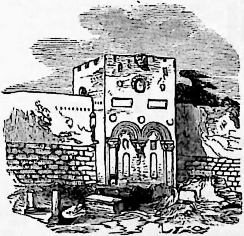
Chapter LIV
Third Day in the Temple
Time—Tuesday, April 4th, A. D. 30: Nisan 12; A. U. C. 783.
Master, exclaimed Pe-ter, as on the following morning Jesus and His disciples came out from Beth-any toward the city, past Bethphage, “ behold, the fig-tree that you cursed yesterday is withered up, root and branch."
References
Mark xx: 20-33-
Matt, ax: 33-46.
Luke 20: x-47. Luke ax : 1-5. John 12: 20-36.
John 12 : 44-50.
John xa: 36-43.
Matt., Chap, aa and 33.
Mark xa: x-44.
“ Have faith in God," Jesus replied. " Verily, I say unto you, whosoever shall say to this mountain (of Olives, where they stood), ‘Be thou taken up and cast into the sea,’ and shall not doubt in his heart, but shall believe that what he says shall come to pass, he shall have it." And as they proceeded. He added:
"And whenever you stand praying, ask in faith, forgiving, if you have aught against any one, that your Father also, which is in heaven, may forgive you."—Mark 11: 25 ; R. V. omits verse 26.
Reaching Jerusalem, Jesus at once entered the temple and resumed His teaching. (Luke says preaching the gospel.) Here He was honored by members of the Sanhedrin, who asked Him, directly and abruptly:
" By what authority do you these things, and who gave you the authority?" Healing and teaching in the temple, and

more especially interfering with their profits by driving out the brokers of yesterday, who seemingly dared not return to-day.
He answered them by a counter question:
" Was the baptism of John from heaven or from men?”
After an aside consultation among themselves, they returned and gave this false and evasive reply:
“ We do not know whence it was." By comparing John I:
6, 19, 28, it seems that they did know.
John had testified that Jesus was the expected Messiah, and they knew it, having sent a delegation to John to ascertain.
“ Neither will I tell you by what authority I do these things," said Jesus.
The rulers were silenced for the time being, and Jesus turned to the people (Luke) with a parable in illustration of the above.
While Mark and Luke place next in order the parable of the vineyard, Matthew records first a parable of the “ Two Sons ” (21: 28), which from its character, comparing Jew and Gentile, and its direct reference to the Baptist (v. 32), and afterwards (33) calling the parable of the vineyard " another parable," show conclusively that Matthew proceeds in order.
In the parable of the "Two Sons” Jesus became the Teacher and the great Sanhedrin the scholar, whom He put upon their catechism.
Relating the brief story of one son, who, when told to go and work in his father's vineyard, replied that he would not, but relented and went, and the other son, who said “ I go,” and did not, Jesus summed it up by asking the rulers:
” Which of the two did the will of his father?”
“ The first," the rulers, like school-boys, replied.
The remainder of the story is best understood by reading Matthew 31: 31, 32. It is very severe on the rulers, but well deserved.
They did not immediately retire, and Jesus said to them:
“ Hear another parable " (before you go).
Here Matthew, in common with Mark and Luke, relates the " Parable of the Vineyard.” It is taken from Isaiah 5:
1-7.
We here transcribe each for comparison.
ISAIAH 5.
t. My beloved hath a vineyard on a very fruitful bill. X And he fenced it, gathered out the stones, planted it with the choicest vines, digged a wine, press, and built a tower in the midst, and he looked for it to bring forth good grapes, but it brought forth wild grapes.
MARK 1 a.—MATTHEW 21: 33.
A man planted a vineyard, and set a hedge about it, and dug a pit for a wine-press, and built a tower (for the watchmen), and let it out to husband-men, and himself went into another country. At the harvest season he sent his servants to the husbandmen that he And now, O inhabitants of Jerum- ight receive from them of the fruits salem, and men of Judah, judge, I pray you, between me and my vine-yard. 4. What could I have done more for my vineyard that I have not done? . . . of his vineyard. And they took bis servants and beat them (Matt.), stoning one and killing another. Again he sent other servants, and to these they did in like manner. At last he cent 5. I will tell you what I will do to his only and well-beloved son, saying: my vineyard. I will take away the hedge thereof, . . . and break down the wall, and it shall be trodden under foot. 6. I will lay it waste: it shall not be pruned, nor digged, but there shall come up thorns and briers, “They will reverence my son."
But when those wicked husbandmen saw the son, they said among them-selves:
“ This is the heir! Come, let us kill him, and take his inheritance." So 7. “ For the vineyard of the Lord they took him, and cast him out of his of hosts is the HOUSE OF ISRAEL, and the men of Judah, his pleasant plant (the good vine planted, a), and He looked for judgment, but beheld op-pression; for righteousness, but behold a cry. For ye have eaten up the vine-yard, the spoil of the poor is in your houses (3: 14).
“Therefore the Lord will cut of from Israel head and tail, root and branch, in one day (9: 14).
“ For behold, the day cometh that shall bum as an oven . . . and it shall leave them neither root nor branch.”—Mal. 4: 1-5. father's vineyard and killed him!
“ Now," said Jesus, “ when therefore the Lord of the vineyard comes, what will he do unto those husbandmen ?‘ The Jews answer: “ He will miser-ably destroy those wicked husbandmen and let out the vineyard to others, who shall render the fruits in their season."
—Matthew and Mark.
Caught in the meshes of the interesting story, the listening, spell-bound Jews had given an honest verdict, while some among them, seeing the point illustrated, cried out fearfully:
“THIS IS THE HEIR.” 439 " Jehovah forbid!”—Luke 20: 16.
“ Have ye not read,” continued Jesus, “ ‘ The stone which the builders rejected (Ps. 118: 22), “ ‘ The same was made the head of the corner.' " .
The rulers of the Jews could not mistake the application of the parable and the scriptural references.
Plainly, Jehovah was the Lord of the vineyard—" the vine-yard ” was the House of Israel (Isaiah 5: 7) rescued from heathenism (2); the " hedge ” was God's protecting care ever round about it; the “ tower ” God's holy temple, whereon He had set His watchmen; the " husbandmen ” were Moses' suc-cessors ; " the harvest" the end of the age; " the servants ” were the prophets who had been sent from time to time to the Jews, and whom they had persecuted, stoned, and killed, and now Jesus stood as the " One, beloved Son and Heir," whom these wicked husbandmen, the Jewish rulers, were about to kill* “ Therefore I say unto you, the kingdom shall be taken from you and given to a nation bringing forth the fruits thereof."
Jesus had before told them "that many (Gentiles, Matt. 8: 5) shall come from the east and from the west, and shall sit with Abraham, Isaac, and Jacob in the kingdom of heaven, but the sons shall be cast into outer darkness. There shall be weeping and gnashing of teeth ”—a peculiar Jewish ex-pression of anger and hatred. They gnashed on Stephen for uttering this same truth.—Acts 7 : 54.
" Then the chief priests and Pharisees perceived that this parable was spoken of them."—Matt. 21: 45.
It also shows as plainly that Jesus, claiming to be the Messiah, understood that He should die through their machina-tions : .
“ This is the heir; come, let us kill Him.”—See John 11: 51.
He was the corner-stone, notwithstanding, and if they threw it down, it would crush them to powder in its fall.
Who, then, would become the children of this new kingdom ?
Gentiles, harlots, and publicans!—Matt 8: 5 ; 21: 31, 32.
But they must first put on the garments of holiness.
To this end Jesus related another parable called The Marriage of the King’s Son.
This is recorded only by Matt. 22: 1, and is not to be con-founded with that of Luke 14: 16-24 of the " great supper.”
While this parable of Matthew illustrates the point of Luke's parable, respecting the calling in the Gentile world and the outcasts of the Jews, its strongest point lies in the fact that these must come clothed in suitable garments for the new kingdom, fit for the King's presence.
We must not miss this point; therefore let us briefly para-phrase the parable:
"A king made a marriage-feast for his son, and sent out his servants, as was the custom, to tell those who had already been bidden that the (formerly unknown) time had arrived for the feast, but who would not come. Other (higher) servants were next sent out, instructed to say to the invited guests :
" Come, for the dinner is all ready. The oxen and fallings are cooked and everything awaits you. Come to the mar-riage-feast."
" But they made light of the matter, going their various ways, to their farms, their shops, and their merchandise, while the worst among them seized the king’s servants and shame-fully used them, even killing some of them.”
" When the king saw this he was wrathful, and sent his armies and destroyed those murderers, and burned up their city; for, said he, ‘ Those whom I bid are unworthy. Go therefore into the highways and bid every one whom you meet come to the wedding which is all ready.’ ”
Again the servants went out and obtained guests, good and evil, and brought them to the banqueting-hall : first directing them to adopt the special wedding garment, furnished free for every guest, for such was the custom at all weddings in the east. There was therefore no excuse for neglect in the matter of dress.
But when the king came in to see that every guest was pro-vided for, he discovered one slothful fellow sitting there in common, and, perhaps, filthy garments.
“ Friend,” said the king, " how is it that you sit here having on no wedding garment? " • “ The fellow was speechless;” he could offer no excuse.
So the king called his servants and said to them :
“ Take him, bind him, and cast him out into the outer darkness there shall be weeping and gnashing of teeth''
While the Jews would be swept away, their city destroyed, and their nationality blotted out, some of the Gentiles might be left out, because of utter neglect to put on the wedding garment.
Stung to madness by these parables, so truthfully put forth by the Master, the Pharisees retired for a short period, during which time they consulted with the Herodian party and the Sadducees, in an united effort to entangle Jesus in His talk. For one party He had already proven an overmatch. Let us see what the whole Jewish and Roman parties can do with Him !
First came the Herodians with much subtlety, backed up by a deputation from the Sanhedrin (Matt. 22 : 16), presenting what might at a glance seem a simple inquiry, but really full of peril to one less wise than the Master, whom they addressed.
“ Rabbi,” said the speaker of the party, with " deferential courtesy,” “ we know that you are true, and that you teach the way of God in truth, regardless of the opinions of men ; tell us, therefore, is it lawful or not to give tribute to Caesar ? What say you ? ”
There stood two opposing parties, eagerly waiting the perilous answer: perilous whether He answered yes or no. If “yes,” it would be in opposition to the Jewish nation, who strenuously opposed this hated Roman tax, which had caused more than one fierce and bloody insurrection, and no one presenting a Messianic claim would be tolerated for an hour who held that a free Jew ought to pay tribute to a heathen nation! If “ no ” should be His answer, behind these acute Herodians stood the Roman emissaries, ready to take Him into custody on the serious charge of treason! How could He escape this cunningly devised snare? Only by divine wisdom. '
" You hypocrites 1" He indignantly exclaimed, rather to the Pharisees who had devised the pitfall, “why do you tempt me ? Bring me a penny.” * To the brokers they went, as they would not carry the hated Roman coin on their person.
“ Whose image does it bear ? ” Jesus inquired, as the Phar-isee held up the penny to His view.
“ Caesar’s," was the prompt reply.
“ Whose superscription is this ? " He asked, the penny being reversed so as to show the opposite side.
“ Caesar’s," they again exclaimed. • “ Render therefore unto Caesar the things that are Caesar’s, and unto God the things that are God’s.”
He had avoided their artful snare by compelling them to render an equitable verdict on their own question.
“And when they heard it they marvelled greatly, and left Him.”
Next came the sceptical Sadducees, saying:
“ Master, we believe there is no resurrection, but Moses said (Deut. 25: 5), if a man die childless, his brother shall take the widow and raise up children unto his dead brother; this one died, and the next, and so on, until the seventh brother had married and died, leaving no children. After that the woman died also. * “ Now, in the resurrection, whose wife shall she be of the seven ? "
This was a very foolish question in consideration of their belief that man at death perished, soul and body.—Josephus,
W. 2: 8, 14.
But it is said to have been a question by which they had confounded the Pharisees, their opposites, and they were curi-ous to see in what way this new Teacher would dispose of it The answer of Jesus was the death-blow to the Sadducees’ cherished dogma—the non-resu rrection from the dead.
* Eight pence halfpenny, English.
TEMPTING JESUS
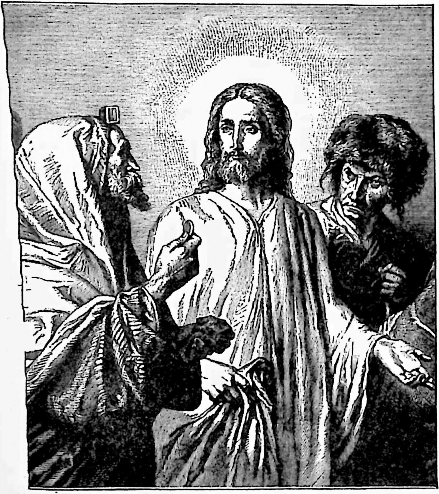
ATTACKS OF THE SADDUCEES AND PHARISEES. 44g " You are in error because you do not understand the scriptures."
First, that they are raised, “ Have you not read in the book that in the . . . bush, God spake to Moses, saying:
" * I am the God of Abraham, of Isaac, and of Jacob' ?
" He is not God of the dead Abraham, Isaac, and Jacob, but of the living."
Second, "And those who are accounted worthy to attain to that world, and the resurrection from the dead, neither marry nor are given in marriage, neither can they die any more, for they are equal to the angels, and are sons of God, being sons of the resurrection.”—Luke 20: 34-36.
After the chagrin of the Sadducees, the Pharisees came around Jesus, and one of them, a lawyer, asked Him a question:
“ Master, which is the greatest commandment in the law?”
Jesus answered: "Thou shalt love the Lord thy God with all thy heart, and soul and mind. The second is this:
“ ‘ Thou shalt love thy neighbor as thyself.’ On these two commandments hang the whole of the law and prophets."
“ Of a truth, Master," exchimed the lawyer, honestly, “ Thou hast well said; for to fulfil these two requirements is more acceptable to God than all burnt offerings and sacri-fices."
“ When Jesus saw that this lawyer had answered discreetly, He said to him, ‘Thou art not far from the kingdom of God.’ ”
If, according to Matthew (22: 35), this lawyer came to Jesus in the spirit of temptation, he went away a better and wiser man.
From that moment the Pharisees dare not ask Jesus any more questions, but He now assumed the aggressive. Said He:
“ What think you, whose son shall the Christ be ? " “ David's," they promptly answered.
“How, then, does David, in the spirit, call him‘Lord?’ thus:
“1 The Lord said unto my Lord, " Sit thou on my right hand, “ Till I make thine enemies thy footstool.’—Ps. I IO.
" If David called him Lord, how is he David's son ? ” or in other words, “ How could David call his son the Messiah ? ”
"There could be but one answer to this," says Farrar. " Because that son would be divine, David's son by human birth (else he could not be called David’s son), but David’s Lord by divine subsistence.’ "
If they had ever taken the trouble to search out Jesus’ genealogy (as Matthew has, chap, i), they ignored the facts that He was in the line of David, born in David's city, as Bethlehem was called, and probably in David's own house, for the khan and stable were Chimham’s house, presented him by David. It was on record in Jerusalem, according to law.
Had the Jews recognized this well-established fact they need not have “held up their hands in holy horror,” and taken up stones to stone Him. They here rejected the clew of faith which would have led them to the true explanation of His oft-repeated intimations and open assertions that He was the Son of God.—See Farrar, in loco.
Before Jesus left the " Court of the Men,” He turned to the disciples and the common people; with a warning against the rulers:
“ They sit in Moses’ seat, therefore you must obey them, But their examples you may not follow, for, They lay on men burdens grievous to be borne, While themselves will not lift a finger to help; They labor only for the praises of men.
And their prayers are offered only for effect; They walk in the market-places in long robes, And love to be greeted of men as ‘ Rabbi; ’ They strive for the chiefest places at the feast, And the highest seats in the synagogues;
They shut up the kingdom of heaven against you, And will not enter therein themselves;
They bring proselytes over sea and land, And make them sons worthy of Gehenna;
They tithe mint and anise for appearance sake, And rob widows and orphans of their houses; They are like the whited sepulchres, without, But within are filthiness and corruption.
Ye serpents! Ye offspring of vipers!
How can ye escape the judgment of hell " (Gehenna).* They could not; they did not!
“ Never," says Farrar, “ was any prophecy more closely, more terribly, more overwhelmingly fulfilled than Christ's." He told them of the very time it should occur: "All these things shall come upon this generation ” (Matt. 23: 36). It occurred in A. D. 69-70.
According to Josephus, the Jewish historian, "such scenes were enacted then as made the demons blush." He tells us of butcheries, treacheries, murders, and horrors unspeakably devilish. Jews were crucified in jest, some one way, and some another, until there was no room for more crosses, or crosses for carcasses. " Blood stood in lakes in the temple court, and flowed in rivers through the streets. Fires raged in mansion and palace, with only blood to quench them." Corpses lay piled one upon another, while carnage raged incessantly.
But the fulfilment of this last prophecy of Jesus, of their "judgment of hell," was most striking, for over that southern wall, and out of these bloody gates, were cast 600,000 Jewish carcasses, and burned in the never quenched fires of Gehenna I In that awful siege there perished 1,100,000 Israelites 1 Behold, your house—this temple—is left unto you desolate; for ye shall see me no more till you shall say, " Blessed is he who cometh in the name of the Lord.”
And so saying, He left the “ Court of the Men,” and descended the steps into the " Court of the Women.” This was that part of the temple where the treasury was located. Women could enter here, but could go no farther.—Josephus.
Sitting opposite the treasury, Jesus noticed those who came in and cast their “ free offerings ” into the boxes.
* Everything corrupt was buried or burned in the Valley Hinnom, or Ge-henna. The Jews created this hell, the Jews perished therein. He that diggeth a pit shall fall therein.
448 "COME FROM THE EAST AND THE WEST.”
While the rich came with ostentation and cast in their gold, and the common people came and penuriously cast in their silver, a poor widow woman—possibly well known to Jesus—came in and dropped into the opening in the wall, her living for the day, two copper bits.* The disciples were scattered about the temple, some near, others in the court of the heathen, outside the " Beautiful Gate."
Some of the former " He called ” to Him, saying: .
“ Verily I say unto you, This poor widow cast in more than all they who are casting into the treasury, for while they give of their superfluity, she has cast in her all, even all her liv-ing.”
The sight had touched the heart of the gentle Lord, and He openly commended her.
Then came to Him Philip and his brother Andrew, saying:
There are in the “ Court of the Gentiles ” certain Greek proselytes who have requested an interview with our Master.
—John 12 : 20.
None but Jews by birth were allowed inside the “ Beautiful Gate;" therefore if Jesus spoke to these Greeks—and He denied none!— He must have passed out into the “ Court of the Gentiles."
“ He therefore went out to them,” says Geikie, “ and they heard from His lips the counsels desired." They evidently desired to become His disciples.
You have come late—“And Jesus answered them, saying, ‘ The hour is near when the Son of man shall be glorified.’" The necessity of this purpose was graphically explained to them (John 12: 24, 25), after which Jesus said to them that, “ If they wished to serve Him, they must follow Him, and, in this life, or that to come, wherever He was, they should be also, and if they served Him, they should be honored (more than Jew) by His heavenly Father.”—26.
There need be no question that these Greeks, here intro-duced by Andrew and Philip, became Christ's disciples. Shall * It required twelve of them to equal a penny English. v we not look upon it as a fulfilment of that saying of His that “ They shall come from the East and from the WEST, and sit in the kingdom, while the Jews are left out? "—Matt. 8: 11. .
The Magi had come to Jesus from the great East—the Greeks had come to Him from the far West!
His work was done!
A short prayer was offered to God the Father, to which
GOLDEN RATE RESTORED
there came a heavenly response in the voice of thunder (29) scarcely comprehended by the mixed throng in the court, and while they discussed its bearings, Jesus, followed by the Twelve, retired across Solomon’s Porch, and, by the “ Golden Gate," went out of the Temple—
FOREVER,
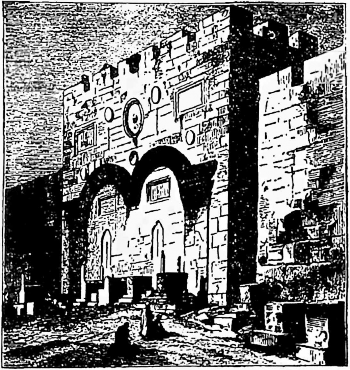
Chapter LV
The End of the Jewish Age
The Evenings Discourse to the Disciples.
TIME—Late Afternoon of Tuesday, April 4, A. D. 30. PLACE—Mount of Olives, Opposite Jerusalem.
Jesus and the Twelve passed out of the temple and down the long flight of steps toward the valley of Kidron, the latter, through their Referencen,
Matt. 34: 1-46.
Mark 13: 1-37.
Luke at: 5-36. John wrote after all these things were past, hence his silence. speaker, called the Saviour's attention to the strength and magnificence of the struc-tures behind them. " One of the disciples said unto Him," according to Mark—
” Master, behold what manner of stones, and what manner of buildings are these."
Very simple language in which to express their admiration of this grand structure, the pride of every Jewish heart!
Above them rose that royal pavilion called Solomon's Porch, with its long line of double columns of white marble each in one unbroken piece, twenty-five feet in height, set upon a base of solid granite, and above this the snowy walls of the temple, built of white stone, of immense size, “ thirty-seven and a half feet, by twelve feet, by eighteen feet,” and the structure a half mile (Roman) in circumference, crowned by a dome of burnished gold, some 600 feet in height (450) •

The whole structure, with the tower of Antonio on the north, was considered impregnable.
Jesus looked up at the magnificent pile.
Well may He have recalled the day, when He, in the bloom of youth, was permitted that coveted privilege of every true Israelite, of coming to his first Passover; when, from a bend in the Damascus road, this glorious structure, gleaming white in morning sunshine, burst fully upon his vision.
Alas! How had its glories since faded !
Well may tears of sorrow have dimmed His blessed eyes, as recalling all these things, in interim, He now turned His gaze through the mist, once again upon the " House of God."
“ Yes ”—He saw it all. He could not in His heart depre-ciate it.
“ But for a truth, I say unto you, the time cometh when there shall not be left one stone upon another that shall not be thrown down.”
And so saying, He proceeded in silence to the Mount of Olives.
Probably four only of the disciples took part in this conversation, the others having walked along towards Bethany.
Reaching the elevation of Olivet directly opposite the temple, Jesus sat down upon a grassy knoll, with the whole city being in full view below Him, and turned His face once again upon the imposing scene. He could not forget all the “ Glorious things that have been spoken of thee, O city of our God;" and even now, as Zion put on her beautiful garments in the golden sunlight of the declining day, she never was more glorious, in human eyes. Yet He must foreshadow her awful desolation.
Then came to Jesus those four disciples—"The four fishermen first called and first named in all the lists, the confidential disciples”—Peter, James, John, and Andrew, with great "pri-vacy,” to learn when the matter should come to pass of which 452 WHEN SHALL THESE THINGS BE?
He had spoken as they came out of the temple, viz., its destruction.
"Privately," because they feared the Jews might overhear them, to their own destruction, for was not this the charge brought against Jesus, “ He said that He would destroy the temple," and again, as He hung in agony on the cross, the Jews wagged their heads, saying: "Ah, thou who destroyest the temple! . . . Save thyself and come down from the cross.” .
"Tell us,” said Peter, " when shall ‘these things’ be, and what the sign when all these things shall be fulfilled ? ”—Mark, Luke.
Matthew records it thus: “ Tell us when shall these things be, and what the sign of Thy coming and the end of the world,” or, really, " the consummation of the age," the Jewish age.
John writing after all these things had past, did not men-tion them. This is important to remember, else we may con-found the simple question of the time of the destruction of the Jewish temple and the Jewish age, with a question not involved, viz., the destruction of our material world.
Of what did Jesus speak coming out from the temple ? The destruction of the temple.—Matt. 24: 1, 2.
Nothing more!
What then did the disciples’ question involve ?
A knowledge of the time and the sign foretelling the de-struction of the temple.—Mark 13:4; Luke 21: 7.
Historical facts taught these Hebrew disciples that the de-struction of the temple, as ever, involved the destruction of the Jewish age. In fact Jesus had but an hour previous to foretelling the destruction of the temple, denounced the Jew-ish nation, and foreshadowed their awful and immediate ter-mination. * That which Jesus had prophesied before going out of the temple applied only to the Jewish nation. This is past ques-tion, from His having fixed the time of its consummation, namely:
"All ‘ these things' shall come upon this generation.”
That His replies to the four on the slope of Olivet, at this time, related to that people and that “ age,” is as positive, from His having again fixed the time, thus:
" Verily I say unto you, this generation shall not pass away until all ‘these things' be accomplished.”—Mark 13: 30, R. V.
“ These things,” the same expression in all, questions and answers.
Says Canon Farrar: “ Immense difficulties have been found in this discourse, and long treatises have been written to re-move them.”
If with the inquiring “ four fishermen "we confine our re-searches to the matter in question, and make no attempt to distort it into a theological and denominational question, we shall avoid all those “ immense difficulties ” of the beloved and learned divine.
Andrews, in’his excellent record of the " Life of Our Lord," passes over the whole matter almost in silence.
Geikie says, among other good things, “ He, Jesus, con-fined Himself as usual to the practical, that He might rouse them to watchfulness over themselves, and remove the illu-sion that the holiness of Jerusalem would preserve it, and that the Messiah must first appear to deliver the nation from the hands of the Romans.” So far from this latter, He would show them that the banner of Rome, with the eagles thereon, hovering over the city, was “ the sign ” which they required of its approximating desolation and their redemption.
Hence their question resolved itself into three parts:
When shall the temple be destroyed?
What is the sign of your coming to do it ?
And what is the sign of the end of the Jewish age?
Was Jesus not the Messiah ? And should they expect any but Him and His armies to destry the Jews and their tem-ple ? Let the unbiased reader examine for himself every point of Christ's warnings and explanations to these four men, and decide for himself whether or not “all these things” have not already past .
“ Verily (equal to an oath) I say unto you, this gener-ation shall not pass away until all these things be accom-plished."
" The prominent reference in these verses," says Dr. Schaff, “is to the destruction of Jerusalem. Another fulfilment is probable, but precisely because the details are so minute, we must be cautious in applying it to the final catastrophe.”
(1) “When* you see Jerusalem compassed with armies, let them that are in Judea flee to the mountains " (Luke). (2) " Let him who is on the house not come down, nor enter in to take anything out of the house, and he who is in the fieid, let him not return (home) to take his cloak" (Mark). (3) "And pray that your flight be not in the winter, neither on the Sabbath."—Matt.
"Titus encircled the city with a wall five miles in extent, and fortified it with thirteen strong garrisons in the almost in-credibly short space of three days."—Josephus.
Thus we see the necessity of haste to get away.
The houses were flat and many streets bridged, so that one could “flee" from roof to roof, and thus escape. There was not even time to go into the house to obtain a coat.
If the flight was in winter, when travelling was bad, then the fugitive would be taken by the outposts. If on the Sab-bath, they who clung to rabbinical laws could go but the prescribed Sabbath day's journey of two thousand cubits, and would be taken. Swift flight was necessary to escape.
“ Of the day, or of the hour, the Son" (Jesus) did not know.
“Take heed, watch, for you do not know the time.”
If Jesus did not know the exact time, He could not impart it to His disciples; therefore they must watch for these many prominent signs of the coming of His power.
“ Behold the fig-tree and1 all the trees; when you see them shoot forth you know of your ownselves (simple as they were) that the summer is nigh. Even so, when you see these things * This took place, the compassing of the city by the Roman armies, early in October, A. D. 66.—Cambridge Bible.
WATCH 1 456 (of which I have told you) coming to pass, know you that the kingdom of God is nigh.”
" "Verily I say unto you, this generation shall not pass away till all these things are accomplished.”
** Heaven and earth shall sooner pass away than my words, which shall not pass away.”
‘ Watch, therefore, for you know not when the Lord of the house cometh," which of the four watches of the night, “at evening watch ” (until 9 P. M.), “or at midnight” (12), “or at cock-crowing” (3 A. M.), “or in the morning” (6 A. M.)
“And what I say to you, four disciples, I say to all, “ WATCH.”
“Watch! It Is the Master warns thee; Pray! it is His ear that hears;
Up ! shake off thy chilly fears, Mindful that whate’er befalls thee Leaves thee farther on thy way—
Watch and pray."
Chapter LVI
The Supper at Bethany
Time—Tuesday night, April 4, A. D. 30. Nizn 13.* PLACE—Simon's House, at Bethany. Place—. follow the order of Matthew
25 and Mark.
“haehs Geikie rightly follows this
References
Matt. 26 : 1-14-
Mark 14: x-10.
Luke aa: 1-6.
John xa: a-xx;
F2S.290 o9rd7er0.
While Jesus and His four dearest disciples lingered under Not in order. some friendly olive tree on the western brow of Mount Olivet, overlooking Jerusalem, the sun had declined behind Mount Zion, soft twilight had faded into night, the stars had come out one by one in the fair heavens,| and the silver moon, “ now rounded to fullness on her twelfth night," cast ghostly shadows along dark Gehenna’s valley, lighting up the royal palace of the Roman kings who dwelt on Zion's sacred hill, the lofty mansions in the city of David, and the snowy walls and gilded dome of the Temple on Mount Moriah, in a golden glory.
As Jesus arose and turned .away from all this magnificence, spread like a picture at His blessed feet, He said to the four disciples, Andrew, Peter, James and John—
“After two days, as you know, comes the Passover.
“Then the Son of man is to be delivered up to be crucified.”
And so saying, He proceeded to Bethany, to the house of one Simon, a former leper.
* With sunset began Nisan 13, the Jewish reckoning. t Olivet overtopped Zion by 100 feet, and Moriah 300 feet.
1 It was always fair at this season.
JESUS AND FOUR DISCIPLES
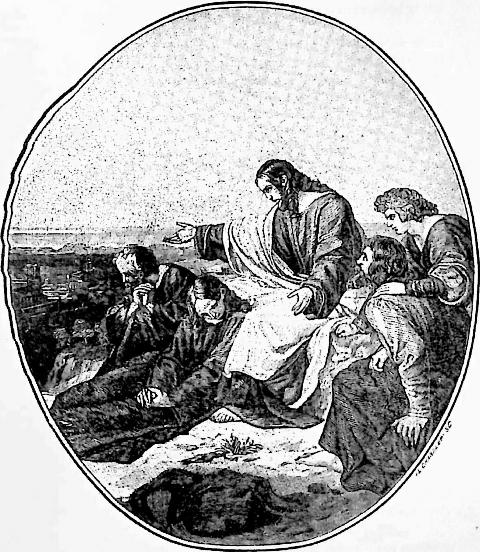
There Martha and Mary had prepared for Him (and the Twelve) a supper. Lazarus, whom He had raised from the dead, was there also, and was one of those who reclined at the table with Jesus.
Some have been led to believe that this supper took place “ six days before the passover," because John has said (12 : 1) that Jesus at this time came to Bethany; but there is no con-nection between the fact that Jesus came to Bethany six days before the passover and the supper. John does not say that the' supper then took place, whereas Matthew and Mark do connect the supper with the "two days ” before the passover, and also with the offence of Judas, and his betrayal to the council, which sat that very night in Jerusalem. We have before shown that this council sat this very night (Matt 26:
3), and that they decided not then to apprehend Jesus, lest there be a riot among the people (4, 5); but a few hours later, Judas having taken offence at the supper at Bethany (14) went out, and to the council, and offering to betray Jesus into their hands (1.5), they changed their minds and consented to have Him delivered at the first opportunity, or at the earliest con-venience of Judas (16).—Mark, ditto.
This order will be found conclusive as we proceed.
Jesus had announced His death, to take place after two days, as He proceeded with the four to Simon's house.
Who Simon was, or his relation to Lazarus, Martha, and Mary, is mere speculation. No one knows. Simon and Laz-arus sat, reclined rather, at the triclinium with the Master; Martha and Mary served the meal.—John 12:2.
While Jesus sat at the table, Mary came to Him bearing a flask of alabaster containing a delicate perfume—made from an oriental aromatic herb *—imported from Arabia or India (Smith). It doubtless was esteemed as a costly perfume, only within the means of the wealthy.—Cmb. Bible.
Mary broke the seal of this flask, and poured the contents upon the head of Jesus. John says " upon His feet, wiping them with the hair of her head.” This is doubtless an error Nardo ilachyi jotamanri. of the copyist, who, like some modern writers, confound this Mary with the " sinner " at Nain (Luke 7). We have already explained why that former woman at Nain anointed Jesus’ feet, viz., because she was so circumstanced that she could not enter the centre of the triclinium, and therefore could not reach His head, but approaching from “ behind ” (Luke 7 : 38) could only anoint His feet.
Mary of Bethany, being on familiar terms with her Lord, as repeatedly shown, and being one who made the supper and served at table, could well approach from before, and so did, and anointed Jesus’ head.* And the rich fragrance filled the house.
It was conferring honor upon her guest " It was a tribute worthy of a king."—Maclear.
Amid great commotion and expressions of wonder at the expensive luxury among the disciples, one of them arose even to indignation, and forgetting the dignity belonging to Christ's disciple, forgetting the respect due his Master, forgetting who he himself was—only a thief as yet, soon to become a traitor —he madly exclaimed:
" Why was this ointment wasted thus ? Why was it not sold for three hundred pence,! and the money given to the poor?”
“ Three hundred pence ” would be about forty-eight dollars.
Judas Iscariot objected to the waste I “The wretch who is just going to sell the Son of God for thirty pence (or thirty pieces of silver), values at three hundred pence a paltry bottle of perfume!"—Quesnel.
Judas said this not that he cared a penny for the poor, but because, as the treasurer of the little company of disciples, and being a thief, he would have been able to appropriate a large percentage of this coveted three hundred pence could he have once got it into his cash-box.—John 12:6.
Jesus knew this, yet His rebuke to the traitor-thief was not harsh:
Luke 7: 46. Il will be seen that such was an honored custom, See Gen. 18: 18. t A penny was a denarins—about 16 cents American.
44 Why trouble you the woman? She hath wrought a good work upon me. For in that she poured this ointment upon my body, she did it to prepare me for burial. The poor you have always with you, and whensoever you will you may do them good, but me you have not always." And as for this woman:
* Verily I say unto you, wheresoever this gospel shall be preached in the whole world, this also which this woman has done shall be spoken of for a memorial of her."
"While the lauded deeds and sounding titles of Egyptian kings and eastern potentates have long since been forgotten, the grateful act of this loving woman, Mary of Bethany, is known throughout the entire world, where it is preached in some two hundred and fifty languages, “ as a memorial of her."
Disappointment sat heavily upon the soul of the covetous Judas, “because that the kingly entry of Jesus into Jerusalem was not followed by immediate victory."—Plumptre.
For all of this truth some would place this supper and Judas' second disappointment at the loss of this money before that entry ! While Andrews places the supper four days ear-lier—and before the entry—he says (4: 22):
" It may readily be supposed that the severe language of the Lord had greatly enraged the rulers, who felt the necessity of taking immediate steps against Him. . . . Thus, it maybe, at the same hour when Jesus was foretelling that He should suffer at the passover (two days before it took place, Matt. 26: 2), His enemies were resolving that they would not arrest Him during the feast . . . Judas coming, then, offers to be-tray Him into their hands."
Now “ the severe language," referred to by Mr. Andrews, was certainly “ two days before the passover." 2. The con-vening of the council was certainly on the same night—“ two days before the passover ”—and, 3. The offence and offer of Judas was after the supperl How then does Mr. Andrews place the supper at Bethany six days before the passover (p. 399), and before the entry into Jerusalem, and Judas’ first disappointment; and, also, four days before the convening of the council, at which Judas came directly from that supper?
Where did they hold this meeting?
In the court-room of the palace of Caiaphas.—Matt, 26: 3. When did they hold this meeting ?
Two days—nights rather—before the passover.—26: 1.
By referring to John (12 : 9-11), we learn that many of the common Jews of Jerusalem came out to this supper to see Lazarus, who, risen from the dead, reclined at the table, quite as much as to see Jesus, who had raised him, while at the same hour the rulers (10) were holding the secret council, how they might kill Lazarus, with Jesus, because of the former many Jews believed on Jesus.
This meeting of the council was after Jesus had vanquished every faction of the Jews, on that very day, in the temple—according to Mr. Andrews.
How plainly Matthew (±6: 15) lays it out After Jesus had finished all these words, After two days more comes the Passover, Then were the chief priests and elders convened, 4 For the avowed purpose of destroying Jesus, 5. But dared not for fear of a riot among the people.
Then came Judas, and knocked at the door of the council-chamber. Being a southern Jew, he may have been known to Caiaphas, or the others (John 18: 15, 16), and he was at once admitted.
Unblushingly he proceeded to the business—
“ What will you give me if I deliver into your hands my Master, Jesus of Nazareth ? ”—Matt They did not know that the price was fixed by prophecy; nevertheless they niggardly offered the sum of “ thirty pieces of silver"—the price of a slave!
These pieces of silver were shekels, worth about 55 cents each, in all $16.50. This paltry sum had been set upon Jesus’ head for a long time, probably, but to this moment no one in all Judea had been found despicable enough to accept it, till at last came this Judas Iscariot and took the prize I Barely enough to buy him a rope with which to hang himself; not enough to furnish him a respectable funeral!
“And they were glad.”—Mark.
“And they weighed for Judas the money," on the spot It was very heavy! It weighed terribly on his soul as he re-crossed the Tyropean valley by a narrow foot-bridge; its weight increased as he stole through the dark valley of Ki-dron, up the mountain path, every tree and rock by the way-side a phantom of accusation to him, till he reached the little home in Bethany, where his betrayed Master was taking His last earthly repose. • Still its weight increased hour by hour, till he could bear it no longer, and he returned and threw it on the temple floor; and yet he could not get rid of its burden on his soul, so he went on again in the darkness—of the next night but one—and hanged himself over that dark valley, which, beginning there, terminates in Gehenna! udas sold what was not his own; the Jews bought what they might have had Free!

Chapter LVII
The Last Passover
Time—Thursday Evening, April 6; or Nisan 15, Beginning at 6 P. M., 14th. PLACE—Jerusalem, in the upper room of a house.
From Tuesday night, after the supper at Bethany, until Thursday afternoon, as above, we lose entire sight of the Lord.
That this time was passed in Bethany is generally admitted.
The Passover Supper
Referenees. Matt. 26: 17-35-
Mark 14: 12-31.
Luka aa: 7-38.
John 13: a.
Deut. 16: j, 6.
retirement at Peloubefs Harmony of Events of the Supper.
| Matt. Mark. Luke. John.
Preparation for the supper. a6: 17-19 14: 12-16 22: 7-13 ■ Christ and Twelve go to Jerusalem. 26: 20 Strife of Twelve for the first place. -----------------
Christ rebukes them—washes their feet.
14:17 23:-4 --------- 22: 24 -------
22: 24-30 13: 4-20 All take their places at supper. Announcement of the traitor, udas takes his departure, nstitution of the " Lord’s Supper.” The warning to Peter.
Christ promises the comforter. All rise from the table.
Christ utters His last discourse. Closing with a prayer, After singing a hymn, they all go out to Gethsemane. a6: 20------ --------- 22; 14-18 ---------------
26: 21-25 14: 18-21 22:21-23 13: 21-30 --------- 13:3b 32 26: 26-29 14: 22-25 22: 19, 20 -----------------
26: 30-35 14: 26-31 22: 3>-38 13: 33-38 --------- 14:1-31 --------- -------------- 14:31 - 15:1-16 --------- 17.
26:36 14:26-32 22:39 18:1 Having not the shadow of a doubt that Jesus would cele-brate with them this time-honored feast of the Jews, the disciples came to their Master on Thursday with the inquiry—(464)

“ WHERE shall we go—according to custom—and make ready, that you may eat the passover ? " Selecting Peter and John, He replied to them:
" Go into the city, and there shall meet you a man bearing a pitcher of water. Follow him, and wherever he enters, say to the good man of the house, ‘ The Master saith, where is my guest-chamber, where I shall eat the passover with my disci-ples ? ’ And he will show you a large upper room, furnished already. These make ready for us."
And they went as directed.
You will notice that it is called the “day of unleavened bread.” “All leaven was scrupulously removed at noon on the 14th Nisan."
The word “ passover ” commemorates the passing over of the destroying angel, amid the scourges of Egypt, passing only such houses as had the blood-stain on the door-post, without destroying their first-born within (Ex. 12:3,4). This feast commemorated that occasion.
It began with a great supper, consisting of a whole roasted lamb, bitter herbs, bread and wine. The Jews divided them-selves into companies of not less than ten or more than twenty, who were to consume the whole of one paschal lamb. For-merly it had been the custom to select the lamb on the 10th Nisan, but the changed circumstances of the nation had natu-rally justified a relaxation of this custom, until it might be t done at any time before 3 P. M. of the 13th. " It would have been simply impossible for the myriads of pilgrims to provide themselves with the paschal lamb so long beforehand."—Farrar.
It is probable that it required for this passover feast 250,000 lambs.* Whether it was a disciple or not who provided Jesus with the guest-chamber for this feast we know not. Universal hos-pitality prevailed, and every one who had a spare room boasted of its freedom to any who first came for it “ The only rec-ompense for its use was the skin of the lamb, and the earthen * Josephus' Wars, 6: 9, 3, says it required 256,000. oven in which the lamb was cooked, and the earthenware used at the meal."
Women were excluded from this supper.—Lightfoot.
Peter and John having secured the room, they had next to proceed to the sheep-pens at the north of the temple, and se-cure a lamb “ without spot or blemish," and be ready at the sound of the priest’s trumpet, by half-past two, to carry the lamb into the temple court to be slain (Ezra 6: 20). As all this slaughter had to be accomplished within about two hours (Ex. 12: 6), the priests deputed certain persons to assist Three blasts of the trumpet, followed by the Levites singing a psalm, announced the moment for the slaying to begin. The blood was caught in great silver basins, and poured out at the base of the altar, where it flowed into a trough, and so ran out into one of the numerous pools north of the temple. The carcasses were hung upon great iron hooks, cut open, skinned and dressed. The liver, kidneys, fat and tail were priestly perquisites; the whole body being wrapped in the skin, was taken away by the owners, and cooked whole in an earthen oven set in the earth.—Lightfoot The supper could commence at any hour after sunset.
As the hour drew near, Jesus bade farewell to the beloved friends at Bethany, and under the tender light of the first stars of the evening, took His ten remaining disciples and went into the city to the place appointed to eat the passover with the Twelve. He knew the place well, and there He and His * disciples often met, even after the resurrection.—Acts 1: 4It was an " upper room "—top story—u furnished ” with water-pots, table, and three reclining couches, and a lamp. It was also “ prepared,” that is, “ swept, the walls whitewashed, the floor scrubbed white, the furniture cleaned, and all things made to put on a new appearance."—Mills' British Jews.
The dusty sandals of the disciples were left .outside the door, and just within were the low water-pots for bathing purposes.
But immediately as they entered, and the disciples saw the smoking table, and the reclining couches placed on three sides of the -table, they began to dispute as to who should occupy the highest position, next their Master.
At the upper end of the room, and at that end of the table, would be the seat of the host and his two most honored friends or guests. The size of the table and couches would depend upon the number in the party. The centre .position, at the head, was always the host’s. Kings occupied this place at a feast, as is represented in the picture of Herod's feast At the supper Jesus occupied this position:
“ I am in the midst (middle) of you, as one who serves.” Unless there were servants the host served.
Here then we have the first position at this supper; that was necessarily occupied by Jesus. He would recline upon the left side, leaving the right arm free. John leaned upon His breast, hence John occupied the second place. James and John were brothers. Eight days before, Salome had taken these, her two sons, to Jesus, petitioning, that they might sit one on the right hand and the other on the left in the coming kingdom. The Jews believed that their position in the future world would be affected by their position in the present, and since John did occupy the place next to Jesus on the right, we infer that his brother occupied the next left, else Salome would - have asked for James' elevation here. For these reasons, and that they were brothers, inseparable, we assign James the third place at the table—at the left of and rather behind Jesus.
At the supper, Peter beckoned John, and whispered to him (24). John, leaning on Jesus’ breast, responded to Peter's call (25), therefore we must place Peter in front of John, and in the fourth position. Andrew, being Peter's brother, is next him. Judas was near enough to Jesus to receive the sop with-out rising (26), therefore Judas was behind Jesus, at the third couch, and in the sixth position. We can only place the others as they stand on the lists of Matthew and Mark. While aware that Judas is placed at the bottom of all the lists, we may suppose it is because of his character, whereas, he being the treasurer of the company, and being near enough to Jesus' person to receive the sop and hear His words with-

out the others hearing them, he must have been near to the Lord at the table. Hence the following table:
Philip and Judas might change positions, and still Jesus reach the sop to. Judas, but Judas in the position assigned here, might rise and go out (30) without disturbing the others.
It would seem that Simon Peter caused the dispute, for it is he whom Jesus rebukes for it:
“ Simon l Simon! behold Satan asked for you that he might sift you as wheat.” . . .
"And do you, when once you have turned again (R. V.) stablish thy brethren.” He then had disturbed the brethren! Lightfoot thinks Peter began the dispute with James and John.
After this rebuke to Simon, Jesus removed His outer gar-ment, and taking a towel, tucked it around His waist, while He poured out water from one of the jars, and began silently to wash the feet of John and James.
Coming to Peter, the latter refused to permit his beloved Master to perform the service of the meanest slave. The very act of girding His waist with a towel implied servility.
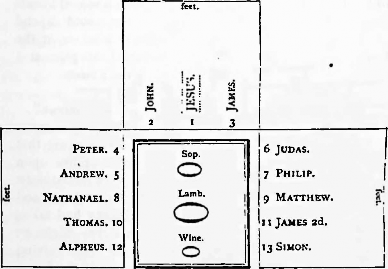
'* Lord, dost thou wash my feet ? ” Peter exclaimed.
•* What I do you do not now understand, but you shall hereafter,” Jesus replied.
“ Nay, Lord, you shall never stoop to wash my feet!"
“ If I do not wash your feet, Peter, you have no part with me.”
“ Lord," cried Peter, " if that be so, wash not only my feet, but my hands and my head I"
After completing the washing of the disciples’ feet, Jesus, reclining at the table, asked them:
“ Do you know what I have done to you ? ” “ No, Master," they answered.
“ You call me ‘ Master ’ and ' Lord.’ So I am. If I, then, your ‘ Lord ‘ and your ‘ Master,’ have washed your feet, you also ought to wash one another’s feet, for I have given you this as an example.” ... ‘ “A servant is not above his master," that he can betray him.
“ I know whom I have chosen, . . . and he who eatcth his bread with me hath lifted up his heel against me."—Ps. 41: 9.
“As they sat and did eat," Jesus twice intimated that one of the Twelve “was not clean” of guilt (11 and 18), still none, save Judas, understood His meaning. Then Jesus, in anguish of soul, made it plain to all by openly saying:
“ Verily, verily, one of you shall betray me.”
At this announcement consternation and sorrow seized upon every heart but that of the shameless Judas. Silence and dread fell upon them all. What, betray their Lord?
At last, Peter, unable longer to suffer the suspense, hoarsely whispered, in self-examination:
“ Is IT I ? "
He would distrust his own honest heart almost as soon as that of one of his companions.
’ Then another whispered:
“Is IT I?"
John, in silent sorrow, lay his head lovingly back on Jesus’ breast Peter, seeing this, and knowing their mutual love, said softly:
“Ask Him who it is."
Without moving, John whispered to the Lord:
“Lord, who is it? "
" It is he to whom I shall give a sop, when I have dipped it,” Jesus replied. Judas overheard this.
Then John arose, while Jesus dipped the bread in the dish of bitter herbs, vinegar, and spices before Him.
When He had so done He gave it to Judas.—John. " Is it I ? ” Judas exclaimed.
“ You have said rightly," Jesus replied. “ The Son of man indeed goeth, as it is written in prophecy, but woe to him by whom the Son of man is betrayed! Better were it for him had he never been born.”—Matthew.
“ What you have to do, do quickly.”
None (save John) knew the purport of these words, think-ing, as Judas arose and went darkly out, that he had gone to buy something further for the feast. The feast lasted seven days, and it was quite possible that Peter and John may have forgotten something essential. All this implies that Judas reclined near the head of the table, as do the words of Mark (14: 20): “It is one of the Twelve who dippeth with me in the dish.” Alexander says, “The expression seems to de-scribe the traitor as particularly near CWrist at the table.”—So Meyer; Andrews.
The gospels arc harmonized only by placing Judas at the table quite near to his Master.
Jesus had spared the traitor the shame of exposition before his honest companions, even to the last moment possible.
The error in the A. V. translation of John 13: 2, has led many to place the washing of feet and exposition of Judas after supper. The better translation places it in its proper place, “ after supper is ready,” the washing, and after sitting down and beginning the supper, the exposition of Judas.
By referring to the order of the supper, we shall see where Judas took his departure.
The supper begins with a blessing on the first glass of wine drank.
“A cup of red wine, mixed with water, was filled for every one, and drank after a touching benediction by the head man of the group " (Geikie), followed by hand-washing. The latter was traditional, and omitted by Jesus. It was be-cause of the neglect of this ceremony that the Pharisees took early offence at Jesus and the Twelve, at Capernaum.
Giving of thanks and partaking of the bitter dish.
This is when and where Judas received the bread sopped in the mixture of bitter herbs, spice, and vinegar.
After this (Matt. 26: 26; Mark 14: 22; John 13: 27, 30), when Judas had received the sop of bitter herbs, " came the unleavened bread and the lamb."
Benediction. "And Jesus took the bread (meat ?), and blessing it, break it (cut the meat?) and gave to the disciples," less Judas, gone out. " Take, eat," etc.—Matt.; Mark.
The second cup of wine is next prepared, blessed, and partaken.
"And He took a cup (of wine), and when He had given thanks, He gave to them, and they all (less Judas) drank of it.”—Matt.; Mark.
This institution having been abolished (Eph. 2: 15) when John wrote—after the destruction of Jerusalem and the tem-ple—he makes no mention of it, except as far as necessary to explain when, where, and how Judas took his departure at the commencement of partaking the "sop."—John 13: 30.
With the partaking of the second cup, it was the custom to explain the object of the passover. Here it was useless—made obsolete—and instead Jesus gave the discourse recorded by John, ch. 14 to 18.
Lastly-came the last cup * and the singing of the " hymn,” that is, the " Second part of the Hallel, Ps. 115-118," or “ Ps. 120-126," or both. More or less.
But before this last, and after the departure of Judas, Peter * Lightfoot, to whom we are indebted for much of the description of the pass-over custom, says, " Four cups were drank." makes his great boast of constancy to his Master, recorded by all the evangelists.
Jesus explained to them that He should be arrested, im-prisoned, and put to death (Luke), and that they all would be " offended ” and flee from Him. Peter then answered:
" Lord, wherever you go, I will go, even to prison and to death."—Luke; John.
“ Will you, Peter ? Verily, verily, I say unto you :
“The cock shall not cease crowing for day till you have thrice denied knowing me.”—Paraphrased.
But Peter still affirmed, " the more vehemently, if I die for it, I will not deny you, my Master.”
And so said all the others.—Mark.
And when they had sang a final hymn, they went out of the city into the garden of Gethsemane.
Matthew and Mark say “ Unto the Mount of Olives,” Geth-semane being at the beginning of the ascent to the mount.
For authority respecting continuation of a part of the feast service, that part termed “The Lord's Supper,” see I Cor. II: 20-34; Eph. 2 : 15-18.
Chapter LVIII
Gethsemane
Time—Midnight, April 6-7, A. D. 30, Nisan 15. PLACE—A garden on the western slope of Mount Olivet
Jesus and the Eleven left the
Beferences
John 18: x.
Matt. a6: 30.
Mark 14: 33.
chamber and passed through Luke 22 ’ ’ the narrow street, thronged by ----------- --------------thousands of people also going from supper. “ It was near midnight, but the full moon lighted them on their way."—Hanna. They would pass out of what is now known as St. Stephen’s Gate, down the steep bank to the dark Kidron —meaning black waters—now doubly dark from the blood of a thousand lambs, across the little foot-bridge, a short distance up the side of Olivet, and they were in the garden of Gethsemane.
The name implies “ oil-press." “ It was probably an en-closed olive-yard, containing a press, a tower, and perhaps a dwelling-house.”—Schaff.
Within the city’s wall no gardens were permitted, “ except a few gardens of roses which had been there since the days of the prophets, but there were many gardens about the foot of the Mount of Olives."
“ Eight olive-trees remain, all very old, but scarcely of the time of our Lord, since Titus, during the siege of Jerusalem, had all the trees of the district cut down.”—Dr. Schaff; Jo-sephus 5: 6, 2.
If the old olive-trees now remaining, “ their trunks fest de-raying,” are not the very same as eighteen hundred and more years ago witnessed Christ’s midnight agony, they still are " the most venerable of their kind on the face of the earth.”—Stanley. One in particular is singled out, of course without authenticity, as the very tree under which Jesus fell on His face and prayed (Matthew). Pilgrims come by the thousands to see it!
“And now, perchance, by thy old trunk is sitting Some outcast wand'rer of the Promised Land ;
Across whose mournful breast is dimly flitting Remembrance of the glorious and the grand.”
GARDEN OF GETHSEMANE—A CORRECT VIEW
This garden was an accustomed place of resort for Jesus and His disciples, and on arriving there, He took PETER, JAMES and JOHN, and going forward from the others a short distance said to them :
" Watch here while I pray, for my soul is exceeding sor-rowful even unto death.”
Going forward a little farther, He fell on the ground and prayed, " O, Father, if it be possible, let this cup (of death)
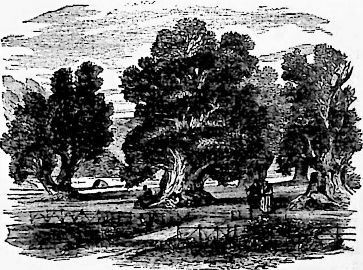
pass away from me; nevertheless, not as I will but as thou wilt”
Returning,. He found the three disciples asleep. " Simon Peter,” said He, “ could you not watch with me a single hour?"
Charging them to watch He retired, and so again the third time. Luke only mentions the bloody sweat and the angelic presence.
The last time Jesus re-turned, Peter could not so much as rouse himself to answer his Lord. Boastful Peter 1 “The spirit was willing, but the flesh was weak.”
“ Sleep on now,” said Jesus. “ It is too late to ‘ watch.’ ”
" The hour is come. Be- ■ hold! ” PETER, JAMES AND JOHN.
At that moment there was seen the glare of torches under the trees at the entrance of the garden, and the midnight stillness was broken by the sound of an approaching mob, consisting of Jews, Gentiles, and servants, armed with clubs, staves, and spears, led by the arch-traitor Judas.
“Arise," said Jesus to the Eleven, “ he who betrays me is at hand."
Yes, indeed, it was true. Judas had been to the council and obtained a captain * and a band of Roman soldiers, and know-ing well where Jesus would go after the supper, had led them out to this His favorite secret resort, to arrest Him. And all for the paltry sum of thirty bits of silver!
* Chiliarch—" captain of a thousand "—equal to lieutenant-colonel.
Jesus saw it all, and coming forward, He asked the captain —in presence of the high-priests and elders: “ Whom seek you ? " . .
"Jesus of Nazareth," was the reply.
" I am He. But do you come out as for a robber, with swords and staves?" demanded Jesus.
Overawed, the soldiers fell back, but Judas came familiarly forward, hailed his Master and kissed Him, for he had cove-nanted with the rulers that to whomsoever he gave a kiss would be Jesus. " Him hold fast,” said Judas, recalling some of his Master's wonderful escapes from His enemies in the past.
“ Betrayest thou the Son of man with a kiss ? " were Jesus’ last words to Judas.
Then the men came forward to bind Jesus, seeing which Peter, who had taken a sword along, rushed impetuously for-ward, saying:
” Lord, shall we smite them with the sword ? "
Before Jesus could answer, Peter made a dash at the nearest foe, and cleaved off his right ear. He was the high-priest’s servant, Malchus.
" Put up the sword, Peter, into its sheath; the cup which the Father hath given me, shall I not drink? " (John.) Luke, who informs us that Jesus at once repaired the mischief done by Peter, is the only writer who has mentioned the taking of the swords from the supper-room. As they were leaving at midnight, Jesus asked the disciples this question:
"When I sent you out (over Galilee) without purse and wallet (for food), lacked you anything on the way?”
" Nothing," they replied.—Luke 22 : 36, R. V.
“ But now,” said Jesus, “ take your purse and wallet, and he who has no sword, let him sell his cloak and buy one, for what is written of me must be fulfilled: ‘ and he was reckoned with transgressors.’ ” And the disciples said:
"See, Lord, we have two swords.”—Isa. 53 : 12. " It is enough," He answered.
Civilian Jews were not permitted by the Roman govern-ment to carry swords, hence the “transgression.” Two swords filled the bill.
Luke’s reference to prophecy may explain the reason for taking the two swords, but not the money-purses and the common Jewish basket—“scrip”—in which they 'carried bread.
They would soon be scattered: Judas, their treasurer, was gone, and Jesus, their Master, soon would be, when each dis-ciple must depend upon himself for support and protection until he reached his home. “ Without purse or scrip," he would become a common beggar; hence this forethought of the Master for their preservation until He be risen.—Matt 26: 32.
“ I guarded these,” Jesus said, while with them.
Further provision was made by Jesus for the safety of His disciples in His demand of the officers, that they " let the dis-ciples go," as recorded by John 18:8.
At this juncture Jesus was seized and bound. The cowards only dared commit this unlawful, midnight outrage when they found that Jesus would not let His servants fight for Him. Noble Jewish rulers I Noble Roman soldiers I Seeing their Master in the hands of His enemies, bound and resistless, the disciples turned and fled.—Ps. 88: 8.
The warrant was for the arrest of “ Jesus of Nazareth" only, and the disciples not finding themselves pursued, two of them at least turned back; and as their Master was being led away into the city, these two followed on at a safe distance behind. .
“And Peter followed afar off."—Luke.
Who the young man was with the linen cloth wrapped about him, and who escaped “ naked ” from the mob, is un-known. Perhaps it was Mark.—Mark 14: 51, 52.
Chapter LIX
Jesus Before the High-Priest
Time—Friday, April 7, between 1 and 5 A. M. PLACE—Jerusalem, Palace of Caiaphas,
Eeferenees
John 18: 12-27.
Matt. 26: 57-75-
the ‘band,’* and the ‘chief Mark 14:53-72. captain,’ and the ‘officers of Luke aa: 54-65the Jews1 f seized Jesus and ------------------------bound Him,' and led Him first to Annas, for he was father-in-law to Caiaphas, who was high-priest that year." Such is John's concise description of the seizure, " Jesus was brought into Jerusalem through the sheep-gate, for that was the way into town (not temple) from the Mount of Olives, and it was so called because the sheep appointed for sacrifice were brought that way to the temple. Very fitly, therefore, is Christ led in that way, who is the Lamb of God who takes away the sin of the world" (Henry).—See gate in eastern wall.
John was present and knew j'ust where Jesus was first led. That the synoptists omit the first move in the tragedy is nothing, since they learned their part from hearsay. John explains clearly enough to any scholar why Jesus was first led to Annas: “because he was father-in-law to the high-priest Caiaphas." Annas was the high-priest de jure, if not de facto.
—Geikie.
Cohort. t Temple captain and under officers, all a ■■ great multitude."—Mark. (478)

It was a mere matter of form, or compliment to Annas, who had formerly been high-priest during seven years. Caiaphas was young, scarcely thirty years of age, and was doubtless subject to the advice of his father, Annas. But it being well known to Annas that Caiaphas had already committed him-self to the destruction of Jesus, the former might well trust his precious son-in-law with the execution of his openly avowed and unjust policy. This was to put Jesus to death at all odds, innocent or guilty.—John 11:51 and 18: 14.
“ So Annas sent Him bound " (as He came) " to Caiaphas, the high-priest." Probably both occupied the same square of buildings. “As far as can be inferred from the various narratives, the palace in Jerusalem, conjointly occupied by Annas the real and Caia-phas the titular high-priest, seems to have been built round a square court, entered by an arched passage (called porch in the gospels), and on the farther side, up a short flight of steps, was the hall in which the council had met"—Farrar.
It was built on the hill-side, hence the court was said to be “ beneath,” rather below, where Peter sat to watch the trial.—Mark 14: 66, " beneath."
John’s expression that Jesus was led " first to Annas,” implies the second leading to his son-in-law, Caiaphas. There was no trial, nor could there be, before Annas. Thence He was “ led " to Caiaphas.
Luke tells us that they led Jesus into the high-priest's house; Matthew more explicitly says " to Caiaphas; ” Mark says “ to the high-priest, and there came together all the chief priests, elders, and scribes," which constituted the court of the Sanhedrin.
They were not a lawful court, however, in capital cases.
" Forty years before the temple was destroyed, judgment in capital cases was taken away from Israel, . . . which them-selves often confessed” (Lightfoot). Contra, see Josephus’ Antiquities, 14: 9, 3.
In the next place it was not lawful to hold court in the night-time (Ellicott). It was an informal and unlawful pro-ceeding throughout.
Within an apartment opening upon the court below, this mock tribunal convened to try the prisoner without a charge.
“ In imitation of the Sanhedrin, while it existed, these judges, before whom Jesus stood, sat, turbaned, on cushions in true oriental fashion, with unshod feet, in a semi-circle. Caiaphas as high-priest sat in the centre, . . . and a scribe at each end of the semi-circle to write down the evidence for or against the prisoner" (Abbott; Geikie). These faced the court without, and Jesus, standing facing them, was back to the court, where stood the officer and Peter—Malchus was an officer (John 18: 10 and 18). In order to see Peter “Jesus turned about."—Luke 22: 53-61.
This court was formed on three sides by the buildings, the fourth being bound by a wall, with a large gateway, in which was a wicker-gate for foot-passengers (Robinson). This was attended by one or more “ damsels “ maids of the high-priest" From the gate, a short way in, was a vestibule called “ the porch."—Matt. 26: 71; Mark 14: 68.
When Jesus was led into the court, a disciple, either John or Judas, following close, also gained admission; but Peter, being far behind, was left out, where he stood shivering in the chilly night air. The other disciple, being known to the gate-keeper, returned and got Peter admitted.
On the pavement of the court the servants had kindled a fire of charcoal, “for the night was cold” (John 18: 18). Peter made bold to go straight toward the fire, where the im-pertinent but sharp-eyed damsel detained him to inquire of him:
“Are you one of this man's disciples?”
“ No, I am not,” Peter shamelessly replied. Then he went and sat down amid the servants and soldiers at the fire.* *The difference in the reading of the A. V. and R. V., Mark 14: 54.
And Peter followed him afar off, even into the palate of the high-priest, and he sat with the tervaitit and wanned himself at the fire.
And Peter hnd followed him afar off, even within, into the tourt of the high-priest, and he was sitring with the efi-cert and warming himself in the light of the fire.
• About this time the trial commenced; and while “Peter warmed himself" he could watch the progress of the trial above, for, said he, “ I want to see how the matter will end."
- Matt. '
The trial opened by Caiaphas asking Jesus:
“Who are your disciples, what their number, and what is the object and character of your teachings ? "
Carefully avoiding any allusion to His disciples, “ lest it be brought up against them in the future," Jesus replied to the high-priest by arraigning him for asking of the prisoner, the accused, questions which belonged to the court to answer by its witnesses:
“ I have taught in your synagogues, I have spoken openly before the world, I have proclaimed in the temple before all the Jews: in secret have I said nothing: why then ask me what I have taught ? Ask these who have heard me."
Caiaphas, thus reminded of his open neglect of duty, was very angry at the prisoner, seeing which the petty officer standing by the bound and helpless accused, struck Him a blow, saying:
“Answerest thou the high-priest thus boldly ? ”
This dastardly act only delighted the noble high-priest, who offered no reprimand to the officer who committed it Jesus, however, said to him with calm dignity:
“ If I have spoken evil, be a witness against me; if well, why do you smite me ? ”
At this juncture is inserted the “ false witnesses,” sought for by the chief priests and council, as recorded by Matthew and Mark. These witnesses, two in number, disagreed in their statements, hence the desired point—that Jesus would destroy the temple—was not sustained. Caiaphas was brought to his “ wits-end.”
During a year and a half had the rulers been trying, through spies and other questionable means, to obtain evidence against “The detignation (in the latter) it employed to explain the circumstance that Peter was recognized in the light of the fire” (Lange). “The spring nights at Jerusalem, which it 2,610 feet above the level of the tea, are often chilly.”
Jesus whereby they might carry into execution their secret design of putting Him to death. In vain had they sought for a pretext to " kill Him," and now, even when one of His own disciples had betrayed Him into their hands, and they had hastily summoned an unlawful council, at an unlawful hour, they could bring no direct charge against Him, nor find a wit-ness by whom they might make out a charge worthy to be offered and sustained before Pilate, who only could order Christ's execution. Caiaphas was about to be beaten in every attempt, when he bethought himself of one more trick. Rising in his official wrath, he demanded of the silent prisoner:
“Answerest thou nothing to these witnesses or for thy-self? ”
Still Jesus remained silent. To speak before such a mock tribunal was useless, and “ He kept a dignified silence.”
The hours were passing; soon it would be “ first cock-crowing,” that is, three o’clock, and at this time of year, an hour later would be daylight, when, for aught Caiaphas knew, ten thousand Galileans and other disciples of Jesus might rally to the rescue. Something desperate must be done in order to get Jesus before Pilate with a reasonable hope of ob-taining his consent to the death of Jesus, before it was too late.
. Again the high-priest arose to the attack, and bending upon Jesus his severest look, he said in Aramaic:
" I adjure you, by the living God, that you tell us whether you are the Christ, the Son of God."
The exact words were, “Art thou the Malcha, Meschicha," the king, Messiah, “ the Son of the Blessed?”—Mark.
And Jesus answered:
“I AM ; and you shall see the Son of man sitting at the right hand of power and coming with the clouds of heaven."
—Mark.
Then the demon of passion got control of the late calm, dignified high-priest of Israel, and he clawed his long, bony fingers as into his heart at such “ blasphemy; ” he tore his
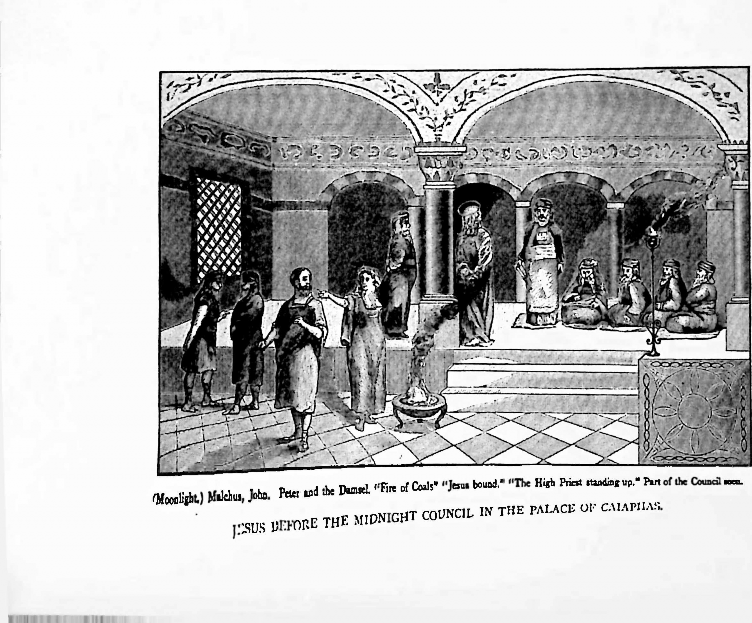

vesture open, as if to admit air into his too narrow chest, and thus working himself up to a quivering passion, he turned to His colleagues with the exclamation :
“ What further need have we of witnesses ? Did you not hear him blaspheme) What think you, all?"
“ He is worthy .of death," they all declared, rising one by one, and having their vote recorded by one of the end scribes.
After coming to this decision the council adjourned till six o’clock, when a final meeting would be holden before the full board of the Sanhedrin, in the council chamber near the tem-ple.
Condemned to all intents and purposes, Jesus was left in the care of the officers and guard during three tedious hours.
—Matt. 26: 67.
“There was nothing now to restrain the coarse natures to whom the condemned prisoner had been consigned. One con-demned was always, in these rough ages, the sport and mock-ery of his guards, and those in charge of Jesus . . . vented their cruelty on Him with the coarsest brutality. Their pas-sions intensified their bitterness, for they were fierce Jewish bigots.”—Geikie.
Yes, Jews! for who but a Jew would spit upon a helpless, bound, and deserted prisoner ?
May not these have been the Roman soldiers?
Not so. Sooner may we believe that the members of the council first offered this unwarrantable abuse to the prisoner.
—Mark 14: 65.
Spitting was a Jewish trick, expressive of contempt (Deut. 25: 9; Numbers 11 : 14). Some blindfolded Him, striking Him, saying:
“ Prophet of Nazareth, prophesy; who struck you ? "
Then the officers (R. V.) or “ servants," which is the same thing, received Jesus in charge, and continued striking and otherwise abusing Him, following the example of their supe-riors.
Now they turn their attention to Peter again, still sitting, or perhaps changing his position to standing, about the fire.—John.
The maid or " portress," either by herself or prompting one of the men (Mark; John), " again ” began to accuse Peter of being a friend to Jesus. Probably one .of the men was the speaker:
" You are one of His friends."—Luke.
“ Man," cried Peter, with an oath (Matt.), “ I am not.”
He relapsed into the old habit of Simon the fisherman.—Dr. Taylor.
After a short respite, Peter was again accused; this .time by a man, the females being silenced by the Galilean's rising anger and profanity, who said to Peter:
“ Certainly you are a friend of this man—” Peter here began to talk loudly—
"And,” adds the accuser, " your Galilean speech proves it”
" I swear —," cries Peter, more vehemently, " that I do not so much as know Him."—Matthew.
Peter’s last denial was the more loud and vehement, per-haps, because accused by a kinsman of Malchus, whose ear Peter had cut off in Gethsemane but a few hours previous.
“ Did I not see you in the garden ? "
Peter had hardly uttered his last denial when the sound of cock-crowing fell on his ear.
“And the Lord turned and looked upon Peter.”
“ Then Peter recalled the words of the Lord, ‘ Before the cock crow twice thou shalt deny me thrice.’
“And he went out and wept bitterly.”
There is a touching and beautiful tradition, true to the sin-cerity of his repentance, if not true as a historical fact, that during his lifetime the remembrance of this night's denial never left Peter, and that every morning he rose at cock-crow-ing, at the very hour in which the look of his Master had entered his soul, and went out to pray for his dear Lord's forgiveness.
The points of this narrative upon which the four evangelists agree are the principal ones relative to the words of Jesus to Peter and their literal fulfilment, that “ Before the cock crows twice you will deny me thrice."
Putting this fact upon record, as they did, at different periods, years and years afterward, it is not surprising, nor does it detract from the fact in illustration, that the minor details are somewhat ai seeming variance.

Chapter LX
Second Trial of Jesus
Time—Six A. M., Friday, April 7th. Nisan 15, A. D. 30. PLACE—Jerusalem, in the Council-chamber.
Then it was morning, Jesus was led, bound, from the palace of Caiaphas, across the Tyropean valley, into the council cham-
References
Matt. 27: x.
Mark 15: x.
Luke 22 : 66-71.
Isa. 53: 3.
ber of the Sanhedrin, in the immediate vicinity of the temple, where the whole council were convened. There, Matthew says, “All the chief priests and the elders of the people took council against Jesus to put Him to death.”
That is, the full board convened at a lawful hour, to ratify the informal decision of the night at Caiaphas' house. If, as Mark implies (14: 53), there was a full board at the former place, its action could not be final, since “ Capital cases were only handled by day.”—Lightfoot.
Salvador claims that Jesus was fairly tried and legally con-demned. But he was a Jew !
THE PLACE.—This trial (the second) was probably in the usual council-chamber, called Gazith, at the southwest corner of the temple.
There seems no evidence that the Sanhedrin offered any witnesses against Jesus at this second sitting, and whereas at the former they made no definite charge, they now presented one in the form of blasphemy, founded upon lawful evidence, and only arrived at by putting the prisoner himself upon His oath! For once they took Him at His word.

Therefore, Jesus was condemned by the Jews for being their Messiah ! There was not a dissenting voice I “ I know," says Peter, in after days, “ that you did it ignor-antly, as did your rulers ” (Acts 3: 17). They did not believe ■that Jesus was the Messiah. They will never see any other, for were it possible that another should come, " COULD HE DO MORE THAN THIS ONE? "
He had established His highest claims to the Jewish Mes-siahship, by fulfilling every prophecy of their own writers. These are too numerous to here mention. Not until He had fulfilled all these did He openly say,
" I AM HE."
Having fulfilled every indication of the Jewish prophets, what evidence did Jesus-offer, in His life acts, that He was their long-expected Messiah ? Here are a few:
The testimony of the Shepherds.—Luke 2 : II.
The testimony of the Wise Men.—Matt. 2 : 1, 2.
The testimony of the Baptist.—John 1 : 34.
The testimony of Nathanael.—John 1: 49.
The maniacs, repeatedly.—Matt. 8: 29.
The Twelve, on the Sea of Galilee.—Matt, 14: 33.
Peter, at Caesarea Philippi.—Mark 8: 29.
Martha, at Bethany.—John 11: 27.
Jesus, Himself, to the Samaritan woman.—John 4: 26.
Jesus, to the recovered blind man.—John 9: 27.
Jesus in the temple, " I am the Light."—John 8: 12.
To a great multitude, in the temple.—John 7: 41.
Chapter LXI
Jesus Before Pontius Pilate
Time—Morning of Friday. April 5, A. D, 30. Place—At the palace of Pontius Pilate.
Then the whole council rose and led Jesus from Caiaphas to Pilate."
Pontius Pilate, the Gov-ernor of Judea, had come up from Caesarea, on the Mediterranean, and
References
Matt. 27: a.
Mark 15: 1-15.
Luke 33: 1, 5-7.
John 18: 38,4a
Matt. 37: 11-26.
Luke 33: 13-25.
John 19: 4-16.
made his headquarters in the beautiful palace on Zion's Hill. This palace was built by Herod the Great, and was second only to the temple in size and magnifi-cence. “ It was constructed of a great variety of beautiful stones, while the height and adornments of the ‘ roofs ’ were a matter of astonishment," recorded by the pen of the great Jewish historian. He also says:
"Vessels, mostly of gold and silver, rich in chasing,shone on every side. The great dining-hall would supply table couches for three hundred guests. Other apartments opened in all directions, each with a different style of architecture. The open space before the palace was laid out in broad walks, planted with long avenues of different trees, and bordered by broad, deep canals, and great ponds, flowing with cool, clear water, and set off along the banks with innumerable works of art."—Josephus, Ant 20, 9, Wars.
This grand structure and grounds were enclosed by a wall of sufficient capacity to contain a large army, in case of a
rising of the Jews, and all under immediate protection of three great towers, Hippicus, Phasaelus, and Mariamne. These towers had been built forty years before by Herod the Great, which, with the palace, “ constituted one vast fortifica-tion." It was all destroyed a half-century later, only a por.tion of the first tower being left to mark the spot See “ David’s Tower," p. 52.
From his customary residence by the Great Sea, Pilate had arrived, with a cohort of soldiers, ready to quell any riot which might occur during this great annual feast, among his excitable and rebellious subjects. Quartering the soldiers in the tower of Antonio, at the northwest corner of the temple, Pilate, his wife and court-followers, took up their temporary abode in the palace of Herod.—See Josephus’ Wars, 2; 14, 8.
Now, for the first time probably, Jesus entered a king's pal-ace, where " dwell men in soft raiment"
It was early in the morning (John), when a loud alarm was sounded at the gate. Looking out, the governor beheld a great mob, headed by the high-priests, known by their robes of blue and breast-plates of precious stones, set in double rows, resplendent in the morning sunshine, followed by the whole Jewish council, and the temple officers, in the midst of which was seen one poor, humble man, his hands bound se-curely with thongs, and guarded by a " band of soldiers.” Jesus was " led," that is, with a rope about His neck, up to the palace, upon the grounds about it, but no farther would the righteous Jews proceed, lest they become defiled by the act of entering the residence of a heathen during passover week. At six o'clock began the preparation day for the Sabbath, a double day, being also Passover Sabbath, and “ at evening there would be a supplementary feast of priests and people, on the flesh of the free-will offerings." It had for centuries been associated with the passover, and was thought a part of it, and Levitical uncleanness would prevent the accusers of Jesus from taking part in it This makes the account of John (18: 28) clear, in which he says “ that the rulers would not enter the palace, that they might not be defiled, but might eat the passover." Some have been led to suppose that the passover was not yet begun. Furthermore, “ Upon each of the seven days of the feast was offered a sacrifice for the whole people " (Numbers 28: 19-24), hence John’s expression, " might eat the passover," must be taken on general terms, as covering the whole seven days’ ’ feast, as in Second Chronicles 30: 22, " They did eat the feast (passover) seven days."—McClellan, 486.
Oh, no! These righteous Jews would not enter a heathen residence, even though it be a palace, lest there be a piece of leavened bread therein of the size of the widow's mite; but they did clamor at the very door for the blood of an “ inno-cent man," even after Pilate, the judge, so declared Jesus. Such was the inconsistency of Jewish character I Therefore Pilate obligingly came out of his palace to ask: " What do you want at this unseasonable hour ? ”
With loud acclamations they presented their prisoner.
“What accusation do you bring against Him?" Pilate in-quired.
They were hardly prepared for this question. Their charge thus far was that Jesus had violated the ecclesiastical law as laid down by their law-giver, Moses, according to which Jesus had blasphemed by taking upon Himself the name, in part or whole, of their God, whom to Pilate, the Roman pagan, was no more than a wooden god of the Phoenicians! Therefore, to present this charge to Pilate, and ask that Jesus be con-demned thereon, would at least create a smile on the judicial face. So they parleyed, saying to Pilate's inquiry:
“ If this man, here bound, was not an evil-doer ”—of the worst dye, that means—" we should not have brought Him to you."—Alford. .
Pilate replie I to this, “ Take Him and judge Him according to your own law.”
" It is not lawful for us to put any man to death," the Jews replied.
Then Pilate began to see the malignancy of the men with whom he had to deal. It must not be supposed that he was the least ignorant of whom Jesus was, and of His teachings. Doubtless the governor’s jealous eye had been upon Him at the very first, and that he had never “ found anything against Him." * It is impossible that he should not have known even of Jesus’ harmless entry into Jerusalem on the humble beast of the Jews, and that while multitudes followed Him, it was only as a religious reformer, and not at all as a temporal as-pirant. He may, furthermore, have heard the disciples of this man hail Him as “King of the Jews" without the least alarm.
Up to this moment, Pilate had been standing without the palace, with Jesus near him, and His clamoring accusers be-yond. Now, calling Jesus, Pilate went with Him into the Pretorium.—John.
“Are you the king of these Jews ? " he inquired.
Respectfully Jesus asked, by way of clearing the way for His reply to the governor—" Do you ask this of yourself (own instigation), or did others tell it to you concerning me?" It was essential to know, says Geikie, whether Pilate spoke as a Roman, with a political use of the title " king." or repeated it in a Jewish sense, as equivalent to the " Messiah."
“Am I a Jew?" Pilate scornfully answered. "Your own nation and the chief-priests have delivered you to me. What have you done ? "
Then followed an explanation, by Jesus, of His position and the nature of His kingdom.
“ The effect of this conversation upon Pilate was very great. He saw at once that Jesus was no vulgar exciter of sedition, no ambitious demagogue, no fanatical zealot, and that the kingdom of which He avowed Himself to be the king was one of truth, and not of force."—Andrews.
“ My kingdom is therefore not of this world." “ You are a king, then ? ” said Pilate.
“ Thou sayest it—I am a king. To this end was I born, and I came into the world that I might bear witness to the truth. Every one who is of the truth hears my voice."
“Truth? What is the truth ?" Pilate ironically exclaimed, and so saying, he went out of the palace, into the presence of the Jews.
Doubtless in this conversation, so briefly related by John, Pilate had heard the true “ word ” from the lips of Jesus. It took hold on the heathen’s heart, and he desired to do the Lord justice, but the clamorous Jews would not let him. In the words of the parable (Luke 8: 12), he was one by the wayside who, having heard the, word, then cometh the devils and taketh it away from his heart, which believing he might have been saved.
With what contempt must Pilate have looked down on the envious, blood-thirsty rabble below him, as he said:
“ I find no fault in the man,” whom you have brought here.
This decided acquittal greatly excited the fury of the Jewish rulers,who, in turns, “accused Jesus of many things.” Jesus was by this time returned from the palace by the guard, and stood by the side of Pilate in full view of His accusers.
“ He perverteth the nation,” shrieked some.
"And forbid giving tribute to Caesar,” said others. " He calls himself ‘ Christ, a king,’ ” cried they all.
“And he stirreth up the people throughout all Judea, begin-ning again from Galilee to this city."—Luke.
“ Galilee ? ” said Pilate, catching at the word. " Is he then a Galilean ? ”
“ Yes,” they cried in chorus, “A Nazarene! ”
Pilate, with quick perception, saw his way out of the present dilemma, and at once said to the officers in charge of the prisoner—
" Take him to Herod Antipas, governor of Galilee, for he is of Herod's jurisdiction.”—Luke 23: 7.
The palace of the Asmoneans, in which Herod Antipas probably made his home while in Jerusalem,* was situated on the south side of the hill next north of Zion, and due west from the northwest corner of the temple, and on the west side of the Tyropean valley.
Therefore, Jesus was led down the broad avenue from Pi*Antiq. 20; 8, 11; also Geikie, 2: 540. late’s house, down the northern slope of Zion, through the narrow streets, closely followed by the band of soldiers, and the Sanhedrin, and, doubtless, by this time, the news of the arrest having spread, a curious rabble following in the rear, and so they arrived at Herod's residence.
When Herod knew who it was brought before him for ex-amination, “ He was exceedingly glad, for he was, of a long time, desirous to see Jesus, of whom he had heard such mar-vellous things.”—Luke.
“ So Pontius Pilate, governor of Judea, has sent you to me for adjudication?" and Herod was greatly flattered, for he and Pilate had been at enmity for a long period, because of the unwarranted slaughter of some Galileans by Pilate.* Now they were friends! Imbecile Herod I Pilate’s flattery had overreached him. Foolish Herod I Pilate only wanted to make a tool of him, in order to get rid of a disagreeable re-sponsibility. He dared not condemn an innocent man, as he was satisfied that Jesus was ; he dared not acquit Him before the clamorous Jews, recalling former refusals to comply with their demands, and the result, almost disastrous to his govern-ment, until at last he was compelled, after nearly a week's siege in his palace, to comply, Never before had the detestable character of Herod as-serted itself with more cowardly meanness than on this occa-sion.
He began questioning Jesus as to His life and teachings, ending this, part first, by requesting Him to perform some miracles for his edification. To his surprise, Jesus stood be-fore him in a dignified silence—the silence of contempt.—Luke, only.
“ What! not answer me, a ‘ king,’ one word ? Not perform for me, your ‘ sovereign,’ one clever legerdemain trick ? ” It was too galling to the would-be-king, after his vassal-king had sent him the prophet-juggler. • To be sure, the Jews stood without the palace shouting their various accusations against Jesus, but that amounted to t Antiq. of Josephus 30: 5, 3; Ewald 51 90, 91. nothing, since they offered no evidence against the accused.—Verses 10 and 15.
Still the great ruler must gratify his littleness of soul by making sport pf the defenceless prisoner. So he took Jesus within the palace, and, by his servants, arrayed Him in a long, purple robe, one of his own cast-off garments, and setting some sort of a crown on His head, he, in common with the soldiers, mockingly hailed Jesus as " King of the Jews."
Having gratified his grovelling tastes in mocking the de-fenceless prisoner, Herod returned Him to Pilate with the message: “ I find nothing condemnatory against Him."—Luke 23: 15.
Back through the hot and dusty streets they led the Son of man, like a beast, with a halter about His neck, still arrayed in the mock habiliments of a king, back into the palace of the governor.
Having read the verdict of Herod, and leaving Jesus in the pretorium, Pilate went out to the Jews, and sat down on a place called the pavement to pronounce the verdict Accord-ing to Roman law, consultation (Acts 25: 12) and examina-tion (10) were made in the pretorium, before the judgment-seat there, but verdicts must be rendered in the open air.—Bib. Encyclo., Kitto, art. " Gabbatha."
The Greek word here used is liihostratos, signifying stone-paved; denoting a pavement of ornamental stones. Taking this fact in connection with Josephus’ statement that this pal-ace was constructed (or ornamented) with stones of countless varieties, and that the " walls were constructed of white mar-ble ;" we may believe that this " pavement" was an ornamen-tal part, “ possibly a permanent erection, . . . projecting from the judgment-hall of the palace, and easily accessible by a doorway from it"—Geikie.
Necessarily Pilate “ sat" above the crowd in the yard, it being a maxim of the Roman law that all criminal trials should be held in a raised tribunal, that all might see and be seen.—Winer.
Here Pilate called the rulers of the Jews before him, and proceeded to sum up the verdict in the following words:
" You brought the prisoner before me accused of perverting the people (23 : 2). I have examined Him and found nothing against Him touching the things whereof you accused Him. Furthermore, I sent Him to Herod, who also having exam-ined Him, has sent Him back, finding nothing 'against Him worthy of death. I will therefore reprimand Him and let Him go.”
Why punish Him at all if innocent?
Pilate hoped thereby to conciliate the Jews.
Now there were among the Jews two customs of the feast week perfectly inconsistent with each other: one was to exe-cute some condemned criminal as a public warning, and the other to ask the release of some condemned criminal from the governor, perhaps as a mark of his leniency. Therefore Pi-late, on this ground, proposed to release Jesus. The rulers had anticipated him, however, by “stirring up the people” (now accumulated before the palace) to demand the release of one Bar-Abbas, a man lying in prison condemned of insurrec-tion in the city. Therefore they raised the cry:
“Away with Jesus, and release unto us Bar-Abbas.”
This fellow, the son of a rabbi, as the name indicates, was “a robber,” an insurrectionist, and “a murderer,” but the rulers of Israel preferred him to Jesus the Innocenti Now Pilate began to see of what stuff these Jews were made!
Again he spoke to them, asking that they release Jesus. It was at this point that they first raised the cry, “ Crucify, crucify Him! ”—Luke 23: 20-23. “A third time Pilate remonstrated ” (22).
“ Why, what evil has he done ? I have found no cause for putting Him to death. I will therefore chastise Him and re-lease Him.”
A wild tumult followed; amounting almost to an uprising of the whole multitude, headed by the fanatical priesthood.
In great perplexity Pilate re-entered the palace and, return-ing, brought out Jesus, still arrayed in the “ gorgeous ” robes . of Herod. Meek and lowly, exhausted by long stress of fatigue, faint from hunger, heartsick and deserted, He stood, bowed before them.
“Behold the man I ” said Pilate, touched by pity, heathen as he was.
“ Crucify. Him 1 Crucify Him ! ” roared the mob below.
From a chamber balcony Pilate’s wife overlooked the whole shameful proceeding. She heard the clamorous mob thirsting for the innocent man’s blood, and she saw her weak-kneed, vacillating husband sitting in judgment over a nation that he dared not offend by releasing a prisoner whom he knew was innocent, and " brought before him from very envy."—Matt. 27: 18.
In haste, for no time was to be lost, she sent a message to her already affrighted lord, saying:
"Have nothing to do with that righteous man ” (19).
Still rose the cry, on the increase, to crucify Jesus.
“ We have a law, and by that law He ought to die, because He made Himself the Son of God,” they cried.
This last expression increased Pilate’s alarm. Possibly this was the " Son of God! ” What if He should be ? Well might Pilate be “ the more afraid ” to kill Him.—John 19: 8, 9.
Again Pilate entered the palace with Jesus, and asked Him: “ Whence art thou ? ”
But Jesus answered Him not a word.
“ Will you not speak to me ? ” Pilate asked. “ Do you not know that I have power to release you, and power to crucify you, as the rabble outside demands ? " To this Jesus replied:
“You could not unless the power was conceded from heaven; therefore he who delivered me to you hath greater sin. 93 It must have been at this point that Pilate removed the mock-royal garments from Jesus, if at all.—John 19: 5, gar-ments on; Mark 15 : 17-20, Matt. 22 : 27, reclothe him.
Again Pilate returned to address the mob outside. His words were drowned in the increasing tumult “If you release this man you are no friend to Czsar;
CHILDREN OF JERUSALEM
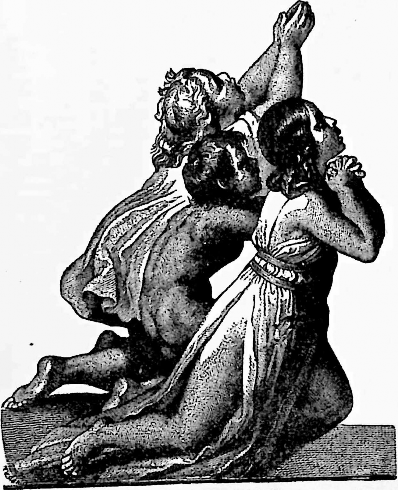
every one who makes himself a king (as He does) is a foe to Caesar."
Pilate heard this remark, which embodied a threat too well understood. It threatened his own head I Calling Jesus to his side, he said to the Jews:
“ Behold your king! "
"Away with Him! Crucify Him ! ” they shouted.
" Shall I crucify your king?" Pilate ironically asked. " We have no king but Caesar,” they replied.—John. Then Pilate called for a basin of water, saying:
" I wash my hands of this man's innocent blood.”
" Let; His blood be on us and our children," cried the Jews.
After Pilate had washed his hands, a custom known alike to Roman, Greek, and Jew, he consented unto the death of the man whom he had three times openly proclaimed as “ IN-NOCENT OF ANY WRONG.”
“ That the conduct of Pilate was highly criminal, cannot be denied. But his guilt was light (John 19: 11) in comparison of the criminal depravity of the Jews, especially the priests. His was the guilt of weakness and fear, theirs the guilt of settled and deliberate malice."—Kitto.
Josephus, who would not name Christ, has recorded two instances in which Pilate conducted in a bloodthirsty and tyrannical manner. In the latter (Wars, 2: 9, 2) he slaugh-tered many Jews in cold blood, for which deed he was called to Rome to answer. The emperor (Tiberius, A. D. 36) was dead when Pilate arrived in Rome, but his successor would not reinstate Pilate, who soon afterward, from disappointment and chagrin, committed suicide. Thus the tyrant ignobly perished.
NOTE.— The name of the wife of Pilate was Claudia Procula.—Tradition.


Chapter LXII
Before the Crucifixion
The End of Judas.
HE TIME of Judas’ death we place directly after the first condemnation of Jesus by the council.
Because Matthew places it after the con-demnation of Jesus. He was, to all intent, condemned by the first council.—Mark 14:
Because Judas, on going to return the money, found the rulers " in the sanctuary.”
The only time during that day, until very late, in which these busybodies could have been in the temple, was be-tween the two examinations of Jesus, viz., between 3 and 7 A. M. They probably had to go early to prepare for the morning sacrifice. It is said that the temple was open earlier during feast days than ordinarily. The city gates and gardens outside were open all night during the feast Early in the morning, John tells us, the council arose the second time, and led Jesus to Pilate.
Judas is not again referred to after the hour assigned to his death.
The first condemnation of his Lord, between midnight and cock-crowing, 3 A. M., convinced Judas that the fate of Jesus was sealed, and bitterly repenting of his treachery, he followed

the high-priest and elders to the temple, as soon as open, and gaining there an audience, he said:
“ I have sinned before heaven, in that I have betrayed the innocent blood of my Master."
“ What is that to us?" Little they cared, innocent or guilty. " See thou to that," and they scorned the traitor.
“And Judas threw down the thirty pieces of silver into the sanctuary* and departed." Such is Matthew’s brief account of this part of the transaction.
The next is even less satisfactory in detail.
“And he—Judas—went away and hanged himself."
Where? Not far. Just across the lower bridge of the Tyropean valley, down along the chasm to where it falls off steep and deep below, and there to a convenient tree he hung himself. There he swung and struggled under the condemn-ing eye of the moon above, all the terrible acts of his black life for an instant flitting through his brain, and Judas Iscariot was dead.
It is the beginning of passover. No Jew will touch a dead body during the feast, lest he become defiled and excluded from partaking of the daily feasts. The very tombs along the pilgrims’ routes have been white-washed days ago, that they may be conspicuous, for to walk over a grave would produce Levitical uncleanness. If a Jew saw the traitor swinging over the valley, either Tyropean or Hinnom, he would not touch the body to remove it. And there in the hot sun of middle April, .as hot as our July, the traitor’s carcass hung and swung, swelled and bloated, day after day, and night after night, in the moonlight, the owls and other birds of prey peck-ing at it, till turning to corruption, too rotten to longer hold together, it fell into the deep dark valley, and in due time, when the holiday was over, the scavenger came round and dragged it down to Gehenna, where all carcasses of beasts and criminals were cast, and there burned.
* Zech. II: la, 13. "And I took the thirty pieces of silver and cast them to the potter (field), in the house of the Lord. (14) Then I cut asunder my bands.” This locates the place where Judas cast the money, in the temple or “sanctuary.”
504 JUDAS’ “OWN PLACE."
Thus “ He went to his own place," Gehenna. The whole statement is perfectly natural:
He went away from the temple and hanged himself He fell headlong and burst asunder.
He went to his own place.—Zech. 11: 14; Acts 1:
25. .
The precipice over Hinnom is from forty to fifty feet in height, and very steep, with rocky bottom. Over this olive-trees grow, hanging over the edges of the rocks above, very tempting to one bent upon hanging himself.—See Hackett’s Illus. of Scrip., 266. ‘ His money, returned, purchased the “Potter's Field,” hence it is said that Judas purchased it He could not have done so in person, because the money was in the hands of the priests in the temple, who bought the field therewith, after due deliberation.
"And Pilate wishing to content the multitude, released unto them Barabbas, and delivered Jesus, when he had scourged Him, to be crucified" (Mark 15: 15, R. V.) This agrees with Matthew 27: 26; Luke 23: 24, 25 ; and John 19: 1-3. These three verses of John should have been placed after verse 16. Then the gospels would have harmonized per-fectly.
The scourge (whip, or, as sailors term it, “ cat-o'-nine-tails ") was made of several thongs of raw-hide fastened to a wooden handle.
Scourging was common under the Roman governors. Herod the Great resorted to it, according to the historian. Pilate ordered Jesus scourged; the chief captain, under Felix, was about to scourge Paul, when he learned that he was a Roman by birth and desisted. They had already tied Paul up with thongs (to a pillar), as was the custom.—Acts 22:
Jerome says that Jesus was bound to a pillar and scourged. It was probably done in a court of the palace.
While preparations were being made for the crucifixion, Jesus was left in the hands of the Roman soldiers, in the guard-room of the palace, who again robed Him in the scar-let gown, and plaiting a rude crown of thorn-twigs they placed it upon His head, mockingly crying:
" Hail, king of the Jews!"
A repetition of the scene at Herod’s residence.
Chapter LXIII
The Crucifixion
Time—Friday, April 7th, A. D. 30. A. U. C. 783. PLACE—Without the walls of Jerusalem, at the Northwest side.
RULERS, at the time—Tiberius Csar, emperor at Rome; Pontius Pilate, Pro-curator (Governor) of Judea; Herod Antipas, Procurator of Galilee, each subject to the Roman Government .
HEN the Roman soldiers had done mocking Jesus, they took off the royal robes, and putting on His own clothing, led Him
References
Matt. 27:31-50.
Mark 15: ao.
Luke 23 : 26-49
John 19: 17-30,
Acta 7: 52.
forth from Pilate’s mansion to the place of cru-cifixion. The route cannot be designated. The topography of Jerusalem has undergone great changes during nearly 2,000 years. If Roman London is only arrived at by digging sev-enteen feet downward, where is Roman Jerusalem, with the numerous sieges and demolitions which she has suffered? Valleys which, within her walls, were once forty feet deep, are now almost level, with long filling up.
Outside the western wall, near a public thoroughfare, that all might see and take warning, and upon a round hill sup-posed to resemble a 11 skull "—not a place of bones, for the holy Jews would not approach such during passover—was Calvary.
As the sad procession, swollen to a host by this time, passed out at the western gate, probably Jaffa Gate, Jesus and the two malefactors being led along, the former, bearing His own cross, now became so weak and exhausted from the long stress of mental and physical suffering as to fall under His too heavy

burden. At that moment a disciple, one Simon of Cyrene—now Tunis, in North Africa, colonized by Ptolemais, B. C. 350—was entering the city, when the captain seized him and compelled him to bear the cross up to the place of crucifixion. Jesus compels none to bear His cross; He asks none; He simply asks us to share His joys, now that “ His yoke is easy and His burden light"
In the “ great multitude" which followed Jesus " up to the place of crucifixion, were women and children, who bewailed and lamented Him." Some of these were from Galilee, and loved Him most tenderly; others were of this city, yet they knew Him but to love Him. To these latter, He turned to speak—
“ O, Daughters of Jerusalem I weep not for me, but weep for yourself, and these, your children (28), for behold, the days are coming in which they shall say, ‘ Blessed are the barren, and the breasts that never gave suck.’ Then shall they call to the mountains, * fall on us,’ and to the hills ‘ cover us.' For if these do these things in the green tree, what shall be done in the dry ? ” “ If such deeds of darkness were possible now, what should be done when the tree was withered and blasted and ready for the burning? Many of them and the majority of their children, would live to see such rivers of bloodshed, such complications of agony, as the world had never before known.”
Arriving at the place, the crosses were laid on the ground, and the cross-beams spiked to the upright posts, while the holes were being dug. The cross was no fanciful piece of workmanship, wound with garlands, and wreathed with flow-ers, as is usually pictured in modern times, but two rough pieces of timber knocked together in the roughest practicable manner, nine feet high, with cross-beam of six to seven feet. Crucifixion being a common punishment in the East, and even with the Remans, it is clear that they would waste no time or means in constructing the instrument of torture (Farrar). Everything being ready, the victim was stripped of all his clothes and he laid upon the cross, his arms stretched on the beam and great iron spikes driven through the palms of the hands into the beam; a block was usually nailed under the feet for a rest, lest the hands tear away, and sometimes the arms were bound to the beam with a rope. Then the cross was raised and dropped into the socket in the ground, and filled round with a few stones. There was no need of nailing the feet to the block ; to nail them to the upright post would be next to impossible, except they were nailed through the ankles. Let any man try the experiment of placing his feet against an upright post, and see where his knees will be in so doing. It does very well in a picture, but fails in the experi-ment Beside, if Jesus' feet had been nailed to the cross, He could not have walked to Emmaus three days afterward. We shall refer to this hereafter.
“The crucified person was not raised high in air, his feet being but a little above the ground " (Dr. Abbott). Over the crucified one was placed the “ title " of his crime, and for what was Jesus crucified ? Let the " title ” answer—
"This is Jesus of Nazareth, King of the Jews.”
“Many of the Jews read this inscription," adds John, “for the place where Jesus was crucified was nigh to the city, and it was written in Hebrew, Latin, and Greek,” that all nations might read and know whereof Jesus had been crucified !
" No, no," cried the chief priests, hastening back to Pilate.
“ Do not write ‘ HE is THE KING OF THE JEWS,' but that He said ‘ I am the king of the Jews.’ "
For once Pilate had a mind of his own, and he replied to the fastidious rulers:
" What I have written I have written." So it shall stand.
And now began the agony of the cross, “A punishment the very name of which should never come near the eyes, the ears, or the thoughts of a Roman citizen, far less his person.”
—Cicero.
Crucifixion was a relic of barbarism, brought from the utmost antiquity. It is traced from Medes to Persians, to Egyptians, Macedonians, Hebrews, Greeks, and Romans. Originally the “ punishment of slaves," kings eventually fell — —==== DESCENT FROM THE CROSS (Xaiieni).
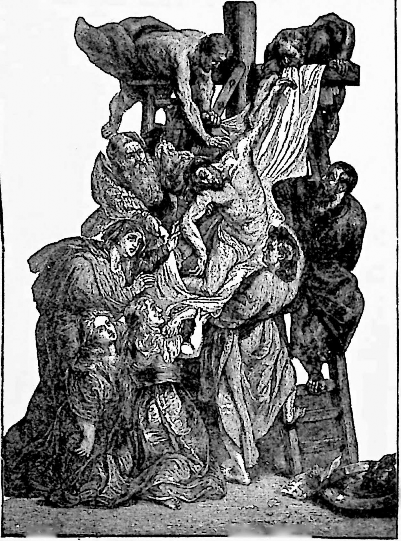
its victim. Three hundred Babylonian citizens were crucified by Darius, about B. C. 500. Valerius M. makes it the com-mon military punishment of the Carthaginians. These were tied to the cross, and there watched and left to die of starva-tion and thirst. After the capture of Tyre, Alexander, exas-perated at the brave Tyreans for holding him in defiance during seven long months, crucified two thousand of her most exalted citizens (B. C. 332). Crassus (B. C. 70) lined the highway from Capua to Rome, over forty miles, with crucified slaves, while Augustus capped the climax by crucifying six thousand at once in Sicily.
The Jews began imitating their heathen neighbors in this, as in a thousand other matters, social, educational, political, and religious, by hanging dead bodies of criminals to trees, but as they grew lower and lower as a nation, the priestcraft leading the van, they could encourage this barbarous cruelty by crucifying even an innocent man alive.
The sufferings of crucifixion are beyond description. Jose-phus states that of three Jews for whom he obtained release from the cross after a few hours’ suffering, but one survived the shock. La Condamine mentions a woman who had for Jansenist fanaticism been crucified three times, and released after three hours on the cross by nailing the hands, and yet recovered the third time. This woman testified to having suf-fered the most in the act of withdrawing the spikes from her hands. As-Suj’unte, an Arabic writer, mentions the crucifixion of a young Turk at Damascus, A. D. 1247, whose hands and feet were nailed to the cross. He complained of intense thirst on the first day, and his sufferings were greatly increased by seeing water continually before him, he being hung on the bank of the river Barada. He was crucified on the same day and hour of the day of Jesus, viz., Friday, at about noon. He survived until Saturday noon, expiring in great agony.—Kitto.
The duration of suffering depends therefore on physical endurance.
Jesus was raised on the cross with a robber on each side of Him, in derision of His pretensions to being a king, with whom it was the custom to have His best friends near Him, " one on the right hand and one oft the left.” “ He took His share in their disgrace when He was crucified with them."—Rev. Philip Brooks, of Boston.
Jesus' first words from the cross were:
" Father, forgive them, for they know not what they’ do."
Then one of the soldiers offered Him wine and myrrh (Mark), which He declined to drink. It is supposed to have been a stupefying mixture. Matthew places this offer of drink before the nailing to the cross, which gives coloring to the statement that it was an opiate.—Godet; Alexander; Plumptre, THE HOUR of crucifixion has been decided, from all ac-counts, to have been completed about midday. All could not have been accomplished much before that hour. The following are the various accounts of time:
' Matthew mentions its completion at the sixth hour. Mark, “ It was the third hour, and they crucified Him." Luke says it was “ about the sixth hour ” (as Matt.)
John says, before leaving Pilate's house, “ It was about the sixth hour."
THE NATURAL. DAY BEGAN AT 6 A. M. Then Jesus was led before the Sanhedrin. Now follow out all that He went through till the cross was erected, and you will find that it must have been midday when Jesus was crucified. If any reading (Mark) disagrees with the facts, let us say it is an error, either in judgment of the writer or the copyist At about midday, then, the soldiers having completed their ghostly work, sat down for the triple purpose of, t, watching the victims; 2, of eating their midday meal; and 3, of divid-ing the spoils, the garments of the crucified.
There was left a guard of four soldiers, under a centurion, who stood over opposite the cross, watching the sufferers. The clothing of the crucified was the soldiers' perquisites. John mentions the fact of there being four articles divided among the four soldiers (v. 23). In lieu of smoking, the modern pastime of the vicious, these soldiers were drinking the cheap sour wine of the country, called vinegar, with their dry bread, and gambling.
So they made, first, four parts of the Lord's garments.
1st. THE SANDALS; 2d. THE HOOD; 3d. THE BROAD GIRDLE; 4th. THE CLOAK.
Having gambled for these, "shaking their dice in a helmet," perhaps, they came to the last article, His vesture (Gr. tunic), woven seamless throughout.—John, " Let us not cut it into quarters," said the soldiers, " but cast lots for it, whose it shall be whole."
And they did so.
Taking a retrospect of this scene, John sees therein a re-markable fulfilment of prophecy, as recorded in Psalm 22: 18:
“ They parted my garments among them, “And for my vesture they cast their lots."
Thus for the first time, in the reading and study of the gos-pels, do we arrive at any description of the wearing apparel of our Lord.
Who Stood About the Cross.
FIRST.—"The chief priests, scribes, and elders,” saying in Hebrew:
“ He saved others, why don’t He save Himself? If He is the ’King of Israel,’ let Him now come down from the cross, and we will believe on Him.” And much more said these men of " gray-haired dignity and lofty reputation.”—Matt. 27: 41.
SECOND.—The common people, who, travelling in and out, wagged their heads, saying in Aramaic:
" You who destroy our temple and rebuildest it in three days, save yourself if you are the Son of God, and come down from the cross ” (40).
THIRD.—Then the Roman soldiers, seeing but not hearing the derisive language of their betters (?), took example, and saying in Latin:
" REX JUDORUM ! Here is to your good health,” and they offered Him a portion of their sour wine in mockery.—Luke 23: 36.
FOURTH.—In sad contrast there stood at a distance, for de-cency’s sake, a group of sorrowing, weeping women, consist-ing of " Mary the mother of Jesus, Mary the wife of Cleopas, Mary Magdalene,” and, perhaps, Salome, and Mary, and Martha, and others, with the beloved disciple John in their midst.
Seeing them, Jesus, forgetful of His own sufferings, turned to them and said, in Aramaic, first to His mother:
" Woman, behold your son ; " then to John:
“ John, behold your mother."
This was said in future provision for His mother, and John so understanding it says, “And from that hour I took her to my own house.”
LASTLY, we note the two robbers hanging with Jesus.
We have given the reason for these two being placed here —“ one on the right hand and one on the left " of Jesus—viz., for His ridicule. Not “ that the scriptures might be fulfilled, which says, ‘And He was numbered with the transgressors'" (Mark 15: 28), before applied to taking the two swords. Professor Schaff says, “Verse 28 is omitted by the oldest manuscripts, and rejected by the latest critics."
These two robbers also reviled Him (Mark). One, seeing Jesus’ sufferings equalling his own, said to the other: “ Do you not fear God, seeing that you are justly condemned, whereas this man is innocent? " Then to Jesus he cried:
“ Lord, remember me when thou comest in thy kingdom."
Was not this the first man to understand that Christ's king-dom was not of this age ? ■ The answer of Jesus was that he should be with Him in paradise that day. “ Paradise is a word signifying ′ beautiful land,' borrowed, by the Jews, from Persia; a waiting-place for saints till the final judgment, according to Jewish popular belief."—Abbott.
Jesus spoke to men as they could understand. His reply to this sufferer was in the popular' language of the day. It was no time to enter into explanation of facts, which would only have bewildered the poor man’s mind, and increased his physical sufferings. As it was, the repentant man was assured of salvation.
Now darkness began to gather over the land: the sun was pallid, the earth quaked, casting up the dead hid in her breast; fear came upon all people, and amid the awful chaos and gloom the temple was shaken, and the veil rent in twain. That vast piece of embroidery, of purple and gold, thirty feet by sixty, with its awful pretensions, tore asunder and fell to the earth.
At this perilous hour the "Son of David," in His terrible anguish, repeating His father's words in a loud voice, cried:
" My God, my God! Why hast thou forsaken me ?"* Couple this cry with His next words, " I thirst," and we may possibly faintly comprehend the “ extraordinary physical sufferings of Jesus (especially) indicated in the phrase, ‘ why hast thou forsaken me.’ ”—Dr. Robinson—S. S. Times.
In answer to the cry, “ I thirst,” one of the pagan guard filled a sponge with the sour wine which was left of his own lunch, and raised it on a rod to the parched lips of the suf-ferer. This was not the myrrh mixture before mentioned, but the common sour wine of the country.
Having drank the wine, Jesus again cried in agony and died. It was three o’clock in the afternoon when He expired. ’
* Aramaic or Syro-Chaldaic tongue, “ Eloi, Eloi, lama sabachthani.’—Pa. 22: 1.
Chapter LXIV
The Entombment
Time—Friday, P. M., from 3 to 6 o'clock, April 7, A. D. 30. PLACE—A Tomb in a Garden near the Western Wall of Jerusalem.
Truly this man was the Son of God."
Such was the testimony of
Weferences
Matt. 37: 57-61.
Mark 15: 43-47.
Luke 33: 50-56.
John 19: 31-42.
Acts 2: 33-33.
an eye-witness to the sufferings and death of 'Christ, and that witness a heathen.
With the appalling darkness and the terror of the earthquake, “ the multitude” in general fled back to the city, crying and smiting their breasts (Luke 23: 48), while the friends of Jesus, who had not all forsaken Him, with the brave and constant women from Galilee, stood afar off, witnessing all these marvellous scenes.
Now night drew on apace. Soon it would be the Sabbath; and while the Romans cared nothing for the Jewish sacred day, and were accustomed to allow bodies to hang on the cross until consumed by birds and beasts of prey, or decom-position, the righteous Jews could not think of permitting three corpses to remain thus exposed so near the holy city on the Sabbath! Beside, their law explicitly stated that the body should not hang on the tree over night, but should be buried the same day.—Deut 21: 23.
" The Jews, therefore, because it was the preparation, that the bodies should not remain on the cross upon the (516)

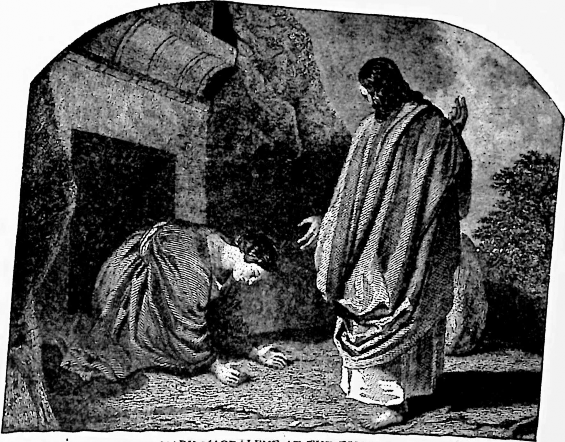
Sabbath, for this day of the Sabbath was a high day, asked of Pilate, that their legs be broken and the corpses taken away.’
It seemed plainly understood that breaking the legs was a common mode of hastening death, and " one in keeping with Roman brutality.” The shock, added to their present suffer-ing, was deemed sufficient to produce speedy death.
Pilate readily consented.
“ The soldiers therefore came and broke the legs of the two malefactors; but when they came to Jesus they saw that He was already dead, and they did not break His legs, but. one of the soldiers with a spear pierced His side, and imme-diately there came out blood and water.” John, the faithful disciple, stood by and witnessed these several acts.—John 19:
31-35.
John intends to prove in his naming the character of the effusion from Jesus’ side, that He was actually dead. The wound was not of the chest, piercing the pericardium; the ribs protected that, and “ not a bone of Him was to be broken."
While the Jewish rulers would not touch these bodies with their own hands, lest they be defiled and could no more par-take of the passover, they supposed that the Roman soldiers, past defilement, would take them and cast them into the Val-ley Hinnom—called the "Valley of Corpses," where the bodies of all criminals were burned with the carcasses of beasts and the offal of the temple and city. It was the law that such should be cast without the city, and no criminal, or " sinner," could be buried in the consecrated grounds of the righteous.
There need be no doubt, therefore, that the two criminals who were crucified with Jesus were cast at once into Gehenna (the Valley of Hinnom), and speedily consumed {cremated); and the body of Jesus would have suffered the same igno-miny, but that it was by heaven otherwise ordered. For David said concerning Him: "Thou wilt not leave my soul in Hades. Neither wilt thou suffer thy Holy One to see corruption.” The servants of the Lord were there to see that the body of Jesus was properly entombed.
As soon as Jesus was known to be dead, Joseph of Arimathea,* “ a councillor of honorable estate,” a member of the Sanhedrin, but one who had not consented to the murder of Jesus, took the centurion and hastened to Pilate, asking for the body of the Lord Jesus.
“ Is He dead so soon ? " Pilate exclaimed, “ amazed.” “ Let the centurion answer,” said Joseph.
“ He is dead—I saw Him die," the centurion replied. Thereupon Pilate made out the burial permit for Joseph.
May we not find a curious connection between this ready consent of Pilate and John’s intimation of Joseph's wealth, in the current tradition of “ Pilate’s openness to a bribe ? ” Philo, a philosopher of Christ's time, says that Pilate was open to a bribe.
Evidently Pilate was unaware of all the physical and mental suffering of Jesus during the past twenty-four hours, when he marvelled that Jesus was so soon dead (Mark), but if, as Alford thinks, " He died of His own act," He might have avoided “suffering death," and given up the ghost hours before He did. This cannot be considered in this plain trea-tise of facts, because it would contradict all Scripture, that Jesus was slain by the Jews. The Gospels do not intimate that His death was any other than natural, like the robbers' at His side.
That “ He died of a broken heart,” is alike gratuitous.
If " not a bone of Him was to be broken,” in His human body (even the nails in His hands spreading the bones apart not breaking them, that He might speedily recover, and as-sume natural volition), how much more necessary that He should have a sound heart, for like reason I Nicodemus, the same who came to Jesus by night, met Joseph at Pilate's house and arranged for the embalming and disposing of the Lord’s body. While Nicodemus “ brought Probably Joseph held a leading position in the Sanhedrin.—Rev. Joseph Cook. a hundred pounds of spices," Joseph ran and bought a web of linen in which to wind the body, according to the Jewish custom. It was no light thing undertaken by these two rulers, in the face of the Sanhedrin and the present prejudice against Jesus and His discipleship; beside, as we said regard-ing the dead body of Judas, yet swinging from an olive-tree over the valley of Hinnom, or Tyropean, the handling of the body from the cross would defile Joseph and Nicodemus dur-ing the next seven days, unfitting them for further participation in the passover exercises. It could not remain unknown to the other members of the council. In later martyrdoms this act cost men their lives.—Abbott.
That Joseph and Nicodemus believed Jesus eternally dead, is evident from the fact of their carefully embalming the body and securing it in a stone tomb. The Jews had learned the art of embalming from the Egyptians, and, like them, believed that their chances for a resurrection (except a few, the Saddu-cees) depended upon the careful preservation of the dead body; hence to be well preserved after death, and to rest in a stone tomb in the Holy Land, where the resurrection was to take place, was the most sacred desire of every Jewish heart. David had this in mind in his Psalm, which Peter applies to the person of Jesus, "that neither was He left in Hades (translated “ hell," A. V.) nor did His flesh see corruption."—Acts 2:31.
Tenderly the two friends, assisted by the three Marys, John, and, perhaps, the soldiers, took the body from the cross. Doubtless they first lifted the standard from the earth and laid it down, then more carefully removed the nails from the hands, pressing back the bones to their places, and binding up the wounds. Next they wound the body with the linen roller covered with spices. In their haste they could not complete the embalming that evening, for the Jews' Sabbath was upon them. There was a garden near, in which Joseph had a new tomb cut in the solid rock (Matt.), and into this tomb they laid the body of Jesus, securing the door-way with a large stone slab, and sadly retiring.
Still in the fading light of day sat two faithful watchers, over against the tomb, Mary Magdalene and that other Mary, His own mother (Mark). These only retired before the Ro-man guard, set still later by the over-wise council, thus reliev-ing their watch. . These afterward prepared more spices for the more complete embalmment of their Lord, when the Sab-bath was past.
Yet were the chief priest and rulers not satisfied. The ghost of the departed hovered over their sleepless pillows during that night, saying, " What if He should yet escape us ? ” " We are not sure of Him, even in the stone tomb! "
So, rising up early on the morrow, these over righteous men hastily convened, and after a discussion of their fears, again marched to the grounds of Pilate, on Zion’s Hill.
What more did they want of him ?
" Sir," said they, “ we recall the mysterious words of that deceiver, when alive, that ‘After three days, I will arise again!'"
Then it was not the temple that was to rise in three days I “Therefore, 0 most accommodating Prince, command that the sepulchre be made secure till after the third day, lest His disciples come and steal him away, and say to the people—’ He is risen from the dead,* in which case the last error will be worse than the first 1” Cautious Rulers. Wise Coun-cillors !
“You have a guard,” Pilate replied, ironically, “go and make the sepulchre as sure as you desire."
So they went and made it sure by sealing it with the San-hedrin's great seal, and, charging the Roman guard to keep a strict watch, retired in great confidence.
Thus secure from body-snatchers, the Lord was left to sleep undisturbed till the Resurrection morn.
At Christ’s Tomb
Softly am I breathing here Of mysterious, gladsome awe Ai if a pious prayer Had lingered in the walls.
AT CH JUST'S TOMB. •523 Here is all my earthly grief Like a vapory milt dissolved. The sweet weariness of death Here holds the soul in Its embrace.
— Translated from the German of Lenaw.

Chapter LXV
The Resurrection Morn
Time—Sunday morning, April 9, A. D. 30. PLACE—Vicinity of Jerusalem.
I am the Light of the World," said Jesus.
Eighteen centuries have re-
References
Matt. 28: 1-15.
Mark 16; t-:i.
Luke 34: 1-12.
John 20: 1-18.
Acta a: 34-31. vealed the great and glorious *ruth involved in these words.
The gospel light which has gradually, per-sistently zoned the world, forcing out the darkness of bondage and death, stands an eter-nal, unimpeachable witness to this truth.
When the morning's sun burst the bonds of darkness in the east, spreading its golden light from horizon to zenith, the Attollents Aureola, heralding the day, now shining over the southern brow of Olivet, across the deep valley of “ dark waters," and still darker Hades, changing them to light and life, across the “ holy city,” till penetrating Calvary’s mount and the surrounding garden’s deepest gloom, it had risen upon an empty sepulchre, and a new Redeemed World !
Jesus had burst the bonds of death, He had "brought life and immortality to light," and demonstrated an existence be-yond the portals of the tomb.
Early in the morning, following the Jewish Sabbath, came Mary Magdalene, Mary, mother of James and of Jesus, and (624) '

other women, bringing spices to complete the embalmment of the body of Jesus.
“ Who will roll away the stone for us ? ” was the burden of their recorded utterances, when to their great amazement they found the stone removed and the sepulchre vacant.
Mary Magdalene had witnessed the entombment, the clos-ing of the opening, and the setting of the guard, if not the sealing of the stone, and knew that it was so secured in antic-ipation of the body being stolen away. Seeing the seal broken and the great stone rolled away, her first and only thought was, " He is stolen away.”
In great trepidation she turned and ran back toward the city to give the alarm. How far she ran is not shown, but somewhere on the way she met Peter and John, to whom she cried in breathless haste (John): “ O, they have taken away the Lord out of the tomb, and we know not where they have laid Him."
Without uttering a word the two sturdy fishermen started upon a run for the sepulchre, Mary following. John, being the best runner, first reached the place, and, seeing the linen cloth of Joseph lying on the stone projection in the tomb, waited for Peter’s arrival.
Bold Peter, coming up, dashed immediately into the sepul-chre, and finding the linen in which the body had been wound, and the napkin which had covered the face, called John to come in.
John then entered, and, seeing the cloths and the place empty, believed the report of the women—NOT that Jesus had risen. He did not believe this after five women had seen Him, and testified to it; he did not believe this on the testimony of Cleopas and Simon (Mark 16: 13); he did not believe until after he and the others had returned to their old trade of fish-ing, and Jesus appeared to them on the lake-shore (John 24: 11-25). Then and not till then does John seem to have be-lieved that He was really the risen Lord.
Peter and John being satisfied that Jesus was gone, returned to the city to inform the brethren. But Mary Magdalene and, 526 THE .“GARDENER" AND MARY. probably, the other women remain weeping, when suddenly through her tears the former sees two persons in shining white garments, sitting in the sepulchre, who said to her, in Aramaic:
“ Woman, why do you weep ? ”
“ Because they have taken away my Lord, and I know not where they have lain Him," she answered.
After saying this she turned about and saw a stranger stand-ing near. It was Jesus, but He was unrecognized by her.
How was He changed! He no longer wore the former well-known cloak and cap, and the dear familiar countenance was pale and sunken. Had the “ gardener ” supplied Him with clothing in place of that which the pagan soldiers had gambled for? Or had the two angels brought Him robes from heaven ? However that may have been it is evident that she mistook Jesus for the gardener, and to Him as such she was about to appeal, when He spoke:
“Woman, why weepest thou ? Whom do you seek ?”
' His voice, too, had changed, and she did not recognize it; to her He was the man having the garden in His keeping.
“Sir," she replied, “if you have borne Him hence, tell me where you have laid Him, and I will take Him away.” She had spoken not only as a woman of influence and means, but as one whose love for her Master was equal to the proposition. All this was self-evident, and one joyous, responsive exclamation burst from His lips: “ MARY!”
It was the old familiar voice again, so dear to the loving heart of this faithful follower of the Lord, and falling at His blessed feet (Matt.), she, in the same dear country tongue, cried out:
“ RABBONI!”—Master mine.—See illustration next chapter. 1 Matthew tells us of the presence of the other women, which fact John omits, as also the conversation between the angels in the tomb and Mary, as recorded by Luke (24: 5-8) and Mat-thew (28: 6-9).
She had, with the other women behind her, looked into the tomb, when the “ presence ” said to her, “ I know whom you seek—Jesus who was crucified. He is not here, but is risen, as He said. See, the place is empty where He lay. Go quickly and tell His disciples that He is risen from the dead as He said to them while in Galilee."
Without comprehending this at the moment Mary Magda-lene turned away, at which moment she saw the person of the gardener, as she thought, and this brings us again into har-mony with John (20: 15).
Mary, after recognizing her risen Master, was evidently about to embrace Him beyond what the other women had—that is, about His feet (Matt 28: 9), when He forbid her, saying: • “ Touch (rather embrace) me not, for I am not yet ascended to my Father, but go unto my brethren (Mark says, " tell Peter and the disciples ") and say to them, ‘ I ascend unto my Father and your Father, to my God and your God.’ ”
Mary Magdalene, and the other women, went as directed,, for they knew of the rendezvous of the Eleven, recalling as they went (Luke 24: 8) the words of the angels and of the Lord, and told the disciples of all the wonderful things which they had seen and heard. And they did not believe one word of it.
" It appeared as idle talk, and they disbelieved them.”
The verse 12 of Luke (24) belongs with John 20: 3-9, and should be placed between the 3d and 4th verses of Luke 24. This will harmonize Luke and John. (Some MSS. omit Luke 24: 12.)
The message which Jesus gave Mary to deliver to the Eleven was evidence that she had really seen Him, for it had been spoken to them in private on the evening of the supper.
—John 16: 16-22.
The careless reading of these four Gospel accounts of what immediately followed the resurrection, or reading them dis-connectedly, will give the impression that one contradicts an-other, whereas a careful and critical examination shows a complete harmony. John, in naming Mary Magdalene as the foremost and most notable woman in the transactions following the resurrection, does not intimate that none other women were present. Luke, omitting all recorded by John (20: 2-10), does not conflict therewith, nor does Matthew, in giving the words of one messenger in the sepulchre, conflict with Luke, who mentions two (Luke 24: 4), nor these conflict with John, who does not say that they advised her of the resurrection of Jesus. John mentions that Mary turned suddenly around, without saying why (14), but it was at this juncture that she had received the astounding information from the two mes-sengers in the tomb (Luke 24: 5-8) that He was risen.
Here Luke omits what next took place—viz., the meeting of Jesus by all the women; but John and Matthew supply the missing link. Indeed, John names only Mary Magdalene, but Matthew refers us to all the women by saying:
“And behold, Jesus met them.”—28: 9.
I do not hesitate to say that the four accounts are in perfect harmony. What one has omitted another has supplied. That Matthew mentions the earthquake which threw the slab away from the mouth of the sepulchre does not conflict with the others, who find the stone removed on the arrival of the women at the tomb.
Mark says that they " fled from the tomb with trembling and astonishment.” Nothing more natural. Now take Mat-thew's account (28: 9), that Jesus met them and hailed them —stopped them—and we harmonize this disputed inconsis-tency.* " Fear not,” were His words (Matt), showing their fears. John, writing forty-eight years afterward, for very “joy" for-gets the " fear.”
The four accounts maybe harmonized as follows: r. Mary Magdalene, as leader, with several other women go early to the sepulchre, and find it empty.
They hasten away to tell the disciples, when they meet Peter and John. Mary tells them that the stone is rolled away, the guard gone, and tomb empty.
* Allord says that the two accounts cannot be reconciled ; in Andrews, page 577They run to the tomb; Peter and John enter, find the grave cloths, and, amazed, retire.
Mary Magdalene, weeping, looks into the tomb and sees the two " angels " sitting six feet apart. The other women see imperfectly, one or both.
The chief angel speaks to Mary Magdalene, as chief woman, saying, 11 Jesus is risen; go tell his disciples,” etc.
The other women hear the voice but do not distinguish words.
They all turn and fly, some amazed, some terrified.
Suddenly they are confronted by Jesus. " Be not afraid,” said He.
Mary M. takes him for the gardener coming to his work. Here occurs the conversation recorded by John (v. 15-18).
Jesus is recognized first by Mary Magdalene, then by all the women, who fall embracing His feet, while Mary M. would fall on His bosom. ” Touch me not,” He said.
Then they receive His message to the Eleven and hasten to their rendezvous to deliver it, which is disbelieved.
Peter and John had been to the tomb and had not seen Jesus, nor yet the messengers ; would they believe that Jesus would have risen and first appeared to these women, and not to His disciples ? They did not believe that He had risen, or would rise 1 Even Simon and Cleopas, hastening back from Emmaus, after Jesus had broken bread for them, could not con-vince them that Christ was indeed risen.
Meantime the well-shaken up soldiers have been into the city and reported what they knew of the opening of the sep-ulchre and loss of their prisoner.
The chief priests, scribes, and elders hastily convene.
“And when they were - assembled, and had taken counsel, they gave large sums (of money) to the soldiers, saying, ‘ Say you that His disciples came by night, and stole Him away while we slept.
“ ‘And if this come to the governor’s ears, we will persuade him and save you,’ "—“ a tale too infamous for credence, and too ridiculous for publicity,” says Canon Farrar. Yet when Matthew wrote his gospel—perhaps twenty years afterward—he says respecting it:
"And this story is current among the Jews to this day.”
It was from the Sanhedrin that these soldiers had received their secret instructions to guard well the tomb, that Jesus’ disciples should not come in the night and take Him away: hence, to the Sanhedrin they had hastened with the appalling story that HE HAD RISEN, AND WALKED AWAY I Alas! the weakness of this great body of rulers of Israel!
To suppose such a matter could be hushed up by bribing two or three (see Matt. 27 : 11) pagan soldiers, who could not speak a word of the language of the country, to say, " His disciples came by night, while we slept, and stole away the body,” is to count too largely on human gullibility 1
Chapter LXVI
Jesus at Emmaus
Time—Afternoon of the Resurrection day. Place—A village eight miles northwest of Jerusalem.
The hot pouring sun stood at
References
Luke 24 : 13-35-
Mark 16 : 12, 13.
z Corinth. 15 : 5. zenith over the city of Jerusalem. Still within an upper chamber, with the door barred against a surprise, were hud-dled the eleven apostles, with other disciples, talking over in hushed tones the horrors of the past three days.
" Cut off suddenly from all hopes of an earthly kingdom which they had cherished, notwithstanding the constant lessons of Christ's life and words, and deeply distressed by the loss of their Teacher and Head, they were left helpless and paralyzed. . . . They believed Him now in paradise, but no one dreamed of a resurrection."
—Geikie.
Added to this was the fact that the body was gone, stolen away, and they had not even the melancholy satisfaction of completing its embalmment, and laying it away in peace and security till the great Jewish resurrection day. Even this last consolation was now denied them!
Mid-day came and passed, and those of the disciples not of the Eleven, who lived not too far distant, started for their homes.
Among the latter were two who resided at Emmaus, a

small village eight miles out on the Jaffa road. Let us say that one of these disheartened travellers was Cleopas, and the other a Simon. The first is beyond dispute, for Luke names him in verse 18.
The other seems to have been the “ Simon " referred to by Luke (verse 34), as we shall endeavor to show further along. Perhaps Simon of Cyrene.
While these two disciples were walking slowly and sadly down toward Emmaus, talking over the occurrences of the past few days, Jesus overtook them and inquired:
" What words are you speaking as you walk ? ”
For very surprise they stood still and looked at Him (18).
The declining sun from the west shines fully in the Lord's face, as the two look at Him critically; but they do not know Him.
“ Have you come from Jerusalem and do not know the things which have there transpired during these few days ?" asked Cleopas.
" What things ? " Jesus inquired.
“ The things concerning Jesus of Nazareth ; ” and Cleopas hastily rehearsed to the “ sojourner ” the story of the deeds and words of this “ mighty prophet,” and His condemnation and crucifixion, adding, sadly:
" We had hoped that it was He who was to redeem Israel. But now it is the third day.” “ This lapse of time completely extinguished their hopes, is the sense of this expression," says Dr. Kendrick. But certain women of our company amazed us by saying that the body was gone, and a vision of angels had said that He was alive! Then some of the disciples (Peter and John) went and found it as the women had said, but JESUS THEY SAW NOT. Observe that this precludes the possibility that Peter had yet seen Jesus.—John 20: 2-10.
Then the “ sojourner ” said to these two travellers:
“O, foolish men, and slow of heart, after all that the prophets have spoken (verse 25, R. V.), that Christ must suffer all these things, and enter into glory! ” And beginning with Moses he expounded to them all the prophecies of scripture concerning the Messiah.
CHURCH OF THE HOLY SEPULCHRE
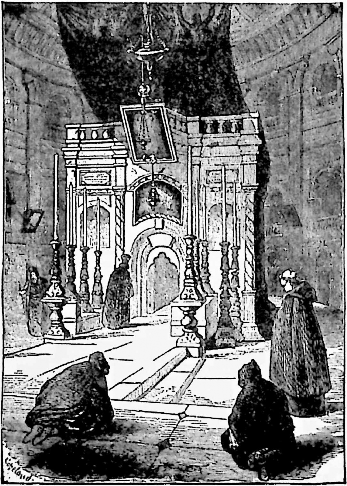
••ABIDE WITH ME." 535 Arriving, meantime, at Emmaus, these two disciples urged the stranger to come in and abide with them. Such a learned rabbi must not be neglected, for such they doubtless consid-ered Him.
* Come in,” said they, “and sup with us; yea, and lodge, for evening draws nigh, and the day is far spent"
"Abide with me; fast falls the eventide.”
Thus urged Jesus entered the humble abode.
The evening repast was soon spread upon a little table for j ust three. The stranger, as the honored guest, was invited to sit at the head and centre of the table, with a disciple on each hand. “Though He was in their house, He acted master of the feast."—Dr. Barnes.
As such it devolved upon Him to bless and break the bread. No Jew would eat bread unless first blessed.
“ Jesus took the bread, and blessed it, and break it." Ah ! but no one did it like Jesus, so peculiar to Himself. “And they knew Him," says Luke.
Yes; as He raised His pierced hands, their eyes saw the dear wounded palms, such as no other living man carried!
“ Natural causes,” says Dr. Schaff, “ may have aided them." Spiritual exemplification, as He opened to them the scriptures by the way, had not.
Yes; “foolish men,” indeed, as He had said of them. ' "And He vanished out of their sight."
There is no occasion to suppose it a supernatural disappear-ance, as some affirm.
After recovering from their amazement the two disciples arose, and in the evening twilight hastened back to Jerusalem.
Loudly they knock at the door, behind which the disciples are secured, and having gained admission Clcopas cries out:
“The Lord is indeed risen, and has appeared to Simon.” Here Mark's testimony comes in (16: 13):
"And they (Cleopas and ‘Simon’) went away and told it unto the rest, neither believed they them."
Mark does not say that the ten (Thomas absent) told it to the two from Emmaus; but they, the two, Cleopas speaker, said:
" The Lord is indeed risen (as the women said), and has appeared to (me and) Simon." He offers his companion as witness.
" But they did not believe these either."—Mark (verse 13).
If Peter had seen Jesus already, would he not have believed ?
" But," say many, " Paul says that He appeared to Cephas."
—i Cor. 15: 5.
May not Paul (or some copyist) have been in error ? " Paul cannot err," you say.
Let us see: in the same verse Paul says that Jesus next appeared to the "Twelve." Did He? There were but ten. Is this an error? Or did not the copyist err in transcribing “ Cleopas,” making it Cephas? One is wrong ("twelve" for ten), may not the other also be wrong? Leastwise we, or the texts, have shown that Jesus had not as yet appeared to Peter!
The Church of Rome desired to give prominence to Peter, as their head, by continuing any error if it aided them in this direction. We only desire the facts.
Peter was always speaker, and while disputing (v. 38) with the two disciples who had declared Jesus risen, and had walked and talked with them, and finally blessed and break the bread for them, He came in—the same door, not yet barred, perhaps, in the excitement—and standing in their midst, in His dear old familiar voice and His accustomed salu-tation, said to them:
“ Peace be unto you."
"And they were terrified," supposing Him a spirit (37).
Not that He was changed in body (39) or any different, ex-cept in His attire, but that He was the last person in the world whom they expected to see, Peter as well as the nine.
“ Why are you terrified ? and why do reasonings (doubts) rise in your hearts ? See my hands and feet; handle them (and see that they are flesh and bones), for a spirit has not flesh and bones as you see me having."—Luke.
WHO IS “SIMON?” 637 “And He upbraided them for their unbelief, because they did not believe them (the women, and Cleopas and Simon) who had seen Him after He was risen."—Mark.
If Peter had already seen Jesus, since He was risen, would he have been “ terrified ” on seeing Him again ? O, no!
Peter’s name when a fisherman was “Simon," but changing his occupation his name was also changed, as was the Jewish custom, and he is no more known as “Simon,” but-Peter. Luke, who tells us this story of Cleopas and his friend, never called Peter by the old name, Simon, after Jesus had changed it. Once the Lord, to remind Peter of his old sinful spirit, called him “ Simon ” in rebuke (Luke 23 : 3), but Luke only calls him Peter. Eight times or more he so calls him in one chapter.
Therefore when Luke called one of the two disciples who had returned with the glad news to Jerusalem, “ Simon ” (24: 34), there is no consistency in applying that name to Peter.
By referring to verse 18, we find Cleopas speaker for the two; referring to verse 34, do we not still find him speaking of his friend and companion as Simon ? By verses 33 and 35 we find “ they ” (that is, those two disciples from Emmaus) the subject; does verse 34 change the subject or person?
If so, we have neither sense nor grammatical construction. Let us read it as it really is, and not be biased by 1 Cor. 15: 5:
“And they (Cleopas and Simon) ... returned to Jerusalem, ... to the ten (Thomas absent), saying: ‘The Lord is risen indeed, and hath appeared to Simon.’ And they, same speakers, rehearsed the things in the way and how ” (>. e., in what manner He was known to Simon and Cleopas). “ He was known in the breaking of the bread.”
There is no reason, from the text itself, to suppose that any other was speaking than Cleopas, or that he referred to any other than his companion, a “ Simon.”
Jesus arriving in their midst, desires to corroborate this evidence, and He shew them His bone and flesh, hands and feet There was yet one more appeal to their carnal minds. " Have you here anything to eat ? ” He asked.
Here, doubtless, were the couches and the tables at which they had eaten the passover supper. In the “ upper chamber" it had been prepared on that night; in the “ upper cham-ber," around a table (Mark 16: 14), they now reclined; and in an “ upper chamber " we again find them gathered, which was their place of " abiding," on the day of His ascension. Doubtless, then, it was their accustomed place of abode when in Jerusalem, and perhaps the house of Mary and her son Mark.—Mark 14: 51.
" Yes, they had something to eat"
“And they gave Hirn a piece of broiled fish and a honey-comb,” and probably bread. “And He took it and ate there-of."—See R. V.
Nothing could be more convincing to these Galilee fishermen than this act of Jesus in partaking of their favorite home diet, a piece of broiled fish.
Some have supposed that Jesus came supernaturally into the presence of His disciples. This would be inconsistent with His desire to convince them that “ He was not a spirit, but of real flesh and bones." The two disciples came in just before Jesus. If they entered by the door, Jesus could have entered the same way. I see no need or object in supposing a supernatural entrance.
When last seen, before this time, He was at Emmaus. He there had " vanished out of their sight,” namely of the two disciples. Prof Schaff thinks it was a supernatural departure, and that Luke so conveys the idea. While respecting Dr. Schaff’s opinion, we note these facts:
That Jesus had walked much of the distance between Jerusalem and Emmaus, which leads us to infer that His feet had not been nailed to the cross His hands were not yet* healed. His feet then could not have been, if so nailed. Neither Matthew, Mark, nor John say anything about the feet * Recollect that verse 40 is questioned by the most learned men, not base found in ancient MSS.
Jesus (in Luke) says, in general terms, "See my hands and my feet," as also He said, " feel my flesh and bones,” merely to show them that He was not a spirit Therefore, He was “ the same Jesus ” who had been buried.
At Emmaus it was twilight or dark (Luke 24: 29), which, with the surprise of the two disciples, aided in His "vanishing.
4- He had occupied as much time (apparently) between Emmaus and Jerusalem as the two disciples.
5. John (20: 19) says that the doors were shut for fear of the Jews, when Jesus " came and stood in the midst” Luke says nothing respecting the doors, but first states that the two disciples entered, and afterward Jesus. It is as easy to sup-pose that the first two entered supernaturally, as that Jesus did, and as essential. * The point in each case is to convince the ten that Jesus had risen.
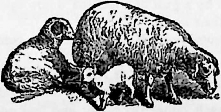
Chapter LXVII
Eight Days Afterward
Eight days after the last record, being the eighth after the resurrection, counting that as one, Jesus appeared unto the Eleven—Thomas being present. This is the TIME.
THE PLACE was in their upper chamber in their own house, in Jerusalem, as before, and where He will meet them once again.
The substance of this brief chapter is recorded in John 2a Thomas, who was also called Didymus, was saying: “I will not believe that Jesus is risen unless I shall see in His hands the print of the nails, and put my finger into them, and put my hand into the spear-wound in His side."
Suddenly, as by a gust of wind, the doors open and Jesus is standing in their midst.
" Peace be unto you,” He said, being the common Jewish salutation.
They are not terrified now at His presence. He is known to ten of them, and to the eleventh He turns, and says:
“ Thomas, reach hither thy finger and feel my hands, and reach here thy hand and put it into the wound in my side, and be not faithless, but believing.".
There was now no unbelief on the part of the others, and to hear his own name pronounced by his Lord and Master, completely subdued the unbelieving Thomas, and to hear that dear one repeat his own late words of unbelief in tender re-

buke, overwhelmed him with grief, and yet affection, and he could only cry out from the depth of his conviction, “ My Lord and my God !"
" Thomas, because thou hast seen me, thou hast believed; blessed are they who have not seen and yet have believed."
The disciples, therefore, were glad and greatly rejoiced, when they knew that their Saviour was indeed risen, and again with them. They had been waiting for Him to meet them again when Thomas should be present, and should see Jesus and believe that it was He indeed. Now He had met them all, and their joy knew no bounds.
“ They doubtless expected that now, being alive again, He would once more gather them around Him, and stay perma-nently with them, and they even fancied that He would now, at last, set about the establishment of that earthly kingdom of Israel, to which they so fondly clung. But to stay thus familiarly with them was no longer in keeping with His glo- rifled immortality."—Geikie.
He had appointed a meeting with them in a certain place in Galilee, both before His crucifixion, and, by the angels to Mary Magdalene, after the resurrection, but their faithlessness had kept them from leaving the city to the present time.
If ten believed, Thomas, the eleventh, said that he would not until it should be demonstrated to him by the test of placing his fingers in the wounds in the hands and side of his risen Master.
In this his kind, condescending -Lord had gratified him, and he, with the others, was now ready to go to Galilee, or to the ends of the world to meet the risen Lord and receive those instructions promised them before His death. Yet how soon did they again yield to doubts, is shown in the next chapter.
Chapter LXVIII
On the Sea of Galilee
Time—April-May, A. D. 30. A. U. C. 783. Place—On the western shore of the Sea of Galilee.
time that Jesus was manifested to the dis-ciples after He was risen from the dead.”
There is no question of this being in order.
The narrative carries us back to the scenes of Christ’s early ministry.
It was night on the Sea of Galilee.
The heavens are spangled with stars, but no soft moonlight * glistens over the dark waters of the lake, which the lulled breath of balmy spring fails to disturb with a single ripple.
This treacherous sea, which we have seen lashed to madness, foaming and writhing like a chained and untamed lion, now lies calm and placid within its iron-bound cage, reflecting yonder the dark, mountainous shore; nearer, the starry heavens above its mirror-like surface; and here at our feet, kissing the white, pebbly-beach in its warm, silent embrace.
A fisher’s boat, leaky and long forsaken, lies moored to the western shore, upon which a night-bird looks from an over-hanging cliff, in wonder, perhaps, that it brings to its shore no more prey, as it used in days forever past * It was on the ** dark of the moon.”

Hark! There is the sound of many footsteps, grating on the gravel of the mountain-path. Dark forms emerge from the surrounding gloom, and seven peasants walk listlessly down to the water’s edge, and gaze out'upon the silent night They are travellers, and have walked from afar. Some carry on their arms their, folded kuftans, others carry the rude and hastily constructed outfit for a fishing voyage, and one the material for a torch, when lighted a fatal decoy for the myriads of the deep. They look sadly upon their long-neglected craft, they gaze in dark despair upon each other’s faces, a terrible gloom pervades every soul. What does it portend ?
These seven men were but recently looking hopefully for a kingdom; even when we last saw them in an upper chamber, that hope, long buried, had received a resurrecting influence. It seemed once again almost within their grasp. What had since occurred, and how had it escaped them ?
We cannot tell. Perhaps it was because of unbelief.—Matt. 28: 17.
However that may have been, it is now all over.
** Yes,” said doubting Thomas, quite recently turned spokes-man, “ it is all over.” • “ Yes," responded Peter, “ and I go a fishing " again.
“ If that is the case, we go with you,” the others replied.
The boat was old and leaky, but it might, with a little caulking, do for the present emergency, and did. So they launched the craft, and entering therein pulled slowly out upon the sea.
Who were these seven disheartened men ?
Peter, already named, energetic, whole-souled Peter; but why here, away from the mount of appointment and his be-loved Master? The loving John, full of faith and affection for the Master and His cause; why is he here? Thomas, not quite so strange, and we fear that he did not quite believe, after all his Master's pains to convince him. And James, a son of thunder, now silent enough at his larboard oar, and John at the right (Mark 10: 37). Nathanael of Cana, guileless as an Israelite, but how now as a Christian? And two other disciples to whom John gives no name, perhaps Andrew and Philip.—Lightfoot. '
’ Out into the night they row. All night long, up and down the lake, hither and thither, the torch at the bow, the net drag-ging at the stern.
"And all that night they caught nothing.” “ I give it up," said Peter, in despair. " Even the familiar fish of the sea have deserted us, and we return with empty nets."
"They keep letting down the net into the dark depths of the sea, and each time it comes up empty. So in thought they plunge into the deeper and darker mystery of Christs death and resurrection, and they can bring nothing to light It seems to them that they have just awoke from a beautiful dream of their Master’s reign on earth, and found themselves but peasants and fishermen."—Dr. March.
And poor fishermen indeed, who had " toiled all night and taken nothing."
It is always the darkest just before the dawn.
Now the day begins to break. The morning star fades in the east, and in its place Aurora, the goddess of day, opens up the royal gates far away over the mountains, and prepares to usher in the god of day. On the western border of the sea, which the boat is now approaching, the dark cliffs begin to stand out clearer and lighter, and soon on the foliage above one lone bird begins to peep, another follows, until quickly a myriad songsters start from their slumbers, in bush and bough, and a grand morning concert is open all along the brighten-ing shore.
As the fishermen draw near, they discover a stranger just above the pebbly beach. Yet they are not surprised. It was nothing strange that a person should come to them as they were landing, to buy their catch.—Geikie.
“Children," said he, “have you anything to eat?”
“ No, nothing," was their reply, still out in the lake a little distance.
He had spoken as one addressing the humbler class; and . JESUS APPEARS ON THE SHORE. 545 as one having superior knowledge of the location, perhaps, He again spoke : •*.
‘ Cast your net on the right side of the boat, and you will find ’* plenty and to spare. • Ah, yes! But to know always which is "the right side,” as we. cast about us. That is the difficulty.! He is not always so near to us, or we so near to Him, as to receive His direc-tions. . •: • “ They cast,” says one present, “ and now they were not able to draw up the net for the abundant fishes it contained.”
Looking from the net to the shore, thence back at Peter, the one greatly beloved disciple said in thrilling accents to his next companion : > ■ “ Peter, it is the Lord, our Master.”
So when John said that it was Jesus, Peter hastily put on his fisher's coat, for he was naked, as was the custom for the one who beat the waters to scare the fish .into the net, and plunging into the sea swam quickly ashore, a distance of two hundred cubits, equal to three hundred feet, to be the first to welcome his beloved Master. •* " Where had He been so long ? O, why had He gone away from them? How did He know that they were here again on the lake, dejected and despairing ?”
O, how many questions there are to be asked, if never an-swered !
When they had all landed they saw a fire on the shore, and one solitary fish roasting on the coals, and beside it a barley loaf.
" Bring here of the fish which you have taken,” said Jesus, and they hasten, wonderingly, to obey His commands (10). .
They drew up the net, pouring out the fish on the whits pebbly beach, counting them as they did so.
“There are one hundred and fifty-three,” said John, in amazement that there were so many, and yet their old net had remained unbroken (v. 11).
" Come and break your fast,” said Jesus, when the fish had been duly cleansed and broiled.
It was the custom when invited to a feast to inquire the name of the bountiful provider, but notwithstanding the dis-ciples had long fasted and were prodigiously hungry, they dared not put the question, " Who art thou. Master ? ”
“ They knew indeed that it was the Lord."
They all sat around on the shore, He in their midst, and as of old He took first of the bread, and, as was His custom, gave thanks, though John omits the mention of it, and divided among them all; also the same with the fish.
In silent wonder the seven partook of the food, and when the meal was ended, Jesus turned toward Peter, the acknowl-edged leader of the disciples, and as was the Master’s habit when His impetuous servant had gone astray, said:
" Simon!"
How the old name startled the guilty owner.
“ Simon, son of Jonas, lovest thou me more than these?"
“ Yea, Lord, thou knowest that I love thee." “ Feed my lambs," said Jesus.
Again He repeated His question, and the third time, each time eliciting the same answer from Peter.
Peter was grieved that the Lord asked him the third time, and replied more forcibly:
" Lord, you know all things, and hence you know that I love you."
Three times Peter had denied his Lord, and it was but fit-ting that he should three times confess.—Farrar.
Then Jesus informed Peter at what terrible risk he should proceed to “ feed His lambs.”
They had risen from the tiresome position of sitting on the hard beach, and were slowly walking along the shore.
“Follow me," Jesus had said to Peter.
The intimation by Jesus of Peter’s violent death as the con-sequence of “following Him” did not weigh heavily on Peter’s mind at the time, for seeing John walking along behind them, he boldly inquired:
“ Lord, what of John? Shall he too suffer martyrdom?"
“ If I will," Jesus replied, " that he tarry till I come, what is it to you ? Do you follow me.”
From this remark it was believed among the disciples that John should remain in the land of the living until Jesus should appear in His glory. It also corresponded with His assertion, previous, that “ One was standing near who should not taste of death until the Son of man be come in His glory.”
“And this disciple forty years afterward bear witness to these truths, and we know that his witness is true.”
There are many other things which Jesus did and said, not recorded by John nor by any other apostle.
But one more " thing " properly belongs to this narrative.
It is recorded by Matthew 28: 16-20.
Directly after this meeting on the lake-shore, the Eleven went up to a certain, and to us unknown, mountain, by ap-pointment, where they met Jesus. There were doubtless many other disciples present beside the Eleven. Paul says about five hundred.—1 Cor. 15:6.
“And when they saw Him," says Matthew, “they wor-shipped him, but some doubted." These were probably not of the Eleven.
Further instruction was given to them later in Jerusalem, to which we call attention in the next and last chapter.
Chapter LXIX
Jesus' Last Days on Earth
Time—May 1-18, A. D. 30. . Place—Jerusalem and vicinity. Rulers—Tiberius Cesar, emperor at Rome; Pontius Pilate, governor of Ju-dea; Herod Antipas, of Galilee. ..
The Gospel of Luke is carried over into the first chapter of Acts. There we learn several
References
Acts x: 1-14.
Matt. 28: z8-20,
Luke 24; 44-53.
John 20: ar, 22.
important facts concerning the last hours of Jesus on earth, and of His ascension. • We learn—
FIRST. That the time between the resurrection and ascension was forty days.
SECOND. That during this time He shew Himself to His apostles many times, "teaching them the things concerning the kingdom of God."
THIRD. That the Holy Spirit was not breathed on them "till the day on which He was received up.”
FOURTH. That the act of “ breathing on them,” as per John 20: 22, was not a completion of the received promise of a " baptism in the Holy Spirit"—5.
FIFTH. That this, completion was promised to be fulfilled " not many days hence."
SIXTH. (Chapter 2: 1-4.) That they did so receive the “ Holy Spirit" on the day of Pentecost.
John, writing forty years later, in his old age, may have an-ticipated this reception of the Holy Spirit, knowing that it had

been promised long before.* It is. very positive that they had not received it up -to'the day of ascension. Why? The read-ing of Acts i: 6 is very convincing. Up to this hour they had no spiritual ideas whatever. They were still looking and asking for a temporal kingdom. .
Where He lived, what He did, and what He taught, in so many words, while in Galilee, we shall never. know. There is no doubt that He remained in Galilee—if “ in the body;" but if in the body or out of the body, I no more know than did Saint Paul on a certain occasion. 11 In favor of Galilee, it may be said that here the apostles were at home and among friends, and that amidst the scenes of His former teachings, His present words would come with double power and meaning; whilst in Jerusalem, they would be among His enemies, and in a state of disquietude, if not positive fear." We may then sup-pose that it was near the fortieth day ere they went up to Jeru-Salem.—Andrews.
This then was “ Jesus' last journey ” upon earth. ■ How or what way He went, is unknown.
However, we .find the Eleven assembled in the upper chamber in the city of Jerusalem (12, 13), and the Lord in their midst. We know it was as above, because Luke says that, after the ascension, they returned to " where they were abiding" before going out Rather as the word “abiding” here implies, a habitual abiding place. “ He met them in Jerusalem," says Canon Farrar, " and as He led them toward Bethany, He bade them wait in the Holy City until they had received the promised Holy Spirit" “ Tarry in the city until ye be clothed with power from on high.”—Luke 24: 49.
The matter recorded by Matthew (28 : 16, 17) must refer to the same occasion mentioned by Paul, where there were some 500 disciples present—in Galilee, wherein Matthew says that “ some doubted.” It could not have been the Eleven who now doubted. They were advanced past that, after their late interview at breakfast on the lake-shore. There was no doubting after that with the Eleven. Hence we place the * John 14: 16, 17.
16th and 17th verses, as recorded by Matthew, in Galilee, and the 18th to the 20th in Jerusalem. This closes Matthew’s gospel.
Mark we have left already, because “ The two oldest Greek manuscripts—it was originally written in Greek—and some other authorities, omit from verse 9 to the end” of chapter 16.
Let us suppose, if any desire, that it was all written by Mark: we still have the better and fuller, and undoubted record of Luke, by which to conclude this chapter.
John’s gospel also was closed, two chapters back. We ex-cept the two verses named at the head of this chapter (21, 22) already shown to belong to the closing scene of Christ’s earthly acts, and not really completed till Pentecost At this last meeting in Jerusalem, there is no question that Jesus gave the Eleven very complete and lengthy instructions for their future conduct.
When they first came together, on this last occasion, the Eleven, still with their minds fixed on an immediate temporal kingdom, asked Him— ■ " Lord, do you at this time (now) restore the kingdom to Israel ? "—-Acts 1: 6.
At this juncture we would place the words of Luke.—24:
45. 46.
" Then opened He their mind, that they might understand the Scriptures,” where it is written, “ That the Christ should suffer (as He had suffered), and rise again from the dead on the third day.” It is not supposed, nor possible, that all of Luke 24: 36 to 49 refers to one and the same meeting, any more than a continuation (50-53) can refer to one and the same. Verses 36-43 refer to the evening of the resurrection, and, probably, verse 44, while verse 45 to the end refer to the day of ascension. By reference to a continuation of Luke (in Acjs.l), we find this. division to be correct. In the latter he wastes no words in repeating, "And Jesus led them out over against Bethany ” (Luke 24: 50), but refers his friend The-ophilus to that ” former treatise.”
In Luke’s Gospel he says that “ Jesus led them out over against Bethany.” In Acts he says (v. 12), that after the as-cension they returned from the Mount of Olives. Bethany is repeatedly called the " Mount of Olives," and vice versa, in the Gospels.
Verse 49 (of Luke 24) compares with Acts 1: 4.
It would seem that it was not Jesus' purpose to meet the Eleven in Jerusalem, at first, after the resurrection, for repeat-edly He had bade them meet Him in a certain mountain in Galilee, after His resurrection; but in their bewilderment and unbelief, they did not obey Him, but remained in their secret quarters in the city.
To them He sent five witnesses of His resurrection, but to whom it was a mere " idle tale." Then He sent Cleopas and Simon, Himself having gone several miles out on the way, but they did not believe these two witnesses. Then He went Himself, and "stood before them," for their inspection, but they would not believe. He next called for food, and sat down and ate in their presence.
Finally, they so far believed, as to. start on their way to the mount of appointment, but their belief oozed out; their courage, their money, and food, all failing them, we find them next trying to help themselves at their old occupation of fishing 1 How totally they failed in this has already been recorded. Again Jesus came to them 1 Blessed, patient Jesus.
This time they all believe; they meet Him again, with all the known disciples—requiring many days in which to notify them all in a temporal manner—at the Holy Mountain. There He bids farewell to the many.
After this, the Eleven return to their old quarters in Jeru-salem, and He meets them for the last time.
After all that Jesus must needs have said to the Eleven on this last occasion in Jerusalem, it must have been towards night when they finally went out of the eastern gate and down the hill-side, over Kidron, once again; past the garden of Gethsemane, and up the western declivity of the Mount of Olives.
Did He look back, as of old, upon Jerusalem? or was she now past all hope, beyond redemption, by* prayers and tears ? i • And Peter and. those others who had so long been taught to sing, "O Jerusalem! If I forget thee, Let my right hand, too, forget; • Let my tongue cling to the roof of my mouth If I prefer not Jerusalem to my greatest joy;"
Did they once look back upon the wicked city, in which they had heard that bloodthirsty cry, " Crucify Him, Crucify Him?” . * No, no! Henceforth they only looked toward the " New Jerusalem,” and " a spiritual house, built of living stones, and a holy priesthood, who would offer up spiritual sacrifices, only acceptable to God, through Jesus Christ."
Of all these things Jesus was earnestly talking, as they reached the spot, and they were all looking upon Him, and as eagerly listening -to “ His gracious words,” when “ He lifted up His hands and blessed them."
"And," continues Luke, "while the blessing was on His lips, a cloud received Him out of their sight " (Acts), or, " He parted from them and was carried up into heaven."
“And I saw, and behold," said John, many years afterward, in Revelation 14: 14, “ a white cloud, and on the cloud one sitting like the Son of man, having on his head a golden crown, and in his hand a sharp sickle.
“And an angel came out from the temple, crying with a loud voice to him who sat on the cloud, “ ’ Send forth thy sickle and reap, for the hour of reaping is come; the harvest of the earth is over-ripe.’
“And he who sat on the cloud cast his sickle on the earth, and the earth was reaped."
The Gospels
END OF THE JOURNEYS OF JESUS
Part Second


PART SECOND
first four books of the New Testament con-stitute the Gospel of Jesus Christ Gospel signifies “ glad tidings."
MATTHEW begins with "The book of the genealogy of Jesus Christ, the Son of David.”
Mark commences thirty years later, with " The beginning of the Gospel of Jesus Christ, the Son of God.” Luke begins—admitting that he was not an eye-witness—at a period fifteen months before the birth of Jesus; while John commences with the “ Word of God," as announced in the preaching of John the Baptist Matthew leaves off without mentioning the Ascension; the most ancient MSS. of Mark’s Gospel stop suddenly with the resurrection (16 ; 8); Luke not only com-pletes the whole story, but reopens it in the Acts, and John terminates his record at the meeting of Jesus and the seven disciples on the shore of Tiberias.
To possess a complete knowledge of the life of our Lord on earth, one must be able to read these detached evidences when placed in order.
MATTHEW’S GOSPEL.—The first of the four Gospel narratives, it is conceded, was Matthew’s, and was written about twenty to thirty years after Christ’s ascension.
Hu Place was Palestine. It was first written in the Hebrew tongue {Papias}, and afterward translated into Greek, and other languages. The old MSS. are in Greek.
32 (555)

Matthew's Gospel was especially intended for the Jews (Tholuck), to convince them that Jesus was indeed the long-expected Messiah.
Genuineness of the Gospel.—There is no more occasion to doubt Matthew and his book, than to doubt Plato or Pliny, whom we accept MARK AND HIS GOSPEL.—Mark was not a " disciple ”—one of the Twelve. He lived in Jerusalem with his mother Mary (Acts 12 : 12). His name was John, surnamed Mark (12 : 25; 15: 37). He was converted from Judaism, by the disciples, and travelled with Paul (A. D. 45 ; Col. 4: 10, 11). He was also with Peter (Eusebius). He introduced the gospel into Egypt, and founded the church at Alexandria (Epipha-nius). He was again with Paul, at Rome, A. D. 61-63. He was in Babylon (1 Pet. 5: 13), afterward returning to Rome, in 68 (2 Tim. 4: 11). Tradition says he suffered martyrdom in Egypt. • MarHs Gospel was written, in the authority of Irensus, after Matthew’s, A. D. 45 to 65 (before the fall of Jerusalem), and before Luke's Gospel.—Eusebius.
MARK’S GOSPEL was written in Rome. It was written more specially for Gentiles. There is little doubt that he had Mat-thew's Gospel before him for reference, but his times and places are more definite.—See Dr. Abbott.
Mark’s Gospel is very authentic, the last twelve verses ex-cepted.—See R. V.
LUKE’S GOSPEL.—Its author was Luke, a physician of An-tioch, a Greek by birth and education. The date of his con-version from heathenism to Christianity is unknown. We first find him with Paul, at Troas Alexandria, in Mysia, Asia (Acts 16: 10). Thence they went to Philippi, a city of Mace-donia, where they remained a long time. Here Paul and Silas were imprisoned, but Luke seems not to have been; he was not preaching, and perhaps was only Paul's physician. After the prisoners had been miraculously delivered, and, after a time, quietly departed (16: 40), Luke seems to have been left behind, perhaps till Paul's return (20: 5), where he met Luke on his third tour. Thence they went to Troas again, seven years from the first visit, A. D. 51-58. Perhaps, during these seven years, Luke was preaching alone in that country ----- 2 Cor. 8 : 18.
He followed Paul to Jerusalem, and afterward to Rome (Acts 27: 1), and probably remained with him to the end of his career.
I n reading the graphic accounts of these travels of Luke ■with Paul, we find the narrator's powers of description very excellent, and his geographical bearings most exact, showing a personal cognizance of what he is writing. Now contrast these with his gospel record, and we at once perceive a vast difference in these points. This we may account for from the fact that the latter was taken down, not from personal obser-vation, but by hearsay. Indeed, he tells us as much in the introduction of his gospel.—Luke 1: 1-4.
Luke's Gospel differs from all others, being addressed to an individual—Theophilus, a Roman, a Gentile, and a person of distinction; as “ most excellent," equal to " his excellency," implies, being the same as applied to governors like Felix or Festus. Luke's second book, Acts, is also dedicated to the same honorable person, in which reference is made to the gospel (Acts i : 1), as “ a former treatise."
Time when written.—The gospel was written before the "Acts.” The latter was written after 63 A. D., because after Paul's second year's imprisonment at Rome. The "Acts" was probably written at Rome.
Luke’s Gospel contains important matter not in the other books; for instance, relative to the mother of Jesus, and his boyhood, doubtless obtained from Mary herself (1: 2), and what is of greater importance perhaps, the long account of Christ’s Perean journey, or rather what there took place, without relating its locality. This is made out from circum-stances connected therewith, and the other evangelists’ writ-ings. During the two years' imprisonment of Paul at Caesarea, 58-60, A. D., Luke probably took occasion to collect the ma-terial for his gospel, and though we cannot certainly fix upon this as the time and place of writing, it is a reasonable sur-mise it was mainly prepared, if not published, then and there (Dr. Abbott). Others think it was completed at Rome two years later, in Greek.
As a narrator he is far superior to Matthew or Mark. His narration of the walk to Emmaus, which if it had been omitted would have broken the chain connecting the after proceed-ings during nearly all the forty days.—See body of this book, chapter 4.
JOHN’S GOSPEL—Time when wriffait.—John’s Gospel was the only one of the four written after the destruction of the Jewish nation, and their city and “holy temple.” Eusebius places it as late as the fourteenth year of Domitian; i. e., A.
D. 95. Others think it somewhat earlier—A. D. 80-85.
Place where written.—Ephesus, in Asia, nearly opposite the island of Samos, is the place first assigned, and the most probable; and Patmos, to whence he was banished, as the second and least probable. John removed from Jerusalem to Ephesus some years before the destruction of the former city, but did not commence the gospel until its downfall.
John's Gospel stands out entirely independent of the other three. He wrote mainly of the words and works of Jesus in Judea. Notwithstanding John’s birthplace was Galilee, and that he followed Jesus in all His “journeys,” over that and adjacent countries, Tyre and Sidon, upper Syria and De-capolis, there are but three places particularly mentioned by him outside of Judea. The first is Cana of Galilee, in which John alone records the first two miracles of Jesus. The second is at Butahi, and the feeding of the five thousand; and the third is the recall of the dispersed disciples after the res-urrection. These were matter of great moment omitted in whole, or in part, by the synoptists.
It is worthy of remark that, as the synoptists followed Jesus to the very borders of Galilee and Judea, and there dropped Him, so to speak, John met Him, in his record, and carried Him along to His return to Galilee, when again in turn the synoptists took Him till the next visit to Judea.
All the matter recorded by the first three Evangelists, rela-tive to the prophecies of the destruction of Jerusalem, the temple, and the Jewish nation, are passed by in silence by John as things of the past, too well known to need repetition. He alone tells us of the first cleansing of the temple, of the night visit of Nicodemus, of all the feasts which Jesus at-tended at Jerusalem, except the last, in which all the Evan-gelists join record, of the nine months’ circuit in Judea (3: 22 to 4: 43), ending at Sychar, December, A. D. 27.
From this time till the first of April, A. D. 28—some " four months "—there is an entire silence of all the synoptists, and John records but one incident of that period (4: 46 to 51).
From the time of the passover, April, A. D. 28, till the fol-lowing April, the time of feeding the five thousand, John makes no record of Christ’s doings. He now helps to a data: “ The feast of the Jew (passover) was at handthis was the first of April, A. D. 29 (John 6: 1). In verse 59 he helps us to both time and place, viz., the Sabbath at Capernaum. To verse 71, inclusive, he relates what occurred in Capernaum.
From this point John is again silent as to Christ’s proceed-ings until the next winter: at the time of the feast of dedica-tion (10: 22), occurring late in December, A. D. 29.
In verse 40 John notes Jesus’ return to Perea—in “Judea beyond Jordan’’ (Matt. 19: 1; Mark 10: 1; Luke 9: 51 to 10: 42). At chapter II John comes in harmony with the synoptists. At chapter 12 he helps us to a data, but at verse 2 is out of order. From this point on to chapter 21 he re-cords what took place in Jerusalem, mostly in harmony with the other Evangelists.
The Disciples
Called the "Twelve” and the “Apostles.”
AFTER the baptism of Jesus, over Jordan, His visit to Jeru-salem (Matt. 4: 1), and His return to Bethabara (John 1: 26 and 35), John the Baptist introduced two of his own disciples to Jesus. Their names were Andrew and John (40). ' Andrew runs away and finds his brother, Simon Peter, who was there among the throng of pilgrims attracted by the preaching of the Baptist.—January, A. D. 27.
“ We (John and I) have found the Messiah," cried Andrew, and the brothers hastened back to Jesus, to whom Simon was presented.
"Thou art Simon, the son of Jonas?" said Jesus, examin-ing Peter critically (42). “ You shall be called Cephas here-after;" i. e., Peter.
“Master, where abidest thou?” one of the three inquired. "Come and see," Jesus replied (39).
They went and saw where He abode, and remained with Him till the following day (39 and 43).
It being four-o'clock in the afternoon, therefore the sense of verse 39 implies that they abode with Jesus that night On the following day Jesus and the three set out for Galilee. The Jews were a hospitable, social people, and there need be no doubt that Peter and Andrew, with John, invited Jesus to their home, at that time in Bethsaida (44), at the northern ex-tremity of the Sea of Galilee.
Their best way would be to proceed on foot, as was the custom for young men (Josephus) to travel in those days, as far as the foot of the lake, at a city called Taricha—a fish pickling place—where the three disciples, who were fishermen by occupation, may, and likely did, have business connected with their trade, and where they may have left their boat until their return homeward.
We have already mentioned the fine pebbly beach on the opposite side from Taricha, at Sumak, an excellent landingplace. From circumstances, custom, and after habits of the Master and the disciples, we may have no doubt but they here took boat and sailed for their next destination, Bethsaida.
Here Jesus found another disciple, Philip by name, a resi-dent of that city (44), and also Andrew, the brother of John. Bethsaida was fast becoming a Roman city. Philip* Herod II. was now governor of Northern Syria, and had here erected a handsome palace, and much enlarged and improved the city. He was in continual communication with Herod Antipas and his court, across the lake, at the new city of Tiberias, another Roman city, and the capital of another Roman governor, and in all Bethsaida was fast becoming an undesirable residence for Gentile-despising Jews. This fact may account for the removal of Andrew and Peter to Capernaum, and John and James to Jerusalem.—John 19: 27; Acts 21: 18..
From Bethsaida Jesus and the five disciples went to Cana, a small town some twenty-two miles distant.
They probably took in Nazareth on the way, and Mary, Jesus’ mother, accompanied them to Cana (John 2 : 1). “ On the third day” after their arrival, counting the day of arrival as one. as was the custom, " there was a marriage in Cana,” to which Jesus and the disciples were invited.—2.
Nathanael' was here added to the discipleship, making the sixth.
With their Master, these six di$ciples went down to Jerusa-lem to the passover—April 27th—and thence all over Judea, preaching the doctrine that John the Baptist preached, and the disciples baptizing with the baptism of John.—John 3 : 22; 4: 2 ; Acts 10: 37.
In December, as before related, they returned through Samaria (Sychar, John 4: 5), where on the way Jesus parted with the six disciples, who returned home, and to their former occupation of fishing until the following April, A. D. 28.
“After John the Baptist was cast into prison “ Jesus came into Galilee, preaching the gospel of God."—Mark 1: 14.
"And leaving Nazareth He came and dwelt in Capernaum, by the Sea of Galilee" (Matt 4: 13). About April Ist, A. D. 28.
Here Jesus recalled His six old disciples, to whom He soon after added six others, completing the symbolic Twelve, who followed Him through all His journeys to near the end of His earthly pilgrimage.
For dress of the disciples, as well as others, see article “ DRESS."
Now we take them up separately and endeavor to give a concise account of each, as revealed to us in the gospels, and also according to the most reliable “ traditions," rather as-sertions, of the elders of the'church, and historical writers of that age. We take them in the usual order, beginning with
Peter
Peter was a native of Bethsaida, “ of Galilee," because bor-dering on the sea of that name. He was the son of John, or Jonas, and was a fisherman by occupation, with his brother Andrew. Their introduction to Jesus is already described. Of Peter's early history nothing further is known than above. From first to last he remained greatly attached to the Master and His cause. His zeal often overstepped his judgment, but, unlike Judas, he received his Master’s rebukes without offence On making the acquaintance of Jesus, about January 27th, Peter “ forsook " his trade, house, and family, and until the following December adhered to the fortunes of Jesus in the Judean circuit. On the recall, in April, 28, he again entered his Master's service, never leaving it, except for a brief period following the resurrection, until his own death. His history during the first period will be found in the "Journeys with Jesus," therefore we will only refer to his subsequent acts.
After the ascension, Peter met with the other ten and chose a disciple in place of the departed Judas. In the "Acts of the Apostles ” will be found many very interesting incidents in Peter’s after-life, the principal of which are as follows: His arrest and trial before the Sanhedrin for preaching the resur-rection ; as also, in connection with John, for healing a lame man at the " Beautiful Gate" of the temple. They escaped with a reprimand. They were called bold, ignorant, and unlearned men by the council, who also admitted that they had done a " notable miracle ; " but a few years later we find Peter able to talk fluently to Cornelius, a Roman officer stationed at Caesarea, whose language was probably Greek. “ There is very ancient authority that Peter employed an interpreter."—Dr. Smith.
A second time we find Peter—and others—imprisoned by order of the council, but when the guard went to bring them up for trial they found them gone, " for an angel of the Lord had opened the prison-doors and brought them out.” After this Peter preached daily,.both in the temple and "at home” (5 : 42), implying residence in Jerusalem.
Peter’s next great work lay in Samaria. Thence we follow him to Lydda, where he healed Eneas, and to Joppa, where he raised Dorcas from the dead. Cornelius sent for him to come to him at Caesarea, where Peter preached to this Gentile and all his household, converting and baptizing them. Thence Peter went up to Jerusalem. Here Herod Agrippa cast him into prison after killing James, the brother of John, intending to also despatch Peter, but again he was delivered by “ an angel of the Lord " in the night, going first to the house of Mark, in the city, and afterwards escaping to Caesarea (?), and also to Antioch. There is a possibility that Peter in his ex-tensive travels (accompanied by his wife, says Paul) went to Rome, but of this there is no certainty, notwithstanding the Catholic Church is founded upon that " possibility.” Luke, the writer of the "Acts," going away with Paul, suddenly dropped the further history of Peter, which no other reliable person ever took up; hence all of his latter life is uncertain. Tradition says that he was crucified with his head downwards. Two epistles of his writing are preserved to us in the New Testament. For Peter’s dress, see DRESS.
APOSTLES—JOHN
John
This eminent disciple and evangelist was the son of Zebe-dee, and brother of James, all of Bethsaida, and all fishermen by occupation. These, with Peter and Andrew, formed a co-partnership in the business, owned boats, nets and outfits, and employed hirelings, which indicated that they were in easy circumstances. Salome was the mother of James and John, and one of the women named as contributors to the support of the Lord —Matt. 26: 56.
In later years John resided in Jerusalem, where he owned a house, which, with his acquaintance with the family of the high-priest, indicates no little wealth and honor.
John’s first acquaintance with Jesus, and subsequent history up to the time of the resurrection, need not be repeated. He was believed to be younger than James or any other of the apostles. Of the quartette representing the inner circle of the Lord’s friends, John seems to have been the favorite. The feminine sort of nature attributed to John, in latter times, is an error. The “ son of thunder ” was no meek disci-ple.—Luke 9: 54; III John 1: 10.
Though the bosom friend of Jesus, John little understood the intent of his Master’s cause, for on the last "Journey” to Jerusalem, when all believed that Jesus was immediately to re-establish, and sit on the throne of David, as a temporal ruler over the Jews, John came (with James his brother) to Jesus, petitioning for the highest position in the new kingdom. It was all plain enough when he wrote his gospel.
The terrible persecutions of Saul and Herod Agrippa failed to drive John from his post in Jerusalem, though James his beloved brother was killed by Herod, and Peter cast into . prison, only escaping alive by a miracle.
Fifteen years after this, on Paul’s third visit to Jerusalem, John was still residing there. About the year 65 A. D. he took up his residence in Ephesus—a large city and the capi-tal of the Roman province of Asia. Here was the great temple of Diana, the titulary divinity “ which fell down from heaven." There lived Alexander the copper-smith, who did Paul much evil, and Demetrius the silver-smith, who made images of the goddess. Books of magic were made there, $25,000 worth being burned there at one time (19). There-fore John must needs have had an active centre in which to establish the Christian Church.
During the persecution of Domitian, John was carried to Rome and condemned to death by being cast into a cauldron of boiling oil (tradition), but the oil failing to harm him, he was banished to Patmos, an island between Athens in Greece and Ephesus in Asia. “ There, in his old age, he was forced to labor in the mines." What mines there were on this small island is not known. While there he wrote his book, Revela-tion, which was probably before the fall of Jerusalem. In chap. 18 is foretold the destruction of the city there called “ Babylon," because it was like that city in abominations, but Babylon had long before ceased to exist! Therefore, if it means anything, it means Jerusalem.
According to Eusebius John was released from Patmos by the emperor Nerva, and returned to Ephesus, where he died at a very advanced age—Jerome says 100 years.
ANECDOTE OF JOHN.—When John became too old to walk he was carried to the church by the young men. He was no longer able to preach, but with childish simplicity he kept repeating the words, " Little children, love one another." " Why do you keep repeating this one saying ? ” some in-quired. ” Because," he replied, “ it is the command of Jesus, and enough is done if this is obeyed” (Jerome). "John . . is buried in Ephesus.”—Polycrates.
James
The biography of John is the biography of James, in the gospel. After Pentecost he seems to have resided in Jerusa-lem until slain by Agrippa, after A. D. 41, at which date he became ruler of Judea, and before 44, when his life was mis-erably terminated. “ He -killed- James the brother of John with the sword, and when he saw that it pleased the Jews, he proceeded to seize Peter also—and put him in prison ” (Acts 12: 2, 4). James was beheaded. It was during1 passover week of that year (44 A. D.) James has left us one epistle.
Andrew
He was the first honored with a presentation to Jesus (John 1: 40). He was brother to Peter, son of Jonas, of Bethsaida The very little that is really known of this the fourth disciple in place of dignity, is found in the gospels. Tradition says that “ He preached in Scythia ” (Eusebius), " in Achaia, Greece, and Asia Minor and Thrace” (Jerome). He was crucified at Patria in Achaia, Greece, on a cross like this X. hence called “ St. Andrew’s cross."
Philip
This apostle was also of Bethsaida, where he had a wife and three daughters (Polycrates). Here Jesus, on His arrival from Bethabara, "found Philip.” We may understand, by some intimation from Andrew, Peter and John, who accom-panied Jesus there, that Jesus was seeking him, as a desirable disciple (John 1: 43). Philip, a few days later, presented Nathanael, as the sixth disciple.
At the feeding of the 5,000, Philip is appealed toby the Lord to know “Where they should buy bread for so many.” Philip replied in amazement—"Two hundred pennyworth of loaves is not sufficient for them, that every one might take even a taste” (John 6: 7). They were near Bethsaida, still the residence of Philip; if any one knew where bread could be obtained in that vicinity, it would be Philip. John adds that Jesus did this to prove Philip. Andrew for once becomes speaker, and says, “There is a lad—keeping the boat—having five barley loaves and two fish, but what are they among so many peo-ple?”
In John 14: 8, Philip again comes up speaker.
“ Lord, show us the Father, and it sufficeth us."
This remark seems to have grieved the Lord. At the pass-over some Greek proselytes apply to Philip for an introduction to Jesus. This implies that Philip, as his name indicates, may have been of Greek origin, and that he conversed in the Greek tongue. We have already recorded all the facts connected herewith. In Acts 1: 13, Philip is mentioned for the last time. Polycrates, bishop of Ephesus, says that he preached the gospel in Phrygia, and that he met with his death in Hie-ropolis in Syria, " with his two aged virgin daughters." Tra-dition makes him to have been formerly a charioteer.
Thomas
When, where, or how Thomas became a disciple of our Lord is unknown. He is said to have been born at Antioch. He was a twin.
Thomas speaks four times in the gospels.
Nothing is known of his late history. He is said to have been killed by a lance in India.
Bartholomew
This is the same as Nathanael, who was the sixth disciple of Jesus (John i: 45). The account of his introduction to our Lord, as above recorded, is very interesting. He is the first recorded person who accepted Jesus as the “ Son of God.”
Nathanael was doubtless one of the six disciples who fol-lowed Jesus on the Judean ministry, ending at Sychar (3 : 22 ; 4: 43). After this, it would seem that Jesus accompanied him home to Cana. On the recall of the disciples at the Sea of Galilee, and the selection of the Twelve, we find him as Bartholomew, son of Tolami, one of the chosen disciples.
He was a native of Cana of Galilee, and is mentioned in Acts I as one who beheld the ascension.
He preached in India and perhaps in Armenia. Nothing further is known of him.
Matthew
was a publican, a collector of customs on the highway near Capernaum. He was the brother or son of one Alpheus.
After Jesus had gained six of the disciples, He was one day passing in or out of Capernaum, when seeing this Matthew, sitting at the seat of customs, He said to him: “ Follow me.” And he arose and followed.
Since Jesus had been preaching from the boat near there, and going in and out daily, it is a fair presumption that He had seen Matthew and conversed with him previous to the call. In leaving one occupation for another, it was a Jewish custom to change names also. Henceforth Levi becomes Matthew, as Simon becomes Peter.
The order of Matthew’s gospel is very bad, wherein he says in chapter 5 that Jesus took His disciples up into a mountain and taught them, and in four chapters later (9: 9) mentions, for the first time, his own call, and still a chapter later before he gives a list of the Twelve and their call. Therefore while we find his statements in the whole in harmony with Mark and Luke, we also find great difficulty in arranging them in order, and have only been able to do so by carefully compar-ing them verse by verse, and transposing them consistent with sense, time, and place. We all know that Jesus did not take the Twelve up onto a mount and there ordain and instruct them before He had called and selected them. Neither did He"go about all Galilee teaching and preaching” (4: 23) before He had disciples to accompany Him—9: 9.
Matthew was a man of wealth, and forsook a profitable calling to become a disciple of the poor and lowly Jesus. Our reasons for making this open statement will be found in its proper place in the " Journeys.”
Matthew remained with Jesus a quiet, faithful disciple to the end. After the ascension he returned to Jerusalem with the ten, and is not again mentioned in the New Testament Euse-bius says that he preached to his own nation before he went abroad. He went to Ethiopia and other countries (Cyrene ?), preaching to his Hebrew brethren (Rufinus). He did not suffer martyrdom, says Clemens Alexander, in A. D. 150, as some assert James of Alpheus.
If James was the son of Alpheus (Acts 1: 13; Matt; Mark ; Luke) and Matthew was the son of Alpheus (Mark 2: 14), it follows that they were brothers, and relatives of Jesus. He was also called “James the Less,” or rather little (Mark 1 5: 40). His mother was Mary of Galilee (Matt 27: 55, 56). He probably received his call at Capernaum, in the spring of
D. 28.
“ James, the Lord’s brother," is mentioned as an apostle in the year A. D. 40, at Jerusalem (Gal. 1: 19; Acts 9: 27). Whether he is mentioned, or James the Less, in Acts 12 : 17; 15: 13; 21: 17, is not decided, but probably the latter is named in Gal. 2: 9, as one of the pillars of the church.
Tradition says that he was cast down from the temple by the Sanhedrin, stoned, and finally killed by a fuller's club. Still this may relate to “James, the Lord's brother," Gal. 1 : 9, and the brother of Jude (Jude 1). He was alive in A. D.
37Jude, or Judas, or Thaddeus.
"Judas, not Iscariot," says John (14: 22), to distinguish him from the traitor. Jude or Judas was a very common Jew-ish name. Jesus had a brother of that name, but this Jude was not he, since " none of His brothers believed on Him." In Acts he is called son of Simon.
Nothing definite is known of him after the day of Pentecost Simon, the Zealot.
He is so called in Acts 1:13, but in Matthew he is called the Canaanite. He was probably the son of Cleophas (?).—Kitto.
He preached in Africa and Britain, where he probably died.
—Tradition.
We need not confound this apostle with “ Simon, the brother of Jesus," named in Matt. 13: 55, and Mark 6: 3. This lat-ter Simon became a believer some time after the resurrection, and in A. D. 62 was appointed bishop of the church in Jerusalem, and that he was searched out by order of Trajan, as one of the heirs to David's throne, accused before Atticus, governor of Palestine, tortured and crucified at the extreme age of one hundred and twenty.—Bib. Ency.
Judas Iscariot
He was the son of Simon of Kerioth, in Judea, hence “ Iscariot"
Of Judas’ early life we know nothing; when or where Jesus elected him as a disciple, is equally uncertain.
When the Twelve became an organized body, travelling continually with their Meister, it seemed necessary that one of them should be their treasurer and steward, since they received contributions for support as well as distribution among the poor (John), and this office fell to Judas.' Since he was a natural bom thief, which fact was known to John (12: 6), the Lord could not have been ignorant of Judas’ character, as “ He knew from the beginning who should betray Him." We may believe that Judas hoped from the first that Jesus would prove the Jew’s expected king, and as such himself would be-come chief treasurer, and so long as this hope remained, he attached his fortunes to his Master. • After the entry into Jerusalem, and the failure on the part of the Jews to receive Jesus as the king anointed, Judas saw his opportunity for wealth as the king’s treasurer fading away, and he turned Him to the next best pecuniary account by selling his Master to the rulers for the paltry sum of thirty pieces of silver. A close, mean bargain, worthy of the Jewish character. Whether they buy Jesus, the Lamb of God, in the Holy City, or sell an old coat in Chatham Row, they look mercenarily to the bargain in the trade. They bought Jesus at the price of a slave, and laughed at their dupe when he thought it too cheap and came back to them with the money.
The friends at Bethany gave Jesus and the Twelve a supper two nights before the passover. (Not in the order of John 12: 1 and 2, for reasons given in the ‘‘Journeys.’1) During that meal Judas took offence at the “ waste ’’ of a certain rich perfume, poured on the head of Jesus by Mary, sister of Lazarus. “ It was worth three hundred pence," said Judas, covetously. The rebuke of his Master was very gentle; therefore it was not for this cause that Judas went out and betrayed his Lord to the Sanhedrin, then in session in Jerusalem, a half-hour’s walk away.
Where Judas was during the examination before Caiaphas, does not appear; but evidently he was near. Hearing the verdict that Jesus should die, Judas hastened away very early in the morning of Friday, found the elders in the temple, and offered to return the money, declaring that he had betrayed an innocent man.
“ See to that yourself,” they replied, and receiving no satis-faction from these murderers, Judas went away and hung himself. The evidences of his death and disposition of the. body will be found in the body of this book.
Climate and Products
The climate of Palestine is extremely variable. But for convenience of description it has been divided, like California, into the “ wet season ” and the “ dry season.” The former commences in November and continues till March, with but a few consecutive days of sunshine.
A description of climate for the highlands will not suffice for the lowlands or valleys. When wintry winds are bleak, and snow-squalls fill the air at Jerusalem or Cxsarea Philippi, it is actually sultry at Jericho or Jaffa, where gay butterflies chase among the bright anemones, tulips and roses, and fruit hangs in every stage, from blossom to rare-ripe, on a thousand trees.
A letter written near Jerusalem on the 20th of March says:
" While I am writing hail is falling, and dense fogs, accom-panied by sharp showers at intervals, drive before the violent equinoctial gale from the southwest, which every moment threatens to tear the cotton shelter from over our heads. Only a few days ago the weather was fine as a June day in England S3 “ Those fine days of early spring are rare, however, and we must look for cold, pelting rains, mists, hail, and even snow, though the latter very rarely, and on the central ridge.
“A little later in the season (May, June) every blade of grass will be withered, the shrubs on the hills will be black-ened and parched, the plain will be covered with an impene-trable veil of white mist . . . Above, the sky will be that pitiless glare of changeless blue, never to be relieved by a single speck of cloud till the welcome rains of autumn begin to cool the scorched soil and burning rocks.
“ Such are the changes of temperature in this country from Petra to Damascus. Two years ago I was snowed up near the former place, at an elevation of 4,500 feet, and three weeks later, in Moab, I sighed for a lump of snow to cool my tea, the thermometer standing at 105° in the shade. ... At Da-mascus snow is rare, though sleet occurs at times in winter."
—Mr. T. Drake, Palestine Exploring Expedition, etc., 1872.
It is said that during two thousand years the climate of this country has remained unchanged. James has verified this assertion, wherein he says:
“For the sun ariseth with the scorching wind, and the flower of the grass faileth, and the grace of the fashion of it perisheth."—James’Epistle 1: II.
The Various Trees
As snows never cease to cap the lofty peak of Mount Her-mon, so the summer of the tropics never ceases in the valley of the Jordan, and the diff .-ent seasons in the different parts of the country, according to the elevation, exhibit a regular gradation between these extremes.
“Thus, within the extent of a single landscape there is every climate, from the cold of Northern Europe to the heat of India.
" The oak, the pine, the walnut, the maple, the jumper, the alder, the poplar, the willow, the ash, the ivy, and the hawthorn grow luxuriantly on the heights of Bashan, Galilee and Hermon.
" Hence, the traveller from the temperate zones finds him-self in some parts surrounded by the trees and vegetation of His own country.
Fruit
“ He sees apples, pears and plums, and rejoices to meet the familiar wheat and barley, peas and potatoes, cabbage and carrot, lettuce and mustard.”—Geikie.
Again, the pilgrim from the tropics landing at Beirut or Jaffa may luxuriate in the delicious product of his own clime, as figs, oranges, lemons, bananas, plums and pomegranates. “ The oranges of Sidon ” are more juicy and of a richer flavor than those of Jaffa, but the latter hang on the trees later, and will bear to be shipped to distant regions. It is here that you see in perfection fragrant blossoms, encircling golden fruit.
“ In March and April these Jaffa gardens are indeed en-chanting.” (They are outside the city proper.) " The people then frequent the groves, sit on mats beneath the grateful shade, sip coffee, smoke the argela, sing, converse, or sleep, as best suits their individual idiosyncracies, till evening, when they slowly return to their homes in the city."—Dr. Thomson.
Let the traveller at this the brightest, fairest season of the year, proceed on his pilgrimage toward Jerusalem, and on every side he will find the country most charming. The hills are green with foliage—where they are not entirely devastated by the Bedowin—the valleys and meadows are covered with sweet grass and the rarest flowers. Jerusalem and the sur-rounding hills are at their best, but nothing as they were two thousand years ago, clad in verdure, and enriched by numer-ous vineyards loaded down with the full green grapes, and the wheat-fields all ready for the reaper’s hand.
Fruits in the Jordan Valley.
He descends into the Jordan Valley as the next step.
Here the grapes are ripening on the vines. Barley harvest is over. The trees are loaded with figs, olives (now rare), oranges, “ shaddock," almonds, and bananas.
“The sight of fields of cotton, millet, rice, sugar-cane. maize, tobacco, yam, sweet-potato, and other southern or tropical field or garden crops, will carry him back in thought to his own sunny home."—Geikie.
These pictures reflect the state of the country in products in the time of our Lord rather than at present. Along the streams of the upper Jordan and Lake Merom the reeds and tropical grasses, the willow and the oleander, are very abun-dant even now. The lilies also are very beautiful at this season, and even later, especially about the upper end of the Sea of Galilee, upper Jordan, and the " Huleh." Doubtless these are the same as attracted the attention of Jesus by their magnificence.—Luke 12: 27.
" Consider the lilies how they grow! They toil not, neither do they spin (i. e., produce clothing), yet I say unto you that Solomon in all his glory was not arrayed like one of these.”
For convenience of reference we have arranged the following table:
Weather and Productions.
JANUARY — Rainy season; heavy rains; thunder storms; snow squalls on the ridges; colder nights produce thin ice, but ground does not freeze ; wind* northwest and east.
FEBRUARY— Rains continue, with winds and thunder. 11 Parent of rains," say the Arabs, of these two months. Days are warm, nights cool; winds Mme as during January, but less vio-lent.
MAUCH—Rivers swollen to their brims, but plenty rain still; slight hail-storms; winds strong. — See Mr. Drake's letter, p. 571 of this article. Westerly winds, dangerous to Medi-terranean shipping.
APRIL (first month in Jewish reck-oning)—Only occasional rains first of month; winds southeast to east; “ Sor-occos;” Dr. Thomson writes of Sor-occos also in April; rivers full to upper banka.—Joshua.
Whole face of nature clothed in green; corn above ground; meadows in bloom; fruit trees generally in bad and blossom; oranges begin to ripen in valleys.
While peach and almond trees are in full bloom, oranges hang ripe on the tree* in the lower regions, and green in high latitudes; cereal* advancing fast; a growing season.
Lemons nnd oranges ripe in the low-land* and in protected places; foliage lovely in green and blossom; palms arc magnificent; barley turning brown.
Barley harvest commences this month called Abib, “ the earing month," also Nisan, “the flower month;” wheat harvest; oleaster and white mulberry ripen.
MAY (Tijar), the “ beautiful month;" dry season begins and continues to October; seldom rains; winds south, soft and balmy; nights comfortable; pll-grirns way begin to sleep out-of-doors; little dew; lightnings, no thunder.
JUNE (" Sivan ") (E«t. 8: 9)—“the bright month; " calm, cloudless skies; ‘‘simoons,” heated east winds; foliage drooping; grass burning np in hot places.
JULY (" Tammuz"), “the heated month;” extremely hot; all who can avoid exposure to the noonday sun; cleat, serene skies; evening breezes; less oppressive heat at nights.—Job 371 17.
AUGUST (“Ab ’’), “ the fruit month;" well named; “ Nile clouds" (dense, southern clouds) seen; night dews felt; little or no rain; nature parched; winds easterly and cooler nights.
SEPTEMBER—Heavy dews at eve; heat-lightning without thunder; no rain to speak of; winds, if any, east to northeast; cloudless skies; “birds hide . in thickest shades.”
OCTOBER—Heavy night dews; rainy season commences last of this month, then foliage starts afresh; colder nights; winds east to northeast NOVEMBER (Bui)—Rainy season sets in in earnest; thunder and lightning; winds south and west, with rain north and east.
DXCEMJSRX (Chisleu)—Rainy sea-son continues; heavy rains; travelling very heavy (John 4: 5 and 10: 22.—Jesus ceased to travel on first occasion, and made a short Journey the second); winds cold, raw, north and east; high mountains are snow-capped; average temperature for December 52° “ Harvest month; ” wheat and bar-ley, apples and apricots ripen, but not corn (i. e., maize), in the valleys and hot places; vegetation drying and with-ering ; oleanders and lilies are in bloom all along the water-courses.
Almonds, apples, and apricots ripe and gathered; grapes turning purple; honey collected in Jordan valley.
“ Harvest season; ” all fruits ripe, except in higher, colder regions; grapes are being gathered in valleys; pump-kins ripe; corn gathered, and all cere-als, in high latitudes.
Great fruit month; figs and grapes all ripe everywhere; olives, walnuts, and small fruits of valleys ripe; olives begin to drop off, and are suffered to ripen on the ground.
September was well called Elul, the “ wine monthvintage begins and con-tinues all the month; harvest of maize, or Indian corn; also pomegranates ri-pening; cotton matures; olives on the ground. Two proclamations go forth to gather them up, after which the poor may take all they find.—Deut. 25 : 20.
TlSRI corresponded with part of our September and October; vintage closes with October; cotton picked; com-mence plowing and sowing of winter cereals; pistachio nuts ripen.
Continuation of plowing and sowing till rains prevent; figs are ripe (syca-more figs); oranges and citrons again in bloom.
Vegetation revives; brown leaves are falling and fresh green ones put forth instead; green grass starts; brown and desolate plains and deserts are changed to green fields and pastures; sheep are driven home from wilderness and housed at night—See chapter a, journeys. .
Dress
In no other country has dress undergone so little change during two thousand years as in Palestine. The dress usually proclaimed the wearer's social position. That of Pilate, the governor, and also of Caiaphas, the high-priest, is shown in the illustrations of this book. That of the common people consisted of a close tunic, under a long, loose outer robe, with or without sandals for the feet.
THE DRESS OF JESUS is first and only mentioned after the crucifixion. According to John it consisted of five articles, viz.: a hood, a cloak, a broad'girdle, sandals, and a tunic or vest The cloak was long, reaching to the feet. It was made of linen for summer, and of wool for winter. The Bedowin’s cloak is made of wool and hair, and usually marked with broad white stripes on a brown or black ground. It is called an abba. “ The most common are made of black sackcloth, of goat's or camel’s hair, very large so the owner may wrap himself in it to sleep." Drawers are worn in colder weather. Shoes now take the place of sandals.
THE DISCIPLES’ DRESS did not vary greatly from that of the Master. When fishing it is said, as of Peter, “he was naked" (John 21: 7): they divested themselves of all clothing. This only applied to the one who swam around, to beat the water and drive the fish, attracted by the torch, into the drag-net LABORERS' ABBAS were worn short, only to the knee.
PETER'S DRESS.—Peter’s limited dress is shown in that last fishing excursion described in the twenty-first chapter of John, when he was said to be naked, and afterward gird the garment about him when he saw the Master on the beach. His improve-ment in dress is demonstrated, as he grew in grace and honor in his Master’s service, in Luke’s description of his dressing himself on that night when the angel took him out of prison (Acts 12: 8). His dress consisted on this occasion of an undergarment, and a girdle to go around it (a wide belt), sandals for his feet, and the outer garment, or cloak of a rabbi FEMALE DRESS.—See woman, page 106, from a photograph; also Salome’s and the dress of the girl in Tadema's Children of Jerusalem. When the girl was past twelve she wore fringe of silk, or linen, on her skirts.
The Birds of Palestine
My VENERABLE FRIEND, MR. JAMES CAMPBELL, of Boston, who has sold books for more than half a century, and who knows every book, worth knowing, in the English language, is unable to find for me a book of the above title or character. He showed me one, entitled “ Birds of the Bible,” but the illustrations were of American birds, and not a Syrian bird among them.
The fire which consumed my first manuscript also burned my beautiful collection of “ Birds of Palestine,1’ gathered at great cost of time and money.' Some of those I have not been able to reproduce.
Palestine has upward of 300 kinds of birds.
Through the body of this book the reader will find illustra-tions of the principal birds met with in the “ JOURNEYS OF JESUS.”
In His teachings the Lord often noticed the beautiful birds. After being expelled from the Samaritan city, He said:
“ The birds of heaven have their nests, But I have not a place to lay my head.”
Again, in the grain-growing land of Perea, where the ground was alive with the little pests, Jesus said to “His friends,"
“Are not five sparrows sold for two farthings ?
And not one of them is forgotten in the sight of God! ”
' In that same country, and where the rich man built the store-houses (Luke 12: 18) for corn and wheat, Jesus drew an illustration from the numerous birds peculiar to the district—Verse 24.
“ Consider the RAVENS ; which neither sow nor reap, and have no store-houses, or bams; yet God feeds them." (See illustration.)
Wild Pigeons were very numerous, especially in Galilee. The Dove, by which we understand the domesticated pigeon, was the exalted bird of the Hebrews, symbolizing the Holy Spirit (John i: 32). Doves were the only birds offered in sacrifices. Such Mary offered in the temple. "A pair of tur-tle-doves, or two young pigeons."—Luke 2 : 24.
The Eagle was, however, the bird of " abomination,” the first pronounced “ unclean,” by the Levitical law. Eagles were very numerous in Syria. Over the route by which Jesus and the Twelve returned from Sidon, across Lebanon, the cliffs and trees were full of them. (See illustration.) Their eyries are seen on every‘available crag. • Below, the timid Conies den in equal numbers, and are an easy prey to the rapacious eagle. (See illustration.) She, swooping in the air, sees them “ afar off,” and falling upon them like a swift bolt from heaven, carries them away for her young.—Ps. 103: 5.
Job describes the scene very graphically—39: 29 • " She dwelleth and abideth on the cliffs Upon the craggy rocks and the high places, From whence she seeketh her prey, And where the slain are, there is she; Her young also suck up the blood.”
The Osprey (see illustration), the diligent fish-hawk of the lake and seashore, were a numerous and “unclean” bird. They are the only fishers of Galilee at the present day. The Owl, several species, the Bat, Hawk, Ossifrage, Cormorant, Gier-eagle and Cuckoo were also pronounced “ unclean,” and were very numerous.
The Purple Gallinion is a beautiful bird, inhabiting the sea-shore. It was a bird of worship in Africa, hence unclean in Syria. (See illustration.)
The Pelican was also unclean, and made his home about the still waters of the sea and inland waters. The Wigtail, a pretty, long-legged bird of a gray, mottled color, runs about the river "banks and pebbly brooks, and the. Pewit is his neighbor. The Hook, similar to that of England, of the genus Corvus, is very common. It resembles the crow, of America, from which it is easily distinguished, as the rooks always go in flocks. There is a small black bird, probably of the starling species, common to Galilee, very pretty.
Ducks are very numerous in the upper Jordan and Merom. They rise up like a black cloud, and float away in the distance in such vast number as to cause us to wonder how and where they all live. (See illustration.)
The Willow-wren, the titmouse, the black-cap, the white-breast, and sparrows of a dozen species, the nightingale and in the winter the robin, cover the hedges and hillsides, while the marten, the swift and the swallow haunt the barns and gran-aries, just as they do in this country. There are about 150 birds of Palestine similar to those of England.
The Hoopoe (illustration) are of two species; one, of our illustration, is a perfect Bedowin, wandering everywhere, while the other is rather a domestic fowl, living around human habi-tations.
" While the Quail whistles loud in the corn—Come rise with the Lark at early dawn."
Ardea, Cinerea, Heron.
Other Palestine Birds
Hawk, several kinds; unclean.
Ardea, Virgo, Palestine water-fowl.
Bat, unclean bird. House. Bilbul, town bird; fine singer. Black-cap, hedge and song-bird. Beeitard, game; size of turkey.
Cormorant (Lev. 11: 17), rare; water.
Crane, water bird.
Dove-(Genesis to Rev.); sacrifices. Bogie, aquila heliaca, common. Binehet, gold-finch, and brown. Glede (Dent. 14: 13), bird of prey.
Heron (Lev.), unclean water bird. Hoopoe, lap-wing; rare and beautiful. tbit, Arabian desert; rare. (Illust.) Jatper-bird, rare and lovely.
King-bird, fisher-bird. Lark, beautiful song-bird. Lapsing, same as Hoopce. Magpie, similar to English.
Nightingale, song-bird; rare.
Night-hawk (Lev. 11), gray; spotted.
Otprey, fisher-bird; plenty.
Ouifragt (Lev.), griffon of Cuvier. (U.) Ostrich, Arabian, rare in Palestine.
Owl, night-bird; several species. Partridge, game; two species; plenty. Peacock (l Kings 10: 20), none.
Pelican (Lev., Ps., Isa.), water; obso-lete.
Pewit, land and water bird.
Quail, game bird; plenty.
Ped-hood, forest bird; very pretty.
Ped-wing, starling; fine. Ping-doves, sacred bird. Pobin, plenty in winter.
Sandbirds, shore of Galilee. (Illust.) Sparrow, varieties; numerous. (Olivet.) Song-thrush, plenty all over Palestine. Stork, water; bird of prey. (U.)
Swallow, house, barn; numerous Swift, species of swallow. (Illust,) Swan (Lev.), sacred; obsolete.
Sun-bird (bilbul), fine song-bird.
Paven, scavenger bird (Corv. M.), first bird out of ark; fed Elijah. (Ulus.)
Thrush, fine song-bird, once sacred.
Turkey, wild game. See .Bustard. Turtle-dove (Gen., Lev., Luke), sacred.
Unclean birde (Lev. tl), twenty kinds only.
White-throat, song-bird; plenty. Willow-wren, and other wrens. Wig-tail, brook bird (snipe?). Wild Ducks, geese, turkeys, etc.
Vulture, Egyptian, Arabian desert.
Palestine
The NAME PELESHETH, in Hebrew, is derived from Phil-istia, a small strip of country comprising the southern part of Canaan, bordering on the Mediterranean. Again, Philis-tines, the name of the inhabitants of this plain, is derived from Palisthan, i, t., “ Shepherd-land,” inhabitants of shepherd-land. They are supposed to have come from Egypt (Genesis 10: 14). From this arose the name Palestine, which, eventually, was ap-plied to the whole country of the Hebrews. It has been known by many other names, as “ The Land of Canaan.” “ The Land of Promise,” "The Holy Land," and " The Land of Judea.”
ITS AREA is about the size of Wales.—Bib. Encyclo.
Beginning at the Jordan source, near' Banias'and Dan, it ex-tends southward 139 miles, to Beersheba. It is twenty miles wide at the northern extremity, and seventy at the southern, drawing a straight line from Raphia through Beersheba to the Dead Sea. Latterly, Palestine is understood to extend north-ward to include Damascus and Hamath, about 200 miles, therefore, in length. Not a very extensive but a very in-teresting country.
DIVISIONS.—In the time of Christ, the country was divided into three states; the northern portion including Ituria, Gau-lanitis, and Trachonitis, down to Bethsaida, at the head of the Sea of Galilee, being governed by Herod Philip II.
GALILEE began at the lower border of Philip’s territory and extended southward twenty-five miles, to the lower border of the valley Esdraelon (to Samaria), and from the Great Sea to the Jordan, and probably eastward to parallel 36. There is no evidence that this state, governed by Herod Antipas (A. D. 4 to 37), ever extended south of the river Jabbok. Judea in-cluded all south of these lines.
THE SEA OF GALILEE. •
This famous inland sea of Palestine needs very little further description. It is an irregular oval, widest at the northern end, of about fourteen to fifteen miles at its longest extremi-ties, and about nine miles wide at its widest points, viz., from Magdala to the Semak.
It lies seven hundred feet below the ocean.
Its depth is various. On the western side the water is com-paratively shoal, and is easily measured, while the eastern shores are mostly very bold and the water deep. In the centre it is said to be unfathomable. Perhaps this is of a piece with the old tradition, traced back to Tacitus, that the Jordan river, which enters at Bethsaida, flows directly through the centre of the lake, and without mingling its purer waters with it, flows directly to the lower end, and so passes out at Tarichaea.
We only desire to recall to remembrance this beautiful sheet of water as it appeared in the days of our Saviour, sur-rounded by its many cities and teeming with life and loveliness.
O, Galilee, bright Galilee, Hallowed thoughts we turn to thee 1 Woven through thy history, .
Gleam* the charmed mystery.
§82 FISH AND FISHERMEN OF GALILEE.
Of the life of One who came. Bearing grief, reproach, and shame; Saviour of the world to be, " God with us ” by Galilee.—SHERWIN.
Fish and Fishermen of Galilee.
The Sea of Galilee was, in the days of Jesus, as now, well stocked with fish of numerous species. While most of these were fit for food, some were forbidden by law (Lev. 11:9, 10), the mark being the absence of fins or scales.
The Mediterranean Sea, which chiefly supplied Jerusalem with fish (Ex. 47: 10), was so richly stored with every variety, from the shrimp of the Thames to the shark and sword-fish of the tropical ocean, that its border inhabitants worshipped a mermaid, that is, a union of a human being and a monstrous finned fish.
He was the god Dagon of the Philistines.
The Hebrews were particularly forbidden to worship this fish-god of the heathens. His most famous temples were at Ashdod and Gaza and Tyre.
In Jerusalem there was a regular fish-market, which was doubtless contiguous to the “ Fish gate,” or St Stephen's gate.
There is little or no doubt that Zebedee and his sons, James and John, as also Andrew and Peter, all of whom were in partnership, and employed boats and servants, supplied the market at Jerusalem with fish taken in the Sea of Galilee. And it is not improbable also that they paid a royalty, as now demanded by the present government, and held the monopoly of fish-catching in that portion of the lake where they labored, and which bordered their own homes.
So important was this branch of industry on this sea, that the city at the head was named after it, Bethsaida, a “ fishing-house” or place, and the largest city on the lake, at its lower end, was named in the same interest, viz., Taricha, a ” Fish-pickling town.”
The intelligence and executive ability of these Galilean fishermen have been greatly underrated by the world.
PALESTINE. ggS Why did Jesus select for His first disciples four young fish-ermen on the western border of Galilee's waters ?
Because they were the very best that the country afforded. ‘There need be no question of this.
When those " wise and prudent ” rulers surrounded Him at Jerusalem with impertinent questions, He turned upon them with another question in reply. It was simply whether John Baptist was from God or man.
" We don’t know," they replied.
“ They were thus brought to the most humiliating confes-sion that they could not tell whether John was a prophet or not,” says the Rev. Dr. Theodore Woolsey, "whether the great religious movement which worked with vast energy on the minds of multitudes of Jews was from God or from a human source. This shows the innate worthlessness of these men. For John they cared nothing, and Christ they hated and dreaded as a more formidable enemy. They believed nothing."
In the body of this work we have shown, by illustration of a stork, the present and only “ fishermen of Galilee," a biped but a degree more intelligent than a goose. The business, as well as the operators, has greatly deteriorated since the days of the apostles, and should the Master return, He still would find the fishermen the most intelligent biped of Pales-tine.
POSITION OF PALESTINE.—When the Roman empire in-cluded the “ whole world"—in Roman conceit and ignorance (see map)—Palestine was believed to be the centre of the uni-verse. It stood directly across the great line of travel be-tween Europe and Asia. To the Hebrews, Jerusalem was the centre, the very hub of the universe. Indeed, the very spot is marked by a granite base and column, now under the dome of the Greek Church in the Holy City, as being the world’s centre.—Handbook of Syria and Palestine.
Yet seriously, no country of the known world possessed greater advantages of position for trade with all other coun-tries, or a finer climate, a more varied surface, a more productive soil, than Palestine; while above all these, she seemed under a special divine protection.
GREAT CARAVANS of a hundred camels, those “ Ships of the Desert," equal to one of our modern railroad freight trains, swept across the land from India and the Euphrates, over Jordan at the fords Jericho, or the stone bridges of Scythop-olis and Taricha, through the teeming productive valley of Esdraelon to Tyre, Sidon, and Caesarea, or down the coast to Egypt; or again, up from Jericho to Jerusalem, and on to Jaffa and the great shipping ports of the Mediterranean. Ships landed at all these named ports, from the Straits of Hercules (where Conceit once wrote his motto, "Ne plus ultra ") and the whole coast-lines of the great sea, north and south, unlading their rich freights, which were reloaded upon these great “ Desert Ships " and again distributed, over and across Palestine, and thence to the East.
THE MERCHANTS owning these great lines of caravans were Egyptians, Arabians, Persians, or Ishmaelites, ready to pur-chase " a pearl of great price,” a rare diamond of the mine, a cargo of corn, or a slave, on the route, as the Ishmaelites pur-chased the youthful Joseph, and never over scrupulous as to source, color, or nation, so long as the speculation was one of profit CITIES OF PALESTINE.—Damascus is the oldest and most northern city in Syria. The ten cities called DECAPOLIS in-clude Damascus at the north, SCYTHOPOLIS at the south and west, three miles west of Jordan, and twelve south of Lake Tiberias. PHILADELPHIA (once Rabbath), one of the “ Seven churches" of Revelation, is still in existence as a Turkish city, by the name of Allah Shehr, the “ city of God." It is twenty-five miles northeast of Jericho ford, and on the great line of travel to Damascus.
Philadelphia is described by travellers as a beautiful city of "three thousand houses," five Greek churches, and six Turk-ish mosques. The city crowns four hills, at an elevation of almost one thousand feet above the sea. It was rebuilt by King Attalus Philadelphus, 200-138 B. C., and passed into Roman hands in 133 B. C. No doubt that Jesus passed some time here, between November, A. D. 29, and February, A. D.
30. on His Perean (meaning beyond Jordan) tours.—Mark 10: 1 ; John 10: 40.
“ The country viewed from this city is extremely magnifi-cent, gardens and vineyards lying at the back of the town and on each side, while before it is one of the most extensive and beautiful plains of Asia.” It is a walled city, enclosing much of the plain below. Among its ruins there is standing one mighty, solitary pillar, of high antiquity, which, beholding, travellers are led to recall the words found in St. John's letter to the " Messenger of the church in Philadelphia: ”
“ He who overcometh I will make him a pillar in the temple of my God, and he shall stand forever more.”
There is no doubt that this pillar stood solitary at that very time of John’s writing, and that he recalled it, using it as an illustration of his subject.
The other cities of Decapolis are Gadara, northwest of Philadelphia, Raphana, Hippos, Galasa, Dion, Canatha and Pella. These latter cities lay mostly southeast of the Sea of Galilee, and though not so mentioned, were doubtless all visited by Jesus in His tour of Decapolis (Mark 7 : 31), and of “Judea beyond Jordan.”—Matt. 19: 1, 2.
The first city named in our " JOURNEYS " is the city of David —Beth-lehem of Judea. Micah says it is not least among the thousands of Judah, because out of her shall spring the future king of Israel—meaning the Christ The Jews so understood it Here Boaz sowed immense fields of grain, down her hill-side and on her plains below the town. The whole book of Ruth is a leaf from the domestic history of this little city, giving us an insight of the habits, customs, and character of her people found nowhere else in the sacred writings.—See “ ROMANCES OF RELIGIONS,” article “ Ruth."
In part first we have given a full description of the place, with illustrations.
Population, Religion, etc.
It is very difficult to realize that a land now almost depop-ulated, except in its cities, to which the country people, tinn-ers, peasants, fishermen, and merchants have fled before the depredations of the robber Bedowins who infest it, once teemed with life and prosperity; that every hillside was covered with cattle, every valley blossomed like the rose, and villas crowned every hilltop, bordered every flowing stream, and surrounded its inland sea like jewels about an emerald.
“ Thou hast been an Eden, the garden of God,” but where now?
The people have banded together in prominent places for self-protection against the Bedowin robbers. As in the days of the Judges, “the Midianites prevail. They come up as grasshoppers for numbers, with their swift-footed camels they destroy the increase of the land, they leave neither sheep, ox, ass, nor substance, they and their camels are without number, they enter the land to destroy it “And because of these robbers, the children of Israel made them dens and caves and strongholds in the mountains.
“And Israel was greatly impoverished.”
Even so now. It is estimated that 250,000 of these sons of Ishmaelites—who form the chief population of Arabia—roam the deserted land.
JERUSALEM, which in her greatest prosperity contained not far from 40,000 to 50,000 inhabitants (Smith), has now less than 18,000. Damascus is the largest city of Syria, and has 200,000 inhabitants. Beirut, the great port of entry on the Mediterranean, has 40,000; Antioch 20,000, Sidon 10,000, Tyre 4,000, Acre 5,500, Joppa or Jaffa, the nearest port of entry to Jerusalem, 10,000; Lydda, on the way nine miles toward Jerusalem, over an old Roman-road, so familiar to Peter and Paul, is a lively village of 2,000 inhabitants; Gaza, on the route to Egypt, has 16,000; Gerar and Beersheba are inhabited by jackals (p. 72); Hebron has 6,000 inhabitants; Bethlehem 3,500; Jericho has none; Scythopolis, the once proud city at the outlet of the great valley Esdraelon, set POPULATION OF PALESTINE (SYRIA). 687 high upon her fortified hills with 100,000 inhabitants, now boasts “ of some forty or fifty wretched hovels of' trap-rock and mud, containing as sinister a gang of inhabitants as can be found, in fact as great robbers as the Bedowins themselves.”
- Dr. Thomson.
En-Gannim has some 2,000 inhabitants. Enough, since they are always quarrelling. They rejected Jesus on His way up to Jerusalem, you know I Nablus, the Sychar of John (4: 5), which received Jesus on His way home after His disheart-ening success of nine months in Judea, has 12,000 inhabi-tants. ' .
Syria has now less than 25,000 Jews. Jerusalem has 7,000 of these; Safed 2,000, Hebron 600, Tiberias 1,000. Damas-cus has 5,000. None of the Jews of Palestine are natives, as remarkable as this fact may seem.
In Damascus and Aleppo the Jews are natives mostly, and all wealthy. They retain the peculiar ancient features, the widening of the al, the grasping propensity and selfishness of the original stock. Aleppo is in Celo-Syria, between the Euphrates and Orontes rivers, and has a population of some 75,000 souls. It has a road and telegraph line to Damascus. Great commerce for inland Asia centres here, its seaport being Alexandretta. The importations of the latter are estimated at $6,720,000, and exports $4,400,000. It is hardly necessary to add that neither Jew nor Ishmaelite rules here Christians of Palestine.
Omitting those whom we term “ Protestants,” and who are very few, the Christians are mostly of the Greek Church, and are natives of the country. There are of Orthodox Greeks about 150,000 in Syria. Of Catholics there are some 80,000. In Jerusalem, on Mount Zion, there is established a Protestant bishopric, with a church building holding 500 persons, its ritual is that of the English Church. At Beirut there is also a Protestant church.—From Dr. Wilson.
JAFFA, one of the oldest cities of the world, the entrepot of Jerusalem, a beautifully situated " city of the Sea,” with over 15,000 inhabitants, " is the natural landing-place of pilgrims to Jerusalem, both Christians and Jews.” Great exertions have been made to Christianize this city, but with a limited degree of success. One Protestant church crowns their efforts.
JERUSALEM. (See Map.)
The history of Jerusalem is not herein discussed. Her appearance and condition in the time of Christ, and a brief account of His prophecy and its fulfilment in the destruction of the city, are all that come within our province to record on this page.
Our landing-place is Joppa, our road a rough but interesting way of thirty-five miles, up to Jerusalem. It is always “ up,” no matter from which way you approach it .
Coming, therefore, up the Joppa, or Jaffa road, in the times of our Lord, one would first discover the three great towers on the western side of the city, the high wall, and, subse-quently, the snow-white walls and the glittering dome of the Holy Temple. Jerusalem is situated on the summit of the chain of hills extending north and south through- the centre of Palestine, and is in latitude 310 46' north, and longitude 350 18‘ east of Greenwich. It is 2,250 miles from London, and 2,250 miles north of the equator. It is thirty-five miles, by road, from the Mediterranean Sea, and twenty-two from the river Jordan.
THE NAME, Jeru-Salem, implies the “ habitation of peace.”
THE GATES, or principal entrances, of Jerusalem, were the Jaffa gate on the west, the Damascus gate on the north, the Sheep gate, subsequently the St Stephen’s gate, on the east north of the temple, and the Gennath gate on the southwest side, near the tower Hippicus, in the “ old wall."
There were other lesser gates, and at various periods the same gate went by different names. Damascus, Ephraim and North gates were the same. Leading out of Solomon's Porch was a narrow gateway, above the long flight of steps down into Kidron. Between this and the Pool of Siloam there was no gateway, the wall and bank being almost perpendicular down into the valley. The “ water gate ” and *• fountain gate” (Neh. 12) are the same as Siloam, and led to the pool south of the wall.
There was an important gate through the south wall into tine valley of Hinnom. It was the offal gate (Neh. 2 and 3), the gate of “ Hell "—(Gehenna in Greek, Hades in Matt. 16: 18, since “ the Jewish writers ascribe real gates to hell "—Kitto’s Bib. Encyc.) Out through this gate all the carcasses, bodies of criminals, and offal of the city and from the temple sacrifices, were carried and burned and buried. Here "their fires ” are said “ never to cease, and their worm never dies.”
It is called “ Ravine gate,” in Neh. 2:13 and 15; 2d Ch. 26: 9.
VALLEYS in and around Jerusalem.—On’the east side is “ Jehoshaphat,” rather Kidron, through which ran a brook, extending south to the King's gardens, sweeping around east-erly, and south of Olivet.' HINNOM commences at Siloam, continuing west, by the south wall, sweeping around the west wall, and joining the valley of Gihon, opposite the tower of Hippicus. Gihon extends westward, the road to Emmaus being on the ridge at its north side. The same road leads to Joppa, and cannot be far from the place of crucifixion.
HINNOM, or Gehenna, is the most notorious spot outside of the city walls. On the southern border of this valley, King Solomon set up the abomination of the Ammonites, the titu-lary god of his pagan neighbors, Moloch.
MOLOCH was first here introduced on account of Solomon’s many "strange wives” (I Kings II : 7, 8), but the worship soon became general. This image was made of brass, some fifteen or more feet high, hollow, with a secret furnace be-neath. It was set up within a chapel (Acts 7: 43) having seven porches, or, " set within seven chapels. And his face (and head) was that of a calf, his hands stretched forth like a man’s. . . . And they kindled it with fire, and the priest took the babe and cast it in the hands of Moloch, and the babe gave up the ghost I"—Kimchi.
In other words, when the image was heated RED HOT by the internal fires, the priest mounted a stand, or altar, and cast the babe, to be offered by its mother, into the fiery em-brace of the hideous monster, where it expired in the extremest agony ! To prevent its cries being heard by the mother and friends, the priests caused kettle-drums to be loudly beaten.
A pathway of fire was also made to this god, through which fathers compelled their sons to walk. Other pagan worships, too filthy and abominable to be described, were set up by Solomon in this valley.
CHEMOSH (I Kings 11: 7), the same asBaal-Peor, the god of the Moabites, mentioned at the time of Balaam's visit to King Balak, Solomon also set up. In this connection (Num. 25: 9) we learn of the necessary destruction of 24,000 Israelites. " So the plague was stayed from the children of Israel.”
These “strange gods,” with Ashtoreth of the Zidonians, King Solomon set in the valley of Hinnom. Other kings followed these worships, which were continued until over-thrown by Joshua.
"And he defiled Tophet, which is in the valley of the chil-dren of Hinnom, that no man might make his son (as Ahaz and Manasseh did) or his daughter to pass through the fire of Moloch. . . . And the high-places which were before Jeru-salem, on the right hand of the Mount of Corruption, which Solomon had builded . . . and Chemosh, the abominations of the Moabites, and of Malcom, the abominations of Ammon."
—II Kings 23: 10.
Joshua caused the filth and dead bodies of the city to be cast into this valley, and to be made a place of burial and burning of carcasses forever. Judas went here.
“ Hence it became a sort of type of hell; the Gehenna of the New Testament being no other than the name of this valley Gehinnon. Greek, Gehenna, translated * hell ‘ ” (Bib. Encyc., John Kitto). All the words in the gospels translated into the Anglo-Saxon word “ hell ” (except Matt 11: 23, ap-plied to Capernaum, and* 16: 18, “ Gates of Hades,” and the same as first, in Luke 10: 15) are Gehenna—valley of Hin-non—in the originals. Mark uses Gehenna only in chapter 9 ; - and ^ohn, who wrote after the destruction of Jerusalem, does not mention either Gehenna or Hades—“The type of Hell.”
With the fall and burning of Jerusalem, the “type” seems to have ended.
THE TYROPEAN VALLEY.—This valley ran through the city from north to south, rather on the eastern side, beginning near the temple and extending to the south wall. It seems to have been ploughed as by an earthquake. The upper end has been much filled up with- debris and earth, but the lower end is deep and abrupt, down “ some thirty to forty feet.” At the northern end there is less abruptness, and " The houses built down the eastern slopes of Zion everywhere face those on the western slopes of the opposite ridge, and the corre-sponding rows of houses meet in this intervening valley, just as Josephus represents them to have been in his day.”
WALLS OF JERUSALEM.—Of these we know nothing. They have been erected and razed, rebuilt and thrown down, con-tracted and expanded so many times that no man knows their Alpha or Omega. There are walls; there were walls. This is all any living man can affirm. I fall back on the authority of my “ old reliable,” Dr. W. M. Thomson.
The southern line of the temple may be traced probably by the remains of the arch of the great stone bridge which crossed over the Tyropean valley from Mount Zion to Moriah. Zion here presents a perpendicular front, and from which to Moriah, a distance of nearly four hundred feet, was (in Christ’s time) a magnificent bridge, estimated from the ruins to have been over fifty feet in width, supported by several arches. Dr. Robinson (Bib. Researches) finds the remains of the spring of the first eastern arch just south of the " Wailing-Place," with which Dr. Thomson seems to agree. He says: “ One of the stones is twenty-five feet in length, another twenty feet; the whole width of the bridge was about fifty-one feet, and its length, across the Tyropean, to Zion, not less than three hun-dred and fifty feet The whole causeway is supposed to have formed a magnificent passage from Zipn to the south porch of the temple.”—Land and Book.
THE JEWS' WAILING-PLACE—This is in the Tyropean val-ley, at the base of the western temple wall. Here are exposed several large stones, supposed with good reason to be a part of the original foundation of the Temple of Solomon, “ cer-tainly of Herod."
THE MOSQUE OF OMAR now occupies the place of the tem-ple, or at least a greater part of it, and also the site of the tower of Antonio, so that the north wall is perpendicular (twenty-five feet) with the rock upon which it stands; but on the west side, far down in the valley, are these stones, largely described by Josephus, the only remains of the Jews' Holy Temple.
To their masters the Jews pay enormous sums for the privilege of standing there, stroking the cold rocks with their hands, kissing them with their lips, and washing them with their tears, lifting up their voices in wailings and lamentations, murmuring ever and again the words of -the song:
“ Be not wroth with us, O our Lord, Neither remember our iniquity forever!
Behold! See 1 We beseech Thee, O God, ■ ■ We are all thy people!
Our holy and beautiful house Where our fathers praised Thee, • is burned up with fire, And all our pleasant things are laid waste I Our tears have been our meat by night and day, While they continually say to us * Where is thy God f1"—Isa. 64: 9 and 11; Fs. 42: 3.
The present streets of the city necessarily follow natural courses, as in the days of our Lord. They cannot be com-pared with the thoroughfares of Philadelphia, nor even old London, being even shorter, narrower, and more crooked, as are the streets of all Eastern cities. These are the principal streets: • I. David's street, starting from Jaffa gate, crosses the Tyro-pean valley over the great bridge into Temple street, to the Temple area.
The street of the Patriarchs, leading from David's street northward to the Church of the Holy Sepulchre.
Via Dolorosa, from the latter to St Stephen’s Gate.
4- The St. Stephen street, extending from this gate across the north end, to Damascus gate, through the markets.
5. Zion’s street continues from Damascus gate to Zion’s hill.
The streets are mostly paved, as were some of the ancient streets found many feet below the present surface.—After Dr. Williams. • In the Tyropean, as ever, the streets lay in terraces along both sides, the cross-streets, narrow, slippery, and not always clean, extending to the hill-tops east and west On the west side was Mount Zion, five hundred feet above Gehenna, the “ City of David," known as the “ old city." There were the shops of the goldsmiths and the houses of the priests who resided in town. The " new city" lay at the north of these, where were found clothes-dealers and other traders, and “ braziers’ shops."—Condensed from Geikie.
From Zion we may look down into Siloam and-the Royal-Gardens, nearly five hundred feet below us, and into. Kidron, about the same distance. .* • Crossing the Tyropean by a bridge, we come to Mount Moriah, on which is situated the Temple of Herod. This building, including additions, extended to the eastern wall. Looking upward and eastward, we may see Olivet, three hun-dred feet above us, and one hundred feet higher than Mount Zion. Gethsemane lies a hundred feet below us, just over the brook Kidron, eastward.
There are evidences that Jerusalem was crowded within her walls with buildings, from among which all gardens were ex-cluded for house-room, and that a great number of buildings occupied the more level space north of the city proper. Fur-thermore, on every hill-top all about,her were the mansions of the wealthy Jews, while the valleys below were entirely occupied by beautiful gardens.—Lightfoot.
THE PALACE OF HEROD, on Zion’s hill, has been, briefly described in the body of this book. Nearly opposite it, at the north, was the old palace of the Asmonean kings, occupied by Antipas on his annual visits to the city (Geikie). The palace of Caiaphas cannot be located at this period. It is supposed to have been situated west of the Tyropean, and probably within the triangle of the temple, Herod’s palace, and the western gate. It was most probably set on the east-ern slope of the hill rising from the foot of Zion, westward, and not far from it It was built around a court, the latter being below, as the palace was on a hillside. (See illustration —Peter's Denial.) Annas may have occupied one wing, and Caiaphas, his son-in-law, the other.
WHAT MECCA was to the Mohammedan, Jerusalem was to the Jews—a holy city. Like Mecca it had its “ Beit Allah," or House of God. The former city was superior in popula-tion, in the number and quality of its houses and adornments, and her temple more capacious, accommodating 35,000 pil-grims at once.. It had nineteen gates and numerous rows of pillars of marble, granite, and porphyry.
But to the Jew no place could compare with Jerusalem. Its sanctity was peculiarly its own. “ Without her gates all else were dogs, sorcerers, fornicators, murderers, idolaters, and liars." Within all was holiness and purity 1 No leper was allowed within her gates; no dead body could be brought therein, or, there dying, could remain unburied over night No gardens were cultivated (except for roses), lest they also cultivate worms! No poultry were allowed, because they would scratch up the earth and defile passing offerings — Geikie, from Lightfoot.
Superstition had invented the most amazing fancies as
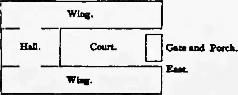
proofs of the passing holiness of the city, which were implicitly believed.
" No scorpion or serpent ever harmed one there, no flies were ever seen about the places.of slaughtering the sacrifices (no carrion bird ever hovered over the housetops), no rain ever put out the altar-fires, no wind ever blew aside its pillar of smoke,” " and its fountains could not be cut off or cor-rupted.”
All because the Holy Temple was here situated.
Since all this sacredness, real and imaginary, originated in the presence and holiness of the Temple, we turn to a more minute description of that edifice.
The temple, at the time of Christ, was that built by Herod the Great It occupied the whole of Mount Moriah, at the eastern extremity of the city, over the valley Kidron. Herod was very fond of architectural display, as shown in the con-struction of his own palaces, on Zion's hill and at Caesarea (B. C. 22), and this fact, coupled with a cunning desire to be-come to the Jews a second Solomon, if not the real Messiah, caused him to undertake the reproduction of the temple, after Solomon. (See article “ Herod,” herein.)
TIME OF BUILDING.—The temple was begun by Herod, A U. C. 734, or 21 B. C. To the original plan, courts and out-buildings were continually added, and we learn by Josephus that works were in progress long after the death of Herod and his several successors, to Pilate’s time; hence the Jews said, "Forty and six years was this temple in building.” The temple of Diana, at Ephesus, was 220 years in building.
SIZE OF THE TEMPLE OF HEROD.—The whole structure, em-braced in what was called " the temple,” was four stadia—one-half of a Roman mile—in circumference. (Diana's temple covered four acres of ground.)
The hill upon which Herod’s temple was built was not leveled, but the building was exacted to suit the southern’and eastern slope of the ground. " The plateau of the successive courts was only secured by building up a wall, from the valley on the south side, of solid masonry over 600 feet in length, and almost equal in height to the tallest of our church spires ”
(Geikie). This was also the case, to some extent, on the eastern side, where its foundation constituted a portion of the wall of the city, over the valley Kidron.
Upon this uneven surface the structure rose, terrace upon terrace, to the centre building, each higher and higher, the last crowning Mount Moriah, white as Lebanon; hence, pre-senting an imposing appearance when viewed from a distance. Beneath the temple were numerous cells, arches, and aque-ducts supplying the various pools in the vicinity.—Recovery of Jerusalem.
SOLOMON’S PORCH.—On the east side there was a straight line of 625 feet, built up from the Kidron valley. On this stone foundation was that part of the temple called "Solo-mon’s Porch.” It was twenty-six feet wide, with double rows of white marble columns, forty-three feet high, extending the entire length, supporting a pavilion of cedars, with a floor of Mosaic stone-work.—Condensed from Josephus.
"THE COURT OF THE HEATHEN," or the “mountain of the house,” came next, within. This extended entirely around three sides of the building. A strong wall separated it from Solomon’s Porch, perforated by five gateways. Gentiles could enter no farther than this court Here were the cattle and sheep-traders, dove-sellers, and money-changers cast out by Jesus, and, on one of the two occasions, the cattle also. It was roofless.
" THE COURT OF THE WOMEN ” came next, extending across the eastern side only. It was a terrace (14 steps) above the last court " The Beautiful Gate ” (Acts 3 : 2-10) opened into it* Here were the treasury boxes, and here the " widow cast in her mite," for women were here permitted.
* "THe Btauliful Galt."—This is the gate so magnificently described by Jo-sephus (Wars 5 : 5,3). After describing nine, covered with silver and gold, he says, "But there was one gate which was of Corinthian brass, and greatly ex* celled those which were only covered with silver and gold. It was fifty cubits high (eighty-seven feet), and its doors were forty cubits (seventy feet). It was • adorned after a most costly manner, as having much richer and thicker plates of silver and gold than the others.'1 It required twenty men to open and close the (tiro?) doors. No beggar, cripple, blind, or any way diseased or deformed person could pass through this gate. • “THE COURT OF ISRAEL" came next above, 15 steps—a cir-cular flight—leading up to it from the " Court of the Women.” This was the court of the men; only the holiest of male Isra-elites could enter. If any one should enter, after thorough ablution, and should recall any trifling unfitness to so do, such as having neglected to wash the hands in a certain way, he must go to the priest and make a " trespass-offering " in atonement. Beyond this court were the halls of the priests, or fore-courts, each place more holy than the last, following which were, first, the " Holy Place,” and the " Holy of Holies "—or “ Most Holy Place "—and between the two was the veil of the temple, rent at the crucifixion. Into this last the high-priest only could enter, and he but once a year.
The temple, in ancient warfare, was considered impregnable. On the east and south the granite of the foundation wall began where the marble of the temple wall left off, and the whole terminated in a rocky, precipitous bank in the deep ravines below. On the north there was another precipitous ravine, but too narrow for complete defence, while the west side was only protected by the thick temple wall; hence at the north and west corner of the temple was erected the tower of Antonia.
“ The whole area enclosed within the temple bounds formed a square of 600 to 900 feet, and over the highest level of this rose the gilded walls of the sanctuary, a building about 90 by 150 feet, the whole surmounted by a roof glittering with gilded spikes to prevent pollution from unclean birds."—Diet Bib. G. 96.
For a description of the riches and magnificence of the internal temple, the reader is referred to Josephus’ Wars, 5 : 5,3, 4, 5,6, etc. • .
The Houses of Jerusalem Are built of limestone, the cheapest material in the country, and set upon “ mountains of rubbish,.twenty or thirty feet high above the natural level.” In fact, almost every present city in Palestine is built upon the debris of older, broken-down houses, temples, and walls. Certainly the whole of ancient Jerusalem is in Hades,* as much as Capernaum (Matt 11: 23). The Pal-estine Exploring Expedition has done much towards estab-lishing many facts respecting the topography of Jerusalem, one of which is that her streets and houses of to-day are very sim-ilar to those of 2,000 years ago.
These houses present on the front a rough, uneven wall, mostly without windows, the apartments receiving light from lattice windows or door, from the open court within. "The ground plot is usually surrounded by a high wall enclosure, forming the house, and sometimes embracing a court, or gar-den. The streets between these enclosures are very narrow, seldom exceeding eight or ten feet in width, and sometimes the houses meet at the top; others are floored over, excluding sun and light from the roughly paved street below. In some instances a building occupies both sides of a narrow street, which runs under a succession of arches, barely high enough to permit a donkey and his rider to pass under. Stone is em-ployed for all possible building purposes; walls, floors, stairs, shelves, and even the ceilings are sometimes formed of flat stones, covered with plaster, for timber is very rare in all Pal-estine. Doors and sashes are about all that can be afforded of a material so expensive as wood.”—Bib. Encyclo.
The Destruction of Jerusalem
TIME—April-August, A. D. 70.
“When YOU see Jerusalem compassed with armies,” said Jesus to His four confidential disciples, “ then know that her desolation is at hand.” ...” For these are days of vengeance, that all things written may be fulfilled,” i. g., written by the prophets.—Luke 21: 20-22.
* Literally " covered over,” or “ in darkness." See Kitto, Bib. Encyclo. See also Hbell,” Smith’s Bib. Diet, "the grave ”—buried.
Malachi was the last of those prophets who predicted the desolation of the Holy City.
" For behold, the day cometh that shall burn as an oven, and all the proud, yea, all that do wickedly, shall be stubble, and the day that cometh shall burn them up, saith the Lord of hosts, and it shall leave them neither root nor branch.”
In verse 5 he calls it:
"The great and dreadful day of the Lord!'
It was to be so “ dreadful ” that Jesus wept in its contem-plation.
He was not thought to be much of a general, or even an engineer, but how exactly did He, on this occasion, as He looked down from the brow of Olivet upon the beautiful city, describe the plan for Titus’ future assault and capture of Jeru-salem and all its people.
” The enemy shall come and throw up a bank (rather, as in the original Greek, ‘ palisade ‘) about thee, and encompass the whole city, and keep the people in on every side, and shall dash them to the earth, and their children within, and shall not leave one stone above another.”—Paraphrase of Luke 19:
41-44Afterward, in describing the horrors of the scenes within those heated walls (Mal. 4: 1), Jesus added:
” Of a truth I say unto you, this generation shall not pass away till all these things (named above) shall be accom-plished ”(21: 32). • The prophecies of Jerusalem’s fall and the end of the Jewish age (Matt. 24: 3), both in scripture and gospel, are so thoroughly established as to require no further reference to them here, but we proceed to show how completely they be-came fulfilled.
In chapter 45.of this work we have fully set forth the fact that the questions of the four disciples on Olivet on that memorable evening related only to the destruction of the city and temple, the time of its coming, and the necessary sign of the end of these things ending the “ Jewish age ” (so revised version of gospels). Let the unbiassed reader examine the records of Matthew (chapter 24) and Luke (21), and decide for himself whether or not " all these things ” have not already been fulfilled. So true is it that they were all fulfilled in John's day, that he passed the whole matter by in silence. He neither mentions in his gospel the threatened destruction of Jerusalem nor the Hades (or Gehenna) to which it was cer-tainly doomed.
John was the one who stood by, who should not taste death till these things should be fulfilled.
The most immediate " sign ” given the disciples by Jesus was to be the gathering of the Roman standards (eagles) around Jerusalem. It is mentioned (Matt 24: 28) in imme-diate connection with the " Coming of the Son of Man"
(27).
Then the Christians were to flee into the mountains of Judea (beyond Jordan) for safety. Of this fact, Dr. Farrar says:
“ Before John of Giscala had shut the gates of Jerusalem, and Simon of Gerasa had begun to murder the fugitives, . . . before the Roman eagle waved her wings over the doomed city, ... the Christians had taken timely warning, and in the little Perean town of Pella were beyond the reach of all the robbery, murder, famine, cannibalism, and extermination, which made the siege of Jerusalem a scene of greater tribu-lation than any that has been since the beginning of the world."
“ Pray that your flight be not in winter.”—Matt 24: 20. The flight of the disciples took place in November, 66.
THE ROMAN ARMY began the campaign in Galilee and other parts of Syria under VESPASIAN, but before completely and finally investing Jerusalem, Nero died, and Vespasian being proclaimed emperor, hastened to Rome, leaving the command of the army with his son Titus, a young man of twenty-eight This brave and accomplished soldier, with 60,000 men, set out from Caesarea, on the sea, on the 1st of April, A. D. 70, A U. C. 823. He pitched his camp on a hill just west of the gate of Ephraim, It was passover week. The city was full of Jews from “ the four corners of the earth.” 20,000 Edomites had just poured into her, and were filling her with robbery and blood-shed.
" Fierce and bloody chiefs were arrayed in deadly strife with each other. Simon, at the head of perhaps the most respectable party, held possession of Herod’s palace and Mount Zion. John, the leader of the Zealots, a band of des-perate robbers, occupied the holy temple and the tower of Antonia, and Eleazar, a renegade priest, led a cabal, who had fortified themselves in the inner cloisters of the temple.
“Titus had sent one of his legions to encamp on the Mount of Olives, but before it could complete its entrench-ments, it was suddenly assailed by both John and Eleazar on one side and Simon on another, and but for the speedy arrival of Titus with reinforcements, the legion would have been en-tirely destroyed. The Jews were driven back across Kidron with fearful slaughter, and compelled to take refuge within the city.”—Israel P. Warren, D.D., etc., Boston.
TITUS next proceeded to put a girdle around the whole city, which he did in three days. He cut down all the trees around on every side, he demolished houses and walls, and with the debris he built a wall five miles in circumference and .the height of a man, and fortified it with thirteen strong towers, in the short space of three days, if we may believe Josephus, who was an eye-witness of all these calamities which befel the " Holy City."
Thus encompassed, her desolation was soon accomplished. And this desolation was not so much the consequence of the great army around her as the conflicting factions within. " Brother betrayed brother, father betrayed son, and children rose up in arms against their parents, putting them to death," just as Christ foretold that they should in these last days.”—Mark 13: 12.
“And the prince that shall come shall destroy the city and the sanctuary, and the end thereof shall be with a flood (of blood), and unto the end of the war DESOLATIONS are deter-mined." • “And there shall be a time of trouble such as never was since there was a nation.”—Daniel 9 : 26, and 12: 1.
“ The misfortunes of all men, from the beginning' of the world, if compared with those of the Jews, are not so TERRI-BLE as were theirs.”—Josephus.
“ The horrors of internal war, followed by pestilence and famine, were such as exceeded all example or conception."—Cambridge Bible.
There can. be no question but that the Jews fought with desperate valor. Again and again did they unite the various factions, and fall desperately upon the well-drilled Roman soldiers, and expel them from their encroachments with ter-rible slaughter. It was only after several of these destructive assaults that Titus resolved to call the demon of war, “ famine,” to bis aid in conquering these desperate foes.
All supplies now being cut off, and the city crowded with people, the horrors of starvation soon began. Josephus tells us that there were 1,200,000 people shut up in the city. They were not all citizens but mostly strangers, yet they were Jews. It was so to be. They did not believe prophecy when it threatened their holy city. Fully two years before this invest-ment Cestius Gallus, with a large army, had begun the siege and abandoned it, and now Titus’ demand to surrender was answered with scoffs and a shower of arrows. But Titus was in earnest, and while the besieged were starving within, the Romans were engaged in battering down the walls and hurl-ing their deadly missiles into the crowded streets. One point after another was assaulted and taken until the temple was reached. This Titus wished to spare. After several attempts to carry it by assault the Roman soldiers gained the roof of the cloisters; but the Jews had- already anticipated this by covering it with combustible material which they now set on fire, and the whole western part from Antonia to the great bridge was burned. On the following day the northern clois-ters were consumed by the Roman soldiers in order to reach the Jews barricaded within the Court of the Gentiles. This was deemed impregnable, owing to the massive walls of solid granite, and the strong gates, covered on the outside and in with heavy silver plates.
During six days the most powerful Roman engines battered at those walls, but in vain. Then Titus in person, seeing how impossible it was to make a breach through the walls, ordered fires to be kindled against the gates, which, by their fervent Beat, melted the silver, and thence communicating to the ■woodwork opened a way to the outer court of the temple.
Still desiring to spare the sanctuary itself, Titus held a six days’ council- with his chief officers, at the end of which the recently paralyzed Jews recovered themselves and made a desperate assault upon the besiegers.
At this juncture a Roman soldier, contrary to his general’s commands, took a firebrand and, mounting a comrade’s shoul-ders, hurled it into the temple, where, lighting among the dry combustible matter in a side chamber, it at once burst into flames. Presently the whole edifice was on fire, and, amid the exultings of the Roman soldiers and the shrieks of rage and despair of the Jewish defenders, the "holy temple,” called “the house of God,” the once inviolable sanctuary of Jehovah, sank to earth to rise no more forever.
A terrible scene of carnage succeeded.
John and Simon, with their soldiers, fled across the bridge , to Herod’s castle, on Mount Zion, leaving the thousands of unarmed priests, women, and children at the mercy of the ex-asperated but victorious Romans.
Six hundred priests sought refuge in a yet unconsumed cloister.
“Their temple is burned,” said the pagan soldiers; "there is no further need of priests,” and they were every one put to death on the spot Six thousand people on the southern cloisters were hemmed in and burned with the buildings.
The intense heat of the dry cedars and the woodwork of the temple caused the stone to crack and break, and the whole mighty edifice soon lay a smouldering, undefined mass.
This occurred on the fifth of August, 823 A. U. C.—Jose-phus’ Wars, 6: 4, 5.
.604 JEWS CAST INTO GEHENNA.
. After offering heathen sacrifice over the ruins of the holy temple, the Roman soldiers turned their attention to the re-maining Jews fortified on Mount Zion. Famished and dis-heartened they were forced to seek a parley with their hated conquerors.
John and Simon came to the western end of the bridge, over the Tyropean valley, and Titus, with his staff, stood on the eastern end, not four hundred feet apart. John and Simon knew not a word of Latin, Titus not a word of Hebrew, but through interpreters the parley began and ended. Briefly it was as follows:
TITUS.—Surrender, and your lives will be spared. JEWS.—We have sworn never to surrender to pagans.
This haughty reply exasperated the Roman general, who answered that they might prepare for the worst, for extermi-nation would surely follow their further resistance.
To carry the fortifications of Zion was an impossibility; therefore Titus erected four great mounds under the eastern wall of Herod's palace—the very building in which Pilate had examined Jesus and declared, “I find no fault in Him.” On these mounds the Roman engines were set up, and heated stones and other deadly missiles were flung into the Jewish garrison. . . . Driven from thence the Jews fled into the three great towers, at the western extremity of the city (Mariamne, • Phaselis, and Hippicus), built by Herod the Great These were connected by underground passages. Here the last des-perate struggle ensued; but the Jews, too weak and exhausted for long resistance, soon were overpowered. The Romans made a breach in the first wall and fell madly upon the stag-gering, famished foe. A few escaped and fled—where? Into the Valley of Hinnom!
Already had 600,000 Jewish carcasses been cast over the southern wall of Jerusalem into Gehenna! They had become so numerous and offensive within the city as to impede the progress and endanger the lives of the Roman soldiers, hence, during (probably) the several days' (20) parley and delay in erecting engines, these bodies had been cast into Gehenna.
Now the remnant of the Jews fled through Siloam and into and over Hinnom," secreting themselves in the caves and vaults as best they could." The wall of Titus circumvallated the hills just south of this valley of bones, preventing all es-cape. Having completed the slaughter at the towers and in all the city, the Romans fell upon the remnant of the Jews and finished them up in the Valley of Hinnom! The caves were searched and the last fugitive put to the sword.
Then Titus razed the entire city to the ground, beginning with the temple, " leaving not one stone upon another that was not thrown down,” as Jesus had foretold; following by destroying the two bridges over the Tyropean valley, leav-ing but a spring of the eastern arch standing, and the western foundation wall of the temple, north of it, now known as “ the Jews’ Wailing-place."
In the hiding of the Jews in the caves and under the rocks of the southern hills, above mentioned, we find a literal fulfil-ment of the words of Jesus, that they should in these last days call for the “Mountains'to fall on them and the rocks to cover them''
One landmark, only, was left by the Roman general—
“ I wish to show to the world," said Titus with no little pride, "what was the strength of the city, which only Roman valor could subdue."
The tower of Hippicus was therefore left standing. It is called, erroneously, the “ Tower of David."—See illustration, page 52.
Simon and John were captured alive, and carried to Rome to grace the victor's triumph, according to Roman custom. Some thousands were sold as slaves, others were distributed among the theatres to fight wild beasts, or as gladiators.
So perished the Jewish Nation I ♦ “And they who do not fall by the sword shall be led away captives unto all nations, and Jerusalem shall be trodden down of the Gentiles."
* History of the Jews; Josephus’ Win; Dr. Schiff, Dr. Israel P. Warren, and others.
The Sanhedrin
“ MORE properly Sanhedrin, the supreme judicial council of the Jews, especially for religious affairs.”—Bib. Encyc., Kitto. “This council consisted of a president, who was the high priest, and seventy councilmen. These latter were chosen of the most eminent priests, and scribes (and elders) of the people, who were chosen for life, but each of whom had to look to his own industry for support.”—Dr. Jost These are the " priests,” “ elders of the people" and “scribes” of the gospels. Once they are called "doctors"
—in Luke 2: 46. It is with the Sanhedrin of the time of Christ that we have to do here. Its origin is not clear.
" The Sanhedrin had power to try capital offences, but it had no power to execute the sentence of death.” John 18:31 —Andrews. This power had been taken from them by the Roman government.
“ The 4 Tabern,’ where they establish their sessions, were shops near the gate Shusan (door into the temple) and so connected with the temple. They went up to that room where they usually met" (Greswell, Krafft, Andrews, 508). In emer-gencies they might meet at the high-priest’s house.
The " chief priest" of the gospels is one, the head, of the ecclesiastical power of the Jews, but the “ chief priests" were the heads of the twenty-four priestly classes (Dr. Ab-bott). “The scribes" were the rabbis (fathers) who were learned in the literature of the church, both scriptural and traditional. A “ lawyer ” was equivalent to the title of scribe.
—Dr. Smith.
THE SANHEPRIN BEFORE WHICH JESUS WAS BROUGHT, on the night of April 7, A. D. 30, was as follows:
The members sat in a semicircle, on mats, with their bare feet crossed before or under them and heads turbaned. The president, 1. e., chief priest, CAIAPHAS, in full costume, sat in the centre; the vice-president, Annas, sat at his right hand (Talmud); Gamaliel, the venerable “doctor of the law (Acts 5: 34) and a Pharisee,” may have sat at the left hand; John and
THE SANHEDRIN
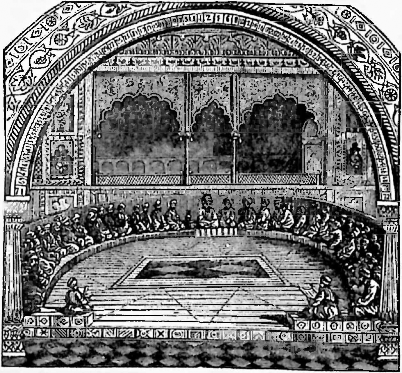
Alexander (Acts 4: 5,6) may have come next, followed by the five sons of Annas—Jonathan, Eleazar, Matthias, Theophilus and Hannas—the five brothers, perhaps, hinted at in the parable of Dives and Lazarus, “ and as many (others) as were of the kindred of the high-priest" (Acts 4; 6). Nicodemus (John 3:
1, and 19: 39) and Joseph of Arimathea were " honorable " members of this body, but “ who did not consent to its evil council and deed." Geikie suggests the presence of Joazar and Eleazar, brothers of Mariamne the second, “ the belle of Jerusalem," wife of Herod the Great.
At each end of the circle sat a “ scribe,” who recorded the proceedings (Dr. Abbott). "As we have seen, already, the three classes of persons (chief priests, scribes and elders) con-stitute the component part of the Sanhedrin; the former being the heads of the twenty-four courses of priests.”—THEO. D. WOOLSEY, D. D., LL. D.
THEIR PLACE OF ASSEMBLY was in the hall Gazjith (Talmud), supposed to be at the south side of the temple (Lightfoot). From Acts 5 : 17-19-21-22 we learn that this hall was not in the temple, for while the apostles were preaching in the tem-ple, the Sanhedrin were waiting for them in their council-chamber. The captain of the temple there brought them word from the temple.—Acts 5 : 24.
A preliminary session could be held at the high-priest's palace.
Before this council Jesus was brought, and later, Peter, John, Stephen, Paul and other Christians. The power of the Sanhedrin extended over all Palestine, as far as Damascus. Thither they sent Saul, commissioned to capture Christians and bring them to Jerusalem.
Pharisees
These claimed to be the dominant religious party in the time of Christ. THE NAME is derived from a Hebrew word meaning “ separated." They pretended holiness above all other men, and publicly thanked God for it (Luke 18: 11). They numbered 6,000 in Judea.
The teachings of Jesus, from first to last, were antagonistic to the Pharisees. On more than one occasion He warned the Twelve against imbibing their views. It was too much like leaven to be exposed to the pure loaf. He called them hyp-ocrites, lovers of money, lovers of praise, lovers of the highest seats at table and in the synagogue, liars, robbers of widows and orphans, and held up their religious views to open and just ridicule.
Whatever other point one may see in the “ parable ” of the rich man and Lazarus, the main one is ridicule of the Phar-isaical religious belief. Luke has recorded it (16: 14, 15, 19, 31). Verses 16, 17 and 18 belong elsewhere. The Phari-sees (14) were scoffing at the pure teachings of Jesus, and in retaliation He said, “God knows your hearts, and that which you exalt is an abomination in the sight of God." Omitting the next three verses, He went on to show up their abomina-tions in their religious “ esteem,” and related the parable known as the “ Rich man and Lazarus.”
We hardly need proceed to show that the story embodied these self-righteous, Pharisees' belief, Borrowed, in toto, from the heathens about them, particularly from the Persians. If it had been sound doctrine, Jesas would have had no occasion for introducing it to illustrate their “abominations ” (v. 15); neither under their “scoffings” (14) at His pure teachings (13), would He have introduced their religious dogmas in contrast.
The Pharisees, while claiming to be followers of their father Abraham, had corrupted this simple monotheism, a faith in one God, the Maker and Governor of all things, into the most absurd and untenable of Parsee dogmas.
Zoroaster, whom Aristotle and Eudoxus place 6,000 years before Plato, or 8,300 years from the present period, taught that there was but one God, pure and loving, just like Abra-ham's God; but through the later false interpretations of the priests, it became, at last, a dualism, or a dogma of many gods. After the bounds of monotheism were past, gods were easily multiplied.
When the Hebrews were carried away captives to Babylon, they recognized but one living God—Jehovah. This is a biblical and a historical fact. On their complete restoration, and in the time of Christ, we find them ver.- thoroughly im-bued with the dogmas of their captors. From this time to their destruction, the Pharisee and Parsee religions were very similar.
The Parsees had a “ gar-demana (heaven), and a drajo-demana, the residence of devils and the priests of the Deva relig-ion.” “Between the two there was a bridge (Luke 16: 26), over which the souls of the pious only could pass.”—Cham-bers' Encyclo.
“ Paradise is a word of Persian (Parsee) origin,. hence it came to be employed in Jewish popular belief as the name of that portion of Hades, or abode of the dead, into which the saints were believed to enter to await final judgment"—Dr. Abbott.
Hades is a Greek word signifying “ unseen," the region of the dead, according to the classic writers, and was partitioned off into a wretched prison-house for the wicked, and an elysian abode of the blessed. In scripture it is the general abode of the dead.
But the Pharisees, after the return from captivity, at which period they originated, in order to make the abode of the wicked (i. e., those not of their views) as uncomfortable as possible, had added to this Greek Hades the eternal fire doc-trine of the later corrupted Parsee religion, and had partitioned it from paradise. That the good might enjoy the “torments ” of the bad, these two places, heaven and "hell,” were placed, to reasoning minds, most uncomfortably near each other. Talking across the chasm was not prohibited (Luke 16: 23). Meantime the sinful body rested in peace in the grave (verse 22).
Rev. Charles H. Spurgeon, D. D., LL. D., objects to this, and proposes a "twin hell," saying, "It will be unjust to pun-ish the soul and not the body, for the body has had as much to do with sin as ever the soul had" (Second Series of Ser-mons, p. 273). This needs no comment.
Paul was a Pharisee; after becoming a Christian he quotes:
" O grave, where is thy sting?
" O Hades, where thy victory ?" and drops the Pharisees* hell.
Peter seems to have believed that our blessed Lord lay in Hades (some thirty-six hours in the tomb) when he quotes David literally:
"My flesh (Jesus')shall tabernacle in hope, “ Because thou (God) wilt not leave my life in Hades.”
Luke, discarding the Pharisees’ hell, says that Christ was not left in Hades, nor did his flesh see corruption.—Acts 2:31.
Therefore we may understand that these three Christian believers, while using the word Hades, divorced it from its Pharisaical meaning, whereas those who became proselytes to the Pharisees' belief were " two-fold more the child of Ge-henna than themselves " (the words of Jesus).—Matt. 23: 15.
Josephus describes the Pharisees as a "party who made men believe they were holier than their neighbors.”—Antiq., quoted by Geikie.
Thus, in irony, Jesus said to the Pharisees, "I came not to call the righteous but sinners to repentance.”
" He trampled on their rules and customs; He cleared away their rubbish, to them like precious jewels, that pure religion might have free course and be glorified.”—Peloubet.
Observe the difference between Pharisees’ Teachings and Christ’s Teachings.
They fasted often.
They made long public prayers.
They followed traditions. They cast out " sinners.”
They despised the poor.—Talmud.
They loved money, and robbed widows and orphans for it.
They were slaves to the Sabbath law, which they perverted.
They neglected the sick and lame. They degraded womankind.
They created a Hell.
Christ prescribed no set fasts.
He prescribed no formal rules of prayer.— Geikie.
He avoided and despised them. He came to save them.
He was the friend of the poor.
He condemned them for their covet-ousness.
Jesus said “the Sabbath was made for man, not man for the Sabbath.”
“ Christ healed them all.” He has elevated them.
He permitted them to enjoy it!
Sadducees
Their name was, probably, derived from Sadoc or Zadok, and dated back to the time of Ezekiel. They were a priestly race (Acts 5: 17), proud and arrogant, and though few in comparison with the Pharisees, their opposites in religion, “ they held the highest posts in the Jewish State.”—G.
They were not opposers of the Roman government like the Pharisees. The latter carried their ends by force of number and stubborn fanaticism; the former by the power of wealth, cool calculation, and keeping in with the government. When Herod wished to place Simon Alexander Boethus in the high-priest’s chair, to please Mariamne, Herod's beautiful young wife, the Sadducees consented against the Pharisees dis-senting.
” The leading tenet of the Sadducees was the negation of that of their opponents, the Pharisees ” (Dr. Smith).—Acts 4: 1 and 5 : 17.
Jesus never assailed them, but when they came to Him with their questions (Matt. 16: 1 and 11) He warned the Twelve to avoid their teachings. On another occasion the Sadducees united with their opponents in asking another question, rather to confound the Pharisees than to worry the Lord, when He gently rebuked them, and explained wherein they erred in denying a future existence. They taught that death ended the whole man (Josephus 2: 8, 14; Matt. 22: 23). As bad as was this belief it was better than that of the Pharisees, whom Christ continually denounced as " hypocrites.”
THE HERODS OF PALESTINE. FIRST—0 HEROD THE GREAT."
HEROD was the son of Antipater, of Idumea, and Cypros, an Arabian woman of the nobility. Thus were united in this crafty monster the bloods of the cruel Edomite and fierce Arab, forming the worst of all human beings, the BEDOWIN.
When only fifteen to sixteen years of age Herod received the chief command in Galilee, while his elder brother Phase-lis was appointed governor of Judea. The times were favor-able for the development of the character of Herod. Galilee was infested with bands of robbers, especially about the Sea of Galilee and the mountain passes leading therefrom.
“ The caves of Arbela,” on the way from Capernaum and Magdala, across the western country, were most famous for being the resort of large bands of robbers. In this pass, a deep gorge, where the rocky cliffs lifted their steep, rough sides hundreds of feet upward, these banditti had hewn out immense caves, connected them by narrow passages, and in this stronghold had for years defied the government Herod came, he saw, and he conquered, Josephus, in his usual graphic style, has given us an inter-esting account of Herod's manner of reaching these “ dens of robbers,” by lowering over the frightful precipice great vans of soldiers into their very midst. By fire, smoke, and the sword the last robber was expelled, and Herod derived great eclat for his grand achievement. (Jesus and the Twelve have HEROD AS A WARRIOR. §15 repeatedly passed up and down this gorge to Cana and Naza-reth.)
Herod's restless nature did not permit him to rest here, but •with Bedowin fury he fell upon Hezekiah and his band of Jews, whom Herod treated as the enemies of Rome, classing them with the common banditti, whose fate they shared.
They had been, however, upheld by Hyrcanus, the high-priest, and the great Sanhedrin, then in full power, which body summoned Herod to answer before them at Jerusalem.
Securing Galilee behind him, the young chief, clad in royal apparel, mounted his swift steed, and followed by a grand retinue, rode boldly into the Holy City. At the appointed hour, backed by armed attendants, he appeared before the august body, which with but one dissenting voice acquitted him.
With tribute from the Galileans, Herod purchased the gov-ernorship of Upper Syria and Samaria. As a Roman citizen on one hand and a mongrel Jew on the other, he hoped by force, intrigue, and conciliation to gain mastery of all Pales-tine.
The invasion of Syria by Antigonus, in behalf of the dynasty of the Asmoneans (Maccabeans), was brought about By force and cunning Antigonus captured Herod’s brother Phaselis and Hyrcanus, but Herod escaped to Rome. First he fled to Joseph at Masada, on the Dead Sea, where in the strong fortress he left his family, and fled on to Egypt by the way of the wilderness. Cleopatra received him kindly, and offered him a high position in her army, which Herod declined with thanks, having higher aspirations.
Starting again for Rome over the great sea, he was over-taken by a storm and his bark wrecked near Rhodes. Noth-ing daunted, he obtained another ship, in which he arrived safely in Italy, B. C. 40.
Augustus and Antony were both in Rome, before whom Herod presented his cause so skilfully as to win their appro-bation, and secure the appointment of “ King of the Jews."
Seven days later, “having been formally installed in the temple of Jupiter Capitolinus with the usual heathen sacri-fices, Herod was on his way back to Palestine, and the cause of Antigonus was doomed.”—Geikie.
Flanking Jerusalem and the Maccabean army, Herod arrived at Jericho, where he gathered a nondescript army, Silo, the Roman general, having been bribed by Antigonus. At this juncture Joseph was killed in battle, and Herod being maddened with the successive losses of his family, left Jericho and fell with his usual fury upon the united forces of the Jews, Romans, and Parthians (hired by Antigonus), and swept them from the land. Jerusalem only held out against him. This city he soon after invested with his nondescript army of Sa-maritans, Idumeans, disaffected Jews, raw conscripts, and mer-cenary veterans, who only fought for hire.
Against these were pitted fanatical Jews and veteran sol-diers, behind the strongest fortifications known to ancient engineering. But the genius and almost superhuman energy of Herod prevailed, and Jerusalem fell into his hands on June 10, B. C. 37.—Josephus.
Antigonus was captured, and after suffering many indigni-ties, was cruelly put to death.
Hyrcanus, whom Antigonus had banished to Seleucia, after having cut off his ears, to disqualify him thereafter as high-priest, was recalled by Herod, who had married Mariamne, "the fairest woman in Palestine,” granddaughter of the unfor-tunate old man. Hyrcanus lived in Jerusalem until B. C. 30, when falling under suspicion of intrigue, he was quietly put out of the way by order of this new " King of the Jews.”
One by one the Asmonean family fell sacrifice to Herod's jealous fears. Even his own family were not spared if the shadow of a suspicion fell upon them. His kingdom was thus established in blood.
In the magnificence of his court, the splendor of his public buildings, and the extent of his territory, he determined to outshine his predecessor David; and since through that wor-shipful ruler of the Jews, a mightier king was about to appear, might not Herod be accepted by them as the promised Mes-siah ?
As a conciliatory measure Herod married as a second wife the lovely Mariamne, a Jewish maiden, and the daughter of a priest, Boethus by name, whom Herod made high-priest. In her honor he erected and named one of the three great towers beyond Zion's hill. Antony fell desperately in love with " Jerusalem’s beauty " by merely seeing her portrait. Though Mariamne was Herod's favorite of ten wives, he caused her to be put to death, after bearing him a son (Philip I.), and thus she was kept from the embrace of the lecherous Antony. Aristobulus was also killed.
A side act to this play was as follows: ■ Alexandra, the mother of Aristobulus and Mariamne, desiring her son to be made high-priest, but disappointed therein, sought for revenge, and sent the portrait of Mariamne to Antony, then basking in the smiles of the lovely Cleopatra in Egypt. In an officer of Antony she found a willing tool, for this general desired Cleopatra for himself, and readily un-dertook Alexandra’s commission. So far the plan succeeded, Antony falling in love with the fair Jewish queen, then in her youth and beauty. Antony sent for Aristobulus first, which so alarmed Herod that he deposed the present high-priest and placed Alexandra's son, then but seventeen years of age, in his place. But as related, both were murdered by the order of Herod.
This Mariamne was the grandmother of SALOME, who danced before Herod Antipas, for John the Baptist's head.
Amid all these tragedies, revolts among his subjects, and supplying the exhaustive demands of Antony and Cleopatra for tribute, Herod fell to building magnificent fortifications, palaces, and even whole cities.
CASAREA, on the Mediterranean Sea, with a “palace of snow,” elegant promenades, grand public buildings, strong stone quays for shipping, and houses almost numberless, rose as if by magic at his word of command. Jerusalem was for-tified, and the “Temple of the Jews" erected on the wallsand over the spot of the “ Temple of Solomon." The great bridge spanning the Tyropean valley was his designing.
At Jericho Herod's genius for building splendid edifices was no less exemplified. The old Asmonean palace was repaired, and a new palace of marble erected on the only elevated spot in the city, and both surrounded by magnificent gardens, the envy of kings.
Antony was now dead, and Augustus was named “ Ruler of the World.” Every great thing done by Herod was now to flatter this august ruler. Caesarea was named in his honor; Samaria, rebuilt by Herod, was called Sabaste; at Panias, the old heathen city of PAN, he built another palace, enlarged the city, and named it Caesarea Philippi.—See Philip II.
Beside the temple, the bridge, the royal palace on Zion’s hill, the three great towers, named in honor of his friends, Phasael, Hippicus, and Mariamne, Herod erected the tower of Antonia (possibly only repaired it), repaired the walls and gates, and built outside of these a magnificent theatre and dens for wild animals adjoining, and repaired the pools and ancient aqueducts of Solomon.
The consternation of Herod on the announcement of the "wise men" that a new king had been born to the Jews is already mentioned.
Herod is said to have died a most wretched, lingering death at the advanced age of seventy, and after a long reign of thirty-seven years. He had in his last hours arranged for a general mourning after death, but his intended wholesale slaughter of nobles miscarried, and his miserable end was the occasion of a more universal rejoicing.
Herod ANTIPAS was a son of Herod the Great and Malthace, a woman of Samaria. ARCHELAUS was own brother to Antipas. PHILIP HEROD II. was half-brother to these. On the death of their father his kingdom was divided between them ; Archelaus was tetrarch of Judea, Antipas of Galilee, and Philip II. of North-ern Syria. There was another half-brother, Philip I., whose mother was the beautiful Mariamne. He lived at Rome, a private citizen, whose wife was HERODIAS, and their daughter was SALOME, who danced for the head of the unfortunate Baptist.
Antipas entered his government at the age of seventeen. Jesus was then an infant of about two years of age, and John the Baptist six months his elder. Antipas rebuilt the city of Sepphoris, making it at first his capital. He afterwards aban-doned it, and built the fairer city of Tiberias, on the Sea of Galilee. South of his borders, over the river Jordan, lay the territory of Aretus, king of Arabia. To secure peace in that direction, Herod made overtures for and married this Arab’s only daughter—name unknown. .
In ten years from accession, Archelaus was banished to Gaul (759), where he died (Dio Caesius), and Antipas, as son of Herod the Great, began to assume the title of " Herod,” and aspire to the kingdom of his father. His coins date from this period.
Augustus Caesar died four years later—August 19th, A. D. 14, in the year of Rome 767, and Tiberius became his suc-cessor. Herod’s ambition hereby received a new impetus. It was at this time that he built the new city Tiberias, and named it in honor of the new emperor. The city was built in the Roman style, and adorned with pagan images, especially offensive to his Jewish subjects. The palace was built and adorned with imperial splendor; the gates and doors were of Corinthian brass, worth almost as much as pure gold. The architecture of his palace was also Roman, and the silver-plate and table-service—carried away at the primary assault of the Jewish war—were of great richness and value. In this palace was a grand banqueting-hall, where Herod, with his lords and generals, held high carnival. In this hall, I have no doubt, Salome " danced before the king " on the occasion of his birthday (Matt. 14: 6). Josephus gives us the name of Salome.
Dissatisfied with his title of tetrarch, Herod went to Rome to visit the emperor, “ seeking a kingdom."
While in the imperial city he was the guest of his brother, Philip I., and his wife, Herodias. Failing of gaining his kingdom, Herod captured his brother’s wife, who, with her young and handsome daughter, Salome, he carried back to Galilee. If his father could marry ten wives, could he not wed two ?
HERODIAS was the daughter of Aristobulus, in the direct line of the Maccabean priests, being granddaughter to Hyr-canus, and own daughter of the beautiful Mariamne, wife of Herod’s father. Thus Herodias was Herod's (Antipas) niece, and half-sister (in law). Does not Dr. Geikie err in saying that Philip I. and Herodias were in Jerusalem (A. D. 26 or 27) at the time of Herodias’ elopement ? Philip was brought up in Rome, where Herodias and Salome were reared and educated. Josephus (Ant. 18: 5, 1) tells us of this visit of Herod to Rome. Farrar says (ch, 28) that Philip was living as a private person at Rome, with Herodias, his wife, when Herod came and carried her off. (So Andrews.)
When, with his “ unlawful prize,” Herod reached his palace in Tiberias, his lawful wife fled to her father for redress. The fierce Arabian king speedily made war upon his polygamous son-in-law, and with 20,000 men invaded his tetrarchy, inflict-ing upon him great loss in both population and territory. In fact, Herod only escaped entire overthrow by appeal to the emperor.
Jesus thus, in one of His Perean sermons, refers to Antipas’ folly:
" What king is so foolish as to make war with another king, until he sit down and council whether with 10,000 men he can cope with the king coming against him with 20,000? Will he not rather, while afar off, send embassadors asking conditions of peace?”—Luke 14: 31,32.
For once the “ foxy ” Herod had lost his cunning.
Herod was about fifty years of age, and Herodias thirtyfive.
Their further sins and follies, in the imprisonment and mur-der of John the Baptist, the visit to Rome, again " seeking a kingdom,” their exposition before the emperor, and subse-quent banishment to Gaul, and death, are already referred to in the body of this work, as also in the articles “ Salome " and " John the Baptist” As bad as Herod was, he was an im-provement on the stock of his father. He reigned over Gali-lee forty years. His territory fell to King Agrippa.
The Herodians
These formed a new political party in the reign of Herod Antipas. This tetrarch was ambitious of becoming king of the Jews, and successor to the entire kingdom of his father, Herod. This plan Herodias had undertaken with Herod. First, by marrying her daughter Salome to Philip, the quiet ruler of Northern Palestine, who in due time could easily be .disposed of; and, second, by creating a strong political party among the wealthy Jews who should favor Herod’s claims to the crown of Herod the Great; and, thirdly, by a direct appeal to the emperor.
All these plans she carried into execution, though the im-mediate result to herself and husband miscarried.
The Herodians first appear in Mark 3 : 6, and are confined to Galilee, but afterward spread to Judea.—12: 13; Matt 22 : 16; Luke 20: 20.
The growing popularity of Jesus, a subject of Herod, living in his jurisdiction, was presented to the Herodians of that district (Mark 3: 6) by the Pharisees. Doubtless the latter hoped to persuade Herod’s friends that Jesus would soon be-come a dangerous rival to the aspirant king. In this the Pharisees were unsuccessful. Later the Sanhedrin, at Jeru-salem, made a similar attempt to use the Herodians as a cat’s-paw. They evidently persuaded these Herodians attending the passover that Jesus had spoken against Herod, calling him a " fox,” and objecting to tribute (Matt 22: 16-22). This also miscarried.
The Herodians increased in power yearly till in A. D. 37 they obtained their ends in the election of Herod Agrippa as their king.
Salome, Herodias, and Mary Magdalene
A PRINCESS, A DANCING GIRL, AND A QUEEN
A ROMANCE AND A TRAGEDY
(From *' Romances of Rellgions.")


SALOME
ONE of the most notorious women mentioned in the gospel, and of whom its record is of the briefest, is Salome, the daughter of Herodias. Even her name is omitted and we only learn it through Josephus.
Salome’s father was Philip I., a son of “ Herod the Great" by Mariamne, the celebrated "Jerusalem beauty," and the “ fairest woman in the world.” So dazzling was the beauty of Mariamne that Mark Antony fell in love with her from merely seeing her portrait To keep her from falling into the embraces of Antony, Herod, her husband, ordered her mur-dered ! She escaped for a time, but was afterward beheaded by his order. Mariamne was tall and graceful, with a “ face of the brightness of an angel,” and ” her memory was held sacred among her people."
Salome, as is related, was the daughter of Herodias, a woman as fierce and unprincipled as she was fair and volup-tuous. Her father was Aristobulus, in the line of the great Maccabean priests, and half-brother to Herod Antipas.
Salome was born and educated in Rome.
When at about the age of fifteen, her mother being about thirty-four, Antipas, tetrarch of Galilee, went to Rome, to pay honors to the emperor. While there he remained the guest of his half-brother, Philip the First The wife of this Philip was Herodias, and Salome was their daughter. Antipas had left a wife at home in Tiberias.
In spite of these facts, and the law of hospitality, which Antipas was duty-bound to respect, he became criminally enamored of the fair Herodias. So completely did this am-bitious woman ensnare the weak and unprincipled “ king ”—as Antipas was called in honor of his father—that, on his return to his government, he gave permission for Herodias to accompany him.
Packing her jewels, among which was Salome, her fair daughter, just in the bud of womanhood, Herodias sailed with her paramour for Tiberias, his new capital, where she became his " unlawful wife."
“ Everything combined,” says Canon Farrar, “ to make this act as detestable, as it was ungrateful and treacherous. He-rodias being the daughter of the half-brother of Antipas, was not only his sister-in-law, but also his niece; so he was both guilty of adultery and incest.” The disgrace of this act re-flected so severely upon Philip, as to exclude him from any interest in his father's possessions, and he remained a recluse to the day of his death. Thus the innocent often suffer for the guilty.
On the return of Antipas to his palace, his lawful wife fled to her father, Aretus, king of Arabia. This fierce and power-ful emir precipitated a war upon the author of his daughter’s disgrace, taking away a portion of his territory, and Antipas only saved his kingdom by an appeal to Caesar at Rome. But the lost territory never was recovered.
Did not the Lord Jesus refer to this historical fact when He said, • “ What king going to war against another king will not first sit down and calculate whether he is able with ten thou-sand men, to meet him who comes against him with twenty thousand?"—Luke 14: 31,32.
This was the exact case of Antipas and Aretus.
Speedily the fruits of this “ unlawful ” marriage sprang up to embitter the tetrarch’s declining years, he being at the time nearly fifty years of age. Herodias had not married him so much for affection as ambition. War with the fierce Arabian emir, in which Antipas was so shamefully beaten, was only the beginning of his sorrows.
Childlessness was the natural result of so close an inter-marriage...............
Herodias was not permitted to rest in peace in the king’s palace. Brief was the enjoyment of her ill-gotten acquisition. There arose against her a terrible accuser in the person of “ John the Baptizer.” It would seem that this strange man, " clothed in camels' hair " and living on the " locusts and wild-bees’ honey” of the wilderness, and Antipas, clothed in royal purple and dwelling in “kings' palaces," were mu-tual friends, and that the latter paid more respect to the opinion of John than of any other living man, the emperor accepted.
“ It is not lawful for you to have your brother’s wife," John had openly and honestly said to Antipas, during conversa-tion.
How this accusation reached the ears of the jealous Herod-ias does not appear, but when she heard of it, she arose in her frenzy, and took an oath to slay the author of it.
" He has utterly destroyed my peace," she well may have said, " and brought reproach upon the head of my fair daugh-ter."
Her lord was unable to appease her, and to save John from her murderous intention he lodged the baptizer in prison. Yet not in a subterranean dungeon, but in a “ safe" room near his own person, where he often talked with him, and ministered in person to his needs, and “ heard him gladly." A correct translation of Mark is as follows:
“ And Herodias set herself against him (John) and desired (t. e., persistently sought) to kill him, but could not, for Herod feared him, knowing that he was a righteous man, and so kept him safe,” that is, kept him from Herodias’ reach.
To this place John’s disciples had free access, which I have no doubt was in Tiberias. It could not have been in the castle of Machaerus down east of the Dead Sea, according to Josephus, since Antipas’ foe, the king of Arabia, held that fortress at that time.—So Geikie; Andrews.
"A WOMAN SCORNED.”—But Antipas* was no match for Herodias. The woman who had ensnared him could be expected to manage him afterward. "Against John she held an inward grudge.”—Maclear. g28 SALOME APPEARS AN ACTOR.
She was “ a woman scorned," the equal of whom “ Hades has no furies," according to William Shakespeare.
At last, after waiting a whole year, nursing her wrath, "a convenient day came” for.Herodias to carry into execution her plans. .
“ It was on the king's birthday.” * Salome Appears an Actor.
As a rare actor is not hurried upon the stage at the first act, but kept in reserve to heighten the expectancy, so Salome, who played the principal part in this tragedy, does not appear upon the boards until Herodias had matured her plans for the murder of her hated foe.
Without the aid of the fair Salome the tragedy could not proceed to its bloody consummation.
“ On the first of Nisan the king will celebrate his birthday 'before his lords, his high-captains (commanders of thou-sands), and the chief men of Galilee,’ ” said Herodias to her daughter.
“ Where will the festivities take place ? ”
“ Where, indeed, but in his new palace, and in his new cap-ital, Tiberias,” Herodias well may have answered. Sipporis had been his capital, but this new city of Tiberias, situated on the western shore of the blue Galilee, was just completed, hence the double importance of this birthday festival.
" Then may I see the grand lords and ladies in their beau-tiful costumes ? ” There is nothing more probable than this was the first desire of Salome.
“ Upon one condition.”
" Name it, and it shall be done."
"Within the strong room of the palace your father (by courtesy, let us say) keeps secure from my reach the man against whom I retain the deepest grudge, and whom I have sworn to destroy. Of myself, I cannot reach him, but you can.”
*An appropriate season, the first of April, "All fools’ day,” an ancient relic, even in Herod’s time.
SALOME PERSUADED. 629.
“ I ?—I reach him whom you cannot?"
“ With your grace of person and beauty of feature you may rule the world, my daughter.” “ But how, mother mine ? ”
“ I will instruct you beforehand (Matthew). In the midst of the feast, when the king shall be exhilarated with much wine, go you in before him, and 4 his lords and high-captains/ and dance.”
” Dance! ” exclaims the daughter, in amazement “ Yes; dance.”
“A princess, the granddaughter of Herod the Great, dance before men ? It is only degraded females who, at this day, take the timbrel in hand, and, half nude, go before men and dance,” exclaimed the fair Salome, in shame and alarm.
“ Dancing, my child, is held not lightly among the Jews, but is rather a symbol of rejoicing at festivals,” said Herodias.
" Indeed; but, like the musicians at present, the office is filled by common if not immoral persons,” replied Salome.
In the vocabulary of Herodias there was no such word as “ immoral,” and in refutation she said:
” Miriam, the sister of the Hebrew leader,. Moses, took a timbrel * in her hand, and all the women of Israel went out after her with timbrels, and dancing. David danced before his god, naked, and history is full of examples of the pro-priety of the dance at scenes of great festivities,” Herodias argued.
41 Did not the fair Michal, the daughter of a king, and the wife of this lusty David, keep aloof, and peeping through her closed lattice behold with shame the nude condition of her husband, dancing with equally nude and, perhaps, professional female dancers ? ”
44 She did,” Herodias replied,44 so runs the story; but was punished for so doing as having thereby committed a greater impropriety. There can be no misconstruction placed upon your simple act, in going in before your father (by cour-tesy) and gladdening his heart by dancing before -him on "Tambourine, with belli, similar to the present in use.. his birthday. Therefore let it' be done,” and Herodias pre-vailed.
The gospel account, though brief, warrants us in saying that very similar conversation to the above must have taken place between Herodias and Salome, before the latter could have been brought to consent to the shameful act of assuring the character of a common dancing-girl.
” Her own daughter," says Professor Schaff, “ was put to the degrading office of a common dancing-girl for the accom-plishment of her (the mother's) malignant purpose."
" The oriental dance," says Dr. Morrison, “ was of a liber-tine character, and seldom appreciated unless it made irrup-tions across the borders of decency.”
"A luxurious feast, of the period," says Dr. Farrar, "was not regarded as complete unless it closed with some gross pantomimic representation; . . . but Herod had not antici-pated for his guests the rare luxury of seeing a princess, his own niece, a granddaughter of Herod the Great, and of Mariamne (the loveliest woman in the world), a descendant of Simon, the high-priest, and in the great line of Maccabean princes; a princess who afterwards became the wife of a te-trarch and the queen of Chaicis, honoring them by degrading herself as a scenic dancer."
“ What is to be gained by this gross act ? " Salome might well have inquired of her persistent mother.
" When the king sees your desire to please him he will, as is the custom, and as duty bound, offer you a choice of gifts within his means," replied Herodias.
" If so, for what shall I ask ? "
How much circumlocution Herodias may have resorted to before she approached the real subject desired, is not easily imagined. But approach it she did, saying:
"Ask for the head of John the Baptizer." ♦ What must have been the moral education of this young girl, under her characterless mother, in order to receive the above announcement with any feeling short of horror, and to "She was BO instructed beforehand,—Mall. 14: 8. become the willing instrument for carrying it into execution, can only be faintly conjectured. Foul enough, surely.
The head of her mother's foe was no reward to Salome, therefore the mother must have promised her a distinct re-ward for the degrading and monstrous service to be per-formed. • “ Whatever you desire I will give you, even to a tetrarch for a husband, and you shall dwell in a palace of your own—at Bethsaida—but do this for me which I alone cannot accom-plish," must have been her promise to Salome. Such, at least, she soon after succeeded to, that is certain, for she im-mediately after became the wife of Philip the Second.
Well did Herodias time her drunken lord, as well as to esti. mate his relish for the voluptuous.
The dancing would take place over against the vacant part in the square formed by the couches—“ in the midst of them" the text reads. A triclinium is a three-sided couch, forming a square, with the fourth side open. It was doubtless in this space that she danced.
Salome before the King and his Lords.
Salome, dressed for the occasion—or rather shall we truth-fully say undressed for the occasion ?—timbrel in hand, with tiny bells on her slender wrists and ankles, as was the custom for all oriental dancing-girls, sprang into the banqueting-hall, and “into the midst" of the revelling “ king " (Mark 6: 22) and his equally convivial “ lords and high captains."
“ The dress of the performer, like that of the dancers of our ballet,” says Geikie," was planned to show off the beauty of the figure to the greatest advantage."—Geikie’s Life of Christ, article, “ Herodias."
Judge of the surprise and admiration of Antipas and his royal guests on beholding this vision of beauty floating before them in the giddy mazes of the oriental dance.
After having witnessed this shameful exhibition of the charms and graces of his niece, the king arose from his re-cumbent position at the triclinium, and said to her:
"Ask of me whatever you may, and I will grant it”
“ Flushed with flattery, inflamed with wine, the king felt in his most magnificent mood, and wished to make the elegant danseuse the very best present she could desire.”—Morrison.
She hesitated. The words which she had, like a parrot, been instructed to repeat paralyzed her tongue. Well they might!
With an oath, the king repeats his promise.—v. 23.
“ Whatsoever you shall ask, I will give, even unto half of my kingdom.” * “ Give me here" she said—meaning now, on the spot, before you get sober and retract your rash promise—“ give me here the head of John the Baptist in a charger.”
’The shock was terrible even to a drunken king, " but for his oath's sake, and the sake of those who sat at meat with him, he would not retract,” and he “ immediately" then and there, sent forth a soldier of the guard {one only) to bring in from the prison the head of John. There could have been no delay.
The whole record of Mark implies that the prison was near, and that the deed was accomplished immediately. .
Probably Salome went on with the dance till the soldier re-turned with the reeking, steaming, ghastly present.
Everything implies that the deed was completed with inde-cent haste. The very " household dish ” in which the head was brought shows that its ghastly contents was conveyed no long distance. It was given to the damsel on the spot, who carried it out to her waiting mother. Herodias desired to make sure of the death of her enemy.
This horrid scene has scarcely a parallel in the annals of history. Its nearest approach is recorded of Xerxes by He-rodotus.
At a birthday festival of Xerxes, his ■ wife Amestris took advantage of the exhilarated condition of her lord and the joyousness of the occasion to demand of him the surrender * Mark implies Out she went out to ask her mother. There is no objection so.
A SCENE OF HORROR! 633 to her jealous hatred the wife of Masistes. Xerxes felt that the occasion warranted the sacrifice, even though the victim was the beloved wife of a prince of his realm, and at once ordered the execution. .
In her fury, Amestris stood by and saw not only her rival’s execution, but witnessed the cutting of the body into fragments and its being fed out to dogsl For a moment Herodias may have experienced gratification at the success of her plan but from that hour her path was full of thorns and pitfalls till she reached her miserable end.
Desiring that her husband should become a king, second to none but the emperor, she persuaded him to go to Rome and present his claims before Caligula. The emissaries of Agrippa (Herodias’ own brother) were there to accuse and oppose him. The result was the perpetual banishment of Antipas to Lyons, where, in disappointment and poverty, he died in the year A. D. 39.
Herodias shared his exile.
“ One by one " came to Richard the Third the ghosts of those whom he had murdered, crying: "Despair and die! Let me sit heavily on thy soul to-morrow!"
In despair and death went down the “ soul" of Herodias, and ignominy sits forever on her memory.
And Salome, what of her ?
“ Pleasure-boats are darting out from Tiberias ... for a morning’s sail on the lake, and it is usual for the officers of Herod's government, and of the Roman army, to be there with their guilty paramours, leading lives of sin and dissipation." ♦ The royal pinnaces of the tetrarch of Galilee plied daily between his capital and that of Philip, at Bethsaida, and as the pleasures of the Princess Salome were mostly restricted to these two cities, she often accompanied the royal retinue to * 4 Walks and Homes," by Dr. Daniel March. the latter city, where she would be the guest of her uncle, the tetrarch of Iturea. The result of these visits, seconded by the desire of Herodias to see her daughter well settled in life, was the marriage of Salome to her uncle, Philip the Second. (Such intermarriages were common.)
Probably this was the first step in the plan of Herodias to possess her husband of the whole former kingdom of Herod the Great (This was the desire of the Herodian party of the gospels.)
The marriage of Salome occurred soon after the murder of John, and doubtless constituted a consideration, in part; for her share in that ghastly crime.
Whether Salome loved or hated her husband Philip, she was not long permitted to enjoy or suffer his society. He died at his palace, in Bethsaida in the year of our Lord 34. [Philip raised the little fishing-village to the dignity of a city, and there built a beautiful palace.]
Salome did not long remain unconsoled.
Either because of her great beauty or her royal connections, she was asked for by the young and handsome king of Chaicis.
Chaicis is a place of great antiquity, in Greece, having been founded before the Trojan war. It passed from one govern-ment to another till it fell into the hands of the Romans. It is a place of great military importance, though but an island of nine miles in circumference. It had many public build-ings : theatres, temples, and castles. A bridge 105 feet long, with a draw, spanned .he strait to the mainland.'
Here, in this ancieut and lively city, as the wife of a re-spected king, we lose sight of “ Salome, the princess, the dancing-girl, and the queen.” Tradition says she died from the bite of a reptile. There is a reptile of the Saurian family called chalets derives, found in this vicinity, a remarkable co-incidence,, but whether it has anything to do with the story of the disreputable end of Salome is mere conjecture.
There seems no evidence that she ever suffered the pangs of a guilty conscience for the puppet part taken in the murder of John, or that her life was blasted in consequence, as were the lives of Antipas and Herodias, but her ready consent to become the tool of her mother in that ghastly tragedy shows that she inherited the furies of her predecessors.
She is remembered only as a voluptuous demon I
THE ROMANCE
OF *
Mary Magdalene

MARY MAGDALENE*
" THE traveller, who, riding among the delicate perfumes of the many flowering plants on the western shore of Gen-nesareth, comes to the ruinous tower (Magdala means a tower) and solitary palm-tree which mark the Arab village of El Mejdel, will involuntarily recall the old tradition of her whose sinful life and deep repentance have made the name of Magdala so famous; and though the few miserable peasant huts are squalid and ruinous, and the inhabitants are living in ignorance and degradation, he will still look with interest and emotion on a site which brings back to his memory one of the most signal proofs that no one ... is regarded as outcast by Him whose very work is to seek and save that which is lost “ Perhaps in the balmy air of Gennesareth, in the bright-ness of the sky above his head, in the songs of the birds which flood the air with their melody, in the masses of purple blossoms now festooning those huts of basalt, he may see a type of the love and tenderness large and rich enough to en-circle with the grace of fresh and heavenly beauty, the ruins of an earthly and desecrated life."—F. W. Farrar, D. D.
What an error is perpetuated in calling this woman a "sin-ner,” and making her pure name the type of a class of repent-ant females, of the lowest order. Its beginning is easily traced to the mistake in confounding her with that so-called " sinner," whom Jesus pardoned (or healed) at the house of one Simon in Nain, on the same day in which the widow’s son was “ raised from the dead."
There is no authority whatever for identifying Mary Magdalene with that nameless " sinner," who was a resident of “that city,” while Mary Magdalene, as her name implies, *From ” ROMANCES OF RELIGIONS," by Dr. Addison Dane Crabtre, a work now completed, in MS., of 600 pages, to be next published. resided at a little hamlet, more than twenty-five miles away down on the shore of Galilee. It was never a city. When her name first appears in the gospels—Luke 8 : 2—she is distinctly mentioned as of Magdala. Josephus also mentions her as the Magdalene. Of this there is no doubt Not only is it to be regretted that her pure name has be-come emblematic, everywhere, of all penitent prostitutes, and that this misnomer is applied to houses for their reformation, but that the error should be so blindly and ignorantly per-sisted in by Christian people, Bible students and Sabbath-school teachers. Never has a fiction, so baseless and shame-ful, attained to such a universal acceptation as this! At the present day the so-named "Authorized version," according to Luke 7, has this error perpetuated, at the hand of some ignor-ant person, in placing her name as the “sinner,” over the chapter heading. None of the evangelists have intimated such a thing. Roman tradition holds her as that “ sinner,” and locates the dinner of Simon at Magdala, in spite of it being no “city.” Her attendance upon Jesus, as he journeyed from place to place, is highly inconsistent with an intimation of a former abandoned life.—See Andrews, in loco.
Says Dr. Lardner, “ I conceive of her as a woman of fine understanding and known virtue and discretion, with a dignity of behavior becoming her age, her wisdom and her exalted station.”
At what time Jesus first encountered the unreclaimed demoniac, Mary, we are not informed, but we know that it was early in His Galilean ministry. When she is first men-tioned, her healing is a matter of the past, and seemingly well authenticated.—Luke 8: 2.
Her Affliction
“Who is Mary Magdalene?”
“The woman out of whom Jesus cast seven demons.”
This is about all that is popularly known of this rare and virtuous female, the friend of Jesus, and the companion of Mary His mother, and other holy women of Galilee.
“SEVEN DEVILS.” 641 In oriental, popular language, the man who was dumb was possessed of one devil, or demon; the man both deaf and dumb possessed two, and that higher numeral applied to the affliction of Mary Magdalene indicated hers as one of more than ordinary malignancy—viz., “ Seven devils.”
And what were these demons ?
The following story may illustrate the fact:
When a small boy, the writer often passed a low cottage, in the chamber of which was confined a raving maniac woman. Her loud crying often attracted my attention, and I persuaded the keeper to let me “just peep at the lunatic.” She was confined in a cage, like a wild animal. Her hair was matted, her person filthy and repellant, her clothes half-torn from her body, while she sat upon a stout mattress, strapped to an iron bedstead, uttering language which might cause the hair on the head of even a larger boy than myself to stand quite on end for fear. “ Was not this a type of the Magdalene before her restoration to health by the Great Physician ?" I asked myself over and again. These were the demons which bound her:
A noisy, turbulent spirit—-Luke 9: 39.
An obscene language demon.
A filthy demon. (Beelzebub.)
Destroying demon.—Luke 8: 29.
Blasphemous (using oaths).
Murderous in intent.—Matt 8: 28. '
Self-destructive—“ often tearing herself.”—Luke 9: 39.
Was not this the affliction of the youthful and beautiful Mary Magdalene before her restoration ? If not, what com-bination of diseases could' have been expressed by the numeral seven ? Certainly, I know of none other.
As A COMPANION OF JESUS.
“And it came to pass soon afterward that Jesus went about through the cities and villages preaching, and bringing the good tidings of the kingdom of God, and with Him the twelve disciples, and certain women, who had been healed (by Him) of evil spirits and infirmities—Mary, who is called Magdalene ... who ministered unto Him.”—(R. V.)
From this hour she never forsook her benefactor.
All through the Galilean ministry she followed the fortunes of Jesus and the Twelve, and ministered of her wealth to their support. When Christ bid adieu to the scenes He once loved so well about His mountain home, and the shores of the blue Galilee, and started upon that ..tortuous course, which was destined to end only at Calvary, she was one of the few minis-tering angels who still attached her fortunes to her Lord.
By rivers and valleys, across deserts and mountains, where foxes only had dens, and birds of the air had nests, and when the Son of man had no place wherein to hide His weary head, that holy woman of Magdala still followed, with other women of Galilee, to cheer Him on His thorny way.
After His false accusation and unjust condemnation before the council, and His forced judgment before Pilate, and when He was being led, like a beast with a halter about his neck, toward the Jaffa gate, out of the city and on toward the place of His slaughter, Mary still followed near her beloved Master, and was among those few, pure-souled women, who wept in sympathy over His agony and departure.
When denuded and nailed to the cross, she modestly with-drew, but " stood afar off,” waiting and weeping, praying and wringing her hands in helpless agony. And when night spread her dark mantle over earth and sky, and Joseph and Nicodemus came to take down the body to lay it away over the Sabbath, Mary still was there, and, drawing near, wrap-ping Him in the shroud, silently followed to the tomb, mark-ing well the spot where they laid Him.
Not till night had completely enshrouded the “ Holy City,” and the stars spangled the heavens above her, and all else was hushed into silence, save the throbbing of her own tender heart, did she leave her praying and weeping by the Master’s tomb, now guarded by heartless ..soldiers who, heeding her, would only insult her in her grief, and, per force, turn away slowly, wend her way back to her sorrowful abode in Jeru-salem.
Only leaving her Saviour's tomb after night-fall, and when it was wholly unsafe to longer stay, we find her returning before the dawn, " while it was not yet light,” on the first day of the week (John 20: l). She came with kindred spirits bearing spices and balms, and fine, new linen, to complete the embalming the body of the Lord. In her mind there was no more expectation of His ever rising before the " great, Jewish resurrection day,” than that the huge stone, covering the mouth of the cave, should have an immediate resurrection.
The burden of her care then was:
"Who shall remove the stone?” that she might enter the vault and complete the embalming of His body.
Great was her amazement to find the stone removed. Greater her consternation to find the body "stolen away.” She could conceive of its removal in no other manner. She stood ready to accuse the gardener, or any other whom she first saw, as having " taken Him away.”
But it was not the gardener whom she. accosted, but her risen Lord, in the semblance of the gardener. Did He have on clothes supplied by that official? for the soldiers had already gambled away His own, and divided them among themselves. Or, did she, in the yet uncertain light behind the city wall, fail to recognize in the wan features and altered habit of Him before her, the late crucified “ King of the Jews?”
Such, indeed, He was; and He kindly inquired:
“Woman, why do you weep?”
“ Because they have taken away my Lord, and I know not where they have lain Him,” she sobbing replied.
In her fear she doubtless imagined all sorts of indignities as befalling the body, the least of which was being cast into Gehenna with the thieves, who so recently shared His suffer-ings on the crosses, as with all criminals, and with dogs, and waste of the city. But it was not so ordained.—Acts 2: 27.
With these agonizing fears pressing upon her, she exclaimed—
“Sir, if you have removed Him, tell me where you have laid Him, and I will take Him away.”
Such love and constancy the blessed Jesus could no longer withstand, and He made Himself known in that one loving word, uttered in their own dear, native tongue—-MARY !
It was a single word only, but .it penetrated the gloom of her heart; she recognized that beloved voice, and in the same sweet language, by the strongest word of affection and rever-ence known to her soul, she cried out:
"Rabboni! Master mine!” and fell at His blessed feet (See illustration in body of book.)
Now the other women coming up (Matt. 28: 9) saw Jesus, and embraced His feet Mary attempted, in their presence, further demonstration, perhaps rising and essaying to embrace Him about the neck, as was the custom of endearment, when He gently said:
"Touch me not" (thus).* It was Mary whom He commissioned to carry the news to the Eleven, to meet Him in Galilee, according to a former appointment.—Matt. 26:32; 28: 16.
" Go tell my brethren to meet me in Galilee.”—28: 1.
The story carried to the Eleven was to them a mere idle tale; the wildest romance of Oriental fabrication.
Again night closed down upon them in their city home.
Meantime Jesus had waited their departure for the ren-dezvous of safety in Galilee, but they dared not stir. With barricaded doors they remained. Meantime Jesus walked out on the Jaffa road, weary and forlorn. Two disciples, Clopas and Simon, of Emmaus, saw Him, and fell into conversation with Him. They proved faithless, and He would not reveal Himself. But arriving at their home, they, with true Christian hospitality, invited Him in to sup with them. He could not refuse, nor be rude, and entered. As the honored guest, it fell to His lot to bless the food, and in the act, holding up His pierced hands, they saw the holes made by the nails of the cross I such wounds as no mortal man could carry, and they knew Him thereby.
These hastened back to Jerusalem, passing Jesus in the * The R. V. uy»: ” Lay not hold on me,” or, “ Embrace me not." dark, and breathlessly burst into the room where ten disciples of Jesus domiciled, crying out:
" We have seen Jesus—Simon and I; ” rehearsing all that had passed both on the road and at Emmaus.
But the ten (Thomas absent) did not believe a word of these two witnesses! Peter had not yet seen Jesus.
Then came Jesus Himself, in by the same door that these two disciples had entered, and declared Himself no ghost, but a living soul 1 .
Once more only can we trace Mary Magdalene in the gospel records. She is not then mentioned by name, but there need be no doubt that she was present We refer to the ascension. She may have been, and doubt-less was, present at the mount of appointment in Galilee, where " about five hundred brethren " met Him. Paul refers to this meeting in I Cor. 15: 6.
From there they returned to their old quarters in Jerusalem, where they remained, after the ascension, until about Pentecost, and often met there in later years. See Acts of the Apostles.
After the ascension, Luke tells us that they, the disciples, returned to their apartments in Jerusalem, and that Mary the mother of Jesus, and other women (of Galilee) were with them, steadfast in prayer and praises.
Mary in Tradition.
Having seen the end of the Master's career on earth, Mary returned to her home for a season, in Magdala, on the western shore of beautiful Galilee.
At that time Magdala was a beautiful village. Her location and surroundings warrant this assertion.
Henceforth Mary would devote her time and talent to the service of the Lord. How better than as the husband of one of His disciples ?
Therefore, " she became the wife of one Jonas,” with whom, like Peter’s wife, she travelled the country, helping and minis-tering to him.
This is one, and the most probable, traditional account of Mary Magdalene in after years. Again, “ The Talmudists have much to say respecting Mary Magdalene,” not altogether probable, or complimentary to her high character. It tells of her wealth, of her great beauty, of her braided tresses, inti-mating that her name was not derived from her place of nativity, Magdala, or Magadan, as in the R. V., but from her braided tresses, or her trade of braiding hair! It tells of her shameless and profligate life, her husband, one Pappos, and of her paramours, among whom was one " Pandera," all before the gospel account, perhaps, which account the Talmud does not, of course, acknowledge; "but all that we really know of the Magdalene in Scripture" (?) says Dr. Farrar, “is that en-thusiasm of devotion and gratitude which attached her, heart and soul, to her Saviour's service.”
All honor to the four Marys of the gospel 1
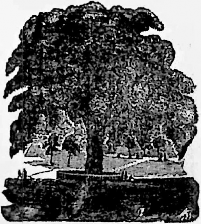
The River Jordan
Its SOURCES, LENGTH, CATARACTS, BRIDGES, FORDS AND HISTORICAL SIGNIFICANCE, THE NEW RAILROAD OF PAL-ESTINE, ITS ROUTE, Etc.

THE RIVER JORDAN
THE Jordan is the most remarkable river in the world, for one its length.
From its extreme sources at the base of Anti-Lebanon to its final outlet in the Dead Sea, its length is only about 200 miles. There are over fifty rivers in North America which are 100 miles longer, and fifteen which are from 1,000 to 4,000 miles longer. There is not a mile of the Jordan which is navigable by shipI There is not a mill on its entire length turned by its waters. Yet it is called the “ Descender."
The sources of the Jordan are mentioned in the body of this work, particularly the source at Banias. It passes through the sluggish waters of Lake Merom, thence onward, growing more and more rapid in its course, till it pours out into the Sea of Galilee, at Bethsaida. It passes through that body, 'fifteen miles to its outgoing at Taricha (See illustration," Outgo-ing of Jordan.") Here it originally passed around an island, now one side, filled in.
From the Sea of Galilee to the Dead Sea, there are twenty-five precipitous rapids. At the former point it is 653 feet, and at the Dead Sea, 1,320 feet Therefore it is seen that it might, if utilized, become a valuable servant It could furnish power for all the cotton and grain manufactories which that once fertile valley could possibly produce. Its entire fall is 3,000 feet.
There are few bridges over the Jordan.
JACOB'S BRIDGE (see our illustration), at Bethsaida, was built by the Romans, and connected the road from Damascus with that to Jerusalem. At the outgoing of the river there was a stone bridge also, now in ruins. At Bethshean—or three miles eastward—there is a third stone bridge.
A Railroad in Palestine
Over this last-named bridge the proposed railroad is to pass.
This railroad is already chartered, and is as follows: It is to start at the Bay of Acre, at the end and north base of Mount Carmel, pass down the valley of Esdraelon, on the banks of the river Kishon, to Bethshean, wind down to the Jordan, cross the old stone bridge, and thence turning north and eastward, follow the eastern branch, the Yarmuk, a short distance, when it would wind along the eastern shore of the Sea of Galilee, past the place where the swine were “ choked in the sea," and the strong maniac of the tombs reclaimed; past where the 5,000 were fed, and Bethsaida, where the blind man was healed; thence onward to the oldest city in the world—
Damascus. What a strange thing it would be to hear the steam-whistle in that strange land, and hear, also, the conductor cry out " Bethsaida! ” or “ Damascus ! ” and see Chris-tian and Mohammedan luxuriating together in a common smoking-carI So it will be, for these two classes have joined hand and fortune in this remarkable enterprise, and already own most of the land from sea to sea.
Desolation of Jordan.
Desolation reigns along the whole course of this sinuous river. Not a city crowns its banks from source to outlet—or ever did I Terak was on the western shore of the lake, rather than on the Jordan, and Hippos on the eastern shore. Beth-shean was three miles west of the river. Jericho was five miles, and nd city lay between these two. The river’s banks are so precipitous that no roads could ever pass aear it for any great distance. Where, then, is the boasted charm of this marvellous stream ? Only in its historical interest For this the reader is referred to the body of this book.
Pilgrims by the thousand have and still do flock to this river, look in admiration or disappointment, bathe in it, per-haps, and turn wonderingly away, but “ for all to which a river otherwise is ordinarily applied, the Jordan is entirely useless." It rises in darkness, under old Banias, it wanders along its crooked pathway, and plunges in death and darkness into that other strange body of water, the Dead Sea, and is gone forever!
Fords of Jordan.
THE FORDS of the Jordan are numerous; the most impor-tant are near Bethsaida and at Jericho. The crossing of the Israelites at the latter ford has made it a place of never ceasing interest. Here, too, may have been the very spot where Jesus was baptized by John, also several of His disciples.—John.
Here the spies crossed before entering Jericho, and here Jesus and the Galilean pilgrims and disciples crossed and re-crossed, going up to Jerusalem and returning to "Judea be-yond Jordan, where John first baptized.”
These facts alone tend to make this river of more sacred interest to Christian hearts than all other rivers in the whole world.
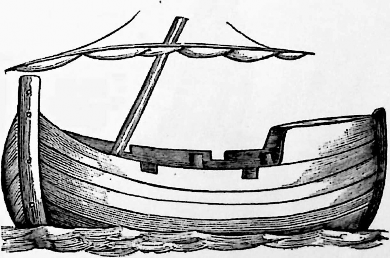
A JOURNEY TO PALESTINE

A JOURNEY TO PALESTINE. DESCRIPTION OF ROUTES
OUR time is computed from the advent of Christ, and while time lasts, the Christian world will feel an abiding interest in the land upon which His feet have pressed, and, hence, Christian souls will ever turn with listening ears, with longing eyes, and willing feet to every new exposition, new develop-ment, or proffered opportunity to hear, know and see for themselves, what new thing may yet come out of Palestine.
We may not take “ the wings of the morning, and fly to the utmost parts of the earth," but we may do the next best thing, for mortals, take the mail steamship and the " light-ning ” railroad car, and reach the same results.
Whether we start from America or England to visit Pales-tine, we take our final departure from the latter country.
One may take a steamship, of the finest sailing qualities and the largest capacity, at Liverpool or London, and proceed via the straits of Gibraltar, to Alexandria in Egypt, provided one is fond of a grand sea-voyage, and his time is not too precious. At Alexandria you re-embark in a good steamer for Jaffa, or farther northward, to Beirut, according as you desire to do Palestine from the south, or the north.
Via France
There is another and much quicker route, by the way of France, to the Mediterranean Sea, and thence by steamship, which, if quicker, is yet more wearisome; if cheaper, is more irritating to invalids and nervous people.
“ We beseech wearied men never to visit Paris, to be baked on the Boulevards, sick of the Rue Rivoli, have their digestion destroyed by mushrooms and cockscombs at the Trois Freres; hot to be pestered by guides, ropes, mules, ladders, or alpinsticks, in traversing slippery glaciers, or savage ravines across Switzerland; or yet be distracted by guides in wandering from gallery to gallery and church to church through Italy ;—but to launch upon the deep, get out of sight of land, and have their brains thoroughly invigorated by fresh air and salt-water.
" It is a weakness of mine to prefer a British ship to any other, especially when ‘ off soundings.’ There is something in the hearty 'Aye, aye, sir/’ which inspires a confidence that nothing uttered by a foreigner can do” (Dr. Macleod, in
" EASTWARD.)
Nevertheless we prefer the “ shorter route," not being an Englishman, who takes it easier and slower, but a Yankee who seizes upon the shorter and quicker route to a given point
The Start
We are at London. We “ fly ” down to Dover by the evening express, take a hot lunch, and enter the steamer, cross by night to Calais in France. • This is the shortest possi-ble sea-route. Rarely one may cross the straits without experi-encing that. most disagreeable of sensations, sea-sickness. The channel is more often rough than smooth, but the passage is necessarily short. Englishmen dread it very much, never-theless.
Your passport being all right, you .are quickly whirled away to Paris. You take a day or two here for sight-seeing. You visit the very places which you have been advised not to visit. Like a good Protestant, or a better Catholic, you go up to the Cathedral of Notre Dame, you walk the magnifi-cent Bois du Boulogne, and ride out to the Royal Palace at Versailles. You spend a half day in the Louvre examining the wonderful works of art there displayed.
PARIS is the great starting-point for all Europe, Asia and a portion, at least, of Africa.
We again take cars, and proceed rapidly, for French cars travel rapidly; passthrough the beautiful vine-clad'country of Burgundy; past picturesque villages, rich valleys, under the shadow of lofty mountains, along the banks of that beautiful river, the Rhone, following it down through Lyonnois; past grand cities, more picturesque villages, over high bridges, across stone water-courses, past royal mansions perched upon the hill-tops, lonely cottages nestling in the secluded vale, through rich fields of waving grain, and by richer orchards of the rarest fruits of a tropical climate, until we reach the southern borders of France, overlooking the Mediterranean Sea.
If we do not stop over at Lyons, or other interesting cities on the route, we may reach Marseilles after riding all night and nearly all day, or from twenty-one to twenty-three hours.
The guides and "importuners " will furnish you with guide-books and advice, to visit points of marvellous interest from here, but your purpose being, like ours, to cross the “ Great Sea " by the shortest as well as the easiest possible route, you turn away, perhaps with a sigh of regret for the loveliness which you must leave behind, not the least of which is the grand old city itself, and at the “ Outer Quay ” take the good steamship “ City of Alexandria," on which we have engaged passage to the port of Alexandria, in Egypt You may possibly find a fast sailing ship bound direct from Marseilles to Joppa or Beirut, but the customary route is via Alexandria, by the regular weekly line of steamers.* " How long will it require to reach Alexandria?" we ask an officer as we proceed on our way.
“A week, if luck favors us," he replied. “ May the gods be propitious 1 ”
On Shipboard
We find the ship somewhat crowded, which at first excites our surprise, not anticipating so much travel to a far-off land; but gaining our “ sea-legs," to use a sailor’s phrase, as the sea is calm and the sky serene, and looking critically about, we grow less surprised at the number of passengers, considering the many nations represented in the various dialects uttered, * Paul sailed 11 in a ship of Alexandria, whose sign was Castor and Pollux.” and the variety of costumes worn by this motley assemblage of men, women, and children.
Here I see representatives of America, England, France, Germany, Italy, on one side of the great sea; and on the other, Africa, India, Arabia, and China. Christian, Hebrew and Mohammedan mingle promiscuously, walking about the decks. I wonder, should the chaplain of the ship, or some zealous pilgrim, call this crowd to prayers, to what deity he would commend them, or in what language he might address the “ throne-of mercy!"
" Neptune might be a compromise,” is suggested by a sea-faring man.
“ Or Castor and Pollux, of St. Paul," said another.
The ship's accommodations are unexpectedly good for the first-class passenger, but one look into the “ forecastle,” or one waft of air from that quarter, is sufficient for a lifetime.
The boasted “ blue waters of the great sea,” the “ gorgeous skies of Italy," and the “ balmy zephyrs laden with the sweet-ness of eastern climes,” the traveller will find, as we have, just like those of his own native home, when " the gods are pro-pitious." Distance alone lends the enchantment. If for these alone we would go abroad, we had better remain at home and not be disappointed.
At Alexandria
On the eighth day we arrive safely in Alexandria, after a very pleasant passage.
After leaving the island of MALTA, we saw no other land until we made the coast of Africa, near, Alexandria.
The “ pilot-boat" was a very welcome messenger.
The vast number and variety of shipping in this port is the first thing challenging the wonder of a western traveller. The wildest imagination can picture nothing more varied. Ves-sels with one, two, three, four, and even five masts I Vessels carrying one cumbersome “ lug-sail; ” feluccas with two-sails, barkentines, brigantines, and ships spreading clouds of can-vas, from spanker to moon-sail and " sky-scraper."
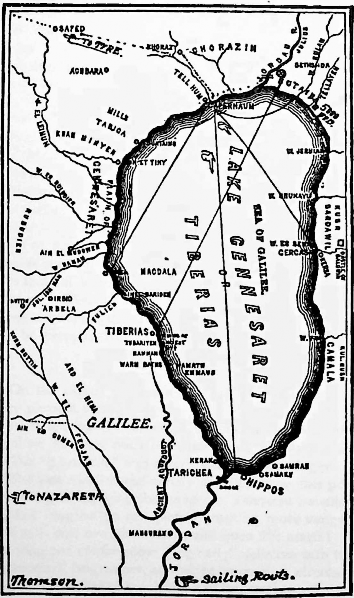
Here were little tow-boats tugging away at a mammoth " Red Jacket" sailing ship, and the “ palatial " steamship, with flags of all nations adorning her masts from deck to truck, ready for sea.
Out of all these we may surely find one bound for Joppa, whither we are to proceed without delay.
When the country is settled, there is no trouble and little delay in passing the custom-house. If one desires to re-main in Alexandria a few days, he or she may readily find a European hotel. Or if one is not fastidious, or wants variety, his tastes may be gratified at a French, Turkish, or Chinese restaurant.
My friend Mr. W. S. Chaplin visited one of those foreign restaurants on the “ European Plan." The proprietor in-formed him that he could have four courses for one dollar.
" Having plenty time on my hands, I said I would take the four courses. Immediately the man went out, I heard the ‘ squalking ' of a fowl. In fifteen minutes the waiter brought in and served the first course—‘ chicken-broth,’ and a piece of bread. When I had finished this, and the dishes removed, he brought in the half of a broiled fowl, with vegetables. After this followed the third course, which consisted of boiled chicken and some strange kind of sauce. It won’t do to ask too many questions regarding foreign dishes.
“ The fourth and last course consisted of curry of chicken, and boiled rice. The fowl was very well sold," concluded my informant , Alexandria to Jaffa.
Our destination being Jaffa, the entrepot of Palestine, we soon take a small steamer for that place. A steamer leaves here weekly for the Levant, touching at various ports of Syria, which after twenty-nine hours lands us at Jaffa.
At Alexandria you will be importuned not only to take passage for Jaffa (and other ports where you may not desire to go), but to take worthless guides, useless servants or travel-ling companions, and engage a dragoman and donkey before starting.
There is no occasion for any of these. A passport and a ticket of passage are all that are necessary in this direction.
At Jaffa
At Jaffa you will find a decent inn. Before you find the inn, a hundred beggars will find you. They stand ready, day and night, to pluck every fresh arrival in the Promised Land. They come up to you in couples, in scores, on foot, on two feet, on crutches, even on horseback I These guides, guards, Bedowins, Arabs, whatever you please to call them, are the worst sort of beggars—and robbers often—“ beggars on horseback.”
Whatever you leave behind, do not leave your courage, nor yet your revolver! They are a world of help. Wear them both in view! Not for use so much as an intimidation to cowards.
Take about as little luggage as the Master allowed His disciples.
WHAT You REQUIRE.
Until the proposed railroad across Palestine and to Damas-cus is completed, you will have to do Palestine on horseback, or afoot There are no good carriage-roads.
The traveller will always find companions at Jaffa, with whom he may go up to Jerusalem. A horse or a donkey may be hired, to be returned or called for, upon which you may reach Jerusalem, thirty-five miles distant If the pilgrim starts from Beirut, he may find there a dili-gence which for five dollars in gold will convey him to Da-mascus, but expect, in travelling in Syria, to find nothing better than a jaded horse, or mule, with a sore back. It will pay to take a good saddle with you from England.
You will need chamois lined pantaloons, a linen hat, ordi-nary underwear, a large shawl, canvas shoes or boots, sponge and towels, and plenty of gold!
Let your baggage, if possible, be confined to one good, strong bag, or port-manteau. Your cloak, shawl, or outer garment may be excluded, carrying it upon your arm. Most travellers carry an umbrella, especially clergymen. Keep a sharp watch over all you possess, or some one else will soon possess it. Perhaps that is why Jesus directed the Twelve to leave all superfluous articles behind, when travelling this same country.
We have already referred to the recently chartered railroad across Palestine. An enthusiastic writer in the “ Boston Ad-vertiser ” says:
" The first railroad in Palestine is being laid out, and the preliminary survey has been completed as far as the Jordan. It is to run between Acre and Damascus, and is called the Hamidic line, after his present Majesty, the Sultan Abdul Hamid, who owns a great amount of the vast plain of Es-draelon, through which the road must pass.”
The concession is held by ten or more gentlemen, Chris-tians and Moslems, but all Ottomans, subjects and residents of Syria.
From Acre it will follow the coast southerly ten miles, to the Kishon river, which it will cross by a sixty-foot bridge. A branch of two miles will run to Haifa, while the main line will follow the north side of Mount Carmel and the Kishon, past Nazareth—twelve miles away—cross the water-shed at an elevation of only a few hundred feet, in above twenty miles run, strike the river Jalud and follow down to the Jordan.
Bethshean, or Beisan, is situated 800 feet above the river, a distance of about three miles. Elsewhere we have described the remainder of the route.
Not only Esdraelon, but the lands east of the Jordan are very productive, and if they could but pass into the hands of better rulers, would shortly become very valuable.—“ Once on this plateau, the road will traverse the magnificent lands of Jaulin, and the grain-producing country of Hauran, and to Mezrib, by branch, which is the principal grain emporium, as well as the great halting-place on the pilgrim road between Damascus and Mecca. The distance to be traversed is about 130 miles, and it is thought that the transportation of grain alone from this region to the sea-coast will suffice to pay a dividend on the cost of construction."
A road from Jaffa to Jerusalem, thence to connect with the Hamidic road, is sure to follow. All this would tend greatly to the civilization of the Bedowin, and civilization is the first step toward Christianizing a people.
This, indeed, leaves the Hebrew behind, and still further lessens his chances for the redemption of Jerusalem—except by the hands of Gentiles and Christians.
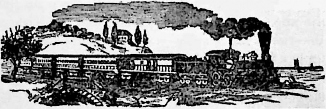
Notes of Appendix
(0»7)
HELL
HELL, HELLAN, GEHENNA, HADES
IT is somewhat surprising to the average mind to learn how few times this word is used in the Gospels and New Testa-ment.
Below we give them in their order, and their significance, as used in the Gospels:
" From Gehenna, original Ge-bene-HinMatt. Matt. Matt. Matt.
Matt
5: 22.
10: 28.
18: 9.
23: 15, 33.
11: 23 nom, a valley under the wall, south of Jeru-salem. (See " Gehenna,” in Part Second.)
/‘Gehenna fire" is here used. All offal, carcasses, and bodies of criminals were there burned.
" Hades ” here used, relates to the destrucMatt. 16: 18) tion of Capernaum; 2, "gates of hell."
Mark 9: 43,45,47.—"Gehenna Fire,” same as Matt. 18 : 9. Luke 10: 15.—Same as Matt 11: 23; relates to Capernaum. Luke 12: 5.—Same as Matt. 10: 28.
Luke 16: 23.—Hades, applied to Jews.
John, writing after the destruction of the Jews as a nation, and the downfall of their city, and obliteration of their cher-ished institutions, fails to mention hell, in his gospel. See Revelation 20: 13, 14—R. V.
Hell, or hellan, is an Anglo-Saxon word. “ It would perhaps have been better,” says Smith, Bib. Diet., “ to retain the Hebrew word ‘ Sheol,’ or else render it always by ' the grave.’ It is deep, and dark, and in the centre of the earth . . . and secured by ′ gates ’ (as a tomb).” The creeds say of our Lord, ” He went down into hell,” where Peter says (Acts 2: 31), “Neither was He left in Hades, nor did His flesh see corruption.” Peter here used David’s own words, which in Hebrew were, “ He would not leave his soul (life) in Sheol" (i. e., the tomb). Where Christ went we need have no fear of, and as He rose therefrom, may we also hope thereby to rise.
The Pharisees, no doubt, advocated a place of eternal tor-ments.—See Smith's Bib. Diet., articles “ Hinnom and Hell.” See also article " Rich Man and Lazarus," in this work. We do not propose to discuss the matter herein.
Peter uses another word, “ TARTARUS,” in II Peter 2 : 4, quot-ing an ancient tradition.
BETHESDA
WE are glad to learn that the writer’s truthful exposition of the Jewish deception of Bethesda has already called forth some adverse criticism. It comes, not from a mercenary Jew, but from a credulous Christian.
No city of the East, except Damascus with a river running through its centre, was as well supplied with water as Jerusa-lem. Mount Moriah, according to the strongest evidence, was “ honey-combed ” with aqueducts and reservoirs. Says Dr. Barclay, “ Within a radius of seven miles, there were no less than thirty or forty natural springs.”
In Solomon’s time we learn from Ecclesiasticus 50: 3, that one single “ cistern to receive water was in compass as the sea, and lined with plates of brass” (or lead). This “sea” was, without doubt, an immense subterranean cistern, still in existence, under the temple area.
"A powerful natural spring,” wrote Aristeas, B. C. 250, “ is received into subterranean reservoirs, the extent of which is surprising and beyond description, through which water flows from one- to another!
" There are above frequent hidden apertures to these depths, known only to those employed at the sacrifices, through which the water gushing out with force washes off the blood of the
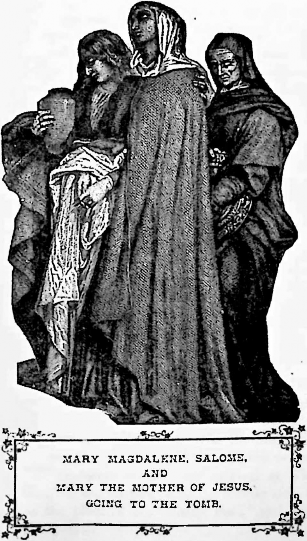
numerous victims. The reservoirs have their floors and sides encased with lead." The distinction between brass, copper, and lead was not always marked by ancient writers. Aristeas was deputed by Ptolemy P. on a special mission to Jerusalem to obtain authentic facts regarding the Jews.—See Josephus’ Ant. 12:2 and 1 : 15.
Lightfoot quotes Aristeas thus: “There was a continual supply of water as if there had sprung an abundant fountain underneath, and there were wonderful receptacles under-ground,' as appeared five furlongs' space about the temple, each one of which had divers pipes by which waters came in on every side—all these were underground; . . . and they (the rulers) brought me out of the city and bade me stoop down and listen to what a noise the meeting of the waters made.”
Here we have authentic proof of the existence of those immense reservoirs under and about the city, as also proof of their connection and supply from underneath, as asserted in our article on the deceptions of Bethesda, in chapter 18.
Furthermore, we adduce proof that the “ moving of these waters," attributed by the Jews to angelic interposi-tion (John 5 : 4), came from secret mechanical causes, as also that the peculiar reddish color originated, as asserted, from the influx of blood of cattle and sheep slain at the sac-rifices 1 We have not affirmed, nor do we, that either Jesus or John was deceived by these pretensions of the rulers, but on the other hand believe that the Jews’ wrath was kindled because of the Master Healer's exposition of their deception. To locate with preciseness the old pool Bethesda is as impossible as useless at this distant day.
The Saracenic Fountain at St Stephen's Gate more than probably approximates the spot, but various modern writers and explorers locate it as far away as Siloam I "Birket Is-rael," at the north side of the temple area, is usually accepted as the place of the “ Sheep Pool," and the true Bethesda of the gospel.
An immense cistem may be entered now by lowering a man through a well opened in the area, near the present Mosque el Aksah.
WHERE JESUS WAS BURIED
WE have a good illustration of the “ Church of the Holy Sepulchre,” but have hesitated in inserting it in these pages, because it seems almost conclusive to every gospel reader of an intelligent turn of mind, that this imposing edifice—in more than one sense—does not indicate the “ spot where they laid Him.” Neither is that place truly known.
The place-of crucifixion and burial was outside the city (John 19: 21). This edifice is within the present enclosure, and also within any which has as yet been discovered.
Matthew says, “And as they came out of the city, they met a man of Cyrene, Simon by name, whom they compelled to go with them'' They then went a distance beyond the gate of exit 1 The present alleged location is only six hundred yards from Antonia out at the northwest corner of the temple, while the gospel record indicates no inconsiderable march from Pilate's house to the place of execution. We do not locate the pre-torium, more properly “palace,” at Antonia, but on the northern side of Mount Zion. History warrants this.
Let us suppose, as universally accepted, that the way led out of one of the western gates, Jaffa, or farther south, Gannath gate. Now, directly west of the wall, there are no indications of tombs, nor were there ever any discovered. Farther south, approximating the valley of Hinnom, there were tombs. The topography of this place fulfils the demand of the texts. The cross could be raised on the elevation across the valley, and from the walls of the city but a few yards distant, the Jews could witness the spectacle, and also read the coarsely written inscription on the cross.
“ The title was read by many of the yews, for the place where j^cstes was crucified was nigh to the city."
Does not this indicate that these Jews, who would not enter a place of burial on the feast day, may have occupied the very walls of the city to witness the crucifixion? No place west of the city meets the requirements of the text, of the " women beholding from afar," or, as Matthew records it, “ sitting over against— opposite—the sepulchre."
It being at a time when the city and suburbs were crowded with people, and “ a great multitude ” following to witness this remarkable execution of one who claimed to be their very king, the place required for the accommodation of such a host could hardly have been elsewhere than where two hills met, as in the upper end of this valley of Hinnom. At the west, as at the southeast side of the city, were extensive suburban villas and cultivated fields, or gardens; indeed, as to that, every spot round about the city, not occupied as a burying-place, as at the north, and east, was cultivated; but here in Hinnom, there were two rocky sides, in either of which, but more particularly the southern, Joseph's tomb could have been readily excavated, and it being a private tomb, may have been in his own " gar-den " (John 19: 41,42). The tomb was close by the cross (42), hence outside the walls.
Therefore from the walls, and the hillside under them, a great multitude could plainly witness the whole scene.
Again, the road to the city, from the south, “ passed by ” this place, up the valley, and here the travellers “ railed on Him.” Luke’s narrative implies that the people stood in masses beholding; that the rulers beheld, scoffing, and that the soldiers were nearer, “ coming to Him,” and all of them where they could fully witness all that transpired.
What other spot fulfils all these indications ?
Olivet could not; it is too far. The west side is too flat, and the north side is fully occupied by old sepulchres.
Our last inquiry is important.—Does Peter’s words, as re-corded in Acts 2: 31, give us any intimation that Jesus was entombed in Gehenna ? He says:
" Christ . . was not left in Hades ”—or Gehenna.
Are not the two words often used indiscriminately? We have, indeed, referred to Peter's quotation of David's words, as that “ He, the Lord, should not remain in the grave, nor see corruption," but there is often a double meaning to scrip-tural phrases, and it is quite possible that Peter's words may point also to the location of the Saviour's tomb.
By referring to the map of Jerusalem, it will be seen that this valley begins at Kidron, and extends around the southern and southwestern walls of the city. The real Gehenna was at the lower end of Hinnom, and there Moloch was destroyed by Josiah. (See Gehenna.) It is not supposed, as hardly pos-sible, that Jesus was there buried, for there the bodies of crim-inals were burned ; but the upper end of the valley was very respectable. Tradition even locates the palace of Caiaphas there, and the Convent of St. George is now at the upper extremity. Here Titus pitched his camp, levelled the grounds, and set up his batteries.
If there were any tombs in this vicinity, they stood a fair chance of being obliterated at an early period. Peter, in this connection, certifies that " David’s tomb is with us to this day,” but neither he, nor any other writer, mentions this of Christ’s tomb! If His sepulchre had been well preserved, it would seem that some authority would have mentioned that important fact, especially as it was cut out of the solid hill!
Constantine's tomb of Christ, as now located inside the walls, was not dedicated until A. D. 335. Who kept a record of its location in the destruction of the city and all the various commotions which followed for centuries? Building after building has been erected and destroyed on this supposed site of the Saviour’s tomb. Even the foundations have been sub-jected to terrible heats of fires, which being of soft limestone, readily succumbed to the ordeal.
Yet Adenear, Glober, and other writers have told us that neither fire nor hammer could destroy the sepulchre, “ and that it still remained as firm as adamant."
But where ?
"God doth not need Either man's work or his own gifts; who best Bear His mild yoke, they serve Him best; His state is kingly; thousands at His bidding speed.
And post o’er land and ocean without rest; They also serve who only stand and wnit.”
Milton’s Sonnet on Ait Blindnw.
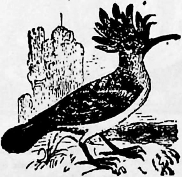
GROUND PLAN OF JERUSALEM
Fortress Antonin
Tombs of the Kings.
Damascus Gate
St. Stephen's Gate.
Golden Gate
Gunnath Gate
Jaffa Gate and near Calvary.
High-priest’s Palace.
Hippicus, David's Tower.
Pilate’s House
Sheep-pens and Bethesda. 14, 15, 16. Temple Site.
Gethsemane
Spot where Jesus Wept over Jeru-salem.
24. Top of Olivet.
Pool of Siloam.
David’s Tomb
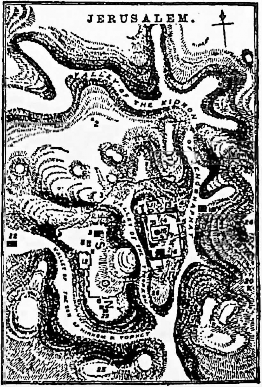
Chronological Table
C.
About
*330 1300 J 040 78:726 5 60
HISTORY
Migration of Hebrews from Meso-potamia.
First abode of the Hebrews in Seulement of the Israelites in Egypt.
Exodus under Moses. [ites.
Conquest of Canaan by the Israel-Samuel.
Accession of Saul. Accession of David.
Accession of Solomon.
Division of the kingdom. Acces-sion of Jeroboam of Israel and Rehoboam of Judah.
Accession of Asa of Judah. Accession of Omn of Israel. Accession of Ahab of Israel.
Accession of Jehoshaphat of Judah. Elijah begins his prophetic work.
Overthrow of the Omn dynasty by Jehu Prophet Elisha active. Athahah usurps the throne of Judah.
Accession of Jeroboam II. of Israel. Accession of Hezekiah of Judah.
Fall of the kingdom of Israel. Accession of Manasseh.
Accession of Josiah Battle of Megiddo and death of Josiah.
Deportation of Jews to Babylon. Fall of the kingdom of Judah.
LITERATURE
Egyptian Book of the Dead.
Folk-poetry in Israel.
Beginning of written records in Israel. Lyrical pieces.
Beginning of Israelitish gnomic literature.
[cal writing.
First attempts at connected historiFirst written collections of laws.
Prophets Amos and Hosea. ■ Prophets Isaiah and Micah.
Various lyrical religious pieces. Prophet Nahum.
Deuteronomy, Zephaniah.
Habakkuk
Jeremiah. 626-580. Ezekiel. 593—
570Obadiah. Lamentations. Psalms. Judges, Ruth, Samuel, and Kings.
B. C.
About 540 5*5 <95 A. D.
HISTORY
LITERATURE
The Second Isaiab
Capture of Babylon by Cyrus.
Return of the Jews to Canaan.
Haggai, Zech. i- viii.
Completion of the second temple.
First visit of Ezra to Jerusalem.
Joel, Zech, ix.-xiv.
Nehemiah governor of Judea. Ezra and Nehemiah introduce the nearly completed Law.
Malachi
The Pentateuch receives its final form.
Chronicles
Septuagint begun.
Onias III. high-priest.
Esther
Antiochus Epiphanes profanes the temple of Jerusalem.
Revolt of the Jews.
Judas Maccabus purifies the tem-
Daniel
ple. Institution of the Feast of
Dedication
Psalms and Proverbs completed.
John Hyrcanus I. destroys the SaEccles. Song of Songs. Son of maritan temple on Mt. Gerizim.
Sirach. Ecclus. 1. Maccabees.
Close of the Canon. Septuagint Pompey takes Jerusalem.
[completed.
Herod king of Judea.
Book of Enoch.
Begins to rebuild the temple.
Birth of Christ.
Destruction of Jerusalem by Titus.
Greek History
Messianic uprising under Barcochba.
Targum of Onkelos. Greek version of Old Testament by Aquila.
Rebuilding of Jerusalem.
The Mishna
Targum of Jonathan.
Helena in Palestine.
Jerusalem Talmud
Omar captured Jerusalem.
Babylonian Talmud
Overthrow of the Babylonian Patriarchate.
List of Illustrations
[• denotes full-page engravings.]
* Frontispiece—Face of Christ {Paul De La Roche}
PACE
Title Page—" Peace,” i ♦Map of Palestine,. 5 FRUIT OF THE VINE (Tail-piece), . . . 13 ♦BETHLEHEM................................................................................. • 31 Blue Bell Birds {Palestine'), . . . 4° ♦Map of the Roman Empire, .... 41 Sheep-Fold,. 45 SHEEP OF SYRIA...........................................................................................
David’s Tower, or 52 Turtle Doves {Drawn in Palestine), 53 Hoopoe (A bird of Palestine), .... 57 ♦Visit of the Wise Men, . 59 Wild turkey 67 Flight Into Egypt {From oldest known figure), . 69 A Modern Eastern Well, .... 71 A Jackal {Thomson),. 72 ♦Karnak, Egypt {Ruins of the Temple of the Sun} 7^ ♦Nazareth 79 LAKE DUCKS—Two WILD GRAIN, ... 82 *MARY, JOSEPH AND BABE {Carpenters Skip), . . 87 SONG BIRD (Tail-piece),. 94 ♦FOUNTAIN WHERE MARY DREW WATER, * . 95 A Fountain of Jordan 103 Woman of Samaria {Photographed P. P. Co.), . . 106 Walls of Jerusalem {South-east Corner), . . 109 PALM TREES,. no ♦City of Jerusalem III Signet Rings 114 Arab Tents, 119 John Baptist 126 ♦Watering Place {Pierce), and Ford of Jordan, 129 Seven Birds {Speckled Snipe), . 134 ♦City of Lake Shore {Tiberias), . . . 139 A Strange Fish,. 142 ♦ORIENTAL MARRIAGE FESTIVAL, . . ■ 149 OLD ELM TREE (Tail-piece),. 153 Harbor and Wreck,. 157 Out-going of the Jordan,. 158 Starling on the Wing 161 Damascus Gate {Jerusalem), ..... 163 Potter and 111s Wheel 164 JAFFA, OR JOPPA........................................................ .......... . 167 ♦Ramleh, or 169 FLOWERS (Tail-piece),. 172 Strawberry,. 173 CORMORANT,.................................................................................... ..........
♦Oriental Street Scene,. 182 Pool in Jerusalem (Hexekiak's}, . . • • 191 ♦Preaching by the Seashore, .... 193 Sea of Galilee {Sfunving Routes of Travels), 197 Ruins of Synagogue, Capernaum {Pal. Ex. Co.), 199 FRUIT (Tail-piece),. 200 ♦Great Catch of Fishes,. 203 An Asiatic,. 207 Jacob’s Bridge Over Jordan {Drawn by Hon. T 7.
Thurber), 218 Fruit Piece,. 224 ♦TOWER AND EAST GATE OF DAMASCUS, . . 227 LILY (Tail-piece),. 232 A City Gate-way, Nain,. 238 Lily Bell,. 241 The Galilean Boat {Drawn by Chandler), 252 Syrian Boar, 255 Lake and Boat,. 258 Mt. Carmel and the Sea, .... 267 Salome Dancing Before Herod {Drawn by T %.
Thurber) 276 ♦King Herod’s Feast {Salome Dancing), . . 278 Bird of Palestine,. 28I Peter Sinks,. 287 Hand Washing, 293 ♦City Overlooking the Mediterranean, 297 Sidon, from the Sea,. 302 Damascus,. 307 A Sea Bird (Thonuon—Drmvn in Syria), . . 309 Bethsatda,. 314 Jordan, near its Source 318 Tail-piece,. 322 Hebrew Coins (P. P. Co.), 333 Syrian Dove,. 338 Candelabra ("Goldth Catude-Stick"), . . , 342 ♦Pool of Siloam,. 349 Lone Fisherman of Galilee, .... 359 ♦Ruined Church of Lydda 371 Plan of the Temple (Ford) 379 ♦Man of Jerusalem (From a Photograph, P. Ex. Co.), 387 Tail-Piece (Second Ed.) 395 Pilgrims, Tents, Horses and Camel, 401 ♦JESUS BLESSING LITTLE CHILDREN, . . . 405 STREET IN JERUSALEM.................................................................... ..........
Mary of Bethaw 422 WHITE Ass OF HEBREWS,...................................................................... STRIKING A BARGAIN (Yaffil Gate), . . . 433 Beautiful Gate 435 •Tempting Jesus (Ford) 443 Golden Gate, Restored,. 449 ♦Jesus and the Four OVERLOOKING Jerusalem, 457 Tail-Piece (Second Ed.), 463 POSITIONS AT THE TABLE (Dr. Crabtre), . . 468 Tail-Piece (Second Ed.), 472 Garden of Gethsemane (From Photograph), . 474 Peter, James and John 475 *JEsus BEFORE THE MIDNIGHT COUNCIL {Copeland), 483 CUCKOO OF PALESTINE.............................................................................
♦Children of Jerusalem (L. Alma Tadema), . 499 Lily of Palestine, 505 ♦DESCENT FROM THE CROSS (Rubens), . , 510 ♦MARY MAGDALENE AT THE TOMB.........................................................
Tail-Piece (Second Ed.)........................................................... ................
♦CHURCH OF HOLY SEPULCHRE (Interior), . . 533 ♦Sanhedrin, 607 A Railroad in Palestine, 666 ♦Mary, Mother of Jesus, Siloam and Mary MAGLALENE GOING TO EMBALM JESUS, . • 671 Ground Plan of Jerusalem, .... 678
General Index
Abia, or Abijah, course of, in Temple, 49. Ablutions of Jews (see Washings), 243, 293. Abraham at Beersheba, 70; seed of, 385, 389, 412. Adulteress taken prisoner, 343 ; before Jesus, 344. Adultery, law of, 343.
Age, the Jewish, 452; end of, 453. Agrippa I., 561, 633.
Alabaster box (see Perfume), 459.
Alexander (see Crucifixion), 303. . Ambition of the disciples, 320, 336, 401.
Amestres, wife of Xerxes, 280.
Andrew the fisherman, 135 ; the disciple, 202; history, 566. Angels to the shepherds, 39, 48.
Anna the prophetess, 47, 56.
Annas the high-priest, 53, 126; Jesus before, 478.
Anointing Jesus’ feet, 343; head, 459.
Antipas, Herod, 110, 270; wants Jesus, 283; sees Jesus, 357, 494, 618.
Antonia, tower of, 451, 490; (see Plan of Jerusalem). Antony, Mark, wants Herod’s wife, 615, 617.
Apostles (see Disciples).
Arabia and Aretus, 270; Arabs, 664.
Archelaus, 69, 70. Aristobulus (see Salome).
Ascension, time, place, 551, 552. Astrology and Astrologers, 62. Astronomy, star-gazing, 29, 48.
Augustine, St., 64.
Augustus Caesar, 33-36.
Baalim, 72; worship, 316.
Babylon, 61; history, wall, bridges, end, 62-64. Banquets, Matthew's, 218; Pharisees’, 383; (see Feasts.) Banias, same as Caesarea Philippi, 316; temple of, 326. Baptism of Jesus, 124-134; of John, 127.
Baptist, John the, 124. Bar-abbas, 497.
Bar-jonas, 546.
Bartholomew (see Nathanael), 147, 567.
Bar-timeus, 413, 414.
Bar-zillai, 36.
Barley harvest, 99; loaves, 285, 289, 545. • Bathing (see Washing) in Jordan, 131.
Beds, oriental, 188, 212 ; let down, 213 ; taken up, 188.
Beggars, 188, 243, 348, 408; on horseback, 664.
Beelzebub, 234.
Beth-abara, 127, 133, 134, 382; Jesus leaves it, 391.
Bethany, 166; lodges there, 347, 375; raises Lazarus, 392; last arrival at, 420; supper at, 421.
Beth-esda, 186 (see note, Part Second). Beth-lehem-judah, 33, 40, 69, 585.
Beth-phage, 425,431.
Bcth-saida, 135, 138, 284, 314, 360.
Beth-shean, 159, 364, 366; railroad at, 565.
Birds of Palestine, 40, 82, 309; Part Second, 577; nightbirds, 542.
Blasphemy of Holy Ghost, 235 ; of Jesus, 189, 190, 380.
Blessing, 228; children, 403; bread, 535 ; disciples, 552.
Blind guides, 294; man, 316, 348; men at Jericho, 408, 414.
Blood, 187; and water, 519.
Boats of Galilee, 143, 214, 309, 358'; Peter’s boat, 251; fishing, 252.
Boys, how reared, 89, 94; in the boat, 285 ; temple, 428.
Boyhood of Jesus, 78, 94.
Bread, 285, 535 ; of life, 123, 289; one loaf in the boat, 315. Bridges of Jordan, 218, 366; over Kidron, 378; (see map). Brothers of Jesus, 117; names, 120; come to bind Him, 234; visit Him, 235, 335 ; do not believe on Him, 123, 355 ; life and end of, 569.
Burials in the East, 237; Nain, 238; (see Notes, Appendix.)
Caesar, 35 ; money of Caesar, 442, 494, 501. Caesarea on the Great Sea, 70, 171; Part Second.
Caesarea Philippi, 268, 308; Jesus at, 316; images, 316.
Caiaphas, 394; high-priest, 462; foe to Christ, 394, 479, 676.
Cana, 85, 143, 146; not Kerf Kenna, wine, 153; healing at, . 178.
Calvary, 506; false location of (see Notes, Appendix).
Capernaum,. 135, 196, 200; down to hell, 315, 360. Captivities of Jews, 6n.
Capture of Jesus, 475.
Caravans, 98; routes, 155, 338, 400, 580.
Carmel, Mt., 267.
Carpenter's shop, 116; son, 117.
Caves, of robbers, 145, 614; of nativity, 37-40. Cedars of Lebanon, 306.
Census, taking, of Palestine, 35, 36.
Centurion at cross, 512, 516.
Ceremonies, 53, 55 ; of presentation, 121 ; temple, 467.
Chazan of synagogue, 94, 180.
Children, Hebrew, 54, 121; in temple, 54,429; blessing, 403, 404; of Jerusalem, 500 ; disciples are, 544.
Chorazin, when visited, 208; where, 313; fall of, 360. Christ, “ the anointed,” expectation of, 46.
Church of the Nativity, 38.
Churches in Palestine, Tyre, 301, 586, 587. Circumcision of Jesus, 48.
Claudias Procula, Pilate’s wife, 501.
Cleansing the Temple, 162,429,433. .
Cleopas, 529-539, 552. .
Climate, 44; see table, Part Second, 571, 574.
Cock crowing, 486, 502.
Coins, 165; illustrations of, 333.
Contrast, Christianity and Phariseeism, 179, 512.
Corn, plucking, 215.
Council, 133, 340; meet, 393, 479, 502, 530.
Court of women, 339, 342, 596; Gentiles, 433 ; of men, 447.
Cross, 131, 321, 506; crown, 552. Crucifixion, 506; (see Notes, Part Second.) Customs, 92,425,460,471, 546.
Cyrenius, 35 ; Cyrus, 63.
Damascus, 307, 584; Jesus visited, 307, 308 ; gate, 109.
Dan, 316, 580.
Dancing, 275 ; dancing-girls of East, 276, 280.
David, 35; city of, 110; heirs, 407; house, 35; sons, 310, 446.
Dead, raising, 222; Jairus' daughter, 222; widow’s son, 238;
Lazarus, 390.
Deaf man, 308.
Deborah, judge of Israel, a giantess, 101.
Decapolis, 257, 305 ; extent, 307. • Defilements, 2x0, 503.
Demons or devils, 132, 234, 256, 269, 301. Desolation of Jordan, 650; of Galilee (see Galilee).
Disciples, 136; first call, 136; second, 202, 560; trades, 226; sermon to, 228; sent, 265 ; ambition, 320, 331, 468.
Divorce, 398.
Doves, 53, 132; sold in temple, 163, 187, 338, 578.
Dress, 98; boys', 91, 576; girls', 577; Jesus', 513; after resurrection, 526; ballet-girls', 276; wedding, 440.
Eagles, Part Second, 578 ; Roman eagles, 358. Early rising, 98, 143, 524.
Ebal, Mount, 107, 174Education, 89,90.
Egypt, 68, 75, 660, 664. .
Elders (see Sanhedrin), 339, 488. '
Elias, or Elijah, 127, 160, 241, 302, 325.
Emmaus, location, 532; walk to, 533.
En-gannim, 98, 102, 160, 173, 363.
Ephraim, 105 ; flight to, 396; location, 397.
Errors, 240, 275, 397.
Esdraelon, valley of, 99, 102; railroad through, 665.
Excommunication, 353.
Faith, 329, 545; faithless, 329; disciples', 543.
Fastings, 183,220.
Father of Jesus, 56, 115, 190.402.
Feasts, 97 (see Passover); Matthew’s, 219, 227.
Feeding the five thousand, 284; the four thousand, 309. Feet (see Washing), 243; of Jesus not nailed to cross, 538. Fig, 431 ; trees, 383, 454; cursed, 431,436; why, 432.
First-fruits, 524; first-born, 54, 122.
Fish, 142; of Galilee, 198; eaten, 538, 546; strange fish, 142; first great catch, 202; second, 545; trade in, 141; house, 198.
Fishermen, 135; of Galilee, 141, 582; lone fisherman, 358, 359- .
Five thousand fed, 283 ; time, place, circumstances, 284, 289* Flight, 68 ; route, distance, time, gone, 68-75.
Flowers, 81, 168, 304, 367, 473.
Flute players, 222; at funerals, 222.
Foolish men, 532 ; foolish virgins (see Parables).
Fords of Jordan, 125 ; illustration, 653. . Forty days, 132.
Forgiveness of sins, 243, 245.
Fountains, 102, 103; of Jordan, 318, Jerusalem, 600.
Fox, 118, 356; foxes have dens, 365. .
Fruit, 573.
Funerals, ceremonies, 222.
Gabbatha, 496.
Gadara, 254; Gergasenes, or Gadarines, 257.
Galilee, 98, 195; extent, 171, 271; population, 209, 266; Jesus and disciples depart from, 354.
Galileans, 226, 266, 268; slaughtered, 495.
Gamala. 138; Gamaliel, 124,606.
Gates, 588; Damascus, 162 ; Golden, 449; Beautiful, 342,434, 596; Jaffa, 433, 506; Stephen's, sheep, 473, 478.
Gaulonitis and Philip II., 271 ; Gaul, 620. Gaza, 68-75, 167.
Gehenna, 51 ; location, 590; Jews perish in, 447, 604; Judas hanged in, 509; Christ buried in (?) 674.
Gennesareth, 232, 284.
Gethsemane, 472 ; trees in, 474.
Gerizim, Mount, 106, 107, 174, 363.
Golden candlestick, 341 ; golden vessels, 490; gate, 349, 449.
Gospels harmonized, 10, 11, 413; history, 555.
Grapes, 168, 304, 339.
Graves (see Tombs), 503.
Greeks, 448; language, 115, 342, 496, 508.
Hades, see Gehenna. .
Hair, woman’s, 243; of John, 127; of Elijah, 127; care of, oil, brush, 243.
Harvest, 131; four months to, 176, 192.
Hattin, or Huttin, Mount, 140; town of, 140, 225.
Hatred of Jews, 439, 492.
Head, John, 269; church, 320; Jesus, 460. Hebron, 70; height 3,000 feet above sea. Heir (parables), 439; to David’s throne, 439. Hell (see Gehenna).
Heralds, of Augustus, 85, 86; of Jesus, 356. 358.
Hermon, Mount, 311 ; height, 323. 325.
Herod the Great, 408 ; Antipas “that fox," 356. Herodians, 441, 621.
Herodias, 1 10, 272, 625.
Heron 1 unclean bird), 359.
High Priests, 394; high seats, 402, 467 ; house of, 479.
Hillel, school, 340.
Hinnoni, valley of (see Hell and Gehenna). Holy Spirit, 132, 196; blasphemy of, 235.
Hosanna, 348, 426, 428.
Hospitality, 110; Eastern, 218.
House of bread, 33 ; prayer, 164; of David, 36; God, 594.
Houses of poor, 81,91, 92, 199, 300; rich, 184, 490; of Jerusalem, 598.
House-tops, 34, 84, 212; torn up, 213.
Husband, of Mary, 36, 116; husbandmen, 438.
Hymns, 103.
Hypocrites, 293, 374.
Image at Banias, 316, 676.
Incense, burnt, 53.
Inn, 36; of robber's pass, Jericho, 417; of Egypt, 663 ; Jaffa, 664.
Isaac, 70; Isaiah, 386.
Jacob, well of, 106, 174; bridge, 155, 268.
Ja-irus, 221, 259.
James, son of Zebedee, 135, 363, 402 ; Less, of Alpheus—his epistle, 569.
James, brother of Jesus, 120.
Jericho, 398, 399, 404; Jesus enters, 410; leaves, 413.
Jerusalem, 377 ; entry, 423; wept over, 427 ; leper quarter, 210, 586, 589; destruction, 59S.
Jesus, 38; birth, 39; naming, 48; home, 78, 94; with elders, 114. .
Jesus baptized, 124; temptation, T 31, 133; death, 506.
Jezebel, 100; jezreel, 100, 160.
Jews, history, etc., 35, 209; attempt the life of Jesus, 381. Jews buy their Messiah, 463; wailing place, 592.
John Baptist, 124, 126; appearance, 127; in prison, 192; death, 269, 270.
Joanna, 261, 227.
John, son of Zebedee, 128, 363, 402, 465; at cross, 522; tomb, $25, 558.
Joppa, 167; (Jaffa) gate, 433; illustration, 167, 563, 663.
Jordan, 141, 158; sources, 318, 319; history, 649.
Joseph, 36, 53, 263 ; of Arimathea, 520.
Joses, brother of Jesus, 120.
Joseph’s pit, 105; brethren, 104; Joseph sold, 104.
Josephus, 65, 168; errors, 240, 275. Journey to Palestine, 657.
Jude, 569; Judea, 166; extent, 167 ; beyond Jordan, 127,273, 356, 382.
Judas’ call, 227; a thief, 228, 256; sells his Master, 421,460, 461; death, 502, 570.
Judean tour, 171.
Judgment hall, 490; seat, 496.
Kan, or Khan (see Inn).
Kana, see Cana of Galilee, 146.
Keepers of sheep, 46; of synagogue, 94, 180. Keys of St. Peter, 322.
Kidron, brook, valley, 110, 433.
King, 495 ; king's son, 440; of Jews, 66, 412, 493, 508.
Kingdom of God, 269, 403; heaven, 373, 383, 389. Kiss, betrayed by (see Gethsemane).
Labor, 576; laborers (see Vineyard). Lamb of God, 46, 478; paschal, 465. Lamentations, where written, 37.
Lamps, 341.
Language, 341; of Christ, 341; Disciples, 486.
Last days, 548; supper, 464; last journeys, 362, 548.
Laws, of Moses, 340; Roman, 496; lawyers, 373, 384, 419.
445.
Lazarus, 375 ; raised, 390; end, 393.
Lebanon, 306, 319; height, Jesus at, 320.
Leontes river, 306.
Leper, 168, 209; leprosy, 210, 364. Levi (see Matthew).
Light of Life, 345 ; " Lights of World," 345, 378. Lily, 232, 367, 574.
Loaves, 287. See Bread, 285, 289, 315. Locust and dates (not wild honey), 127.
Lord, 411 ; Lord’s Supper, 464.
Love, 393; of God, 109; for Jesus, 546; of money, 389. Lots, feast of Purim, 183.
Luke, 366, 367; life, 556; gospel, 367, 556. Luther, Martin, his testimony, 9.
Lydda, 171; Peter at, 563 ; ruined church at, see illustration.'
Machaerus, 270, 274.
Mad, 206; maniacs, 206, 254; Jesus mad, 234* Magdala, 78. 143, 309, 310.
Magdalene (see Mary Magdalene). Magi, 39; who, 62.
Magicians, 62, 65.
Malchus seizes Jesus, loses an ear, 476, 486. Manners and customs (see Customs).
Malachi, 412.
Manger, 37; babe lain in, 37, 38.
Maps, Palestine, Roman empire, Sea of Galilee, 197. Mariamne the beautiful, 110, 272.
Mark; life, 556; gospel, 556.
Marriage, 148; of Cana, 148; customs, 151; king's son, 440.
Martha of Bethany, 376, and Mary, 375, 392, 459.
Mary of Magdala, 155, 227, 358, 524; history, 639; her life, virtues, errors, tradition respecting her, 244.
Mary, mother of Jesus, 36, 39; at cross, 522, 524. Mary of Cleopas, 522 ; of James, 524.
Matthew, call, 217 ; feast, 218; history, 567; gospel, 229,656. Medicine (see Physician), 212.
Megiddo, same as Lejjan, 102.
Messiah, 35 ; born, 61 ; expected, 64; evidences of, 489, 437. Minstrels, at wedding, funeral, 223.
Miracles, 12, 152, 178; last, 545.
Mission of Judea, 167, 171 ; of Twelve, 265-269. Mite, widow’s, value, 448.
Moab, 34.
Molech, or Moloch, 589, 676. Months, Jewish reckoning, 448.
Money, 53, 164; value, 460.
Moriah, Mount, 53.
Moses’ law, 344, 340; at Mount, 326.
Mountain, 228; sermon on, 229, 33; Moriah, height, 456;
Mount of appointment, 347. Multitudes, 230, 231, 234, 285, 404.
Murderers, 270.
Music, 222 ; musicians, 341 ; at feast, 466.
Mourning, 222; mourners, 223.
Nablus, same of Shechem, and Sychar, 106, 107, 177.
Nain, 236; route, 237 ; Jesus at, 238-245 ; widow’s son, 237. Napoleon, route from Egypt, 75 ; in Palestine, 102.
Nathanael, Bartholomew, 147. Part Second, 367.
Nativity, 43 ; church of, 38.
Nazareth, 76, 86, 147, 179; first visit, 261 ; second, 262.
Nets (see also Fishing), 202, 249, 545.
New dispensation, 46, 47.
Nicodemus, 166, 520, 606.
Night, watches of, 290; fishing by night, 202, 544; watch, 343. 445. 455.
Nobleman’s son healed, 179.
Oaths, 454; Jesus put under oath, 482; Peter's oath, 486. Ointment (see Perfume).
Oleanders, 160, 171.
Olives, 358,473 (see Trees); Mount of, 336, 347, 246, 456, 486, 552. .
Omar captured Jerusalem, A. D. 634; built Mosque, 683, 592. Oranges, 168, 304, 416.
Palaces, 480, 594; Pilate’s, 490; Asmonean, 494, 496; highpriest’s, 480, 594, 676.
Palestine, 204, 580.
Palm trees, 131, 407, 425 ; Palm Sunday, 422.
Pan, 317; Panias (see Banias), 316.
Papias, father, 8, 555.
Parables, beginning, 246; in Perea, 385; pounds, 412; Good Samaritan, 416; in temple, 437, 440.
Paradise, 514, 611.
Passovers, 97, 154, 162, 182; last, 464; described, 465.
Paul, 119, 366, 377, 536, 607.
Peace, 287; salutation, 536. Pearl of great price, 249.
Penny, 418, 442, 460.
Pella, 137.
Perea, 362 ; extent, 369; Jesus abode in, 369, 382 ; cities, 585.
Perfume, 243, 460.
Persia, 62, 64; religion of, 611. • Peter, call, 136, 202; house of, 205 ; on the sea, 287; rebuked, 332.
Peter prepares the supper, 465 ; denies, 480; at tomb, 525, 562; Peter's dress, 576; Peter's wife, 645.
Pharisees, to John, 125, 220; rebuked, 385, 610.
Philip, 143, 208, 266, 566; Philip Herod, 271, 633.
Philistines, 384. 582.
Pieces of silver, 385, 462; gold, 448.
Pigeons (see Doves), 53, 144.
Pilgrims, 98, 155, 291; in Jerusalem, 426; to Mecca, 665 ; to Jerusalem, 98, 338, 399.
Pilate, Pontius, 52, 271 ; Jesus before, 490; mob, 491, 501, 522. Pillars of temple, 378; at Philadelphia, 585.
Potter’s wheel, 164; illustration, 164; field, 504 Poor, 168, 460; always have, 461. Pounds, parable of, at Jericho, 412. Population (see various cities), 586, 587. Possessed (see Demons).
Possessions, great, 373, 403. Prayer on mount, 325, Preaching vs. speaking, 179, 195, 201, 436.
Presentation at temple, 50, 56. . Pretorium, should be " palace," 496.
Priests, 398 ; high, 394; chief, 462 ; end of, 603. Prophets, 55 ; Jesus a prophet, 360.
Proverbs, 91.
Publicans, 217, 345, 411.
Purification, 50; law of, 51, 293.
Purim, feast of, 183 ; a riotous scene, 183. Quails, 329 ; Queen of Sheba, 64.
Rabbi, 136, 201; Rabboni, 526; Rab-niag, 62. Railroad in Palestine. 656.
Rain, rainy season, 650. Ramah, 77. ■ Rachel, 77 ; tomb, 34, 77 ; Rahab, 407.
Raphael’s pictures, 92.
Raven, 289, 394.
Redemption money, 54.
Rejoicing at feast, 351; of disciples, 426.
Religion, 586; of Jews, 610; of Persians, of Pharisees, 613. Resurrection, “ I am the," 392 ; mom, 524.
Rich man, 373, 403 ; and Lazarus, 384; riches, 404. Richard, King, in Palestine, 86.
Rites, 53. 55.
Rivers—Jordan, 649; Euphrates, 63 ; Kishon, 102.
Robbers, 140, 164, 364; pass, 417; on cross, 511-519, 586.
Roman power, 35 ; time, 35 ; government, 495 ; soldiers, 125, 141, 491.
Romans destroy Jerusalem, 394, 695.
Roofs, 70, 212 ; temple, 108, 456. Roses in Jerusalem, 473.
Routes to Damascus, 308; to Egypt, 68, 70; Jerusalem, 97 Tyre, 296.
Ruins, 137, 199, 603, 650. .
Ruler, young, 403 ; of Jews, 496, 479, 481.
Ruth, 34, 407, 585.
Sabbath, 205 ; arbitrary observance, 2 15, 391.
Sabbath-day’s journey, 215, 288; disregarded, 195, 340, 352, 383.
Sacrifices, 46; old and new, 47; human, 325 ; Christ the, 355.
Sadducees, 128, 441 ; origin, 613; end of, 614.
Salome of Herodias, 276, 623 ; wife of Zebedee, 135, 400.
Salutations, 287, 536, 544 Samaria, 102; borders, 102; woman of, 106, 174.
Samaritans, 103 ; good, 418; hatred of, 269, 363, 397.
Samson, 77, 167.
Sandals, 265 ; shoes, 265 ; latchets, 133, 466, 513.
Sanhedrin, 115, 133, 606; Jesus before, 189, 214;. resort to ridicule, 341 ; Jesus brought before, 479; condemned by, 502; 530.
Saul, 99, 159; beheaded, 100, 159.
Schools, 94, 115 ; of Rabbis, 340.
Scourging, 504; of Jesus, 497, 504.
Scribe, 367; office, 480.
Scrip, 477.
Scripture opened, 532, 550.
Sea, Galilee, 85, 197; extent, 198, 581; Jesus sails on, 141, 198, 253; walks over, 287; last time, 542.
Sea, Great, 85, 300, 416, 657; Dead Sea, 34, 416.
Seasons, 378 (see Part Second). Sermon, to Disciples, on Mount, 228. Seals and rings, 114.
Seventy sent out, 354Shechem, 106; streets, 107 (see Sychar), Sheep, 43, 48 ; holy, 44; folds, 45 ; temple, 163, 187.
Shepherds, 43, 45, 48, 296, 299.
Ship, 157, 196 (see Boats). Shushan, gate, of the temple, 428.
Sick, 178, 188, 206, 214, 221, 234, 374.
Sidon, 295 ; Jesus at, 301 ; population, 302.
Signs, Jews ask for, 165, 180, 312, 455.
Siloam, pool, 348; illustration, 351. Silver (see Pieces).
Simeon, the Prophet, 47, 56.
Simon, of Cana, 178; Emmaus, 529; Cyrene, 507; leper, 282.
Simon, leper, 456, 469; of Nain, 242; gives a supper, 244 ; the tanner, 168.
Sinners, 244, 246; pardoned, 344; sin-offering, 214.
Shunem, 99; Shunamite, 99.
Soldiers (see Troops) mock Jesus, 506; at cross, 5 12. Solomon's porch, 596.
Son, of David, 52, 408; of God, 128, 254, 479; Thunder, 364.
Sorrows of Christ, 7, 294, 312, 357, 360.
Sower, 176, 248.
Sparrows (see Birds). Spies, 214, 292, 395, 522.
Star, 64; of east, 65.
Storms, 253. 286.
Stones in temple, 344, 450.
Stoning, of Jesus, 190, 391 ; Stephen. 609.
Streets, Bethlehem, 82 ; Jaffa, 566, 663 ; Jerusalem, 592. Sumakh, ruins of, Jesus and disciples at, 137.
Superstitions, 234.
Supper, at Nain, 242 ; Bethany, 459 ; last, 467. Susanna, 227, 261.
Swearing, 454, 482 ; Peter swears, 486.
Swine, 255, 258; over sea, 255.
Sycamore trees, 410.
Sychar, 107 ; Jesus at, 175, 177. .
Synagogue, Nazareth, 261; Capernaum, 199, 359.
Syro-Phcenician woman, 300, 337.
Tabitha, or Dorcas, 171, 563.
Tabernacles, 326; Feast of, 335, 347.
Tables, 219. 243, 384; at feast, 466-468; crumbs, 301.
Tabor, Mount, 84, 237; height, 325 ; history, 324-Talents (see Parables), Talmud, quoted, 44. 45, 391. Tares, sowing of, 248.
Taxes, 219; temple-tax, 332; paid by Jesus, 333.
Teachers, 94, 609.
Teachings of Jesus, 179, 367; in Perea, 373; Pharisees' teachings, 613.
Temple, 53, 594; plan, 379; fee, 54; stairs, 339; entry, 429.
Temptation, 131, 133. .
Ten Lepers, 364; virgins, servants, 413.
Thaddeus or Jude, 569.
Theatre, Herod's, 51 ; Bethshean, 159.
Thieves (see Judas), on cross, 511 ; fate of, 519. Thirty pieces of silver (see Silver), 462.
Thomas, 226; disciple, 391 ; speaks, 392, 543; history, 540, 567.
Tiberias, 138, 156, 270.
Time, computed, 33, 35, 97.
Titus, 126, 138, 454, 600.
Tombs, 39, 237 ; dwell in, 255, 305 ; of Jesus, 522. (See Notes.)
Towers, David's, 52; Hippicus’, 52; others, 490.
Trades of Jews, 116; of disciples, 226. 560. Traditions of Jews, 93 ; of Peter, 486; Roman, 244. Traffic in Temple, [62-165, 429-433.
Transfiguration, 323; when, 310; where, 325. Travelling in the East, 148.
Trees, variety, 131 ; of Lebanon, 306; sycamores, 408, 410; olive, 474, 572 Treasure, hidden, 249; temple-tax, 332.
Trials of Jesus, 189; first, 481 ; second, 488, 491.
Tribute, 333.
Troops (band), 275 ; parable of, 275 ; in Jerusalem, 491. Triumphant entry, 428.
Twelv., chosen, 226; work, 266; mission, 269.
Tyre, 296; history, 299; Jesus at, 300; house at, 300.
Tyropean valley, 463, 488, 591; Judas hanged in, 463, 503.
Unbelief of Jews, 462 ; disciples, 537 ; brothers, eleven, 538. Unclean, 210, 503; spirits, 234.
Union of Herodians and Pharisees, 233, 311. Unleavened bread, day of, 465.
Vales, 589; valleys, 99, 102; in Jerusalem, filled up, 506. Versions, old and new, 7; need of change, 8.
Villages vs. cities, 266; disciples at, 265, 269.
Vine, vineyard, 438 ; vinegar, 515.
Vices, 243; of Jews exposed, 187, 344Voices from heaven, 128, 326, 449.
Wages (see Penny). .
Washing, 243; hands, 293; feet, 243; Pilate, 501 ; disciples, 468.
Watch, 454 (see Night-watches).
Water, 175; pots, 243; of Jordan, 128, 131; of life, 351.
Wealth of Matthew, 218; disciples, 560.
Wedding, 151; at Cana, 151; king's son, 240; garment, 441.
Wells, 51; Beersheba, 71, 106; Jacob's, 106, 173.
Wine, 151; wine at Cana, 151; at supper, 471; cross, 512.
Widow’s son, 338; mite, 448.
Wilderness of Judea, 132, 133.
Wise men, 39, 61, 65.
Withered fig-tree, 431; Jews, 436. Witch of Endor, 266.
Woman of Samaria, 106; illustration, 1 74-Woman taken in adultery, 343 ; before Jesus, 344Women follow Jesus, 639; to cross, 507; excluded from feasts, 288, 466.
Wounded man, 417; wounds of Jesus, 508, 538. Writing and materials, 9.
Wife of Pilate, 498, 501.
Xerxes, 303; feast, 280; wife of, 280, 632. Youth (see Boys).
Zaccheus the publican, 260; called, 410; repents, 411; in tradition, 412.
Zealot, Simon the, 569. Zebedee, 135, 400.
Zion, Mount, 426; height, 593; Herod's palace, 490.
Notes of Appendix.
Defence of Bethesda. A delusion, 670. Gehenna, times used in gospels, since, 669. "Where Jesus was buried, 674List of Illustrations, 681. Chronological Table, 679.
General Index, 687.